Leading Through Complexity: What Higher Ed Communicators Are Saying
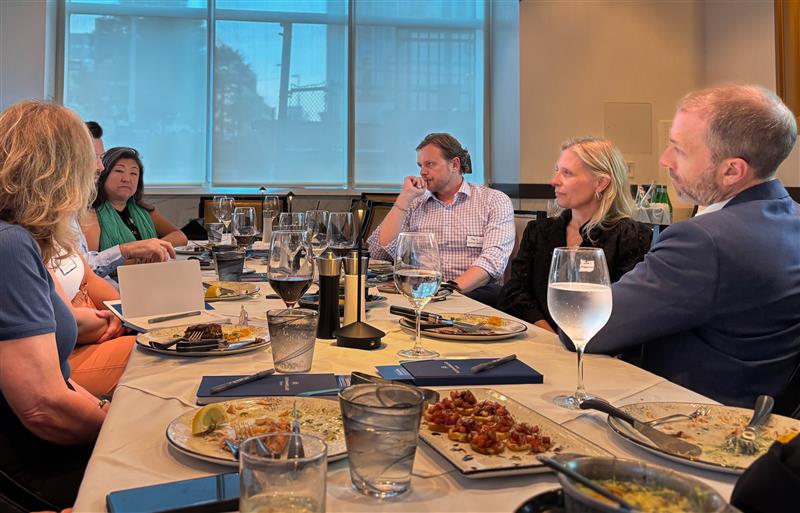
What one word best describes your day-to-day work?
That was the icebreaker posed by FleishmanHillard’s Sarah Francomano, who hosted and moderated a candid dinner conversation among senior higher ed communications and marketing leaders. Responses like “firefighter,” “pivot” and “controlling chaos” weren’t said for dramatic effect—they reflected the current state of the higher ed landscape. The group all concurred that leading communications in higher education today is intensely complex, often chaotic and always high stakes.
The conversation was twofold, starting with discussions around what senior leaders are currently seeing in higher education. Then, the conversation moved to what’s next and how higher-ed professionals can leverage AI and other emerging tools to support them in their roles.
The Current Reality: Complexity and Constant Pressure
Communications leaders in higher education are facing unprecedented, often competing demands—with the stakes higher than ever. A single misstep can trigger consequences ranging from trustee backlash to federal scrutiny. Plus, in an environment where issues are deeply personal and highly visible, it’s often the job of the communications team not just to respond, but to cut through the noise, determine whose voices matter most in a given moment and identify which relationships need to be prioritized in order to guide the institution through crisis or change.
Participants shared their experiences managing a high volume of inquiries on a consistent basis from students, parents, alumni, donors, faculty, media and the general public on issues pertaining to their schools. One participant described a case where their team received more than 10,000 emails in response to a global crisis. After sorting through all of the messages, they found that only a small fraction came from individuals actually affiliated with the institution. It was a telling example of how the general public’s perspective does not always reflect the opinions of key stakeholders who have an impact on a university.
Others spoke about the weight of deciding when—and whether—to issue public statements. Choosing to speak up on a cultural or political moment may be the right call in one case, but it often sets expectations for the next moment. The act of staying silent can also become a message, leaving universities at risk of receiving backlash. One communications leader noted that even a simple interaction with a reporter can draw the institution into a larger story, whether they want to be part of it or not.
Enrollment also surfaced as a key pressure point. Some schools are dealing with declining numbers and budget shortfalls; others are seeing higher-than-expected demand. Several attendees commented on the long-term risks of tuition discounting—the idea that while short-term financial aid boosts can help meet yield goals, they may also chip away at perceived brand value over time. Once an institution begins competing on price, it becomes difficult to return to a different model.
The Future: How AI is Shaping Strategic Readiness
Toward the end of dinner, the conversation shifted to some of the solutions now available to address the challenges that come with working in higher education. The group was introduced to a live AI-powered crisis simulation, led by FleishmanHillard’s Alex Lyall. The FH Crisis Simulation Lab draws from real-world crisis events and FH simulation methodologies and presents users with unfolding scenarios in the form of projected stakeholder reactions. Unlike traditional simulations, which are static, this AI-powered tool is dynamic in nature, responding to the real-time decisions of participants by evolving the crisis scenario to reflect how stakeholders might respond.
When the demo immersed participants in a campus protest scenario, the group decided to put the tool through its paces and selected the most aggressive response, forcing demonstrators to disband by a set deadline. The result generated backlash, escalation and reputational fallout in the form of emails, social media posts and media coverage, mirroring how a crisis team would experience these types of situations.
Participants were quick to note how well the tool captured the complexity and pace of an actual crisis. The AI agent mapped out the often-conflicting reactions across stakeholder groups—students, faculty, alumni, media, donors—and showed how quickly one decision can lead to a cascade of consequences. Later in the simulation, when the team chose how to correct course, the tool was prompted to generate internal and external holding statements that offered strong, usable drafts that could be easily customized to fit the voice of an institution.
Participants saw clear potential for the AI agent as both a training and planning resource—especially in conversations with boards or leadership teams. It provided a structured, precedent-informed way to explore how crisis scenarios might unfold, helping teams evaluate why one communications path might be more effective than another.
Alex shared that while this particular demo was generic, the FH Crisis Simulation Lab can be tailored to reflect each school’s culture, governance structure and audience. Even those in the room who were skeptical about AI said they could see its value in this kind of application—not to replace human instincts, but to sharpen and support them.
Going Forward: Navigating Reputational Complexities
The evening was a chance to connect with peers, swap stories and explore fresh ideas about what the future of higher ed looks like. It was an invigorating conversation that left many in the room feeling energized and inspired.
Higher ed communications may be complex, sometimes chaotic and full of tough calls—but it doesn’t have to be faced alone.
