Social Media in 2026 Is About Where Your Proof Lives: A POV
This Year Promises to Be About How Other Voices Validate It, and What AI Aggregates About You
A few weeks into the year and we’ve unsurprisingly seen tons of 2026 social media trends and predictions; like these from Sprout Social, and this report from Meltwater or these from Forbes.
Did you bookmark them? Have you shared anything with your team? If so, I hate to break it to you, but most of them seem to be missing the bigger picture.
It’s not about algorithm changes, new channel features or the latest platform launch. It’s about something more foundational.
How trust forms have shifted, where decisions are made has changed, and the role of proof inside the social and digital ecosystem has completely inverted. The brands who understand the new rules will thrive. Those who don’t will keep wondering why their social metrics look good while their business results don’t.
My 2026 analysis reveals the high impact shifts your brand must master to outpace the competition and turn social presence into profit.
Over the past few years, the social media landscape didn’t just fracture; it reorganized into three distinct layers, each governed by a different logic. Understanding which layer(s) matter for your business and where proof needs to form is now the central question in social strategy.
Layer One: The Dying Town Square. These are the legacy social platforms: Instagram, X, Facebook, and YouTube’s open feeds. These layers still drive scale, and they’re still where cultural moments bubble up, but noise is overwhelming intimacy. Status is more about exclusivity to access and being somewhere only a few people are allowed to see, not about number of likes.
Yes, this layer still matters for discovery, mainly as a top-of-funnel awareness play, but fair warning: while platform metrics may report activity, your average person is socializing or participating less. On TikTok, for example, the platform saw a 24% decrease in users actively jumping into comment threads, according to Social Insider’s 2026 benchmarks. What they are doing is searching, lurking, reading the comments and watching creators solve problems.
For brands still optimizing the town square in a traditional sense, you’re competing in a layer that’s becoming less relevant every day, with metrics of success (impressions, engagement, followers) that are no longer delivering the value they once did.
Layer Two: The Algorithmic Engine. This is the most unstable layer, but it’s where the eyeballs are. It’s also where most brands are pouring energy they don’t fully understand.
The Algorithmic Engine doesn’t care about your message or your community. It cares about one thing: what keeps each user scrolling the longest. The algorithm predicts what will trigger engagement and hold attention for each person. Then it serves it up, repeatedly. This includes TikTok’s FYP, Instagram Reels, YouTube’s recommendations, Snapchat Spotlight, synthetic creators and AI-fueled parasocial relationships. These are all optimized for engagement loops, not authenticity.
People know this is happening. They stay anyway because the experience is too perfectly calibrated. There’s awareness and acceptance happening simultaneously, but users continue to opt-in seeking a quick hit of dopamine.
What’s emerging here is the blurring of what’s real and what’s not. The algorithm doesn’t distinguish. Increasingly, neither do audiences. The brands winning in this layer are the ones pairing synthetic efficiency + human validators + transparency around provenance.
Layer Three: The Niche Villages. This is where trust, decisions and culture now dwell. Discord servers. Niche podcast comment sections. Subscription newsletters. Group chats. Invite-only, gatekept spaces. This layer has been referred to as “social dark forests“—private sanctuaries where users retreat from the performative, often toxic public internet for more authentic, likeminded and trustworthy interactions.
The 53% of people who say online communities should max out at 200 aren’t looking for less connection. They’re saying they want:
- Connection that doesn’t perform
- Spaces where discovery happens through recommendation, not algorithms
These communities create compounding credibility loops through trust that scales because it’s rooted in problem-solving, not reach. Think about it this way: someone asks a question in a Discord server, another answers with specifics; a third adds nuance. Over weeks, this group becomes more trustworthy than any public brand channel because the information is peer-validated.
In this layer, brands must make themselves worthy of integration into the rooms where conviction is arrived at. Broadcast messaging isn’t just unwelcome here; it’s explicitly rejected. Your only option is to show up as useful, contribute genuine expertise and let proof form through validation that emerges from within the community itself.
Where Proof Actually Forms Now
This is where the old model breaks down completely, and it’s the crux of why most brand strategies are no longer working.
Before, proof meant control. If you said something about your brand and showed evidence, you expected people to believe you because you said it with authority, celebrity, or scale. Testimonial videos. Case studies. Thought leadership posts. All brand-developed, brand-selected and brand-distributed.
Most brands are still operating inside this model, waiting for proof to convert into trust and sales.
The hard truth is that proof no longer forms when brands distribute it. For example:
- In the Dying Town Square, your branded proof competes against millions of other messages vying for attention in the same feeds. It reads as noise. Just another brand claiming another thing.
- In the Algorithmic Engine, you can drive impressions and engagement metrics, but AI is increasingly discounting brand claims in favor of community discussion and creator commentary. In other words, AI is optimizing for clicks, not credibility.
- In the Niche Villages, where actual trust lives and decisions form, your branded proof isn’t exactly welcomed. Your only lever is to show up without a sales agenda and let proof form through validation.
Then there’s AI aggregation. A few domains tend to dominate what AI systems pull from when generating answers, and they differ from the domains marketers traditionally view as SEO drivers. In late 2025, Semrush reported that Reddit, LinkedIn and Wikipedia topped the list. So, while it may not be your press release or promotional content that gets cited, the Reddit thread where engineers discuss your product in technical terms? Yeah, it’s probably popping up in AI-generated answers. That YouTube video where creators breakdown how it actually works in real life? Same. And those citations become the proof.
The brands doing it right aren’t just distributing their own proof across the three layers. They’re architecting coordinated conditions where proof emerges independently, gets amplified through creators and communities, and gets aggregated by AI as evidence.
It’s worth nothing that as rapidly as LLMs are advancing, so too are their citation models. Since Semrush published their initial report, ChatGPT has shown a significant reduction in citations to Reddit, for example. We continue to see a rebalancing of citation models and this is why we’re deploying our AI Optix search solution more and more. It allows us to audit, inform and influence how brands show up in LLM responses, so we can keep you out in front.

One. Map where proof needs to form for your category. You need to know which social spaces matter for your industry and brand. Which communities congregate to discuss solutions. Which creators investigate your space with rigor. Which long-form content AI can surface and cite. Which conversations are driving purchase decisions. That’s where proof of formation needs to happen. It’s not where you’re comfortable. It’s where your audience is congregating and deciding.
Two. Build authentic relationships with gatekeepers and stewards. As a longstanding fundamental practice in the communications business, building relationships is now on steroids. Not as a brand account pushing messaging. As a collaborator who belongs to the conversation. Give creators early access to your product and creative freedom. Don’t script them. Answer questions in communities with real expertise, not promotional language. Show up because you have something genuine to contribute, not to generate impressions or citations. This is slow. It requires real interest in space, not just marketing opportunism. But it compounds. Communities notice stewardship. They reference it. They tell their networks.
Three. Create information and experiences that invite investigation and citation. The proof that scales now is proof creators reference, communities discuss, and AI aggregates. Long-form deep dives about your product features and how they benefit different audiences. Raw data that invites analysis. Clear documentation that becomes the reference material creators speak to in their videos. Live moments worth clipping and sharing. Experiences are genuinely worth documenting authentically because they’re interesting, not because they’re designed for social. Content that’s so useful, communities can’t help but reference it.
Four. Ensure your proof is discoverable by AI. If your proof is locked in press releases or behind website walls, AI can’t find it. AI engines pull from social platforms (plus Substack, traditional news sources, public documentation, etc.) into single, source-cited responses. This means your content should span all three layers mentioned and be nuanced for each. When these citations accumulate, your share-of-answer scales. People see your brand referenced as a credible source, and that becomes proof itself.
It’s not just where you’re discoverable; it’s what you’re saying and how machine-readable it is. Content subject matter must consider what people are searching for and how questions are being asked to ensure your brand is providing specific, evidence-rich answers.
Five. Anchor proof in real experience. This is where online and offline converge. Create genuine moments of connection, not designed for recording, but real moments people want to share. Not every brand needs physical activations, but the most legible brands create moments that feel authentic precisely because they’re not designed (primarily) for social content extraction. These moments compound into proof far more powerfully than content created specifically for social distribution. They create memories and real human engagement that can’t be faked or algorithmically optimized.
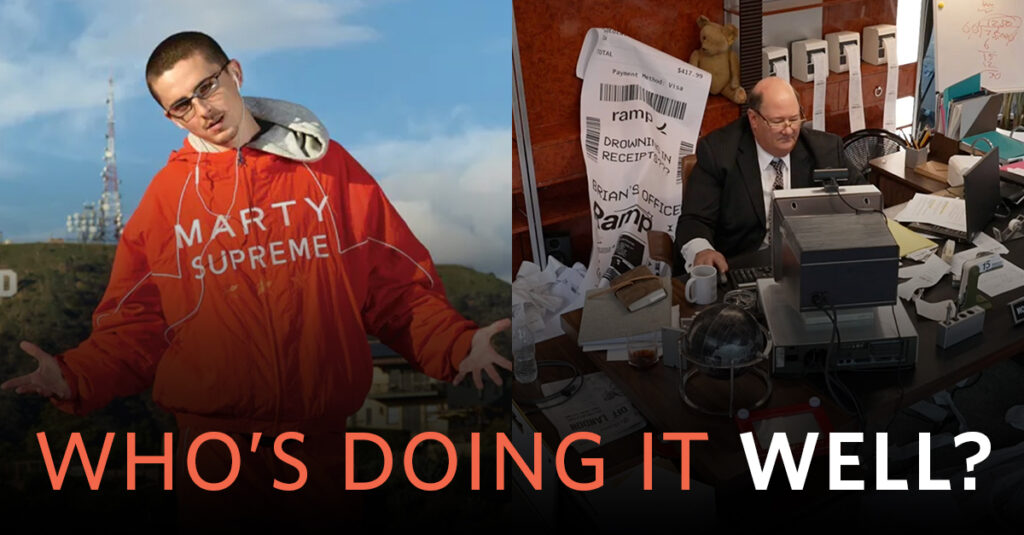
Understanding the framework is one thing. Seeing it in action is another. Here are two brands executing proof architecture in fundamentally different ways.
A24: Building Legibility Through Cultural Participation. A24 demonstrates how to make a brand legible to Gen Z through self-aware cultural credibility. They make moments that feel culturally intelligent. Ironic, but sincere. And they use a surround sound approach—showing up equally in small corners of social media, with big out of home stunts architected for digital capture and using celebrities and creators as validators—making it seem like they’re everywhere, all at once.
Their Marty Supreme campaign looks like chaos on the surface:18-minute marketing meeting videos, Timothée teaming up with rapper EsDeeKid, jackets reselling for thousands on StockX. But it’s not really about the stunts or viral moments. What A24 did was architect the exact conditions where proof emerges independently across all three layers. The satirical marketing meeting wasn’t trying to convince you the film was good; it was creating something communities could deconstruct and validate themselves. By making Timothée deliberately arrogant and self-aware about it, by embedding product references into underground rap videos, by handing exclusive jackets to unexpected celebrities, A24 forced proof to form through creator participation and cultural legitimacy rather than distributed brand messaging. The audience wasn’t being sold to. They were being invited into the construction of something that felt genuine because it acknowledged its own artifice.
What makes this a masterclass in proof architecture is that none of this lived primarily in the Dying Town Square. The real validation happened in the Niche Villages: Reddit threads and TikTok comment sections where communities were genuinely debating whether Timothée was serious, whether EsDeeKid was real, what the jacket actually meant. That collective uncertainty and investigation became the proof. When AI now aggregates Marty Supreme marketing, it’s not citing A24’s press releases. It’s citing the memes, the creator commentary, the community theories. The brand never had to prove the film was worth seeing. The audience proved it to them.
Ramp: When B2B Stops Preaching and Starts Belonging. Ramp, a finance operations platform, livestreamed Brian Baumgartner filing expenses in a glass box outside their NYC office. The six-hour visual gag was simple: his office slowly filled with paper as he processed claims manually, creating a stark contrast to how the same work looks inside Ramp’s platform. Guests, including David Wallace from The Office, Ramp leadership and other characters. The livestream was structured like a creator stream with segments, surprise bits, and cameos. This format made the content inherently clippable and discussable. Ramp connected the online to offline with OOH ads and appearances on US news and weather shows.
What makes this relevant to how B2B proof legitimately forms is the content spine Ramp builds behind their activations—like the livestream—and ongoing digital marketing. They sponsor business podcasts where decision-makers congregate. They publish a monthly AI Index (derived from their product telemetry) as thought leadership content that spreads on social. They maintain a Ramp Economics Lab Substack newsletter that comments on spending data not as promotional content but as genuine cultural commentary backed by data.
This infrastructure means proof about Ramp isn’t forming through stunt-like moments alone. It’s forming because Ramp shows up consistently in the spaces where finance pros and business decision-makers get their information. This makes the brand someone/thing who belongs in the conversation about how modern finance operations work rather than just another vendor. And that is far more sustainable than any single moment could ever be.
What This Looks Like Across Categories
B2B: Enterprise software companies are running private Slack communities where customers share use cases and questions. They’re seeding product with devs in Discord servers. The community is where the selling happens, not the cold outreach.
Healthcare: Health systems are building private groups for patients managing specific conditions. Peer support + expert answers + real evidence. They’re identifying subreddits where customers are researching solutions and showing up with valuable expertise. They’re creating the infrastructure for support and decision-making.
Consumer: Luxury brands are creating invite-only WhatsApp groups where customers co-create, and limited drops happen. Beauty brands are launching Substacks that people willingly subscribe to. They’re investing in micro-communities where shoppers are already discussing similar products. The brands winning aren’t chasing followers; they’re nurturing community.
Common threads? Stewardship beats stunts. Consistency beats virality. Utility beats reach.

Social fatigue is no longer anecdotal. Data now proves its existence. People are logging off. Users are spending more time scrolling but engaging less. There’s a quiet malaise about a performative social presence.
Yet the reality is most brands are still pushing content to feeds, measuring reach, hoping engagement converts to loyalty. In 2026, the brands who will end up on top are the ones intentionally architecting proof in the right social layers, where creators and communities are validating it, and where AI aggregates it as credible evidence. Put simply, they’re showing up in private spaces not to sell but to steward. That distinction is everything.
