Employee Login

Enter your login information to access the intranet

Enter your credentials to access your email

Reset employee password

Article

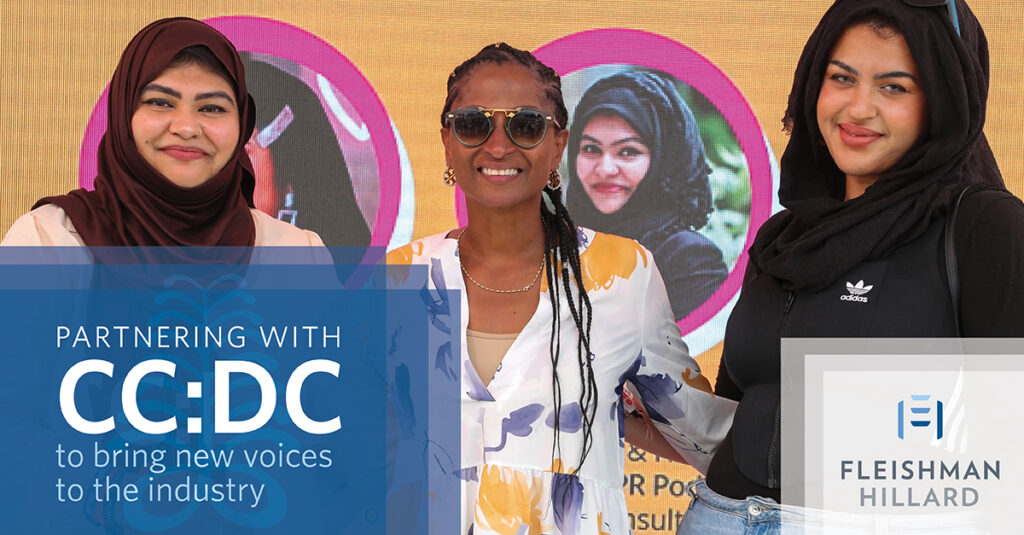
FleishmanHillard Partners with Cannes Can: Diversity Collective to Bring Positive Impact to the Industry with New Voices

September 14, 2023

FleishmanHillard and Cannes Can: Diversity Collective (CC:DC) joined forces this summer to bring fresh perspectives to key creative gatherings, leveraging the power of FH4Inclusion, FleishmanHillard’s pro-bono and volunteer initiative that has provided more than 37,000 hours of service to more than 130 global nonprofit organizations advancing inclusion.

It all started when Adrianne C. Smith, FleishmanHillard Chief Diversity & Inclusion Officer and CC:DC founder, attended her first Cannes Lions Festival and witnessed a significant lack of representation. She created CC:DC in 2017 to continue the conversation about the lack of diversity in the communications industry and to bring previously underrepresented groups to the table. In 2018, the organization brought its first group of ambassadors to the Cannes Lions International Festival of Creativity, where storytellers, creatives and other industry professionals gather annually. From there it took off, bringing more ambassadors each year and creating bespoke programming.

Fast-forward to 2023, we locked arms with CC:DC and supported social media management, media relations, thought leadership, activation planning and on the ground logistics at CC:DC’s two annual activations: the Cannes Lions International Festival of Creativity and Inkwell Beach at Martha’s Vineyard. At the events, our colleagues helped connect Grammy award-winning producers, well-known activists, artists and Fortune 500 sponsors to facilitate thoughtful and impactful conversations surrounding the intersection of inclusion, creativity and the need for continued investment into both within our industry.

Our global creative team also got in on the action, working with CC:DC to reinvent its AYA Inclusion Awards program hosted in Cannes. This included developing the graphic design and overall aesthetic of the awards, along with creating the award categories and judging standards, and having a hand evaluating the entries. In the spirit of inclusion, the AYA awards are free to enter.

“The goals of FleishmanHillard and CC:DC align in many ways to create a more inclusive communications and marketing industry. We were able to uplevel the already impactful work that CC:DC has been doing by enhancing the AYA Inclusion Awards with our world-bending creative leaders, managing the flow of events flawlessly, and increasing social and traditional media awareness, which garnered great feedback and engagement online while landing over 20 pieces of coverage in publications such as PRWeek, PRovoke, the Lions Daily News, Campaign, Fast Company, Human Resources Director Magazine and more,” said Francesca Weems, Director of DEI, FleishmanHillard.

The reinvigorated awards were also a hit.

“It was inspiring to see so many amazing pieces of work that center various aspects of diversity – be it race and ethnicity, accessibility or gender equality. With work entered from China, Brazil, France and the U.S., the AYA Inclusion Award is a great showcase that across the world diverse agency teams are using creativity to make an impact for marginalized communities,” said Anne Beutel, FleishmanHillard vice president.
Article

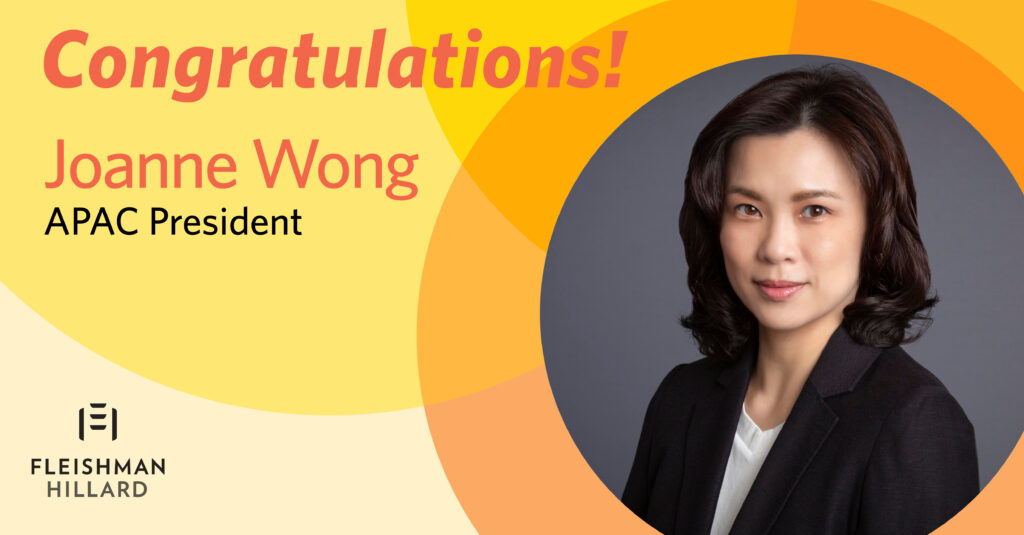
Joanne Wong Returns to FleishmanHillard, Appointed Asia Pacific President

September 7, 2023

ST. LOUISFleishmanHillard today announced the appointment of Joanne Wong to president of its Asia Pacific operations. Wong was previously with the agency for nearly two decades, last serving as its executive vice president, managing director – client service and head of business development for APAC. Wong returns to FleishmanHillard after serving as a senior managing director with FTI Consulting Strategic Communications.

“I am thrilled to welcome Joanne back to the agency in this key role for our global network,” said John Saunders, president and CEO of FleishmanHillard. “Joanne’s experience is steeped in consulting and client service. And she has a proven track record of growth achieved by supporting colleagues and teams, creating new paths and opportunities for high-performing employees. She will undoubtedly help us generate growth and commercial results in the region and globally, deepening relationships with our current clients and helping to define the future of our company.”

In the role, Wong will oversee FleishmanHillard’s operational excellence in nine countries across the APAC region. Her responsibilities will include developing and organizing successful new-business efforts, managing the region for growth and profitability, developing high-functioning colleagues and teams, and leading with a focus on respect, collaboration and inclusion at the core of the business.

“I am very excited to return to FleishmanHillard, which nurtured and built my dedication and expertise in the communications profession. I look forward to collaborating with the leadership team in the region to co-create a network that is recognized for our distinctive capabilities to problem-solve for clients, and as the destination for the best talent to achieve their most-rewarding career experience,” said Wong.  

During her initial 19 years with FleishmanHillard, Wong was a key leader in the APAC region and among the most significant contributors to the agency’s regional growth and success over the past two decades. In her most recent role, she oversaw regional operations and profitability, working closely with general managers to build business and hire and retain talent in key geographic markets. She also set standards for regional client service and developed and supported client leaders managing teams across multiple countries serving clients in the healthcare, energy and natural resources, technology, manufacturing and supply chain, and consumer industries. She also built and led the agency’s Financial Services, Public Affairs and Healthcare practices for APAC.

Wong serves as a trusted counsellor and executive trainer for C-suite executives on media and special situation responses ranging from transactions, crises and public issues to new strategies, partnerships and market entry. She also presents regional trends and landscape analysis to global clients’ headquarters and boards. 

Born in Hong Kong and educated in Canada, Wong holds a bachelor’s degree with honors in international relations and international law from Trinity College, University of Toronto. She was a journalist in Toronto and Hong Kong before beginning her communications consultancy profession. She was recognized by Campaign Asia Pacific as “Best 40 under 40” in 2013 as amongst the “most recognized future leaders of the industry in Asia.” She was also FleishmanHillard’s 2005 John D. Graham Award for Excellence recipient, one of the agency’s highest accolades awarded to colleagues who embody the culture, spirit and principles of John D. Graham, FleishmanHillard chairman and former CEO.

Article

FleishmanHillard’s Rachel Catanach to Speak on How GenAI is Transforming Marketing

When: Sept. 12, 2023

What: Generative AI World Conference

Where: The Royal Sonesta Hotel, Cambridge, MA

FleishmanHillard’s Rachel Catanach, senior partner and New York general manager, will be a speaker on the “How GenAI is Transforming Marketing” panel at the Generative AI World Conference on Sept. 12. The event takes place at the Royal Sonesta Hotel in Cambridge, MA.  

The panel will tackle topics such as how marketing as a profession is being transformed by GenAI, along with real-world examples of breakthrough creative projects and practical advice on scaling marketing organizations to take advantage of the productivity and quality benefits of using GenAI.

Find out more about the Generative AI World Conference here.

Article

FleishmanHillard Receives Four Finalists Nods for the 2023 PRNEWS Platinum Awards

August 23, 2023

ST. LOUISFleishmanHillard received four nominations for client work across four categories for the 2023 PRNEWS Platinum Awards. The global public relations agency received recognition for client work including:

  • AARP with FleishmanHillard, “The Fight for Fair Rx Prices” (Public Affairs)
  • SeaWorld with FleishmanHillard, “Combating an Unusual Mortality Event: How SeaWorld Galvanized a Tidal Wave Effort to Save the Manatee” (Cause-Related Marketing)

For more than 20 years, the PRNEWS Platinum Awards have put the spotlight on excellence in public relations, communications and marketing. Winners will be announced at an awards ceremony in New York City on Oct. 18, 2023. Get the full list of finalists here.

Article

The Importance of Focusing on Tasks, Not Jobs, with Generative AI

August 22, 2023
By Ephraim Cohen

To all the generative AI fearmongers: Don’t we all complain that there’s never enough time in the day to do the critical, long-term, deep-thinking work? 

It’s time to reframe the discussion around the impact of generative AI from jobs and roles to tasks and deliverables. Too many of today’s generative AI discussions focus on the number of jobs that will be eliminated rather than considering all the new opportunities that can be unlocked when we automate tasks, thus freeing up more time for higher-value work and the eventuality of new roles. 

And let’s be honest … we have been using automation, natural language processing and computer vision to complete tasks long before the surge in popularity of generative AI. That’s because when technology truly does its job, it becomes nearly invisible. While the concerns may be altruistic, they’re also misguided. It’s not the technology that matters as much as the benefits you derive. It’s the suggested cart item, the grammatical correction, and the hyper-relevant search result. It’s the surfaced insight, seamless customer experience and so on. When we embrace the potential value to be gained, our mindset can shift from worrying about AI replacing jobs to reimagining a future where AI can enhance and augment our own human excellence.

When humans focus solely on the task at hand, we prioritize near-term deadlines at the cost of longer-term, higher-level ideas and creativity. For example, in PR we may rush to finish a measurement report only to quickly move to the next one when that time could be better spent developing more actionable insights based on the data, which can then be used to develop more strategic and impactful plans.

And what happens after tasks? When generative AI takes on enough tasks, it can create a full-time role just to manage and optimize all those tasks. For example, a new type of AI graphics manager can focus on generating the best possible images to convey a story. Meanwhile, the roles of traditional graphics managers have moved on – they’re now spending their time digging into data and creative sources to come up with more effective visual concepts, out of which generative AI can rapidly create 100 or more variations for consideration. This will provide more choice and options at scale — and for a fraction of the cost — while also freeing up the designers to take on more fulfilling work.

This certainly isn’t the first time that communications roles have evolved in ways we previously couldn’t have imagined. Let’s look at two historical PR examples where technology impacted what we do daily and was perceived as a significant threat to jobs but ended up creating new and better opportunities for individuals in those roles.

First, those of us working in this industry in the ‘90s can recall when media lists began to move online (for those starting after 2000, lists were previously created manually from a printed directory of media contacts).

  • The task: Creating a media list.
  • New opportunity created: More time for counselors to develop better story pitches and cultivate deeper relationships with reporters, analysts, and later bloggers and influencers. 
  • Result: New roles emerged, like media and data analytics, which help our media relations pros determine which outlets and story angles will deliver the most impact.

Now, let’s consider the seismic shift that happened because of AI-powered video editing.

  • The task: Studio editing.
  • New opportunity created: Producing higher-quality video became accessible and attainable to all, enabling talent to develop more customized video solutions at a fraction of the cost.
  • Result: As video production became significantly more affordable and internet/mobile bandwidth expanded rapidly, video became much more common on social media, leading to even more demand for video content from brands and, therefore,more creative and production jobs in PR.  

What many fear about change is often only the mind’s reaction to something unfamiliar. Change often happens one step – or task – at a time. When real change comes to fruition, new roles and higher-value opportunities inevitably arise to meet the demands of the latest technology. It’s everywhere in industry’s history – from horses to cars, factories to robots and typewriters to computers. So far, history is repeating itself, and that’s creating even more opportunities, one Gen-AI powered task at a time.

This communication is offered as general background and insight as of the date of publication, but is not intended to be and should not be taken as legal advice. Each organization should confer with its own legal counsel and its own business and strategic advisors for guidance that is specific to and considers the organization’s status, structure, needs and strategies.

Article

How Very Public Labor Disputes Might be Impacting Your Workforce

August 21, 2023
By Donna Fontana

From unionization efforts by Amazon and Starbucks employees to months of recent coverage on Hollywood’s WGA/SAG strikes, the Teamsters contract negotiations and an unusually public start to UAW contract negotiations, a union-centric national narrative has taken hold. As hourly workers (both union and nonunion) absorb these media and social conversations, corporations should pay close attention to their employee engagement levels.

In the most pro-union environment in decades, support for the hourly workforce follows the national focus on well-being and equity. Add to that the shift in power from employer to employee as companies struggle to fill positions, and you have trending topics that are about much more than wages and benefits for a particular company’s rank and file. Today’s conversation is about fair play, respect and dignity for the workforce.

It’s a topic that impacts a much wider circle of companies beyond those involved with or directly impacted by union contract negotiations. It threatens to widen the gap between workers and management. Whether your hourly workforce is under 10 or over 10,000, those employees are part of the conversation: on TikTok, social media groups or Glassdoor reviews. Your workforce—and its collective satisfaction—is the core of your reputation, and taking a hands-off approach can put any organization in a perilous position. Management’s messages and actions during a potentially charged environment will speak volumes about its attitude toward and support of its workforce.

At FleishmanHillard, our counsel is to take nothing for granted. When employees are flooded with outside points of view, it’s critical for leaders to assess what the workforce is being impacted by—both internally and externally—and how they can authentically address concerns. The employee engagement principles below are a good place to start.

How to Keep Employees Engaged

  • Keep listening. There’s a real danger to assuming what the workforce thinks/feels/believes. Use a variety of approaches—1:1 meetings, group discussions, surveys, advisory groups, diagonally slice meetings— to get input from all levels and a realistic picture of the good, the bad and the ugly.
  • Assess what’s working. Revisit current communications channels, employee events, Employee Resource Groups or other workforce committees to identify if employees are effectively receiving information, building communities and providing feedback.
  • Make managers integral to success. Ensure they are well-equipped with information and training to communicate with their teams and shepherd feedback.
  • Maintain a people-first, empathetic approach. The steady coverage on strikes and workers’ rights can be both exhilarating and exhausting for a workforce. Remember the importance of humanity in communications and actions.

Maintaining a positive, respectful work environment requires commitment to listening and following through on what you hear. It’s about regularly, and authentically, demonstrating a thoughtful approach to a future of shared success.

The workforce has changed. There’s a new generation with its own perspective on work-life balance. There’s an increased demand for transparency and equity. There are more communication channels to share ideas and points of view. Leadership’s ability to embrace this evolution will play a big role in an organization’s success as an employer of choice.

Donna Fontana is the global Manufacturing practice lead for FleishmanHillard.

Article

Jacob Porpossian Honored with a Spot on the PRWeek 40 Under 40 List

ST. LOUIS — FleishmanHillard’s Jacob Porpossian, executive creative director, Health & Life Sciences, has been named to PRWeek’s 40 Under 40 2023 list.  The list honors the best and brightest up-and-coming talent who are redefining the role of communications, PR and marketing.

In addition to his role leading creative for the Health & Life Sciences practice, Porpossian previously built the creative team in our Toronto office that transformed how our Canadian offices operated and approached creative culture. Porpossian’s work also includes DE&I efforts like launching the New York chapter of OPEN Pride, our parent company Omnicom’s LGBTQIA+ inclusion group, and he remains on the global OPEN Pride Board. He also contributes to industry panels, participates in speaking engagements and serves on the jury of award programs.

Porpossian and his fellow honorees are featured in PRWeek and invited to an award ceremony on October 26th in New York City. For the full list of winners, click here.

Article

Protecting Your Reputation in the Wake of MOVEit and Software Supply Chain Cyberattacks

August 17, 2023
By Spencer Girouard and Alexander Lyall

The ongoing MOVEit vulnerability has become one of the most significant cybersecurity issues in recent years. Several hundred companies have reportedly been affected to date, with the potential of thousands more globally and across nearly every sector.

Unfortunately, this situation is only the latest example of a growing cybersecurity trend: attacks on software vendors that can result in millions of individual victims. The SolarWinds attack in 2020 may be the highest-profile example of this type of event, but in recent months, other examples include a business communications software provider and a developer platform.

It’s imperative that leaders consider the reputational implications of an attack stemming not just from internal systems, but from anywhere within their software ecosystems — including vendors.

The FleishmanHillard Cybersecurity practice has supported multiple clients affected by MOVEit and numerous other breaches. In helping these clients effectively protect their reputations while dealing with these matters, we have identified notable trends that others should consider.

What to Consider When Communicating About a Cyberattack

  • Accept accountability while providing context.

In cases where MOVEit or another compromised software was used by a vendor rather than by the company, that company may have the option to allow the vendor to disclose the breach to the affected individuals directly. Before choosing a path, the company should weigh this choice against their stakeholder’s expectations.

  • Consider all audiences and be prepared.

Organizations may receive questions from stakeholders regarding risks associated with MOVEit. When deciding when and how to communicate — whatever your level of exposure — have a plan that balances transparency without causing undue alarm.

  • Take a long view.

Examine your current risk and ask yourself: Is the data I collect essential for conducting my business? Will my stakeholders be surprised by the data I collect? How many third parties receive that information? What are their data privacy standards and practices?

  • Prepare ahead of time.

Experiencing a data privacy issue is no longer a question of if, but when. These attacks are increasingly more sophisticated and common — a trend that will only continue. While a data security incident by itself does not necessarily represent a reputational crisis, failure to meet your stakeholders’ expectations regarding your level of preparedness and ability to respond in a manner that is transparent and timely could result in long-term reputational damage. To maintain that trust and protect business continuity, it is critical to have a communications plan that is up-to-date and takes these nuances and possibilities into account.

You can reach the FleishmanHillard U.S. Cybersecurity Practice Group at [email protected].

Article

How to Attract and Retain the Next Generation of Talent

July 27, 2023

A New Approach to the Employee Value Proposition

Gallup recently published its State of the Global Workplace 2023 Report and the results are grim. Engagement has dropped another 2% in the U.S., with employees continuing to check out at record levels.

In fact, according to Gallup, the majority of your employees (60%) are disengaged at work — with 18% actively disengaged.

This means most of your workforce is simply putting in a less than optimal effort to drive your business forward — and probably looking for another job. While nearly a fifth of your employees are actively doing harm by undercutting business goals and railing against leaders.

What’s going on?

The truth is companies leaned heavily on their employees during and after the pandemic – and employees, particularly Gen Z, are pushing back and reshaping their relationship with their employer.

They want more flexibility and autonomy. A focus on mental well-being. A better work-life balance. And to work for companies whose purpose and values align with theirs.

And while most organizations have recognized this fundamental shift, the empathy gap between workers and company leaders is now bigger than ever. As the WSJ put it, “rarely have bosses and workers been so at odds over so much.”

Rebuilding employee trust and engagement.

Organizations need to rebuild employee trust and engagement. Particularly with the 60% of employees who are disengaged. When you think about it, they’re your greatest opportunity for growth if you can re-engage them by clearly reinforcing and rearticulating your promise and aligning them behind it.

The most effective way to express that promise is through an Employee Value Proposition (EVP), conveying your unique offering as an employer (“the gets”), balanced with the expectations (“the gives”) for prospective and current talent.

However, the truth is EVPs have been around for a long time and frankly many of them are too transactional, vague and generic. More important, they often don’t authentically reflect the actual lived experience of your employees.

Which is why FleishmanHillard has taken a new approach.

A new approach to fulfilling your employee promise.

In our report “Unlock the Power of your EVP: Fulfilling Your Brand Promise to Talent,” we highlight how the conversation has shifted from compensation and benefits to one that reflects employees’ new expectations. An EVP that:

  • Clearly articulates what you value, and what you value in others, in an authentically human voice.
  • Explains how you provide employees with opportunities to grow.
  • Tells the story of who you are and what you stand for, highlighting your commitment to shared purpose.
  • Represents your vision for the candidate and employee experience – from entry to exit. 
  • Spells out your expectations of employees in creating a safe, caring and inclusive workplace.
  • Maps out how you’re empowering employees to make well-being a priority and find balance in their personal and professional lives.

The human deal.

This new approach to EVP calls for a human deal that recognizes employees as people, not just workers, and delivers on attributes that allow the integration of an individual’s employee experience and life experience. The nine elements to get right:

1. Well-being

  • Compensation and Benefits: Am I rewarded fairly? Do my benefits and compensation align with my skills and experience?
  • Work/Life Balance: Am I able to balance and integrate my personal and professional life? Am I able to perform my job wherever I am?
  • Safe and Efficient Workplace: Is the technology effective? Do I feel both physically and psychologically safe?

2. Growth

  • Recognition: Am I acknowledged and rewarded for good work?
  • Advancement: Do I have opportunities to learn, grow and advance my career?
  • Pride and Affiliation: Am I proud of my company? Can I grow as my company grows? Does it provide me with challenging and meaningful work on prestigious projects?

3. Belonging

  • Belonging: Do I feel a sense of belonging? Is my firm inclusive and diverse? Do I feel accepted?
  • Culture: Does my company have a positive, collaborative and inspiring workplace culture?
  • Purpose: Is my company committed to having a positive impact on society? Does my company’s purpose and values align with mine?

Of course, the work doesn’t end with mapping out the EVP itself. From top to bottom, leaders throughout the organization need to understand the company’s EVP strategy and the role they play in bringing it to life for their teams.

This requires thoughtful approaches that continue to inform, equip, align and engage leaders at all levels in making your EVP a lived experience, not just words on a page. Managers, as employees’ most sought-out and most trusted sources of information, are a particularly critical link in this chain.

With these considerations addressed, the EVP should and can be a strategic brand platform and an essential component of your corporate business strategy. Whether you’re just about to define your EVP or refresh an existing one, if done right, it can drive performance and profits, with noticeable improvements in important business metrics, such as turnover, absenteeism and accidents.

A strong EVP has the power to transform your disengaged workers into motivated and engaged employees aligned with your business priorities.

Paul Vosloo leads the Talent & Transformation team out of FleishmanHillard’s New York office.

Article

TickTockTech: How to Create a Leading Event in an AI and Machine Learning Filled Landscape

July 24, 2023
By Elizabeth Hayes

In an artificial intelligence (AI) and machine-learning (ML) filled world, competition is fierce. The will to ethically utilize the problem-solving, efficiency-boosting and humanlike tech has found its way to the forefront of business strategies globally and the race to successfully integrate it to optimize operations is on.

We’re now seeing these intelligent machines emerge with immense impact on our daily lives. Its limitless potential and accessibility is empowering just about anyone to give the tech a go. Experts have high expectations for AI, with digital advances believed to range from personalized medical care to environmental sustainability by 2035 (PEW Research). These systems also come with risk and worry of what they could lead to — from misinformation to unemployment.

There’s plenty to unpack when it comes to AI and ML — the good, the bad and the ugly — and industry conferences and events are becoming a hub to talk tech. It’s a crowded landscape, and every AI and ML event is trying to stand out. But as you try to navigate the dense environment, there are a few key findings that can help make for an impactful event.

Plan for the Specific Needs of In-person and Virtual Media Attendees

The pandemic pushed us into a hybrid event model where a virtual component is now the expectation, no longer the exception. And though virtual events open the door to borderless media attendance, content must be engaging and thought provoking, especially when seemingly everyone is trying to talk about AI. We need to keep media tuned into the live stream. Remember: it’s easy to click to another browser and start multitasking. We want to prevent that from happening.

But lest we forget, in person events are back, and while it’s not as easy to walk out of an exhibit hall mid presentation as it is to exit a livestream, media have busy and ever-changing schedules. We want to remain on their calendars and need dynamic, immersive experiences to draw in their RSVPs. 

Through a strategic approach, events can be mutually beneficial for both reporters — whether onsite or from the comfort of their home office — and for your brand. So, when you’re in the early stages of planning, be sure to ask yourself a few key questions that can help shape that strategy: Is this session best served as a livestream or can I make it more engaging through an in-person session? Are there any partnerships that can be leveraged to enhance discussion or reach an expanded audience? What is the key differentiator of my AI event from others, and am I clearly articulating that in external communications?

Create a Unique Angle, Specific to Your Audience

We know the AI and ML event landscape is packed, and it’s becoming increasingly challenging to make a lasting impression. In fact, since November 2022, 98% of tech-centric events shifted their focus to AI and ML regardless of it being part of their strategy prior. But as events look to include AI as a unique driving factor in its core narrative, it ends up having the opposite affect — it eliminates differentiation.

So, what’s the solve? Organizations need to be strategic in their event approach and carve out space in an oversaturated AI environment. Recognizing that not all AI is created equal is key and making a point to understand your audience and shift the broader AI conversation to a targeted, niche dialog can make a big impact.

Develop Your Post-event Strategy Early

Pre-event traction is a given, post-event relevance is not. A post-event strategy is critical to maintain your audience once the hype dwindles and the event wraps. To bring some longevity to your event, know what stories to tell and where to tell them. To achieve this, map your narrative and internal stories to how the topic is being covered in the news, along with your target audience’s news consumption habits. With this data at hand, you can tell high-impact stories that not only break through to your audience but move them to action.

Focus on High-level Content and Engagement Over Celebrities

Despite what you’ve seen, A-list stars don’t drive event attendance or talkability. Their keynote or live performance won’t convince experts to register. The truth is, audience-centric content, thought-provoking conversations and networking opportunities with like-minded professionals will. These attendees are eager to collaborate and hear unique perspectives on various AI topics; and they were likely interested before you announced your headlining celebrity. Don’t use up your budget on a high-profile guest.

So, instead of an award-winning actor, bring in subject matter experts who will encourage ideas and innovation, or industry thought leaders who will initiate discussions around groundbreaking AI advances. If agenda content and the experience is tailored to your target audience, attendance will follow suit.

Navigating an inflating AI and ML event landscape will continue to be an uphill battle, so long as innovations continue and use-case breakthroughs emerge. There’s room for everyone and every AI event to have a seat at the table if you plan accordingly, carve out space in an inundated AI event environment, take a driven approach to reaching the right audience and bring in relevant thought leaders to encourage engaging conversations.