Employee Login

Enter your login information to access the intranet

Enter your credentials to access your email

Reset employee password

Article

When the World Gets Noisy, Great Storytelling Breaks Through 
December 3, 2025
By Trine Hindklev

In a world where disruption feels like the norm, clarity can feel out of reach. Our President and CEO, J.J. Carter, put it well at a recent PR Decoded discussion: “Clarity often comes from chaos for those who are bold enough to seek it.” That’s the mindset driving how we approach communications today. For us, it’s our call to action for how we think about storytelling. 

That perspective came through in our recent discussion with Chrissy Farr, editor-in-chief of Second Opinion, former tech and health reporter at CNBC and author of “The Storyteller’s Advantage: How Powerful Narratives Make Businesses Thrive.” Chrissy’s research and real-world experience show that the most effective leaders strategically use compelling narratives as a springboard to craft stories that connect, persuade and inspire.  

When storytelling is left to chance, companies lose control of the narrative. And no one wants to lose their narrative. Today, there’s a genuine need for trusted counselors to help leaders put communications at the center of their business strategy, not as a last-minute fix or a siloed function cast off to the side. 

Complexity isn’t going away. It’ll likely to get, well… more complex, but the ability to cut through it with authentic, sharp, well-crafted narratives is the key to thriving. Here’s how: 

Building resilience through narrative 

Organizations that invest in their narrative build real equity. It’s more than a safety net for tough times, Chrissy said. It’s a foundation of trust, engagement, and clarity that holds up in any environment. Leaders who go beyond facts and figures, sharing vivid, relevant and relatable stories, build solid reputations and relationships that last.  

The lesson? Invest in your narrative before you need it.  

That translates to mapping out your narrative assets, finding gaps in credibility, and creating processes for authentic engagement and rapid response. Resilience isn’t just about weathering storms; it’s about being known and trusted, no matter what comes your way. 

Moving beyond spin with courage  

Let’s be honest, being clear and human isn’t easy. It feels too risky. Too vulnerable. But the bigger risk is being boring and forgettable. People crave something real. Something bold and relatable. The risk of irrelevance is greater than the risk of saying something fresh.  

This holds true whether you’re B2B or B2C. Broad, generic messaging just gets lost. Clarity and specificity cut through. Every time. That’s why it’s so important to help leaders tap into their authentic voice, not just the safe, polished version, Chrissy shared. There’s a need to coach leaders to lean into what makes them different and set up the right guardrails to navigate complex issues with confidence. This isn’t about spin. It’s about showing up as real humans and letting that drive real connection.  

Reach without the reaching 

Metrics, dashboards and percentages dominate most conversations at the top. But honestly, who remembers a stat sheet? 

It’s stories that stick. Share the right story, and suddenly your message is making the rounds in rooms you’ve never entered, and your message travels further than any paid campaign could. That’s the kind of reach every communicator dreams of. 

But too often organizations chase impressions and views, Chrissy said. Impressions don’t impress if they don’t move people, and most don’t. The real impact of storytelling shows in influence: your message shapes industry conversations, earns trust and opens doors that numbers alone never could.  

In a nutshell, it’s time to move beyond those vanity metrics. So, look for measurement models that track the full picture, from traditional reach to narrative traction and influence mapping. Build dashboards that look at what counts, such as stakeholder sentiment, leadership invitations and the conversations you’re sparking across your sector. 

Chrissy’s advice is simple: focus on quality engagement. Nurture the audiences that matter. Invest in content people value. Rethink channel strategy, prioritizing depth over breadth and building real communities.  

Move away from chasing numbers to building lasting influence, think more modular content + smart thought leadership + executive visibility all working together as part of an integrated approach.  

Be a trusted partner  

Storytelling carries risks. But so does playing it safe. As Chrissy and J.J. put it, leaders and brands who stand out are the ones willing to show up with clarity and courage, sharing the moments that matter even when they aren’t perfect. That’s how impact grows. 

As a modern communications agency and trusted partners to many of the world’s most vibrant brands, we believe crafting a narrative isn’t just a tactic, but a strategic asset that drives measurable impact. The organizations that treat storytelling as a line item or an afterthought will get left behind. The ones who invest, with purpose, will lead. 

Do you need help being human, specific and bold? Be brave. Let’s talk.  

Trine HindklevTrine Hindklev is a senior partner and FleishmanHillard’s Global Strategic Media Relations Lead. She is part cultural anthropologist, part media strategist, part creative storyteller and all-in change-maker..
 
Article

Win What Matters

November 11, 2025

How a Purposeful Award Strategy Can Strengthen Employer Brand and Attract Top Talent

In today’s dynamic talent landscape, one principle stands out: recognition matters, but only when it’s meaningful. From “Best Places to Work” lists to industry-specific accolades, employer-of-choice awards remain a powerful tool for building credibility, boosting brand perception and attracting the right talent.

But not every award is created equal … and many come with a hefty price tag (from entry fees to the time and effort spent preparing submissions).

As the hiring market cools and qualified candidate searches intensify, now is a strategic time for organizations to double down on their employer brand. Third-party awards, in this context, retain their power as a powerful tool.

But the goal isn’t just to win. It’s to win what matters. The proper recognition, grounded in authentic storytelling and aligned to business priorities, can differentiate your organization in a crowded marketplace.

Why now?

While some companies are scaling back recruitment efforts, smart employers see this moment for what it is: a rare window to stand out and attract exceptional candidates. With fewer organizations actively vying for talent and less noise in the marketplace, even modest increases in employer visibility, such as industry mentions or niche awards, can generate an outsized impact. Recognition as an employer of choice not only draws in new talent but also boosts engagement and morale among current employees, provided it is earned and shared authentically.

That means skipping the “spray-and-pray” approach to awards submissions and instead adopt a strategic lens. Start by pondering over the following:

  • What does your organization want to be known for?
  • Which recognitions align with your values and culture?
  • How can internal communications help bring that story to life?
  • How well does your organization satisfy the award criteria or compare against potential competitors?
  • Will your chances of winning improve by implementing programmatic changes ahead of the next submission cycle and applying then instead?

When these questions are answered honestly, a more straightforward path forward emerges.

Go beyond the boilerplate

Be inspired by the fact that at the heart of every effective employer brand is strong internal communication. Award-winning cultures are built from the inside out, grounded in authentic stories that bring purpose and values to life across teams and in everyday moments. That’s why we help clients dig deep to uncover the stories that matter: how purpose is lived, how values are demonstrated at every level and how culture is defined by employees themselves.

But building a great place to work requires more than compelling narratives or polished award submissions. It takes consistent, thoughtful strategies that genuinely connect people, business goals, values, brand and reputation, resulting in an exceptional employee experience.

A smarter path to recognition

Of course, even the best narrative won’t make an impact if it’s sent to the wrong place. Award submissions can be expensive, time-consuming and competitive.

To invest time and effort wisely, an awards assessment matrix is a valuable tool organizations can use to evaluate which opportunities best align with their purpose, values and strategic priorities. Using such a resource can help your team focus on efforts that will drive real business value.

The results speak for themselves

Rest assured, a well-executed award strategy doesn’t just earn headlines. It builds trust with candidates and fosters employee pride. It instills confidence in the communications and talent attraction functions, potentially leading to additional resourcing to expand the programs responsible for the accolades won. And when an organization tells the story of its positive employee experience with intention, the benefits extend far beyond a single submission cycle. They reinforce the culture employers work hard to build—and invite others to be part of it.

We’re proud to help clients develop employer recognition strategies that do just that. From building employee engagement and alignment programs that are the foundation of a great place to work, to delivering standout storytelling, to selecting the award programs that will make the biggest impact, our team helps organizations focus their efforts where they matter most. Because when it comes to awards, the smartest strategy is simple: win what matters.

Ready to move beyond generic recognition?  FleishmanHillard’s Talent + Transformation team builds award strategies that deliver measurable talent and business outcomes.

Let’s build an awards assessment matrix to identify the right opportunities and craft a story that reflects your people, your culture and your purpose—and achieves your recruitment and retention goals.

Article

Super Bowl LX: The Ultimate Pressure Test

October 29, 2025
By Steve Hickok and Rebecca Rausch

The Super Bowl has always been more than a game. It’s the most-watched cultural moment in America and one of the most valuable sponsorship platforms in the world. But heading into Super Bowl LX, the playbook for brands must adapt to today’s reality.

Case in point — the NFL’s selection of Bad Bunny for the halftime show has already sparked cultural and political debate and even led to an “alternative halftime” event to counter it. For the NFL, NBC and major advertisers, this creates a highly polarized, high-visibility environment where every decision and creative choice will be interpreted through a political lens.

This year’s game underscores what our teams across FleishmanHillard Sports and Crisis, Issues & Risk already know: Brand activations and storytelling live in a 360° risk environment — one where culture, politics, fandom and identity collide in real time.

Why This Matters and What it Means for Advertisers, Sponsors and Opportunistic Brands

For advertisers, sponsors and even those brands looking to jump into the Super Bowl conversation, this isn’t just about managing risk — it’s about navigating a cultural flashpoint skillfully, strategically and confidently.

That’s because Super Bowl LX is more than just a marketing showcase — it is a real-time reputational stress test for every brand involved. Audiences are more polarized than ever, athletes and artists are cultural flashpoints and sponsors and advertisers are under heavy scrutiny to demonstrate value to stakeholders, as every moment will be instantly amplified.

Anticipate, Adapt and Lead Under Pressure

For decades, FleishmanHillard has helped guide brands on the biggest stages – from the Olympic Games to FIFA World Cup and Super Bowl. We bring together event-tested expertise and relationships across sports sponsorship, issues navigation, and brand reputation to help clients anticipate risks, prepare for what’s ahead, and play to win.

Brands should consider the following elements from our ever-evolving Playbook as they work through their “Big Game” communications plans:

  • Always on situational awareness. Understand that the environment surrounding the game is more complex than ever — a fragmented, emotional and politicized audience where every move is scrutinized in real-time.
  • Act with clarity and purpose. Brands should be grounded in who they are and what they stand for. Decisions and scenario planning should be anchored in brand identity and long-term objectives — not reactions to political noise or short-term controversy. Purposeful action signals confidence and consistency, even in a polarized environment.
  • Pressure-test everything. Great creative ideas are only as strong as their ability to withstand the cultural moment. The best brands pressure-test their ideas before launch — understanding how different audiences might interpret tone, imagery or associations. Use research and audience intelligence tools, including Sage Synthetic Audiences, to preview how different segments — from fans to policymakers to Gen Z — might react. FleishmanHillard’s Risk Radar, a forward-looking telemetry system that helps organizations spot reputational issues before they break, can be used to evaluate risks tied to creative, activations, partnerships and messaging.
  • Plan for the “what ifs.” When the moment comes, speed matters — but so does discipline. The most effective brands build Super Bowl–specific playbooks that define who acts, who approves and how decisions are made when the pressure hits. From monitoring protocols to escalation matrices and stakeholder communications, these should be tested well before game day — not written during it. The FleishmanHillard Crisis Simulation Lab can be leveraged to rehearse these scenarios in a realistic, dynamic environment that mirrors real-world pressures — social chatter spiking, a sponsor calling or a halftime controversy trending. Practicing the response, not just writing it, helps teams move faster, stay aligned and communicate with confidence when a 15-second moment becomes a headline and days’ worth of conversation.

Super Bowl LX is the ultimate pressure test. The best brands won’t avoid risk; they’ll embrace it strategically, purposefully, and be prepared to win on the world’s biggest stage.

Steve Hickok is the Global Lead of FleishmanHillard’s Sports practice. He’s led award-winning and business building campaigns for more than 20 years surrounding the Super Bowl for brands including Visa, State Farm, Buffalo Wild Wings, Amazon, Little Caesars and Lindt.

Rebecca Rausch, FleishmanHillard’s Americas Crisis Lead, is a trusted expert in reputation management and crisis communications, advising sports organizations, leagues, athletes, and brands through high-stakes issues and reputational challenges. She’s led crisis and issues planning and management for global sporting events including the FIFA World Cup, Olympic Games, Super Bowl, major international tennis and golf tournaments and more.

Article

Go Positive with Images; Go Negative with Words 

April 24, 2025
By Caitlin Teahan and Ephraim Cohen

Museums often inspire through beauty and wonder. News media? Not so much. Why do we associate one with hope and the other with dread—even when we say we want more good news? The answer lies in how our brains respond to words versus images.

Understanding the emotional mechanics of language and visuals helps communicators craft messages that resonate. Words and images both shape perception, influence behavior and drive engagement. But when it comes to emotional impact, they trigger opposite effects.

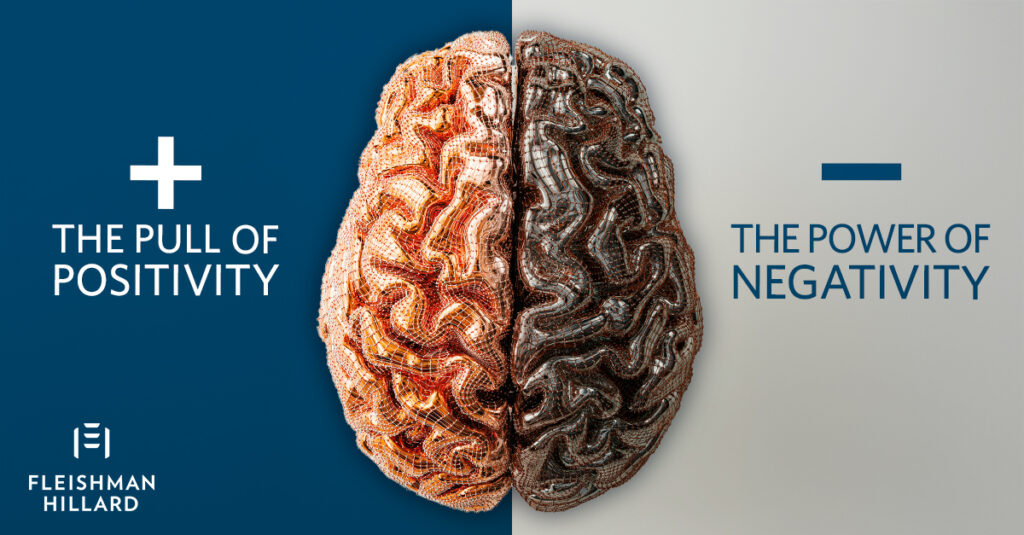
Words: The Power of Negativity 

In written and spoken language, negative words carry disproportionate weight due to the negativity bias—a psychological tendency to pay greater attention to threats and adverse stimuli as an evolutionary survival mechanism. Think, for example, how one stinging criticism sticks with you far longer and more intensely than a dozen compliments do. It’s just human nature.

  • Negative News Headlines: Research from the University of Pennsylvania indicates that news articles with negative headlines generate 30% higher click-through rates than neutral or positive ones. Fear and urgency remain powerful motivators. 
  • Lasting Impact in Conversations: Critical remarks or alarming statements tend to linger longer in memory than positive discussions, often overshadowing constructive dialogue. 
  • Social Media Amplification: A 2021 study from NYU found that tweets with negative sentiments are 20% more likely to be shared, reinforcing the viral spread of outrage and conflict. 

Images: The Pull of Positivity 

Visual content, on the other hand, has a different impact. Whether paintings, photographs or digital images, positive visuals evoke instant emotional responses, often bypassing analytical thought and fostering a sense of optimism. 

  • Color and Expression: Bright colors, serene landscapes and smiling faces consistently generate feelings of joy and relaxation. A study in The Journal of Positive Psychology found that viewing uplifting artwork can increase happiness levels by 30%
  • Art as a Source of Hope: Historically, art has served as a medium for resilience and solace. From Renaissance paintings depicting harmony to contemporary visuals that counter societal anxieties, positive imagery offers a counterbalance to distressing narratives. 
  • Viral Visual Content: On platforms like Instagram and Pinterest, uplifting imagery—such as acts of kindness or vibrant nature scenes—is 40% more likely to be shared, demonstrating the innate appeal of positivity. 

Why the Difference? 

The fundamental disparity between our reactions to words and images stems from how our brains process them

  • Analytical vs. Emotional Processing: Words require cognitive effort to interpret, often triggering deeper emotional responses, particularly when negative. Images, however, activate the brain’s emotional centers instantly, fostering quicker, more positive engagement. 
  • Context vs. Universality: Word receptivity is driven by context, meaning their impact varies based on language and interpretation. Images, by contrast, are largely universal, making their positive effects more consistent across audiences. 
  • Speed of Processing: Research from MIT shows that the brain processes images 60,000 times faster than text. A powerful image can evoke emotion in milliseconds, while words take longer to register and influence perception. 

Implications for Media and Communication 

These insights present opportunities for content creators, marketers and journalists to balance emotional engagement with constructive messaging. Communicators must play to each medium’s strength:

  • In Journalism: Reporting will always involve critique—but pairing solution-based reporting with compelling visuals can temper doomscrolling with hope. Consider how photojournalism, infographics, and video clips can reframe stories through action, not just alarm.
  • In Brand Marketing: Language can create urgency, but visuals build trust. Strategic use of emotionally rich imagery (not just stock photos) can help brands feel more human, especially when the message is complex or controversial.
  • On Social Platforms: Leverage the algorithmic lift of visual content to reframe critical narratives. For instance, pair a provocative claim with an image that signals empathy or optimism to shift engagement from outrage to curiosity.
  • In Internal Comms & Leadership Visibility: Executives communicating change or challenges can soften negative language by accompanying it with clear, calming visual design—think tone-matching slide decks or video messages filmed in relaxed settings.

Conclusion 

The key takeaway? The medium shapes emotional impact as much as the message itself. 

Words and images wield distinct emotional power. While negative language commands attention and shapes discourse, positive imagery offers a pathway to optimism and connection. By recognizing these dynamics, communicators can design content that not only informs but also inspires, fostering a more conscious and balanced media landscape. 

(Disclosure: we wrote this article with the research and editing assistance of a custom GPT. The article is opinion only and we take responsibility for its content).