Why Your AI Rollout Is Stalling (And What Actually Moves the Needle)
Most organizations are investing heavily in AI but seeing minimal return. The tools are rolling out. The impact isn’t landing. This article examines why adoption is stalling, what employees are really feeling and why a new model for change is essential to close the gap between investment and outcomes.
There’s a paradox unfolding in organizations right now – and its quietly derailing AI initiatives at scale.
Companies are pouring millions – in some cases, billions – into AI infrastructure. Platforms are deploying. Training programs are launching. And yet, most organizations report that their AI efforts aren’t delivering the results they expected.
In fact, 95% of generative AI pilots fail to reach measurable business impact. Only 1% of organizations consider their deployments truly mature. And across the workforce, a third of employees are actively considering leaving over unclear AI expectations and lack of support.
The investment is real. The adoption and impact is missing – and the disconnect is striking.
So, what gives?
What we’ve learned supporting organizations through AI transformation is this: they’re treating it like a technology problem when it’s actually a people problem. And until we acknowledge that difference, adoption – and business impact along with it – will continue to stall.
The Emotions Nobody’s Talking About
Walk into most organizations right now, and the conversation sounds logical. “Here’s the business case. Here’s the ROI. Here’s the productivity uplift.” But underneath that rational overlay is something messier – and infinitely more powerful: how people actually feel.
- 82% of workers say they don’t fully understand how to use AI in their roles. That’s uncertainty.
- And only 1 in 5 employees is confident their organization puts employee interests above its own when implementing AI. That’s fragile trust – the kind that doesn’t show up in a rollout plan but absolutely shows up in adoption rates.
- Plus, more than half of employees feel they’re falling behind on AI, and only half have received any training. The message employees are receiving – whether explicit or implicit – is: We expect you to do this. We haven’t given you the tools to feel safe doing it. And by the way, we’re not sure what it means for your future.
The data points here are endless – and we could marshal dozens more to prove that adoption is stalling. But honestly? They don’t really matter. What does matter is whether you feel your organization is progressing at the rate you know it’s capable of.
If not, or if you don’t know where to start to answer that question, it may be time to look closely at your adoption strategy.
The AI Readiness Gap
This is the mistake we see companies continuing to make: assuming a strong business case is enough to win people over. We’re treating AI adoption like a switch you flip, when it’s actually a continuous, messy, non-linear process that requires people to move through change at different speeds.
Most organizations are still leaning on traditional change models – the kind that default to logic and expect a single launch moment to do the heavy lifting.
But AI transformation isn’t a single moment. It’s not a product launch. It’s a fundamental shift in how people think about their work, what they value in their roles and whether they trust the organization to shepherd them through it.
That gap – between what leaders expect and what employees experience – is the real barrier to adoption.
A Different Path Forward
What’s needed is a model designed for how people actually change. Not how we think they should change. How they actually do.
The good news: that change management model exists; it features three phases and three layers of employees’ experience, and all three matter equally:
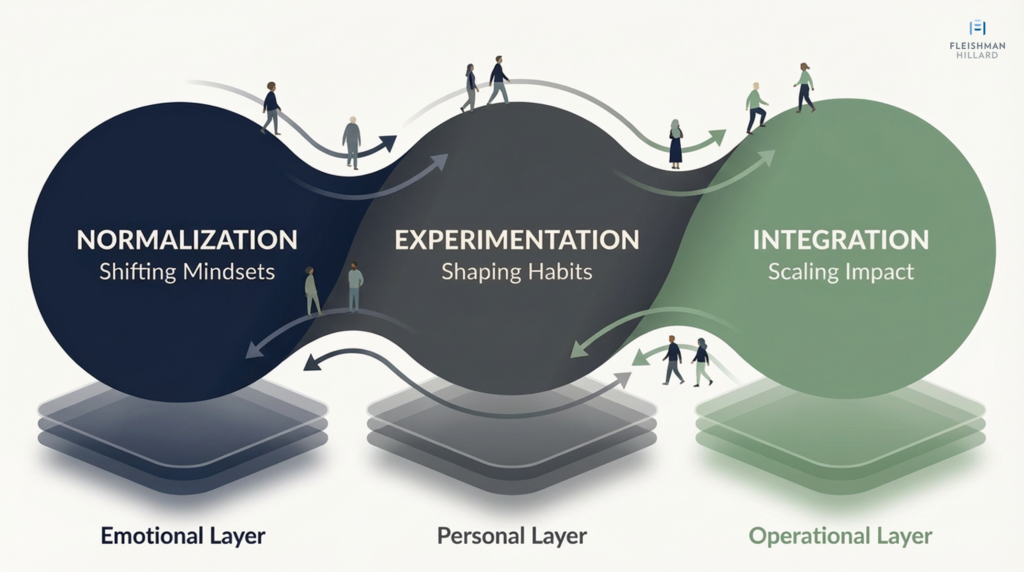
Phase 1: Normalization – The Emotional Layer
Normalization is about shifting mindsets – listening, building psychological safety and trust, de-weirding tools and making AI part of everyday conversation. Before anyone can adopt anything, they need to feel safe, seen and supported. This means listening before launching.
It also means leaders modeling vulnerability, not just expertise. And it means identifying trusted voices –both champions and skeptics – and giving them visibility in shaping the journey. When you remove the mystique around AI and make it visible in how people actually talk and work, adoption becomes possible. Listening earns you permission to lead.
Phase 2: Experimentation – The Personal Layer
Experimentation is about shaping habits – encouraging participation and creating low-risk opportunities to try, learn, fail safely and reflect. Once people feel safe, they’re ready to connect AI to their own work and identity.
This is where curiosity replaces skepticism. You can help replace skepticism with curiosity when you share stories from peers – not polished case studies, but real moments where someone figured something out or tried something that didn’t work. When people see themselves in the adoption story, they move from “this doesn’t apply to me” to “I see where this helps.” Experiments become personal. Habits begin to form. Failure becomes data, not judgment.
Phase 3: Integration – The Operational Layer
Integration is about scaling impact – building and validating use cases, measuring value, embedding AI into workflows and scaling solutions. When adoption becomes embedded in how work actually happens, impact becomes measurable and repeatable.
Proven experiments turn into templates and workflows. Success stories become standard operating procedures. Recognition systems reward AI fluency. And AI stops feeling like the new initiative and starts feeling like “just how we work.”
The Continuum, Not the Launch
The shift here is fundamental. Instead of treating adoption as a destination, we’re treating it as a progression.
Instead of betting everything on a single launch moment, latest tool or new corporate mandate, we’re developing constant feedback loops. Instead of assuming readiness, we’re building it – intentionally, measurably and with employees at the center.
Whether you’re leading an organization, a department or a team, your people will never move cleanly through one phase alone. They will move at their own pace. Some people will be experimenting while others are just beginning to normalize. And as new information emerges, they will oscillate back and forth – revisiting earlier phases to deepen their foundation before moving forward again.
The bottom line: AI adoption accelerates only when the environment is ready – when culture, clarity and context catch up to ambition. That’s when change starts to feel real. And when people decide it’s worth leaning in.
More to come on all this. Stay tuned.