The Power of Sport Can Move the World Even in the Dark Times
March 25, 2020
Share
2020 was supposed to be a big year for sports. With the coming of the Tokyo 2020 Olympic Games, and the two-year countdown to the Beijing 2022 Olympic Winter Games, the mass sports market in Asia was developing at a particularly rapid pace. But the outbreak of COVID-19 delivered a hard blow to this expanding market, and that hit is now being felt around the world as the global sports industry experiences firsthand the impact of the virus.
However, as China becomes the first to shift to the recovery phase, we see that COVID-19 has also propelled the local sports industry to new levels of innovation, cultivating what may be a new era in sport and signaling what could come next for the rest of the world.
While there is much that remains unknown about whether China’s experience with the novel coronavirus will be replicated in other countries, there are also good learnings that will be universal and inspiring to sports business leaders and marketers today.
1. Home fitness as the new lifestyle in response to “social distancing”
In the midst of China’s months-long quarantine, home fitness has become a social phenomenon. Fitness applications and online fitness content platforms grew incrementally. The popular social platform Sina Weibo released a number of social topics such as “home fitness plan” and “home fitness sports award”, encouraging people to do sports with their families and share home sport videos. Led by Olympic champions, celebrities and fitness enthusiasts, the campaign created a trend in China and these topics achieved a total reach of more than 2 billion on Weibo. Keep, a popular fitness APP, partnered with consumer brands to launch a livestream training course, reaching a cumulative audience of more than 50 million people.
We also saw home fitness break through to the front lines of the COVID-19 response, as patients and medical staff in temporary hospitals embraced Chinese ‘square dancing,’ a popular new exercise promoting health in a relaxed and fun environment, under safe protection.
2. An explosion of online sports content consumption
Also due to the quarantine, both the number of daily active internet users and average time spent daily online reached record highs. Inspired by this increase in online consumption, traditional sports enterprises in China have actively embraced digital solutions to reach their audiences. As a result, China has seen an uptick in online sports engagement and spend – both by the younger generation and the super-aging population.
PP Sports released online fitness programs sharing content from online and offline fitness institutions, supporting athletes and merchants with home fitness livestreaming. Sina Sports focused on fans engagement, inviting popular players from its brand competition 3×3 Golden League to broadcast online. Sina Sports also joined hundreds of ski resorts, brands and opinion leaders to produce promotional content related to winter sports and the Beijing 2022 Games.
E-sports also grew significantly in popularity during this time, lighting a spark across the online sports and entertainment industry resulting in increases in video streaming, online gaming and in-game spending. Console game sales also surged, despite manufacturing and delivery limitations.
3. Sporting goods and apparel brands turn to “Social Commerce”
To make up for losses in bricks-and-mortar sales, sporting goods and apparel retailers have recalibrated their efforts around a retail strategy that digitizes their marketing operations around e-commerce solutions. In addition to focusing on efforts to boost sales via traditional e-commerce channels like Alibaba-owned Taobao Live, sports retailers are stepping up their game within social media livestreams, turning them into opportunities for e-commerce traffic and sales.
This is supported by innovations from social media platforms. For example, Tencent launched a live audio and video broadcasting tool for WeChat Official Account (OA), leveraging its WeChat fanbases, to drive e-commerce sales. Without having to download the App, consumers can just click the mini-program in the brand’s official WeChat OA to push subscription and watch. ByteDance’s Douyin (known as TikTok globally) launched the “Cloud Shopping” project, providing one billion live streaming views from the platform and zero cost for brands to insert its shopping cart function. The e-commerce feature in the app also allows users to participate in the challenge and buy products related to sponsored brands.
Among the new users of these social e-commerce apps, the proportion of the middle-aged and elderly increased the most and users from lower-tier cities also expanded greatly.
The impact of COVID-19 on the global sports industry as a whole is as yet unknown, but this crisis also puts forward a new direction for sports brands and business, ultimately spurring the sports economy to innovate further and faster.
A month ago, FleishmanHillard client TOKYO SKYTREE sent good vibes to Wuhan, China and the Chinese people via a special lighting display from the world’s highest broadcasting tower, with the blue light symbolizing “hope the epidemic will end soon” and the red light to cheer for China. People in China appreciate this friendship with Japan. I hope to pass on this blessing and support.
Writing this from home and sending some positive vibes #StayInspired.
See what else is happening
You might also like
Expertise
Black Hat 2026: A Conference and Industry Transformed
August 10, 2026
Expertise
When Food Safety Crises Test Trust: A Guide for Communicators
July 24, 2026
Expertise
We Went to Cannes Lions: Where the Industry Is Trending
July 1, 2026
Expertise
Healthcare’s Moment Has Arrived. The Question Now Is: Will Your Organization Move Fast Enough?
July 1, 2026
Expertise
The Visible CEO: How Leadership Can Serve as a Strategic Asset
July 1, 2026
Expertise
How to Win the GLP-1 Food Industry Wake-Up Call
June 30, 2026
Expertise
Cannes Lions Exposed an Industry’s Transition of Power: Takeaways From Winning Work
June 26, 2026
Expertise
Lessons From Cannes: Don’t Let Speed Fail Storytelling
June 25, 2026
Expertise
Get Bold Work Out Into the World: How to Seize the Chaos Advantage
I have asthma — one of the underlying conditions that elevates the health risks of COVID-19. And my son is preparing to be a physician assistant. So, the challenges the world faces today are quite personal to me.
For decades, I’ve helped companies become better corporate citizens — and, as a result, improved their businesses and reputations. Corporate Social Responsibility (CSR), a term coined more than three generations ago by American economist Howard Bowen, is now baked into strategic decision-making for many corporations. Today, together with countless others around the world, I depend on individuals to bring a similar thoughtful and responsible approach to daily life.
If we glean nothing else from our current life-altering circumstances, let us agree that our institutions can only do so much. And this extends far beyond responding in the moment to a highly visible crisis.
While we’ve made incremental progress, real change remains elusive on key environmental, social and governance (ESG) issues. No country is on track to achieve all 17 United Nations Sustainable Development Goals (SDGs) by the 2030 target. Even the best performers fall well short on many critical concerns. And, of course, today’s pandemic looms large going forward.
If governments, the private sector, NGOs and other institutions that endorse the SDGs aren’t getting the job done, then who will?
Sometimes it takes an existential threat to illuminate a core truth.
So much is up to you and me.
To lessen the devastation of our present situation and make long-term progress on many other fronts, we need to usher in a new era of PSR — personal social responsibility.
Unlike Bowen, I haven’t coined a new term. PSR has been the subject of books, Tedx presentations and even research studies. But the concept itself has yet to go mainstream in the same way as CSR.
So, what is PSR and how can we best practice it? It’s different than altruism, which the Merriam Webster Dictionary defines as “unselfish regard for or devotion to the welfare of others.” Rather, PSR is more akin to CSR. Companies act responsibly not only because it’s the right thing to do, but also because it’s good for business. The key words here are “act responsibly.” PSR isn’t about belief, it’s about action. If each and every one of us acted within our own PSR framework, the world would be a lot better off and so would we as individuals.
We can learn a lot from company CSR efforts. The most obvious and timely example is the massive number of corporations that have done right by their employees and instituted work-from-home policies to avoid spreading the coronavirus before governments began mandating shelter-in-place. It’s common sense that when your job sends you home for something like this, you should also heed the warnings of health and government officials to avoid large, densely packed gatherings. As crowded bars and beaches have recently illustrated, a lot of people didn’t accept that message. Many of them and their friends and families, and perhaps even you and I, will suffer unnecessarily as a result.
The flipside of this example are the people who not only took proper precautions, but also went out of their way to help others — checking in on neighbors and delivering food and essential supplies to those who couldn’t get out. And how about our frontline healthcare workers!
Being proficient at PSR needn’t be complicated. Small acts of personal responsibility undertaken by billions of people add up to real change. Tweaking one’s own lifestyle to change consumption habits, buying products that have smaller social and environmental footprints, giving back to our communities and, yes, social distancing — these simple acts benefit us all.
But PSR does take some forethought and planning. Otherwise, we run the risk of sporadic, rather than deliberate, ongoing action. Let’s take a page from formal CSR platforms to craft our PSR strategies. Companies have plans, policies, goals and activities in place to deliver on their CSR commitments. We expect it of them. Why not hold ourselves to the same high standard?
So, stay home as much as possible during these challenging times and take to heart the wisdom of Mahatma Gandhi:
“The future depends on what you do today.”
See what else is happening
You might also like
Expertise
Black Hat 2026: A Conference and Industry Transformed
August 10, 2026
Expertise
When Food Safety Crises Test Trust: A Guide for Communicators
July 24, 2026
Expertise
We Went to Cannes Lions: Where the Industry Is Trending
July 1, 2026
Expertise
Healthcare’s Moment Has Arrived. The Question Now Is: Will Your Organization Move Fast Enough?
July 1, 2026
Expertise
The Visible CEO: How Leadership Can Serve as a Strategic Asset
July 1, 2026
Expertise
How to Win the GLP-1 Food Industry Wake-Up Call
June 30, 2026
Expertise
Cannes Lions Exposed an Industry’s Transition of Power: Takeaways From Winning Work
June 26, 2026
Expertise
Lessons From Cannes: Don’t Let Speed Fail Storytelling
June 25, 2026
Expertise
Get Bold Work Out Into the World: How to Seize the Chaos Advantage
“These sure are interesting times!” That was the common phrase used by friends and colleagues during our first FH-WFH (Work From Home) week. And honestly, how can you disagree? It was a whirlwind as we all started to grasp and understand what our new reality not only meant for our clients but also how we work together as a team. As the Creative lead for FleishmanHillard in New York, and a very social creature by nature, I found myself constantly reaching out to family, friends and colleagues throughout the week, looking for inspiration to continue to spark our collaborative approach to creative and creativity during this time.
As humans, we have a tendency to get creative and innovate when put under pressure and last week was no different. Although the world is in a turbulent place at the moment, one can argue that this is also a moment in time where we are also experiencing a surge of creativity. Maybe it’s boredom, the newfound abundance of time or in some cases parents having to keep their kids entertained, but people all over the world are getting creative in how they operate in their homes and sharing it with us online. Brands are no different. We have seen many brands get creative about how they can help in a meaningful way during this time too.
So, you might be asking yourself, “How can I keep up my creative fire in this current landscape?” Well, with being only one week in, here are just some of the ways you can keep your creativity on point during this time of self-isolation:
1. Explore:
Virtually, of course. Make sure you take some time to dive into the discover capabilities of social platforms like Instagram, Snapchat and TikTok. This will give you a first-hand look at the creativity taking place at a grassroots level all over the world. It will make you sing, dance and sometimes even LOL. It’s a great way to keep your pulse on culture, it might spark an idea or shift your mindset to think differently.
2. Meet (Virtual) Face to (Virtual) Face:
If you haven’t been doing so already, take advantage of all the video calling and conferencing features to get some virtual face-to-face interaction. It’s so important for our (at least my) mental health but also critical for fueling our creativity when brainstorming.
If you are planning on hosting a brainstorm, make sure you have the following:
Have a plan. If you are facilitating the brainstorm session, then it’s important to have an action plan to guide all the participants to contribute to the best of their virtual ability.
A brief is STILL super important. It will help focus the discussion for everyone and ensure the objective is crystal clear.
Demand focus. Yes, demand. Working virtually also means that there can be a lot of distractions. Instruct participants to turn on video sharing and refrain from multitasking.
Try new tools. Try to utilize different video conference tools and find which one works best for you. Also, don’t forget to use programs like PowerPoint, Google docs or even fun cue cards to drive and spark the ideation session.
Beyond brainstorms, virtually connecting also allows you to speak to friends that you potentially didn’t get a chance to regularly. It’s always easy to get caught up in our busy lives, but now it’s a great way to get a different perspective.
3. Fuel your creativity
Take on a new creative challenge or maybe invest in one that you couldn’t make enough time for before. Many brands are providing free online activities. Museums and galleries are providing virtual tours, guitar companies are offering free guitar lessons and more! You can also take a break and dive into a fictional world through the book that you just haven’t had a chance to start in a pre-COVID world. Having your brain explore these different areas will only boost your creativity.
4. We are all in this together
At the end of it all, just remember — we are all in this together. We are all navigating this new reality at the same time. So, take the time to explore, connect and re-fuel. It’s only going to help you navigate our new normal while still keeping your creative fire burning bright!
See what else is happening
You might also like
Expertise
Black Hat 2026: A Conference and Industry Transformed
August 10, 2026
Expertise
When Food Safety Crises Test Trust: A Guide for Communicators
July 24, 2026
Expertise
We Went to Cannes Lions: Where the Industry Is Trending
July 1, 2026
Expertise
Healthcare’s Moment Has Arrived. The Question Now Is: Will Your Organization Move Fast Enough?
July 1, 2026
Expertise
The Visible CEO: How Leadership Can Serve as a Strategic Asset
July 1, 2026
Expertise
How to Win the GLP-1 Food Industry Wake-Up Call
June 30, 2026
Expertise
Cannes Lions Exposed an Industry’s Transition of Power: Takeaways From Winning Work
June 26, 2026
Expertise
Lessons From Cannes: Don’t Let Speed Fail Storytelling
June 25, 2026
Expertise
Get Bold Work Out Into the World: How to Seize the Chaos Advantage
How Are You Supporting Your Employees Who Are Still Going into Work?
By Josh Rogers
Share
As the world attempts to slow the spread of COVID-19, businesses everywhere have instructed employees (who can) to do their jobs from home. For workers in manufacturing plants, distribution facilities, call centers, service depots and retail locations, this isn’t an option. If these operations have been able to continue in your company, it’s critical that the employees performing these activities are informed, engaged and recognized as they work through the pandemic – especially if their colleagues in other parts of the business are able to work from home. Do these six things to ensure the people who are driving your business forward on the front lines feel supported by their leaders and co-workers.
Mobilize your executives in thanking the teams who are still working. If your facilities have video capabilities, send a video in which each of your senior leaders shares a personal word of thanks to the frontline heroes keeping operations moving – calling out notable achievements, acknowledging workers’ personal commitment and sacrifices, and providing encouragement – as they continue enabling you to serve the customers who depend on you. Don’t forget subtitles and translations. If video isn’t viable, capture these sentiments in written format and share on digital signs or via your managers.
Activate supervisors. Your people managers are the key to reaching frontline workers. And the manager-as-communicator role never has been more important. Provide supervisors with resources to communicate why their teams are essential to business continuity, along with regular updates on the state of the business/team/facility. Underscore with supervisors the importance of listening; being a conduit for their teams’ questions, concerns and suggestions; and recognizing team wins and successes.
Share wins to share hope. As your teams in other parts of the world come back online and their ways of life begin to normalize, report what you’re hearing from them to bolster teams working in places where the curve has yet to flatten. Better yet, enlist your leaders from these recovering locations to personally share with the rest of the company their first-hand accounts of weathering the worst of the outbreak. Reassuring video messages and photos of local teams getting back to business as usual can help boost morale in geographies where conditions remain critical.
Thank them often and meaningfully. This team is rallying for you. Rally for them. Feed them – frequently – if you can do it in a safe and healthy way (individually packaged meals distributed with appropriate social distance). In the process, you can support local restaurants who need the business. You can also send a letter from your CEO to these employees’ homes, thanking them and their families for their efforts to keep your business moving forward and your customers’ needs met.
Ask everyone else to thank them too. If video is an option at these facilities, issue a call for selfies in which employees from other parts of the business hold up a sign featuring a message of thanks to those who are still on the front lines; share a supercut with employees worldwide. You can also remind these workers you value them every day by creating banners emblazoned with a message of thanks from employees everywhere. Display the banners prominently in locations where people are still working.
Take good care of them. Do everything in your power to give your employees a safe and healthy environment to work in. Empower them to speak up if they identify potential health and safety risks. Address their concerns and let them know the precautions you’re taking to protect them.
See what else is happening
You might also like
Expertise
Black Hat 2026: A Conference and Industry Transformed
August 10, 2026
Expertise
When Food Safety Crises Test Trust: A Guide for Communicators
July 24, 2026
Expertise
We Went to Cannes Lions: Where the Industry Is Trending
July 1, 2026
Expertise
Healthcare’s Moment Has Arrived. The Question Now Is: Will Your Organization Move Fast Enough?
July 1, 2026
Expertise
The Visible CEO: How Leadership Can Serve as a Strategic Asset
July 1, 2026
Expertise
How to Win the GLP-1 Food Industry Wake-Up Call
June 30, 2026
Expertise
Cannes Lions Exposed an Industry’s Transition of Power: Takeaways From Winning Work
June 26, 2026
Expertise
Lessons From Cannes: Don’t Let Speed Fail Storytelling
June 25, 2026
Expertise
Get Bold Work Out Into the World: How to Seize the Chaos Advantage
Lest We Forget: Learning the Lessons from the COVID-19 Crisis
March 20, 2020
By Brian West
Share
While it may be too soon to talk about recovery, we will return to Business As Usual (BAU) from COVID-19, whatever form that BAU may take. So it is the right time to be capturing the lessons learned from this unprecedented global event for the next time we are faced with a crisis.
Every company has a Business Continuity Plan (BCP), right? Perhaps not. Research suggests that up to a third of companies globally still don’t have a BCP. For those that do have them, they would take reference and tell everyone – staff, customers, suppliers – that they have a specific response to the anticipated scenario around infectious diseases and how to keep them safe and the business going.
A strong BCP would specifically rule out a management team physically coming together to meet and agree the company’s response to COVID-19, instead opting for virtual meetings and decision-making. For those strong-minded teams that insist on meeting in person, the consequences can often lead to even slower and ineffective responses.
In one actual case of this happening, the President of a large organisation was admitted to the local infectious diseases ward with a high temperature the day after meeting his team. The management, while waiting on the results of the President’s tests, had to self-isolate too. In the end, the tests were negative, and a bad curry was named as the culprit. The lesson was learned, but almost the hard way.
While BCPs focus on keeping a business running or getting back up and running again after an incident, even the best BCP does not concern itself with the important art of reputation management.
Yet again, surveys show that between 30% and 50% of companies globally do not have even the most basic Crisis Communication Playbook. They are totally unprepared.
Of those that do have Playbooks, research tells us that only a third run drills to simulate potential crises and often these simulations are box-ticking exercises rather than a real test of management’s ability to respond and lead in a crisis. On-the-job learning can be a real career-defining challenge!
Now is the time to capture the lessons from COVID-19 and build that BCP, that Crisis Communication Playbook and commit to running simulations around other highly probable crises, such as a cyber breach. A modern Crisis Communication Playbook is also built around the power and opportunity offered by technology and social media.
It was recently suggested to a global manufacturing company that the CEO go on video to talk to the workforce, to offer support, compassion and, more importantly, confidence that the company would come through the situation, while prioritising the health and safety of their staff. This would add to the power and authenticity of the company’s commitment and message.
Two members of the management sniffed that their factory floor workers don’t have access to computers, so we needed to stay with emails, notices and posters for the noticeboard. They added that their sales representatives are always on-the-road and are infrequently in the office.
The modern-day obvious response is that everyone has a mobile phone, with WhatsApp/WeChat/Telegram/Yammer and many other platforms offering the opportunity to reach all employees in real-time in various ways, including by video.
In other types of crises (earthquakes, tsunamis and other natural disasters) these technologies can allow companies to account for staff. As a side note, even in poor areas of regions in Africa, where people are lacking basic services and are malnourished, they still have mobile phones. People march to their own beat.
Everyone is on social media and accustomed to consuming visual information, so the challenge for companies is to use infographics around the issue and videos of the company leaders talking about it. This is a far more powerful way of management teams presenting themselves as being authentic in their care for staff and their families.
The COVID-19 issue demanded that companies focus on internal communications, internal communications, internal communications – and only then other stakeholders. In times of fear and uncertainty, communicate regularly but not always from the CEO – cascading communications through team supervisors remains very powerful.
Another key learning is to centralise decision-making on policies and outgoing communication and enforce it – you can’t have managers telling their staff in their office/geography that they can do something different to company-wide policy (such as travel for business when the rest of the company is not).
Employees will have lots of questions and one central body needs to be reviewing and answering them – for all company employees to see and understand. Listening also remains a critical skill to understanding the motivation, worries and agendas of your key stakeholders.
The final lesson is that while people crave BAU and want to return to work, we cannot become complacent. We are seeing in parts of Asia already, even though the crisis is not over, that there is a second wave underway (imported cases), and who can rule out a third wave?
If people are to return to their communities soon – their work community and their social community – both business and society need to be alert, responsive and precise now. Nobody wants the reputation of having done too little when it truly mattered.
See what else is happening
You might also like
Expertise
Black Hat 2026: A Conference and Industry Transformed
August 10, 2026
Expertise
When Food Safety Crises Test Trust: A Guide for Communicators
July 24, 2026
Expertise
We Went to Cannes Lions: Where the Industry Is Trending
July 1, 2026
Expertise
Healthcare’s Moment Has Arrived. The Question Now Is: Will Your Organization Move Fast Enough?
July 1, 2026
Expertise
The Visible CEO: How Leadership Can Serve as a Strategic Asset
July 1, 2026
Expertise
How to Win the GLP-1 Food Industry Wake-Up Call
June 30, 2026
Expertise
Cannes Lions Exposed an Industry’s Transition of Power: Takeaways From Winning Work
June 26, 2026
Expertise
Lessons From Cannes: Don’t Let Speed Fail Storytelling
June 25, 2026
Expertise
Get Bold Work Out Into the World: How to Seize the Chaos Advantage
Six Things to Consider Before You Send That Blast Email Update …
March 19, 2020
Share
People are inundated with COVID-19 updates from nearly every organization they’ve ever interacted with. The less value those emails bring, the faster communication fatigue sets in. And that, in turn, gets in the way of building positive stakeholder relationships and affinity for your organization. Here are our guidelines for thinking through not just what to communicate, but if you should communicate at all.
1. If you don’t have anything to say, don’t say anything.
We all know to wash our hands now. If you’re sending a message just to say “we’re taking precautions” but aren’t actually addressing anything on the recipient’s mind, there may not be a need to push a message out at all.
Key Question: Do I have something genuinely worth communicating?
2. It’s not about you; it’s about them.
Let’s say you’re a retailer. Are you planning to tell your customers that your HQ personnel are working from home? Do you think your retail customers are interested in what happens there or might they be more interested in what happens in the store they actually visit? If you’re not focusing on what matters to them rethink your message.
Key Question: Is my message about them or about us?
3. Stay in your lane.
A shirt-maker sent an email that said “We all need to take a breath.” That might be fine from a meditation center, but … a shirt-maker? Be careful about leaping from your business to broader commentary.
Key Question: Do I have the credibility, authority and stakeholder permission to say what I’m saying?
4. Now’s not the time for “on a lighter note …” (but it might be later).
A luggage company sent an update covering the now-usual messages: “we take this seriously … sent people home … operating with skeleton crew … you can still buy our products …” etc. That’s fine. But then it added. “On a lighter note, we’re conducting a photo contest!” No. Don’t. In six weeks, if we’re still hunkered down, some “lighter stuff” might make sense. But not now.
Key Question: Is my message sensitive to the moment?
5. Get to the point.
A mass retailer sent a three-screen scroller that began with a long essay of thanks to first responders, an inspirational quote from a historical figure, and then finally a little bit of information about store closings and cleaning procedures they’re undertaking. The longer it got, the less value it brought. Don’t mistake stakeholder communication for a commencement speech.
Key Question: Am I getting to the meat of my message as quickly as possible?
6. Do something real.
Especially in times of crisis people are more interested in action than anything else. How are you fixing the problem? What are you doing to make my life better? Good messages reflect actions. Actions come from leadership decisions. And they don’t have to be groundbreaking to be powerful. A great example? A travel-industry app for paid subscribers sent this remarkably short, direct and meaningful email to its customers: “We know the coronavirus may pose financial hardships for some people. That’s why we’ve automatically extended your paid subscription for six months at no cost to you.” Period. Not just relevant, but thoughtful. Great actions make for great messages.
Key Question: Have I thought about what I can do rather than just what I can say?
See what else is happening
You might also like
Expertise
Black Hat 2026: A Conference and Industry Transformed
August 10, 2026
Expertise
When Food Safety Crises Test Trust: A Guide for Communicators
July 24, 2026
Expertise
We Went to Cannes Lions: Where the Industry Is Trending
July 1, 2026
Expertise
Healthcare’s Moment Has Arrived. The Question Now Is: Will Your Organization Move Fast Enough?
July 1, 2026
Expertise
The Visible CEO: How Leadership Can Serve as a Strategic Asset
July 1, 2026
Expertise
How to Win the GLP-1 Food Industry Wake-Up Call
June 30, 2026
Expertise
Cannes Lions Exposed an Industry’s Transition of Power: Takeaways From Winning Work
June 26, 2026
Expertise
Lessons From Cannes: Don’t Let Speed Fail Storytelling
June 25, 2026
Expertise
Get Bold Work Out Into the World: How to Seize the Chaos Advantage
Tips for how to get your message across while employees, customers and partners work through the COVID-19 pandemic
Against the background of the global COVID-19 pandemic, all communicators understand the need for clear, concise, consistent communications. This is critical with all audiences, be it employees, customers, partners or third parties. There is a need to keep people informed, to reassure, to mitigate and to ensure audiences understand the plan and can keep a level head.
But getting the message across in the traditional way is being disrupted as much as our everyday lives. Many companies are already encouraging workers to stay home, significantly impacting team collaboration and communication. Restrictions on travel are stopping team meetings from taking place. And fears of contagion have seen the cancellation, postponement or virtualisation of annual events and conferences.
In this environment, many companies are turning to virtual solutions to communicate with their audiences.
But producing a perfect virtual event or meeting – and ensuring that your audience receives and understands the intended message – is quite simply not the same as producing a perfect face-to-face session.
Here is some practical advice to help deliver the most polished and engaging experience when it comes to presenting virtually, so that you can be sure your message gets through.
The Right Message and Tone
Your staff, customers and partners are all currently worried, concerned and confused. Getting the tone of your message right is incredibly important. Virtual meetings are not the same as in-person meetings: attention spans are shorter, distractions abound and people simply don’t stay on virtual platforms for hours at a time. It’s therefore more critical than ever for your messaging to be succinct, easily digestible, audience-centric, engaging and presented in a compelling, compassionate and considerate manner.
Think about the message and the tone
Develop your speaking notes and messaging in the context of the current COVID-19 outbreak and how people are feeling emotionally. Check for appropriate language and sensitivity to global teams and colleagues.
Reduce the narrative to only the most essential information so that the core message gets across. Communicate the most important points within the first 5-10 minutes, before you lose peoples’ attention spans. Then make sure your conclusion repeats the most important message you wanted to convey.
Timing is everything
People don’t sit in virtual meetings for hours. Try to plan your session for no more than 30-45 minutes maximum. Do not include ‘surround-sound’ content and narratives. Get to the point quickly, and only include the most important elements.
If possible, presenters physically present
If you have numerous presenters, trying to ‘dial’ in speakers separately will result in a disjointed and unconvincing presentation. Getting at least a couple of presenters in the room together will greatly ease the natural flow of conversation and ensure a more authentic and digestible experience for the audience.
That said, given the COVID-19 environment, this will likely not be possible. In this instance, limit the number of presenters to 2-3 speakers. One person should clearly facilitate and host to make the message as easy to understand as possible.
Learn from the evening news
Think about the dynamics of the presentation and narrative. Having a call host or moderator will keep the content compelling and fresh. A good tip is to think of a virtual meeting as a live TV news broadcast. Different voices and perspectives can boost the content and get the message across more effectively, as long as you’re not jumping around too much. Think 3-4 minutes per person as a winning formula.
In contrast to the evening news, however, avoid video content as a presentation support, given its propensity to lag in virtual formats.
In communications, repetition is key
During the virtual meeting, underscore the most important messages with very clear visual cues, and repeat them for clarity at the end.
But that’s not the only place to get the message across. When inviting people to attend, be clear on the topic and what is going to be communicated. Then follow up with a short recap that highlights the main takeaway.
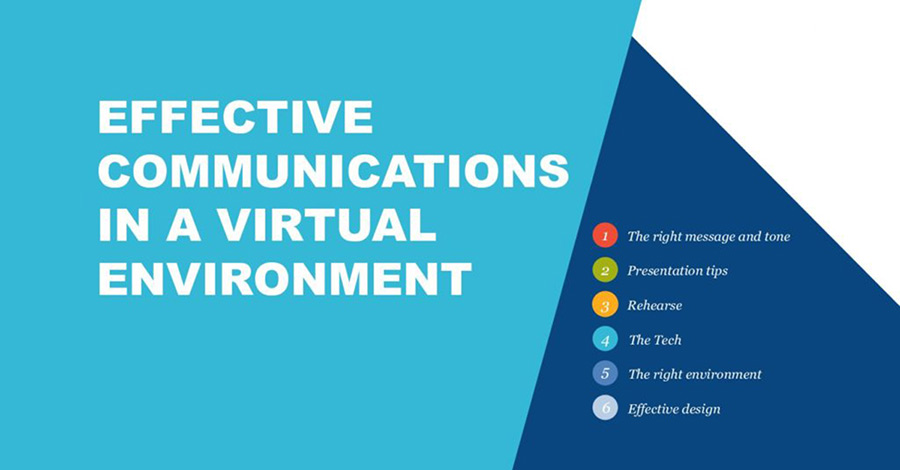
Please refer to our PDF for more practical advice to help deliver the most polished and engaging experience when it comes to presenting virtually, so that you can be sure your message gets through. The Effective Communications in a Virtual Environment document includes recommendations on presentation techniques in a virtual environment; how to rehearse to get the best out of the meeting; tips on using the tech to best advantage; making sure the presenter’s environment and back- and fore-ground are conducive to getting the message across; and making the associated content as compelling as possible.
See what else is happening
You might also like
Expertise
Black Hat 2026: A Conference and Industry Transformed
August 10, 2026
Expertise
When Food Safety Crises Test Trust: A Guide for Communicators
July 24, 2026
Expertise
We Went to Cannes Lions: Where the Industry Is Trending
July 1, 2026
Expertise
Healthcare’s Moment Has Arrived. The Question Now Is: Will Your Organization Move Fast Enough?
July 1, 2026
Expertise
The Visible CEO: How Leadership Can Serve as a Strategic Asset
July 1, 2026
Expertise
How to Win the GLP-1 Food Industry Wake-Up Call
June 30, 2026
Expertise
Cannes Lions Exposed an Industry’s Transition of Power: Takeaways From Winning Work
June 26, 2026
Expertise
Lessons From Cannes: Don’t Let Speed Fail Storytelling
June 25, 2026
Expertise
Get Bold Work Out Into the World: How to Seize the Chaos Advantage
Navigating COVID-19: A Test of Reputation and Reality
March 17, 2020
Share
2020 may be remembered as the year that the world changed irrevocably due to the COVID-19 pandemic. The year when working from home (WFH) became the norm rather than the exception. The year when holding virtual events became an expertise. The year when social distancing and social isolation became common terms. The year when medical experts became the best predictors of the market. And the year when leaders, both new and established, made their reputation – or severely tested it.
FleishmanHillard recognized early on that this situation requires not only the voice of reason and reassurance, but new thinking and new ways of doing things. We have created our own COVID-19 Taskforce, bringing together key practitioners from across our crisis management, employee communications, public affairs and reputation management practices, in addition to sector-specific expertise. We’ve been applying the lessons learned from APAC as the crisis has expanded globally.
The focus of the Taskforce is helping our counselors from around the world provide clients with insights, resources, perspectives, case studies and opportunities. Through it, we’re helping brands more easily anticipate and respond to quickly changing situations, ensuring they receive the best available counsel based on experience, the latest intelligence and best practices.
Recognising that these challenges – from social isolation to supply chain disruption to making major events virtual – vary by industry, we have created a resource that includes specialist advice by practice area and industry. We hope it helps organizations protect and build their reputation during this challenging period – in both the short- and long-term.
A full list of our insights and materials is available on our Navigating COVID-19: A Test of Reputation and Reality page on fleishmanhillard.com. Our focus for clients remains on supporting them through this situation and developing creative solutions to new challenges. Watch out for new articles and information as the situation evolves and if you have any feedback or questions, we would love to hear. You can contact us at [email protected].
As the COVID-19 pandemic sends shockwave after shockwave through the business world, leaders are scrambling to communicate how their organization is staying in front of the crisis to maintain the health and safety of employees and customers.
But that is only half of the job before us. When confidence is shaken by so many unknowns and our employees and the public are fixated on the rapidly escalating events, effective corporate leaders must provide more than policy guidance on how to maintain the health and safety of their employees and customers.
Plenty of research shows that CEOs have tremendous social influence (and in some cases are more trusted than government leaders), particularly when CEOs speak out on issues that impact their customers and employees. This matters more than ever right now as public health experts struggle to influence the behaviors of so many individuals to achieve the collective goal of mitigating the spread of the Coronavirus.
So what does exceptional CEO communication look like when thinking beyond policies and practices? Here are five things to keep in mind and some practical examples you can use with your own teams and executives.
1.Remember the human element: You have clearly communicated policies, sending numerous emails that answer a voluminous number of questions. Your work is not done. No one has ever changed someone’s behavior or rallied a team together simply by sending a memo. Even though it may be more complex to produce, a quick video or even short podcast can be more powerful and more calming than anything else you do.
A situation like also this brings out the very best and the very worst of us as human beings, making this an important moment to be mindful of diversity and inclusion. This virus is borderless and blind to race, sex and religion. CEOs need to ensure inclusive behaviors are modeled and help extend these behaviors into the wider community.
2.This is a whole life experience: While the pandemic threatens business continuity, quarterly profits and even a global recession, for your employees it is more personal. The effective leader gives employees space and time to be caregivers first. The pandemic is creating vulnerabilities in our entire social and family support systems. It is unsettling. It is distracting. And that was before we needed to provide extra support for grandparents and an elderly neighbor or to help a child navigate an untested e-learning regimen. The traditional cycle of work during the day and home responsibilities in the evening has been thrown out the window. Employees can’t even hear the bigger tasks you are asking of them if other concerns they see as more pressing aren’t being addressed. (What happens if I have IT problems at home? What if I need to take care of my family?) Effective executives acknowledge these stresses and realities in their communication. This is a time to build cultural resilience and draw on the collective strengths of the organization. A fighting spirit will be important given the likely duration and global impact of the virus.
3. Leading is a conversation: In a time when we are faced with more questions than answers, this must be a two-way exchange. You trust your employees to execute your business. Listening to them during a crisis is just smart management. Responding to concerns from employees shows you are listening and adapting to an ever-changing situation and likely provides some of the answers you are looking for. Executives should balance basic policy guidance sent by email or posted on company intranet sites with additional forums that allow employees to ask questions and get answers. It can be hard for a single person to take on a forum like a virtual town hall when they know they don’t have all the answers. Consider bringing together an executive team of three or four leaders in a panel. It projects an even greater sense of confidence and allows the leaders to share the burden of fielding questions. Be honest. Admit when you don’t know something. Talk about what you do know.
4. Think about the larger social impact: Last year hundreds of CEO members of the Business Roundtable said their business was about more than delivering value to shareholders. Now’s the time to see that promise in action. Business can’t afford to be bystanders. They need to work together with government and industry stakeholders to develop non-partisan solutions. This is a fine line companies will tentatively explore in the coming weeks as no one wants to seem opportunistic or exploitive. Employees and customers will remember how a company acts like a civic partner in a crisis, thinking beyond the walls of its own operations to how it can help solve the larger challenges we face today and more that will come in the weeks and months ahead.
A few companies are stepping up to help customers with the things that they need the most. Hopefully businesses will lean in to address the increasing isolation of the elderly or help families struggling to meet basic household needs. Companies may take up endeavors that ensure basic household supplies are getting to those who must stay home and help reduce panic buying that limits available supplies. Others might find innovative ways to support particularly vulnerable industries, such as arts, music and theater, while also helping get their uplifting message to groups and communities that are feeling isolated. There is much to be learned from many brands who have already show tremendous creativity in supporting communities in APAC.
5.Look to the horizon:We will get through this pandemic, but the fears of many are about what will happen next – to the global economy, to the health of their own company. Every good crisis response has a Now Team and a Next Team. The Next Team is a group of leaders who are not consumed with the day-to-day emergencies of running the business. They are thinking about what comes next and how to prepare the business to not only return to operations, but also prepare it for improved success. After 9/11 the world’s global airlines had teams thinking about what pilots would say to passengers on those first airplanes that took back to the air. They were thinking about how to manage the business and protect their employees and customers through what would be many months of difficult economic pressures. If you don’t have such a team running right now, you should. Possibly most important, you should communicate to employees some of the things those teams are thinking about and working on, even when you don’t yet have all the answers. Planning for recovery and rebuilding during the crisis signals a confidence that employees will appreciate.
It is never easy to communicate when we don’t have all the answers. Those who look beyond the immediate policies and practices will better ensure their organizations emerge ready to recover in the weeks and months ahead.
See what else is happening
You might also like
Expertise
Black Hat 2026: A Conference and Industry Transformed
August 10, 2026
Expertise
When Food Safety Crises Test Trust: A Guide for Communicators
July 24, 2026
Expertise
We Went to Cannes Lions: Where the Industry Is Trending
July 1, 2026
Expertise
Healthcare’s Moment Has Arrived. The Question Now Is: Will Your Organization Move Fast Enough?
July 1, 2026
Expertise
The Visible CEO: How Leadership Can Serve as a Strategic Asset
July 1, 2026
Expertise
How to Win the GLP-1 Food Industry Wake-Up Call
June 30, 2026
Expertise
Cannes Lions Exposed an Industry’s Transition of Power: Takeaways From Winning Work
June 26, 2026
Expertise
Lessons From Cannes: Don’t Let Speed Fail Storytelling
June 25, 2026
Expertise
Get Bold Work Out Into the World: How to Seize the Chaos Advantage
Navigating the Impact of Coronavirus on the 2020 Tech Industry Event Landscape
March 10, 2020
Share
The biggest global story of the moment is undoubtedly novel coronavirus (COVID-19) and as more cases are confirmed globally, concerns are increasing that efforts to contain the virus may not be enough to prevent a worldwide pandemic.
Against this background, we have seen the disruption of international travel and normal business operations around the world. The tech industry has been particularly affected and many companies with direct ties to China have already felt its effects. Both Mike Isaac at the New York Times and Natt Garun at The Verge do an excellent job of outlining some of the more immediate ways the tech sector is feeling the impact.
Many of the big tech companies are already encouraging workers to stay home with some speculating that the long-term effects could create a permanent shift in attitudes towards a distributed workforce and a work-from-home culture. Based on what we are seeing from our clients, including some of the biggest and most-global names in the sector, these arrangements are working pretty well so far.
The restrictions on travel and fears of contagion have perhaps had the biggest impact on the tech industry’s mammoth calendar of annual events and conferences. Many, such as GSMA Mobile World Congress in Barcelona and SXSW, to name just two, have already been canceled. Other events such as RSA’s 2020 Cybersecurity conference are going ahead (at least at the time of writing), but without the presence of many of the major brands and/or with significantly scaled-down numbers of participants. Others, such as Collision have made the decision to cancel the live event and make them online-only this year.
As communicators and strategic advisors, there is already an enormous responsibility to provide proactive and clear communication to help stakeholders understand how organizations are planning to deal with the coronavirus outbreak – whether or not they are currently impacted.
For most, this means now deciding how to move forward with internal, owned and industry events. Accurately calculating the risk, as well as the impact of canceling, is among their top priorities, especially if they are scheduled to happen in the first or second quarter of 2020.
Key factors in informing this decision making should include the following considerations:
Keep It Centered on the Stakeholders – it’s critical to understand the diverse, sometimes conflicting, needs and concerns of your key stakeholders.
Rely on the Experts – the World Health Organization, U.S. Centers for Disease Control and other local health authorities can be relied on for the most accurate and up-to-date guidance on how companies and individuals can prevent infections.
Align with Your Values – values are a critical element of decision making, particularly in a crisis or issue situation. Operate with purpose and demonstrate both empathy and accountability as a way to acknowledge the impact of your decisions on health and economic outcomes.
Recognize the Potential for Complications – Opponents, competitors or special interest groups may seek to take advantage of the situation to negatively impact your business or your reputation.
The tech industry is uniquely suited to respond to the current circumstances. With the prospect of a potentially event-less 2020, the industry that coined the term “digital transformation” has a real opportunity to put its money where its mouth is. In 2015, a tech industry leader said, “At least 40% of all businesses will die in the next 10 years… if they don’t figure out how to change their entire company to accommodate new technologies.”
Digital Transformation is literally defined as “the use of new, fast and frequently changing digital technology to solve problems” and COVID-19 appears poised to put this promise to the test. The industry that has given us HD video conferencing, virtual and augmented reality, artificial intelligence and machine learning, 5G networking and the Internet-of-Things is now poised to help us truly re-imagine the way we do business. We are about to see if and how technology can provide a rich, engaging and productive workplace or event experience, now that we momentarily operate without the ability to get on a plane to Las Vegas, Beijing or Barcelona to shake someone’s hand in person. Nothing will ever be able to take away from the rich experiences of human interaction – and nor do any of us want that – but in the interim, and as the world’s medical challenges continue apace, it is reassuring to know that technology is on our side to help keep business moving.
See what else is happening
You might also like
Expertise
Black Hat 2026: A Conference and Industry Transformed
August 10, 2026
Expertise
When Food Safety Crises Test Trust: A Guide for Communicators
July 24, 2026
Expertise
We Went to Cannes Lions: Where the Industry Is Trending
July 1, 2026
Expertise
Healthcare’s Moment Has Arrived. The Question Now Is: Will Your Organization Move Fast Enough?
July 1, 2026
Expertise
The Visible CEO: How Leadership Can Serve as a Strategic Asset
July 1, 2026
Expertise
How to Win the GLP-1 Food Industry Wake-Up Call
June 30, 2026
Expertise
Cannes Lions Exposed an Industry’s Transition of Power: Takeaways From Winning Work
June 26, 2026
Expertise
Lessons From Cannes: Don’t Let Speed Fail Storytelling
June 25, 2026
Expertise
Get Bold Work Out Into the World: How to Seize the Chaos Advantage