Employee Login

Enter your login information to access the intranet

Enter your credentials to access your email

Reset employee password

Article

The Patient Engagement Gap Your Competitors Are Closing

February 26, 2026
By Barry Sudbeck

Here’s a question more pharma executives are asking: Does patient engagement move the needle, or is it just good optics?

It’s a fair question.

In an era where pharmaceutical innovation must prove its value not only through clinical efficacy but also through demonstrated patient relevance, the question is no longer ‘whether’ to engage patients—it’s whether that engagement translates into an advantage.

New research from FleishmanHillard’s Global Health & Life Sciences group found it might. Released in recognition of Rare Disease Day, The Patient Engagement Premium: Defining the Strategic Value of Patient Input in Drug Development examines FDA submissions for rare disease therapies approved between 2018 and 2024 and finds directional associations between documented patient input and regulatory outcomes.

From Philosophy to Evidence

The shift from transactional patient engagement to embedded patient evidence isn’t new thinking though, but it is accelerating practice. And as regulatory scrutiny of traditional DTC channels intensifies and Health Technology Assessment bodies increasingly consult patient advocacy organizations, companies face a choice: embed patient evidence directly into development processes, or risk losing ground to those who do.

But let’s be honest, executive decision-makers demand more than anecdote. This research represents a crucial step toward establishing a measurable evidence base for patient engagement as a strategic investment, not just a values statement.

A Rigorous Approach to a Complex Question

The analysis examined 179 rare disease drug approvals that included Patient Experience Data (PED) tables, a requirement formalized following the 21st Century Cures Act. Each product was assigned a ‘Patient Engagement Score’ based on six distinct engagement activities, from patient advisory committee insights to patient-reported outcomes (PROs) and clinical outcome assessments (COAs).

Here’s what we found:

  • Patient input is increasingly embedded in regulatory submissions. Nearly nine in ten submissions in 2023-2024 explicitly cited at least one patient engagement activity, up markedly from earlier in the study period. PRO and COA data have become the most common form of patient input, signaling that companies may be integrating patient insights systematically and earlier in development.
  • Higher engagement scores trended with patient-centered labeling. Products with label claims tied to patient input averaged 1.4 documented engagement categories versus 1.0 for those without, a modest but directional association that could confer commercial advantage.
  • Company size isn’t a barrier. Mid-cap sponsors engaged in patient-centered activities nearly as frequently as large pharmaceutical companies. Translation? The potential benefits of patient engagement appear accessible across the competitive landscape.

What Happens to Companies That Don’t Move?

Let’s be clear: the evidence base is still developing, and these associations are directional rather than conclusive. But the implications are hard to ignore.

Patient engagement is evolving from ethical consideration to strategic necessity. Companies are prioritizing structured, quantifiable patient data, particularly PROs and COAs, for FDA submissions. Yet many underutilize other pathways, including patient organization partnerships and patient preference studies. That suggests that comprehensive investment in the full spectrum of patient evidence could be an untapped competitive edge.

For smaller companies not yet systematically integrating patient perspectives, the takeaway is encouraging, structured engagement may level the playing field. For larger companies that under-invest in patient input, the risk is equally clear, patient-centered rivals may be building advantages that compound over time.

Looking Ahead

As the evidence base expands and sponsors document patient engagement more comprehensively, clearer patterns will likely emerge. But the direction of travel is already obvious: regulators, payers, and patients themselves are reshaping how innovation is valued. Companies that embed patient engagement as foundational, not peripheral, will compound advantage across regulatory, payer and reputation landscapes. The infrastructure to do it exists. The question is in the execution.

Our approach combines regulatory expertise with data science and AI tools to help clients operationalize patient input across the product lifecycle, ensuring innovation is positioned as both evidence-driven and human-centered.

The pharmaceutical industry is at an inflection point. The companies that treat patient engagement as foundational—not peripheral—will define what comes next.

To access the full report or discuss how strategic patient engagement can create value for your organization, visit fleishmanhillard.com or contact Barry Sudbeck and Laura Musgrave, Patient Engagement Specialists with FleishmanHillard’s Global Health & Life Sciences group.
Click the image to download our Global Health & Life Sciences patient engagement analysis

Article

AI is Reshaping Communications: Inside FleishmanHillard’s Enterprise-Wide Approach

February 19, 2026

In his new Forbes piece, Bernard Marr explores the breakneck pace of AI transformation in the communications landscape with Ephraim Cohen, FleishmanHillard’s global head of data and digital. Cohen reveals that unlike past technological shifts that took decades to prepare for, today’s AI evolution is happening so rapidly that even full-time experts are struggling to keep pace.

Watch Their Full Conversation Here:

Three Key Takeaways:

1. Democratizing AI Across the Organization Rather than creating an elite “AI team,” Cohen outlines empowering every employee with hands-on access to frontier models and training. This bottom-up approach has yielded more powerful, bespoke solutions because they’re built by people who intimately understand client challenges, rather than strictly technical specialists.

2. The Power of Curated Knowledge Libraries Building digitized libraries of proven case studies and best practices that feed AI agents creates more relevant, accurate outputs than relying on open internet training data. For crisis simulations and campaign work, this approach delivers precision over generic AI-generated content.

3. Keeping Humans in the Driver’s Seat Cohen emphasizes that human creativity remains paramount. AI works best as a talented assistant—helping test, refine, and optimize human ideas, not replacing them. The result: less “AI slop,” more polished, high-impact work.

Article

A Rubber Stamp or Chaotic Exit? A Strategic Approach to USMCA Uncertainty

February 12, 2026
By Donna Fontana

With the approaching July 1, 2026, mandatory review of the USMCA trade deal, business leaders need to be on their front foot to keep stakeholders assured of their ability to operate, no matter the outcome. Negotiated during the first Trump administration in 2019, this administration has already stated it will not rubber-stamp the next iteration and is negotiating for concessions, while it also continues separate talks with Mexico and Canada for potential new bi-lateral agreements. Most recently, media reports that Trump is considering withdrawal as a nuclear option as well.

Yet the context for this negotiation has shifted beyond bilateral U.S.-Canada-Mexico dynamics. Mark Carney’s Davos speech signaling that alternative trade architectures are possible has empowered countries to consider diversification beyond U.S.-centric arrangements. For companies, this creates a more complex calculation: the outcome of USMCA renegotiation now intersects with broader geopolitical realignment that will affect market access and positioning beyond North America.

As we’ve seen over the past 12 months, trade and tariff negotiations come with a genuine, but unclear risk with a spectrum of possible outcomes:

  • The deal gets renewed with modest concessions (labor provisions tightened, critical minerals collaboration added, Rule of Origin adjusted).
  • On the other end: Trump follows through on exit threats, tariffs spike, supply chains scramble.
  • Or we end up in the somewhere in the middle with a period of extended ambiguity where the deal’s fate is unclear, decisions get delayed, and market uncertainty persists for months or longer.

Do you try to influence that outcome through strategic communications or stay silent and potentially face greater risk if the worst-case emerges?

Three Potential Reputation Risks

Risk 1: Being Seen as Unprepared if your company hasn’t communicated USMCA’s impact on your business to stakeholders with proactive plans for managing the potential risk to your supply chain.  The situation demands clarity. Can you articulate in 30 seconds why USMCA matters (or doesn’t matter) to your business?

Risk 2: Being Blindsided by Your Own Stakeholders Your trade association is mobilizing. Your competitors are taking positions. Your suppliers are making contingency plans. If you’re silent while everyone else acts, you’ll look reactive when you eventually have to respond.

This happens because urgency compounds. In February, speaking up is a thoughtful choice. In May, it looks defensive. In July, it looks panicked.

Risk 3: Having Your Position Misunderstood If you don’t clarify your view on USMCA early, people will infer one. That inference is often wrong. A company that’s genuinely exposed to Mexico tariffs but stays silent gets read as either indifferent or politically opposed to Trump. Neither is probably true, but silence creates a vacuum that gets filled by assumption.

Critical Context: Distinguishing Negotiating Theater from Genuine Threats

One overlooked dimension of USMCA risk is distinguishing genuine policy shifts from negotiating theater. Some observers say that President Trump’s documented pattern with major trade decisions is to escalate to the “cliff edge” through public threats, then either negotiate a compromise or implement partial measures. Understanding which scenario you’re in will determine your response intensity.

Companies that respond to every statement as existential crisis will exhaust stakeholders and damage credibility. Those that can distinguish signal from noise will preserve organizational energy for when real decisions are being made. Monitor not just the rhetoric, but whether it’s accompanied by institutional action that suggests implementation.

Next Steps for Communicators

1. Get a realistic view of your company’s exposure:

Stakeholder interest: How much do your investors care about this? How much do your employees in Mexico/Canada care about this? (Will they worry if you’re silent?) How much do your customers care about this? (Would tariff increases affect pricing you can offer them?) How much do policymakers care about your view? (Do you have any actual influence?)

Additionally, map your non-North American stakeholder exposure: How important are European or Asian markets to your business? Do you have significant operations or customers in markets signaling openness to alternative trade relationships (per Mark Carney’s Davos call for countries to resist U.S. economic coercion)? Could public positioning that strongly aligns with Trump’s approach to USMCA alienate stakeholders in other markets? This matters because the geopolitical context is shifting. Countries are actively building alternatives to U.S.-centric trade architecture.

Supply chain: What percentage of your inputs come from Mexico or Canada? Which of your products would be most affected by tariffs on those inputs? How much pricing power do you have to pass through tariff increases? What’s your realistic mitigation (inventory, alternative suppliers, nearshoring, product shifts)?

Tariff options: Do you actually need USMCA continuity, or could you adapt to tariffs? Are there specific terms (labor, environment, digital trade, Rule of Origin) that matter to you beyond just the deal existing? Would your business be better served by bilateral deals with Mexico/Canada rather than tri-lateral? Do you have competitive exposure? (Would tariffs on inputs hurt you more or less than competitors?)

If the answer to most of these is “not much,” maybe your communications strategy is to stay informed but quiet. If the answer is “a lot,” you have to engage more visibly.

2. Prepare a messaging framework and response plan that allows you to be strategically engaged without being operationally alarmist. While you should be honest about uncertainty, emphasize continuity in messaging. Connect to broader business interest—jobs, innovation, community—not just tariffs. Importantly, frame your USMCA position as aligned with business growth and market access broadly, not as opposition to or appeasement of any particular administration or policy approach. This positioning gives you flexibility as political winds shift (e.g., if Congress exerts pressure to preserve USMCA, or if alternative trade relationships emerge) while maintaining credibility with diverse stakeholders. Avoid language that boxes you into a corner if the geopolitical or political context changes.

In addition, check in with your trade association(s). You may have the option to publicly align with their position and provide quiet support.

As you develop a response plan with messaging aligned with each potential outcome, be inclusive of direct communications to key stakeholders including briefings to analysts/investors, employees, suppliers and customer briefings if you have a very high exposure.

3. Monitoring seems obvious, but things change fast these days. Watch the news and trade publications, but also USTR announcements and congressional activity. Keep an eye on the signposts that indicate whether outcomes are moving toward your scenario or away from it: is the administration signaling progress, are either Mexico and/or Canada making public concessions (even symbolic ones) on key terms, is public pressure coming from business leaders, does Trump publicly or repeatedly threaten withdrawal or shifts statements to bi-lateral rather than tri-lateral? All of these require adjustment to your communication plans.

USMCA is genuinely in flux. How much flux is the guess. As most communicators understand, you plan for the most possible flux, and hope for the least. Understand your exposure. Clarify your interests. Communicate your position clearly. Monitor signposts that tell you whether things are moving toward deal renewal, extended ambiguity, or collapse.

Reputations can be cemented in challenging times. Companies that understand both the genuine risks and the political constraints, that map their exposure accurately, that clarify their position early, and that avoid alienating stakeholders in markets beyond North America will emerge from this stronger. Those that simply react, or that optimize for one narrow audience at the expense of others, will find themselves disadvantaged regardless of which USMCA outcome materializes. Preparation and positioning are not just defensive; they’re competitive differentiators in a shifting landscape.

Donna Fontana width= With 35 years of experience in the B2B and industrial sectors, Donna Fontana is the global lead for the firm’s manufacturing and energy practice and serves as the general manager of FleishmanHillard’s Detroit office.

 
Click above to download our Leadership Playbook ‘License To Lead’
Article

From the Super Bowl to the World Stage: What Health’s Cultural Moment Means Now

February 11, 2026
By Jacob Porpossian

Super Bowl LX offered more than a strong showing for health and pharma brands. It signaled something more durable: health is no longer a category that waits for cultural permission. It’s actively shaping culture on the world’s biggest stages. That shift matters.

Roughly seven major health and pharma campaigns aired during the big game. But what stood out wasn’t volume. It was confidence. These brands claimed space alongside beer, cars, and tech.

More importantly, this moment shouldn’t be viewed in isolation. As we look ahead to the Olympics and the World Cup, we’re entering an extraordinary run of global tentpole moments where health, science, performance, access, and equity will increasingly intersect with culture at scale. Super Bowl LX was an early proof point.

What the strongest work got right

Across categories and geographies, the most effective campaigns shared three defining moves.

1. Stigma reduction through entertainment
Novartis used NFL tight ends to make prostate screening feel approachable, even funny, rather than fearful. Boehringer Ingelheim reframed early-detection testing as a “mission,” turning anxiety into agency. Humor and storytelling didn’t trivialize health; they unlocked attention, relatability, and permission.

2. Normalizing everyday health decisions
GLP-1 related ads put the focus on being human and positioned their treatment options as support and empowerment for patients, not intervention. These brands met people where they are. Not where the healthcare system wishes they were.

3. Cultural clarity
Simple metaphors. Human voices. Ideas that survived the post-game social conversation and shaped Monday-morning dialogue. The work that traveled didn’t over-explain science; it translated it.

The bigger signal

Industry and media reaction underscored a structural shift playing out globally: health is no longer purely clinical. It’s lifestyle-adjacent, values-driven, and culturally expressive. The brands that resonated weren’t just marketing products. They functioned as cultural facilitators, translating science into relevance, credibility, and permission. For trust-based, highly regulated categories, this is the difference between building confidence and eroding it.

Why this matters now

As health brands look ahead to the world’s next major cultural moments, the opportunity (and responsibility) is clear.

Cultural strategy and creative as core health capabilities
Brands need to enter culture without trivializing health, balancing regulatory rigor with entertainment and emotion. This requires earned-first thinking that travels across markets and moments.

Integrated moment marketing
Impact now lives across broadcast, social, earned media, influencers, and executive voice working together. The most effective programs build always-on platforms that culminate in tentpole moments, rather than relying on one-off activations.

Prevention and behavior-change storytelling
As healthcare moves upstream toward screening, early detection, and access, brands must reduce fear and inertia. That demands new creative frameworks that motivate action without alarm.

Corporate narrative alignment
Many of these campaigns carried implicit corporate messages around innovation, access, and equity. As scrutiny around healthcare ethics and pricing intensifies, alignment between brand, corporate, and leadership narratives becomes essential; not optional.

Looking ahead

Health is moving faster than many organizations are prepared to follow. The brands that succeed will be those that show up credibly, responsibly, and creatively. Not just during one event, but consistently across the world’s biggest cultural stages.

With the next Super Bowl less than a year away and the Olympics and World Cup on the horizon the window to plan thoughtfully is already open.

Jacob Popossian width= Jacob Porpossian is the Global Executive Creative Director for FleishmanHillard’s Health & Life Sciences practice, where he builds and leads creative and storytelling capabilities for major health brands. With a background spanning creative strategy, digital marketing, communications, and production, he advises integrated teams across healthcare, CPG, corporate, and technology sectors, while also championing diversity and inclusion initiatives across the agency and industry.

 
Article

From Buzzword to Backbone: What ALM 2026 Signals for AI and Advertising

By Matthew Caldecutt

Each year, the Interactive Advertising Bureau (IAB) Annual Leadership Meeting (ALM) offers a snapshot of where digital advertising stands and where it is headed. In 2026, that picture sharpened quickly. AI is no longer an emerging trend. It has become the industry’s operational substrate, shaping how decisions are made, campaigns are executed, and value is measured.

At ALM 2026, AI was not treated as a standalone topic or future experiment. Under the banner “It Starts Here,” it emerged as connective tissue across conversations on measurement, identity, commerce, and privacy. Rather than signaling a mandate for any single stakeholder, discussions reflected a shared reorientation toward common operating principles. The question shifted from whether AI will shape advertising to how decisively organizations are prepared to rebuild their foundations.

In prior years, AI discussions often focused on pilots or novel demonstrations. This year marked a clear shift toward what many described as industrial plumbing. AI is increasingly central to planning, activation, and optimization in 2026. According to the IAB’s 2026 Outlook Study, digital ad spend is projected to grow 9.5%, with growth shaped in part by AI-enabled targeting and automation. It now powers how media is bought, optimized, and valued.

Across sessions, a consistent theme emerged. Organizations that delay embedding AI into foundational workflows risk falling out of step with a market rapidly reorganizing around automation and intelligence. AI is not simply accelerating existing processes. It is redefining how planning decisions are made and how performance is evaluated in real time.

The emphasis on measurement made this shift especially clear. With the launch of Project Eidos, the IAB elevated a challenge the industry has grappled with for years: the erosion of trust in an opaque, AI-driven environment.

As signal loss continues to erode traditional tracking, the risk is not just fragmentation, but reduced transparency across platforms. The IAB’s 2026 State of Data report highlights a sobering reality: most buy-side respondents believe current AI-powered measurement falls short on rigor and trust. When platforms define metrics in isolation, brands are left comparing results that are difficult to audit or reconcile.

Discussions at ALM reflected broad alignment that this is not a failure of intent, but a structural challenge. Shared definitions, interoperability, and consistent frameworks are required to restore confidence. Project Eidos represents a coordinated effort to move beyond today’s patchwork of channel-based metrics toward an interoperable approach built on shared constructs, framed as a multi-year foundation effort to ensure AI delivers confidence alongside automation.

Commerce and retail media were positioned as the most immediate proving grounds for AI, combining rich first-party data with clearer paths to closed-loop measurement. However, the conversation was not solely about efficiency. Two friction points emerged.

The first was publisher sustainability. IAB President David Cohen introduced the AI Accountability for Publishers Act to address concerns surrounding large-scale AI data use and publisher compensation. Discussions reflected ongoing debate across the ecosystem about how value is created and shared in an AI-driven market. The focus was on exploring guardrails that balance innovation with the long-term viability of journalism and creator ecosystems.

The second was the AI ad gap. While 82% of ad executives believe Gen Z and Millennial consumers feel positive about AI-generated ads, only 45% of those consumers report feeling the same, according to recent IAB and Sonata Insights research. This gap highlights a disconnect between advertiser assumptions and audience sentiment. The findings suggest that clearer, more consistent disclosure of AI use, supported by the AI Transparency and Disclosure Framework, can help rebuild trust and improve resonance without undermining long-term brand equity.

A more understated challenge was the human element. While technical foundations are being put in place, many organizations are still building the expertise required to manage increasingly complex, agentic systems. The shift toward AI as infrastructure is driving demand for deeper AI fluency across strategy, creative, measurement, and governance.

Taken together, the conversations at ALM 2026 suggest that AI’s role in advertising has fundamentally shifted. The question is no longer how quickly the industry can adopt new capabilities, but how deliberately it can operationalize them. Measurement standards, disclosure frameworks, publisher protections, and talent development are no longer secondary considerations. They are the scaffolding required to make AI durable at scale. The shift from buzzword to backbone is already underway. What comes next will depend on whether the industry treats AI as a shortcut or as shared infrastructure that must be governed and trusted over time.

Matt Caldecutt is a Senior Vice President in the Technology Practice at FleishmanHillard, with extensive experience in advertising technology and digital media. He advises companies across the ad tech ecosystem on media relations, emerging trends, and industry issues, helping translate complex developments into clear, strategic communications.

Article

How B2B Brands Win Buyer Attention and Trust Today

By Bob Beasley

If you feel like you’re being asked to do more with fewer resources, you’re not alone. In sectors ranging from manufacturing and energy to technology and pharma, communications teams are expected to build trust, win business and safeguard reputation, all while juggling tight budgets and a growing list of channels and stakeholders. This is the new normal.

But complexity brings opportunity. The brands that succeed are those that adapt fastest to changes in buyer behavior, technology and trust by getting specific about what works, measuring what matters and using the right resources in the right places.

Your Buyers Have Changed, So Must Your Communications

One of the biggest shifts in recent years is demographic. The data back up what many communicators are seeing: 70% of B2B buying committees now include Millennials and Gen Z (Forrester). These buyers expect digital experiences, transparency and credible proof, not just polished sales messages. And research shows that more than 80% of B2B buyers have made their decision before ever talking to sales (6sense). That means your digital reputation is often your first — and sometimes only — chance to make the shortlist.

Research Looks Like Consumer Shopping Across Many Channels

Today’s B2B buyers do deep research before they ever fill out a form or book a demo, relying on reviews, forums and specialist sites when evaluating vendors. They’re also turning to LinkedIn, YouTube, podcasts and even TikTok for demos, peer perspectives and behind-the-scenes content.

In practice, this means you, as a B2B communicator, should focus on building a credible presence on platforms like LinkedIn and YouTube, sharing technical case studies, how-to videos and thought leadership. You might also experiment with TikTok or podcasts to reach new audiences, especially around workforce branding and recruitment. The key is to prioritize the channels where your buyers actually spend time, not to try to be everywhere at once.

Algorithms Are Now Gatekeepers

AI-powered search and recommendation engines increasingly determine what information buyers see and what gets buried. More than half of B2B buyers say AI-driven search is now their most influential source for vendor discovery (LinkedIn).

And with most buyers nearly through their decision process before talking to a salesperson, your digital reputation may be your only chance to make the shortlist.

As AI-powered search tools become the norm, from Google’s generative results to LinkedIn’s AI-powered recommendations, “generative engine optimization” (GEO) is about making sure your brand’s story, expertise and proof points are surfaced by these systems.

How do you do this?

  • Publish technical articles, how-to guides and answers to common customer questions on your site and LinkedIn.
  • Use schema markup — basically having your web development team “label” your content — so search engines understand and trust the information (Google Search Central – SEO Starter Guide).
  • Encourage your engineers, product managers and technical leaders to share insights on platforms like LinkedIn or industry forums. AI engines reward credible, multi-source expertise.
  • Contribute to trusted third-party sites (like industry magazines or review platforms) that AI engines already see as authoritative.

What This Might Look Like for Your Company
As a B2B communicator, you might identify the top technical questions customers are searching for, then work with your technical teams to develop clear, searchable answers in blog posts, LinkedIn articles and videos. Over time, this approach can help your content appear more prominently in AI-driven search results and featured snippets, potentially leading to more qualified inbound leads and requests for product demos. (Best practice reference: Google Search Central – SEO Starter Guide, LinkedIn B2B Marketing Blog)

Regardless of sector or focus, one fact is consistent: you must adjust your approach to be successful in today’s complex market.  Your buyers demand it, and your brand must rise to the challenge.

Start today by auditing which channels your buyers actually use (not the ones you think they should use). Then, commit to building a credible, consistent presence in those places. That’s how you’ll win their attention and earn their trust.

Bob Beasley width= Bob Beasley is a senior vice president with FleishmanHillard’s B2B & Manufacturing practice. A former newspaper reporter, Bob has worked for more than 30 years helping people, communities and organizations tell stories with impact. Since joining FleishmanHillard in February 2007, Bob has provided communications counsel to some of the most respected companies in the world.


 
Article

How Legitimacy Risk Is Changing Modern Communications

February 10, 2026
By Matt Rose

For decades, corporate risk followed a familiar playbook. If a company focused on its core business, complied with the law, treated employees fairly, managed crises competently, and protected its reputation, it earned the right to operate. Risk was something to mitigate. Reputation was something to manage. Legitimacy was largely assumed.  

It’s time to stop assuming that.  

A Quieter, More Unsettling Question

Some of the most serious risks companies face today have nothing to do with misconduct, operational failure, or scandal. Instead, they stem from a single, uncomfortable question – one increasingly asked by policymakers, journalists, and the public alike:  

Should this company be allowed to operate this way at all?  

That question sits at the center of what has been called the Legitimacy Gap: the chasm between what companies are legally permitted to do and what society is still willing to tolerate. It is not a new theory and has been discussed among academics since the 1970s. Today, however, legitimacy is becoming one of the most consequential forms of corporate risk – and one of the least well understood.  

Reputation Is Not Permission

Many companies still assume that a strong reputation guarantees legitimacy. If customers trust you, regulators engage constructively, and investors reward performance the social contract feels intact.  

Recent experience suggests otherwise.  

Take the pharmaceutical industry. Large pharma companies are widely respected. They are innovative. Scientifically credible. Their products save lives. Their R&D pipelines are admired. Leadership teams are treated as serious and competent.  

And yet they find themselves in a legitimacy crisis.  

The issue is not that these companies are breaking the law or operating unethically. The issue is simpler – and harder. A growing share of the public and the political class questions whether any private company should have unilateral authority to set prices for medicines people cannot reasonably refuse.    

Complicating matters further, the scientific authority that once helped offset these concerns no longer carries the same weight it did. Confidence in pharmaceutical innovation remains high among experts, but public trust in science itself has become more fragile and contested. As that trust erodes, appeals to data, trials, and regulatory rigor are less effective at resolving what is increasingly a legitimacy question rather than a technical one.  

That is not a reputational critique. It is a permission question.  

A similar conversation is unfolding around artificial intelligence. Many innovative AI companies are respected for their technical sophistication and for engaging regulators in good faith. But the core concern is not whether these companies are reckless. It is whether private actors should hold so much influence over information, labor, creativity, and large-scale decision-making.  

In both cases, the tension is the same. It is not about bad behavior. It is about concentrated power.  

When private companies control the systems people depend on – whether it is access to medicine or algorithmic decision-making – the debate fundamentally shifts. Questions of efficiency give way to questions of fairness and control, and concerns that the public’s wellbeing is at risk because of what companies do and how they do it, and that wellbeing may not be recovered. And once that shift happens on a large scale, even strong factual defenses begin to feel beside the point.  

How Legitimacy Slips Away  

Legitimacy risk rarely arrives with a bang. It does not begin with protests or front-page scandals. It starts quietly and in places most companies do not watch closely enough.  

First, policy experts and academics raise questions. The language is procedural. Abstract. Easy to dismiss. The experts may be considered fringe or unorthodox, and therefore ignorable.  

Then the framing flips. Critics are no longer treated as outliers; they become credible counterweights in an environment that feels unbalanced in favor of big commercial interests. Coverage shifts from “How does this work?” to “Who benefits from it?”  

Next, the issue becomes moral rather than mechanical. Subjective evaluations of fairness replace objective, carefully measured, and previously acceptable trade-offs. Motive matters more than mechanics. Silence starts to look evasive. Defense begins to sound self-interested.  

From this point, intervention feels inevitable. What is often missed is that legitimacy rarely collapses through formal intervention alone. As permission weakens, organizations lose the latitude to move quickly or adapt. Necessary decisions become slower, more contested, and harder to implement long before any rule formally changes. 

The debate is no longer whether change is needed, but how aggressive it should be. Most companies do not realize what is happening until this stage – by which point the legitimacy of the existing model has already eroded.  Urgent corporate defense compounds the negative responses that have been built over time.   

Why This Catches Companies Off Guard

Legitimacy risk doesn’t show up neatly in dashboards. It doesn’t trigger media-monitoring alerts.

Media teams tend to prioritize volume and sentiment, while legitimacy challenges often emerge among low-volume, but high-credibility voices long before anything trends.

Risk teams focus on compliance and consensus, even though legitimacy questions typically arise just outside that consensus – from skeptics credible enough to matter, but uncomfortable enough to disrupt.

Communications functions are built to respond, not to sense.

Legitimacy risk lives in the gray zone before materiality becomes obvious. That’s why escalation feels sudden. It isn’t. It simply unfolds somewhere companies aren’t looking.

A key signal companies often miss in this early phase is their own workforce. Employees frequently experience legitimacy tension firsthand, particularly during periods of technological disruption, automation, or organizational change. They see how decisions are made, who bears the cost, and where stated values collide with lived reality. When employees begin to question fairness, transparency, or purpose, they are often articulating legitimacy risk before it becomes visible externally.

In that sense, employee skepticism is less a cultural issue than an early-warning indicator of how broader audiences may eventually respond.

Legitimacy risk concentrates where systems become essential, and power becomes unavoidable. The more society depends on what you provide, and the less fair your control over it is perceived to be, the greater the exposure.

Healthcare. Finance. Infrastructure. Energy. Platforms. AI. Education. Housing. Transportation. Food. In these sectors, success doesn’t insulate companies. It magnifies scrutiny.

Click above to download our Leadership Playbook ‘License To Lead’

What Smarter Companies Do Differently 

Companies that navigate legitimacy risk well do not try to message their way out of it. They treat communications as early-warning intelligence, not just amplification. They pay close attention to who is shaping emerging narratives, not only to what is being said. They stress-test uncomfortable critiques internally before journalists, policymakers, or activists do it for them. 

Most importantly, they stop collapsing three very different questions into one. 

Is this legal? 
Is this defensible on the facts? 
Is this still socially acceptable? 

Legitimacy risk lives in the gap between those answers. And it is magnified by another question: Can an average person understand what we do and how? Because the more complex, arcane, and secretive a company’s work is seen to be, the more legitimacy risk attaches to it. 

The Gap Is Widening 

The legitimacy gap is widening. Markets move faster than norms. Technology outruns regulations. Public patience is thinner than most companies realize. In this environment, permission to operate is no longer implicit. It must be continuously earned – and it can be quietly withdrawn long before any law changes. 

Companies that focus solely on compliance and reputation will find themselves defending systems that no longer have public consent. Those that recognize legitimacy as a core strategic risk can shape the terms of debate while they still have room to maneuver. 

The real danger is not regulation. It is discovering, too late, that society has already decided the rules should change. 

Matt Rose width= Matt Rose is the Americas Lead for Crisis, Issues & Risk Management. An SVP & Senior Partner in New York, he brings more than 30 years’ experience in advising organizations on crisis and issues management, risk mitigation, and reputation recovery. He has guided companies through reputational crises, labor issues, regulatory challenges, ESG controversies, and high-profile litigation.

 
Article

FleishmanHillard Integrates Porter Novelli to Form a Stronger, More Specialized Global Communications Consultancy

February 9, 2026

The combination brings deeper sector expertise, faster access to solutions and greater scale to meet growing client complexity.

As part of the realignment of Omnicom Public Relations, Porter Novelli is integrating as a dedicated brand into FleishmanHillard, uniting two industry-leading communications consultancies to better serve clients navigating complex business and reputational challenges.

The integration reflects a strategic priority to deliver deeper sector expertise, faster solutions globally and more precise counsel for mission-critical work. FleishmanHillard now operates with expanded talent and specialization across key growth sectors.

A Stronger Platform for Clients

Together, FleishmanHillard and Porter Novelli form one of the industry’s most comprehensive communications consultancies with pronounced strength across:

  • Health and life sciences
  • Technology
  • Financial and professional services
  • Social impact and ESG
  • Public sector and public affairs

The integrated organization will operate at greater scale in markets where clients are centered, enabling faster collaboration, broader access to specialized expertise and more consistent delivery of solutions across regions. This concentration of talent strengthens FleishmanHillard’s ability to advise at the intersection of reputation, policy, growth and transformation.

A portion of Porter Novelli’s current client portfolio — including U.S. public sector relationships and select other clients — will continue to be served under the Porter Novelli brand, which will operate as a dedicated brand within FleishmanHillard.

The combined organization will be led by an integrated executive leadership team, effective immediately:

  • J.J. Carter, Global President and Chief Executive Officer
  • Patti Portnoy, Chief Financial Officer
  • Lisa Moehlenkamp, Chief Operating Officer
  • Jillian Janaczek, Chief Executive Officer, Americas
  • Della Sweetman, Chief Strategy and Innovation Officer
  • Mitch Germann, Chief Growth Officer
  • Emily Frager, Chief Client Officer
  • Sakima Johnson, Chief Integration Officer

This leadership team will work closely with regional leaders across the Americas, EMEA and APAC to ensure continuity for clients while advancing the firm’s strategic priorities.

Looking Ahead

The integration reinforces FleishmanHillard’s position as a trusted partner for organizations facing global complexity, from regulatory and geopolitical risk to transformation, innovation and growth. By combining talent, expertise and scale, the firm is positioned to deliver more specialized and impactful communications for clients worldwide.

Article

The Modern Comms Playbook in Motion: Super Bowl Media Week, Hour by Hour

February 6, 2026

As players and coaches cram on the gameplan for Super Bowl LX, it also takes a village to manage global media attention and protect a complex brand moment. PRWeek’s latest “Notes from the Field” takes readers inside the daily rhythm of Super Bowl Media Week alongside Chief Business Development and Brand Officer Mitch Germann, who is also serving as head of communications for the Bay Area Host Committee.

From coordinating national media interviews and shaping real-time intelligence to aligning messaging across stakeholders and navigating red carpets and community events, each day of Super Bowl Media Week is a case study on how disciplined, strategic communications operates when scrutiny never lets up. Now, you get the hour-by-hour look at what it takes to execute with precision on the biggest sports stage in America.

Want more insights about the high stakes in sports collaborations? Watch FleishmanHillard CEO discuss the power of partnerships in sports below in his interview with Campaign.

Article

 Ticket To Biotech: The Real Value Is in the Conversations 

By Samantha Donaghey

Last month the biotech and pharma universe descended on San Francisco for the 44th Annual J.P. Morgan Healthcare Conference. Thousands of industry leaders, investors and media gathered for a week filled with investor meetings, insightful presentations and opportunities to gauge the current state of the industry. 

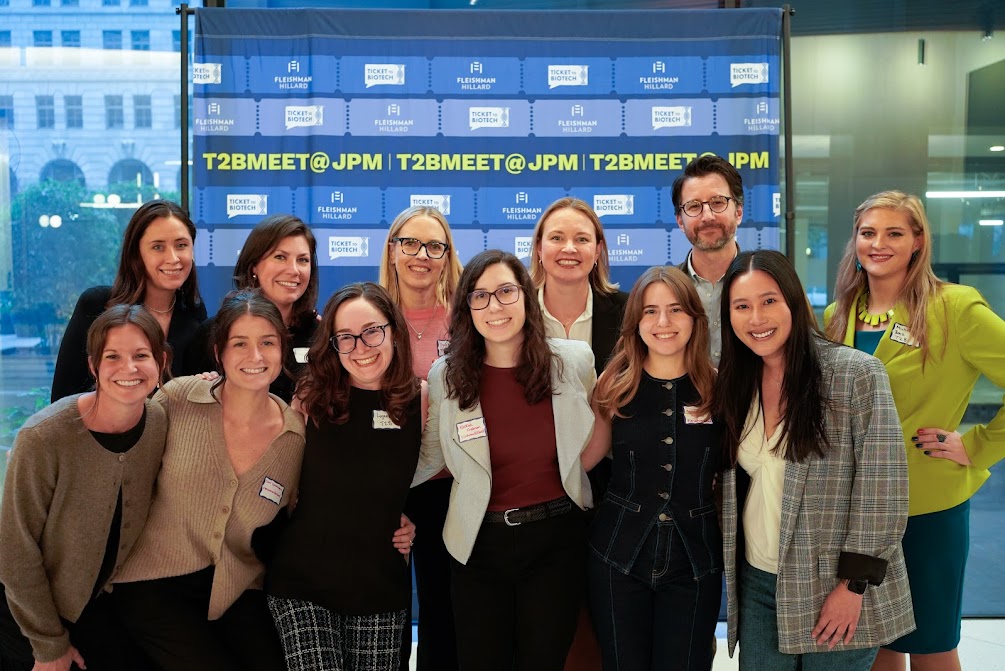
For communications professionals, the week is always bustling with activity. This year, we kicked off with nearly 200 healthcare communication experts joining our networking event, co-hosted with Ticket To Biotech. Attendees stole away from packed schedules to enjoy an evening of reconnecting with old friends and making meaningful, new connections.  

A shared appetite for connection and insight.  

At our event, attendees weren’t interested in quick pitches—they were looking for deeper engagement. They wanted to explore the future of healthcare, identify emerging trends, and learn how peers are navigating the ever-changing industry.  

The growing appetite for collaborative spaces among healthcare and biotech communicators was evident by the sheer number of event attendees — Ticket to Biotech’s largest networking event so far. 

What struck us most was the collective spirit of curiosity. Attendees were enthusiastic to hear from peers facing similar headwinds, inviting diverse perspectives on managing the shifting regulatory landscape, bridging talent gaps and adjusting to the relentless pace of innovation and change.  

Healthcare is in a moment of unprecedented change, and communications practitioners know it. 

At this year’s meeting, communications professionals showed they are far more than observers—they are actively shaping the industry through conversation, collaboration and connection. Organizations like Ticket to Biotech aren’t just connecting people. They’re shaping the industry by cultivating a community committed to driving progress.