Employee Login

Enter your login information to access the intranet

Enter your credentials to access your email

Reset employee password

Article

The AI Readiness Gap Series: How to Build a Culture of Experimentation 
June 22, 2026
By Zack Kavanaugh

This is the third installment in a series on what it takes to close the gap between AI investment and tangible business impact.

In the first two pieces, I argued that AI adoption is fundamentally a people challenge – not a technology one. And I walked through why normalization – that initial work of building psychological safety and making AI feel less like a mandate from above – is where adoption begins.

But normalization is foundational, not sufficient for scaling and sustaining a transformation.

Listening builds trust, transparency creates permission and leaders modeling curiosity make space for people to be curious too.

Yet at a certain point, readiness must turn into action, and trust must move into experimentation – and that’s where things often stall for organizations.

What experimentation entails

Experimentation is not a single workshop or training session where people learn AI in theory and hope to apply it later.

Experimentation is the deliberate work of creating low-stakes opportunities for people to try AI with daily tasks, see what happens, share what they learn and let those discoveries shape how their team and the broader organization evolves.

Why experimentation stalls

Many organizations are making the mistake of treating experimentation like compliance.

They may schedule training, mandate it or expect it to happen in a structured, predictable way. Then they’re surprised when adoption remains stuck at the edges – concentrated among early adopters while the rest of the organization watches, wondering why this whole “AI thing” isn’t for them.

What tends to move people from curiosity to confidence is relevance. When people see how AI fits into their work, adoption stops feeling like a mandate being forced upon them and starts feeling like a tool they’re better off with than without.

Who influences experimentation

Experimentation doesn’t happen without active support – and managers’ involvement is often what determines whether it takes root or trails off.

  • Microsoft’s 2026 Work Trend Index found that when managers visibly use AI themselves – not just endorse it – employees report a 17-point lift in AI value, a 22-point lift in critical thinking and a 30-point lift in trust in AI tools.  

Manager visibility and support are the prerequisites for experimentation to become embedded in how work gets done.

And beyond that non-negotiable support, companies can deploy three strategies to accelerate experimentation:

1. Design low-stakes opportunities to try, not mandatory programs.

The difference between training and experimentation is permission to fail.

Experiments are designed to surface discovery. The expectation is learning – which includes failure. The point is to uncover insights that shape what comes next, not to prove mastery.

This changes how people engage. Instead of one-size-fits-all training, create role-specific challenges.

These don’t need to follow a single format.

  • Some organizations run week-long sprints where teams tackle a specific workflow problem with AI.  
  • Others build 15-minute “AI challenges” into team meetings – quick, low-pressure moments where teams tackle something together and debrief in real time.  
  • At FleishmanHillard, we’ve deployed “try this” email campaigns that highlight role-specific tips and best practices – paired with reinforcement in team meetings – and structured, cross-functional hackathons and competitions where groups solve real workflow problems with AI.  

Format matters, but less than the regularity with which you encourage and provide opportunities for your people to try something with their work, see what happens and reflect on it – moments where stakes stay low, the learning gets documented and momentum builds as people see peers discovering things that work.

2. Spread learning through peer voices and stories, not polished case studies.

Your AI wins will get turned into case studies – charts, metrics and messaging locked in to prove ROI. While these matter for leadership dashboards, they often read less like something a peer figured out and more like something the company or an expert achieved.

Peer stories work differently. They come from someone familiar and in a similar position. They’re messier, they show what someone was really thinking when they tried something and they make room for context – “Here’s where I am, here’s what I tried, here’s what happened and here’s what I’d do differently.”

That messiness is what makes them powerful. It signals that perfection isn’t the bar – and if someone who thinks like you and works like you figured something out – suddenly that same experiment feels possible for you too.

Those stories create permission in ways polished case studies never do – which is why leaders should find ways to share these.

This could take several forms.

  • Create internal campaigns where teams share what they tried that week and what they learned – misfires included – via Slack threads or Teams channels.  
  • Host show-and-tell sessions where someone walks through how they solved a problem, where they got stuck, what went wrong – and invites the room to help troubleshoot next steps.  
  • Or establish dedicated architect and ambassador roles – like we’ve done at FleishmanHillard – where builders and super users experiment alongside their teams, share what’s working and what isn’t, and create permission for others to do the same. 

And with peer stories, tone is everything. “I tried this and it didn’t work, but here’s what I learned” is infinitely more relatable than, “Here’s how our company is transforming productivity and driving efficiency.” One invites personal experimentation – and the other signals compliance.

3. Build informal peer-to-peer momentum instead of formal training.

Training is periodic and linear. Peer-to-peer learning is fluid, constant and evolves as your organization does.

Both are valuable, and you should deploy each as needed, but peer-to-peer learning builds adaptive capacity – the kind that compounds and grows alongside your culture.

When you create simple mechanisms for ongoing peer-to-peer learning – “What I learned this week” rituals in team meetings, Teams threads where people drop quick tips, debrief huddles where someone walks through how they applied AI to a real use case, side conversations where a peer shares a shortcut – learning stops being something that happens to people and starts being something they do together.

At FleishmanHillard, we’ve made this easier by building off-the-shelf training resources and templates that any role can use or adapt for their teams – simple scaffolding that removes friction and makes peer sharing more accessible.

We’ve witnessed firsthand that those moments compound, and they reshape how your organization thinks about discovery and experimentation.

They also serve as a continuous feedback loop. You may learn more about what people care about, what confuses them and what would help them in a few weeks of informal conversations than from your annual survey.

On top of all that, assuming you’re following through on what you hear, your people will feel like their voices shaped what comes next – because they did.

How you know experimentation is becoming part of your culture

Experimentation is a continuous, messy, non-linear process – not a single moment. Here are three signals you’re heading in the right direction:

  • AI is being applied to everyday work. Analytics and team check-ins show employees testing AI with real tasks.  
  • Learnings are being shared. Examples, wins and failures surface in meetings and peer showcases. The conversation has shifted from, “how do I use this?” to, “here’s what I tried and here’s what I learned.”  
  • Confidence is building. The tone in surveys shifts from, “I’m not sure where to start” to, “I’m figuring out where this could help.” People are getting more and more curious and taking small, concentrated risks because they feel safe doing so. 

Building the cultural conditions for experimentation

Right now, organizational culture is roughly twice as powerful as individual mindset in determining whether AI delivers value.

The organizations accelerating adoption are the ones making room for people to learn and figure out what this technology means for their work – where people feel safe trying them, failure is a learning opportunity, peer discoveries shape strategy and use becomes personal enough to stick.

So, the question for leaders right now is less about the technology itself and more about whether you’ve created the conditions for everyone to use it. And if you haven’t normalized this shift and built experimentation into how your organization operates, the answer will always be no – no matter how good the tools are.
Article

The AI Readiness Gap Series: Why Normalization Is the Most Skipped, and Most Essential, Phase of AI Adoption

April 30, 2026
By Zack Kavanaugh

This is the second installment in a series on what it takes to close the gap between AI investment and tangible business impact.

In the first piece, I argued that the real barrier to AI adoption is not the technology itself. It is the human side of change. You can have the tools, investment and strategic urgency — and still fall short if your people are not ready to come with you.

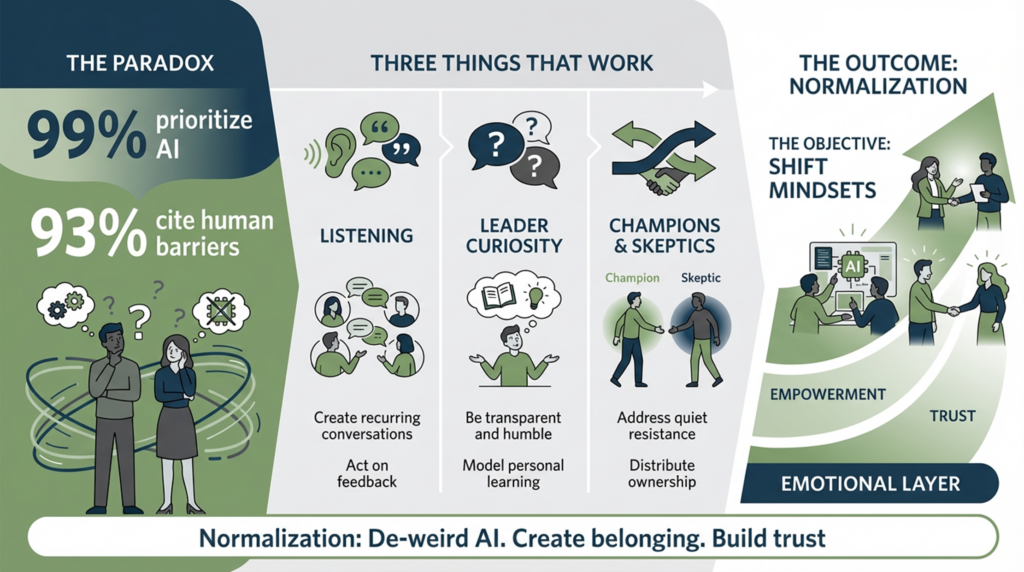
A new data point from Harvard Business Review reinforces just how widespread this challenge has become. In its annual AI & Data Leadership Executive Benchmark Survey, 99% of respondents said investments in data and AI are a top organizational priority.

And yet, 93% identified human issues — culture and change management — as the key challenge to AI adoption, the highest percentage in the survey’s 15-year history.

That is the paradox organizations are facing right now. We have never been more aligned on the importance of AI, and we have never been clearer about what is standing in the way.

So, what do we do about it?

That is what this series is for. In forthcoming posts, I will go deeper into each phase of the AI adoption continuum I introduced in the first piece, starting with the one most organizations rush past: normalization.

What Normalization Means

Normalization is not a communications campaign. It is not a CEO video about the future of work. And it is not a training session scheduled before a platform goes live.

It is the deliberate, ongoing work of helping people feel safe, supported and included as they begin to make sense of AI and what it may mean for their work. It is how organizations “de-weird” the technology, create space for honest questions and begin making AI feel like something that belongs in everyday work rather than something being imposed from above.

Why Normalization Matters

Psychological safety is a critical condition for learning, experimentation and collaboration. When people don’t feel safe, they don’t ask questions, test ideas or admit what they don’t know. They comply quietly, or they quietly disengage. Neither is adoption.

The goal of normalization is to close the distance between where people are emotionally and where the organization needs them to be. Some employees will move quickly and begin experimenting right away with the tools they now have at their disposal.

Others will be unfamiliar, skeptical or unsure what this shift means for their role, their value or their future. For those employees especially, adoption does not begin with training. It begins with the feeling that engaging with AI will not make them look foolish, irrelevant or behind.

And creating that kind of readiness requires three things done well.

Three Things That Actually Work in the Normalization Phase

1. Create space – and systems – for listening.

The biggest mistake organizations make in this phase is starting with all the answers. They launch the platform, send the announcement, schedule the training – and assume those things alone will shift mindsets and change behavior.

They won’t.

What creates the conditions for readiness is being heard first. At its core, this means building an ongoing conversation about AI across the organization – one that gives employees regular, low-pressure spaces to surface questions and ideas, voice concerns and get honest responses.

That can take several forms: Office hours. Small-group sessions. Open Q&A. Pulse surveys and live polls. Not as symbolic gestures, but as mechanisms for shaping how AI gets introduced into the work people actually do.

And if you’re going to ask people to take the time to engage, you must show that what they share matters. The only thing worse than not asking employees for feedback is asking and then ignoring what you hear.

That’s why listening cannot be treated as a singular event. It has to be built into the rollout itself.

One all-hands meeting is not an AI listening strategy. Listening has to be structured, recurring and visibly tied to action. When people see their input reflected in how your AI transformation evolves, trust grows. When they don’t, skepticism hardens.

2. Coach leaders to show curiosity.

This may be the most uncomfortable shift for many leaders — and one of the most important.

We often expect leaders to project confidence during change: Here’s where we’re going. Here’s why it’s the right call. Here’s what I need you to do. In many transformations, that kind of clarity is reassuring. But AI introduces a level of uncertainty that makes a different posture more effective.

Much of this is still unfolding, and employees know that. When leaders over-index on certainty, it can unintentionally create distance. What tends to build trust instead is transparency – a willingness to share what is clear, what is still emerging and what they themselves are learning along the way.

Leaders who say, Here’s what I tried last week. Here’s where it didn’t go as expected. Here’s what I’m still figuring out, give their teams permission to approach AI the same way: openly, curiously and without needing to have everything resolved upfront. In doing so, they model the kind of learning culture this moment requires.

And this does not have to be overly formal. It can be as simple as a leader taking a few minutes in a team meeting or a 1:1 to share how they have been using AI, where it has helped, where it has fallen short and then asking whether others are seeing similar use cases or running into similar issues. Moments like that make AI feel less abstract and more like part of how the team solves problems and gets work done.

A little humility goes a long way here. Saying, We don’t have all the answers yet, but we want to understand what you’re seeing and what you need, helps build the trust and reciprocity that make people more willing to engage over time.

3. Engage both champions and skeptics.

Most AI rollouts activate champions. Fewer engage skeptics.

That’s a missed opportunity – and often a source of quiet resistance that never gets addressed.

Champions build belief. They carry peer influence, spread early momentum and make it socially safe to try.

But skeptics matter too. They ask the questions others are hesitant to raise, stress-test the strategy and identify blind spots the optimists have not yet considered.

And both groups need to be identified across the organization. The concerns people have, the language that resonates, and the use cases that feel relevant will differ by role, function, team and location. A centralized group of AI-forward employees alone will not catch those nuances.

Bring both into the process. Involve them in reviewing messaging before it goes out. Ask them to serve as ears on the ground within their teams, surfacing the quiet hesitations people may not yet be voicing openly. Invite them to curate real-world examples, flag what feels off and help co-create the evolving story – not just receive it.

When the people most likely to champion the change and the people most likely to question it both have a hand in shaping the narrative, two things happen: the strategy gets sharper, and trust grows. That makes the rollout more credible, because it starts to reflect the reality of how different parts of the organization will actually experience it.

How You Know It’s Working

Normalization isn’t a box you check. It’s a condition you build. Here are three signals that tell you the work is landing:

  • Safety and trust are growing. Survey data and anecdotal feedback show people feel comfortable asking questions about AI – even uncomfortable ones.
  • Ownership is being distributed. Champions and skeptics are in the room, giving honest input, not just nodding along.
  • Early participation is building. Attendance at office hours, demos and opt-in sessions is growing – not because it’s mandatory, but because people are curious and finding value from what you’re sharing.

These signals matter because they show people are getting more comfortable – asking questions, engaging more openly, and beginning to see where AI might fit into their work.

But that does not mean everyone is in the same place. In most organizations, some people will already be experimenting or integrating AI into parts of their workflow, while others are still making sense of what this technology means for their role, their value and their day-to-day work.

That is why normalization matters. It is not something you complete before moving on. It is the ongoing foundation that helps leaders understand where people are, how they are experiencing the change and what they need next as the work continues.

Organizations should be moving. But they need to keep listening as they do. That is what makes adoption more coherent, more durable and more likely to spread beyond the early adopters.

Article

Sustaining AI Adoption on Your Team: Moving from Launch to Long-Haul Momentum 

December 19, 2025
By Zack Kavanaugh

Your organization launched the tools. Ran the trainings. Clarified the policies. Maybe even branded your AI initiative to rally employees and excite stakeholders.  

Now what? 

Three Brutal Truths About AI Adoption 

  1. For many organizations, AI remains more of a talking point than a true driver of change in daily work, employee experience or customer service. 
  1. With a thoughtful, risk-aware approach, adoption may not be straightforward or fast
  1. Employees will always be at different stages – some experimenting, some integrating AI into workflows, some skeptical or uncertain, and many shifting between these states as priorities and information evolve. 

Your Role as a Leader 

That’s where leaders – C-suite members, team leads and managers alike – come in. With AI adoption – a business transformation that carries emotional baggage, operational challenges and even existential questions – leaders have a responsibility to guide their people through the hype and toward something practical that drives business value. 

What You Should Get from This Article 

This piece closes out our 2025 series on AI adoption. The first article mapped out readiness across culture, leadership, knowledge and infrastructure. The second examined why adoption stalls, unpacking hesitations at the enterprise, team and individual levels. The third highlighted risks when communication and leadership lag behind technology. 

Those pieces focused on the big picture and the organizational must-haves. This one assumes those foundations are in place. It gets more tactical – outlining what leaders can do with their teams to move from launch to long-haul momentum. 

Ultimately, sustaining adoption comes down to three things: reinforcement, relevance and reflection. 

1. Reinforcement: Make AI Part of Everyday Routines 

After rollout, leaders must embed AI into daily routines, not treat it as a one-off initiative.  

Practical ways leaders can reinforce AI: 

  • Build in five minutes during team meetings for questions, concerns and hesitations related to AI use. Consider launching a dedicated channel, email thread or chat on your company’s collaboration platform so team members can share resources and ideas in real time. Funnel what you hear to the cross-functional team responsible for driving adoption. 
  • Identify and empower an AI champion – ideally, someone curious, willing to advocate and experiment, and who is influential on the team. Position this role as a professional development opportunity.  
  • Integrate AI into performance conversations and onboarding so it’s part of every team member’s role, not an optional add-on. Encourage people to rethink their work – and how that work gets done – in ways that push your team’s objectives forward. 

If reinforcement isn’t visible in everyday conversations, adoption will stall. Leaders should pay attention to whether AI is being treated as optional – and redirect if it’s not yet treated as an expectation. 

2. Relevance: Tie AI Directly to the Work People Do 

Adoption won’t stick if AI feels abstract or disconnected. It has to feel useful in the context of actual work. 

Practical ways leaders can make AI relevant: 

  • Share your own AI examples regularly – where it saved time, where it added value and, equally importantly, where it didn’t and why. Use existing channels – chat, email, 1:1s with direct reports and team meetings – to socialize your learnings. 
  • Engage the team in solving challenges and capitalizing on opportunities together. For example, run bi-weekly brainstorming sessions where team members bring problems and explore whether AI can help address them. 
  • Recognize small wins so adoption feels attainable – and do the same with failures so the team can learn from what didn’t work. Spotlight and reward team members who solve customer challenges, improve processes or identify new use cases. 

Relevance ensures employees see AI as a tool for them – not just for the company. Leaders should surface challenges, encourage collaboration and keep examples concrete and tied to team goals. 

3. Reflection: Measure What Actually Matters 

Tracking logins shows activity – but not necessarily maturity. Leaders need to move beyond superficial usage metrics and measure whether adoption is building confidence, capability and alignment with business objectives. 

Practical ways leaders can reflect on adoption: 

  • Run short (potentially anonymous) monthly pulse surveys with two or three questions that gauge clarity of your company’s AI strategy, how it connects to employees’ work, and confidence in using the tools to solve business problems. Include at least one open-ended question for crowd-sourced ideas and opportunities. 
  • Work with your AI champion to surface issues employees may hesitate to raise directly with you. Encourage them to set weekly office hours or meet 1:1 with team members to collect insights, and report back to you. 
  • Check often whether AI efforts are aligned with team objectives. If your priority is expanding your customer base, do you have the use cases to support it – or are you drifting into experimentation that doesn’t advance your goals? Consider setting time with your AI champion each month to reflect on whether you’re driving the value you set out to. 

Reflection helps separate meaningful progress from surface activity. Pairing usage data with comprehension metrics gives leaders a sharper view of where adoption stands and where support is most needed. 

The Final Test: Is Your Team Living It? 

At the start of this series, we asked what readiness looked like at the organizational level. Now the question is more immediate: Is your team living it? 

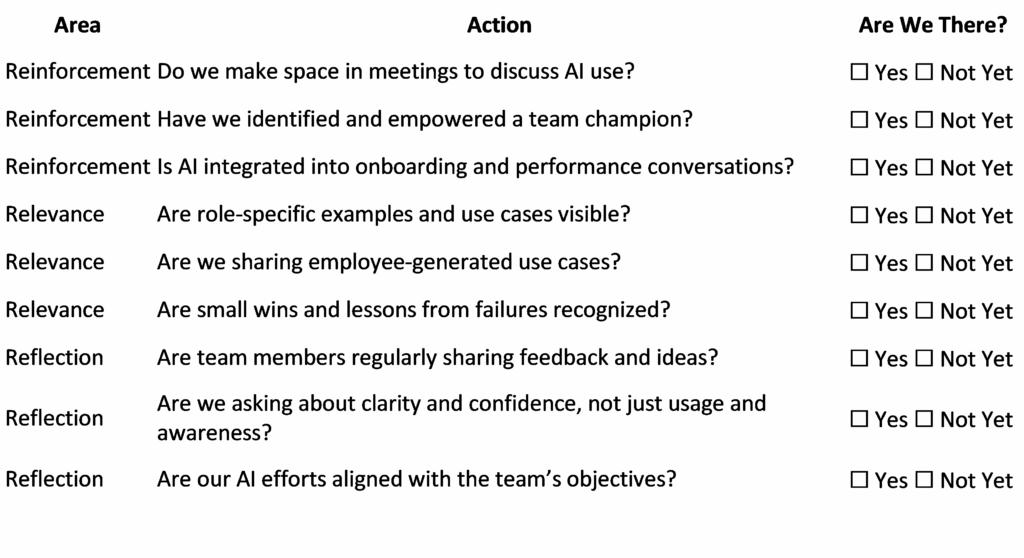
Use this scorecard to check your progress: 

This isn’t a one-time exercise. Revisit it monthly – and at a minimum, quarterly. Consider having your AI champion fill it out too, to guard against blind spots.

The Bottom Line

The biggest challenge of AI transformation in 2026 isn’t speed – it’s staying power. The organizations and teams that succeed will be the ones that take the actions above now and treat adoption as an ongoing process, not a one-time push.