The 5 Vaccines for Your Crisis Communications during the Coronavirus (COVID-19)
April 10, 2020
Share
The current Coronavirus ( COVID-19 ) pandemic crisis has held Thailand and the whole world captive. The overall impact of the pandemic continues to evolve across a range of health consequences, economic effects, political exposure, and personal concerns reflecting social impact and family concerns. […]
Will COVID-19 Turn the Tide on Innovation for Pharma Companies?
April 8, 2020
By Emma Cracknell
Share
The current COVID-19 pandemic has launched huge humanitarian waves across the globe, uniting the general public, healthcare providers, governments and industry around one common goal – to beat the virus. Even as countries begin easing the restrictive containment measures that govern our daily lives, we can be certain that the post-COVID-19 world will look radically different from the one we have left behind. Global leaders will be at the forefront of the assessment, tackling key questions: could this have been prevented, should finding a treatment have happened sooner and would there have been a more efficient way to limit the disease’s spread?
Research and innovation, led by the pharmaceutical industry, will be at the forefront of these conversations. However, it will bust the debate on the sustainability of our existing innovation eco-system wide open. We need to ask if we can afford for science and innovation to be undermined by an ever-changing public opinion and by policymakers who are compelled to follow it.
In recent years, the pharmaceutical industry has developed a somewhat unsavoury reputation. Exponential media coverage of both pricing debates and the opioid crisis has created a distrust of the industry, at a time when we are living in an overall era of suspicion towards large corporations, big institutions and above all, facts. We just have to look at the rapid rise in the anti-vaccination movement to understand how these dynamics can come together in a dangerous cocktail of scientific disregard.
The industry’s negative public perception and criticism from NGOs have triggered the current political atmosphere in the European arena which has made intellectual property (IP) incentives a legislative target in recent years. Reducing IP rights is viewed as a move that undermines innovation by the pharmaceutical industry. On the other hand, it’s praised as an attempt to lower prices by NGOs – albeit a short-sighted one. The introduction of the EU’s Supplementary Protection Certificate (SPC) Manufacturing waiver for both exports and stockpiling was therefore highly criticised by the industry, but welcomed by many NGOs as a move towards equality.
Fast-forward a couple of years after the ‘lost’ SPC debate, the pharmaceutical industry is now being criticised for its lack of innovation by the same society that formerly considered innovation a dirty word for profit-driven. A FleishmanHillard TRUE Global Intelligence COVID-19 study, released on April 8, 2020, revealed that 67% of respondents believe that pharmaceutical companies are ‘very important’ in responding to the COVID-19 crisis. This ranks the role of the industry second only to that of national governments in the crisis response. Facing an unprecedented pandemic, we need diagnostics, treatment and above all, a vaccine. Innovation is difficult in the best of circumstances, with regulatory burdens and the tedious nature of clinical trials, including for vaccine development. We need an environment that empowers industry to provide solutions for society in the best and worst of times.
We can expect draconian style measures to continue in some form for as long as we can’t control transmission and treatment. We will have a long and difficult wait, losing many loved ones along the way, if our best solution to the crisis at hand is herd immunity. Even this approach remains a huge bet given that at present there is no proof we become immune to the virus once we have been infected and recovered.
The debate around innovation in the context of a pandemic puts forward a very important question – can innovation be turned on and off by demand or should we as a society consistently foster a stronger European research and innovation eco-system to protect our European way of life, and most importantly, our citizens? Can we afford to allow our opinions to fluctuate between the need for a robust innovation framework and the pressure to keep prices down? Such a mindset switch might be best demonstrated by President Donald Trump, who has started calling Pharma bosses ‘geniuses’ (reference to innovation amidst COVID-19), when previously he’d accused the same groups of ‘getting away with murder’ (reference to price).
To conclude, COVID-19 is demonstrating the value of innovation to society in tangible terms. A global pandemic puts everyone’s health and livelihoods at risk, demonstrating the absolute necessity of honing our ability to innovate. In the post-COVID-19 era, private and public sectors will need to come together and evaluate their responses to the crisis in order to understand how Europe’s innovation framework provides an environment where science can thrive. With multiple public commitments to fight the virus being made by almost every single pharmaceutical company, this is a huge opportunity for the industry to demonstrate its value to society and look to change the path of the research and innovation debate.
See what else is happening
You might also like
Expertise
Why Trust is the Real Competitive Advantage in Ag Tech
April 2, 2026
Expertise
Notes From the Road: RSA Conference 2026 Edition
April 1, 2026
Expertise
Why Your AI Rollout Is Stalling (And What Actually Moves the Needle)
March 25, 2026
Expertise
Get the Report: Inside China’s 2026 Two Sessions
March 24, 2026
Expertise
The New Culture Gap Report: How Brands Stay Relevant for 100 Years
March 24, 2026
Expertise
The Tech Industry’s License to Lead Problem: How Tech Companies Made Themselves Vulnerable to the AI and SaaS Apocalypse Doubt
March 4, 2026
Expertise
The Five Principles of Decision-Ready Intelligence: A Framework for Making Hard Calls in an AI-driven Environment
March 3, 2026
Expertise
The Patient Engagement Gap Your Competitors Are Closing
February 26, 2026
Expertise
AI is Reshaping Communications: Inside FleishmanHillard’s Enterprise-Wide Approach
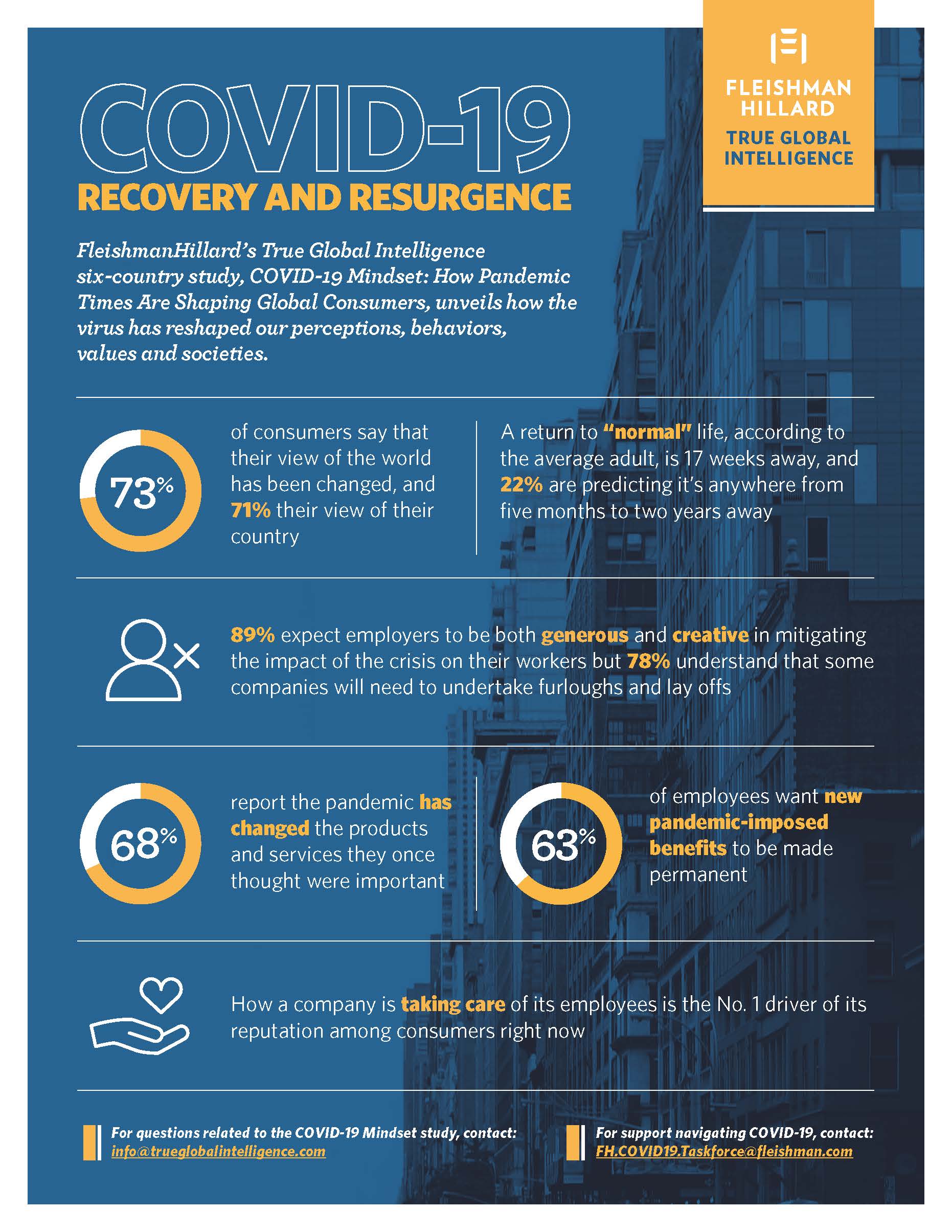
“This crisis has clarified what really matters to individuals,” said Natasha Kennedy, senior partner and global managing director of FleishmanHillard’s TRUE Global Intelligence practice. “Consumer behavior has changed, and for many, those changes will persist past the pandemic. For example, consumers are signaling a seismic shift in their future buying behaviors for products and services they deem important. With a clear understanding of how the crisis has changed our expectations and beliefs, organizations can make decisions and communicate relevantly and meaningfully among employees, customers and communities.”
Simultaneous surveys of the United States, China, Germany, Italy, South Korea and United Kingdom recently carried out by FleishmanHillard provide a snapshot of various stages and expectations of the crisis, voiced by a cross-section of the population including healthcare workers, people at medical risk and those considered essential workers (65% of working adults), all of whom seem to feel the impact more acutely. While these countries are at various stages of the pandemic, the study illuminated some common experiences, which the agency will continue to track in subsequent studies as attitudes and behaviors shift over time. These include:
Consumers are most confident in their governments, least confident in their employers
Across markets, national government receives the best rating (47%) for its performance compared to other institutions, but while 79% of Chinese consumers rate their national government “excellent” or “great,” their counterparts in the U.S. (34%), U.K. (50%), Korea (43%), Italy (39%) and Germany (37%) all give their national governments much lower ratings.
Major corporations are also receiving higher satisfaction in China (66%), but ratings range from a high of 28% (U.S. and Korea) to a low of 17% (Germany) across the other markets.
Employers of all sizes perform the worst, with only 29% rating their response “excellent” or “great.”
Across these markets, seven out of 10 feels that other individuals are doing “excellent,” “great” or “good” in fulfilling their role in this crisis, though some still need to understand the importance of cooperating – 12% reported they’ve ignored shelter-in-place requirements.
Individuals are planning for the long-term and aren’t planning to snap back to “normal” life
A return to “normal” life varies by country, with the average individual in China believing it’s as few as nine weeks away. Individuals in other countries believe it will take longer: 15 weeks on average in the U.S.; 17 weeks in South Korea and Germany; and 22 weeks in the U.K. and Italy.
More than one in five believe it will take between five months to two years to return to normal.
While most understand there will be layoffs and furloughs, 89% expect employers to be generous and creative in mitigating the impact on workers
91% expect companies to take steps to help workers stay healthy – providing them with protective equipment and hand sanitizer, making sure they have breaks to wash their hands and making physical changes to space and operations to allow social distancing, among other steps.
78% understand that some companies will need to furlough and lay off workers, a majority that holds across these countries (59% in Korea, the lowest, and 86% in the U.S., the highest).
52% describe employers taking better care of their employees as “very important” right now.
Consumers are willing to help organizations support their employees
71% will find ways to continue to patronize businesses, such as opting for delivery and pick up (50%) or through holding appointments by phone or online (44%).
34% will purchase or pay for things they can’t currently use, like gift cards (19%), and continue paying for memberships and services (17%).
14% are willing to tip more and 9% are willing to pay higher prices.
17% will donate to employer-administered funds that support workers.
Consumers plan to be cautious, even when the spread of the virus subsides – with substantial implications for economic and social recovery
95% of consumers want companies to implement physical protection and distancing measures to help keep them healthy.
65% are currently postponing purchases and travel, and 52% intend changes to their buying behaviors to continue.
34% are postponing major life decisions, and 26% will take planning for major life decisions more seriously after the pandemic.
27% are currently saving more than they normally do, and 26% plan to save more in the future than normal.
The pandemic has changed what people value, and they want new benefits and policies to endure
68% report the pandemic has changed the products and services they once thought were important, a phenomenon even more widespread in China (86%) and Italy (73%).
63% of employees want new benefits offered during the pandemic to be made permanent.
71% want some of the positive government policies created during the crisis to be made permanent, including: 69% of Americans; 89% of Chinese; 77% of global millennials; 76% of workers deemed essential during the pandemic; and 77% of healthcare workers.
21% of people (26% in the U.S.) who would normally need to be at their place of business to do their job now expect to have the option of working from home.
26% of employees say they will be looking for another job with an employer that supports its employees, will no longer be loyal to their employer because of their actions during the pandemic, or will look into how an organization treated its employees when considering new employers.
63% of America’s Republican Party demographic base and 68% of the Democratic Party’s demographic base say their view of the country’s political system as a whole has changed.
Nearly everyone has felt the impact
98% have undertaken some new practice or postponed or canceled plans or purchases, and 90% report enduring changes in expectations and behaviors after the pandemic ends.
78% are concerned for their health, and 74% are concerned for their financial situation; this level of concern is consistent across demographics.
18% have a family member or friend whose health has been impacted by COVID-19, including 5% whose family member or friend died of the disease. In China and Italy, one-third (31% and 33%, respectively) have a family member or friend whose health has been impacted by the virus.
“Our research underscores the indelible importance of the actions taken by organizations now,” said Peter Verrengia, senior partner and head of FleishmanHillard’s global Recovery and Resurgence practice with deep experience in helping organizations emerge from crises. “The study shows the bigger the threat, economically and socially, the more important it is to create a foundation of confidence based on accountability, transparency, frequent updates and realistic, incremental goals. Well-structured communications, based on values and actions, can acknowledge the pain and challenges we all face today, while helping to improve and even accelerate better outcomes for individuals, organizations and society.”
Around the world, despite different systems and experiences, individuals are being united by this common experience.
“What we have seen so far as cities in China begin their early stages of recovery, is a sense of purpose and determination, and a recognition of personal responsibility,” said Rachel Catanach, chair of FleishmanHillard’s COVID-19 Taskforce and president and senior partner for Greater China. “Workplaces are arranged to maintain healthy distances while still enabling operations to resume. Employers can acknowledge concerns about the health and safety of their employees and customers, but still create an expectation of progress, even if there may be occasional setbacks. With ongoing communications to inform and engage all stakeholders as the return to work rolls out, we believe that organizations can encourage productivity and shared innovation that can speed a sustainable recovery.”
FleishmanHillard’s new Recovery and Resurgence practice is utilizing the data and insights from the study to provide guidance and communication expertise to organizations as they navigate the current situation and plan for a return to operations.
TRUE Global Intelligence, the in-house research practice of FleishmanHillard, fielded an online survey of 6,566 adults 18 and older in China (n=1,057), Germany (n=1,131), Italy (n=1,093), South Korea (n=1,043), the United Kingdom (n=1,123) and United States (n=1,119) from March 30-April 3, 2020. The data has been weighted by gender and age in all markets as well as region in the United States. The margin of error is ±1.2% for the global total, approximately 3% in each market, and higher for subgroups. For reference, 10% of respondents corresponds to 151.9 million adults across these six countries.
About FleishmanHillard
FleishmanHillard specializes in public relations, reputation management, public affairs, brand marketing, digital strategy, social engagement and content strategy. FleishmanHillard was named 2019 PRWeek U.S. Outstanding Large Agency; 2019 Holmes Report North America Large Agency of the Year; ICCO Network of the Year – Americas 2017-2019; Agency of the Year at the 2017 and 2018 North American Excellence Awards; 2018 Large Consultancy of the Year by PRWeek UK; PR News’ Best Places to Work in PR 2016-2018; Human Rights Campaign Best Places to Work for LGBTQ Equality 2018-2020; PR Awards Asia 2017 Greater China Agency of the Year; and NAFE’s “Top Companies for Executive Women” 2010-2020. The firm’s award-winning work is widely heralded, including at the Cannes International Festival of Creativity. FleishmanHillard is part of Omnicom Public Relations Group, and has 80 offices in more than 30 countries, plus affiliates in 50 countries.
About Omnicom Public Relations Group
Omnicom Public Relations Group is a global collective of three of the top global public relations agencies worldwide and specialist agencies in areas including public affairs, marketing to women, global health strategy and corporate social responsibility. It encompasses more than 6,300 public relations professionals in more than 370 offices worldwide who provide their expertise to companies, government agencies, NGOs and nonprofits across a wide range of industries. Omnicom Public Relations Group delivers for clients through a relentless focus on talent, continuous pursuit of innovation and a culture steeped in collaboration. Omnicom Public Relations Group is part of the DAS Group of Companies, a division of Omnicom Group Inc. (NYSE: OMC) that includes more than 200 companies in a wide range of marketing disciplines including advertising, public relations, healthcare, customer relationship management, events, promotional marketing, branding and research.
The FleishmanHillard study, COVID-19 Mindset: How Pandemic Times Are Shaping Global Consumers, unveils how the virus is reshaping our perceptions, behaviors, values and societies.
FleishmanHillard Shortlisted at SABRE Awards EMEA 2020
April 7, 2020
Share
ST. LOUIS, April 7, 2020 — FleishmanHillard earned four finalist nods at the SABRE Awards EMEA 2020, presented by PRovoke Media. The global public relations and marketing agency received shortlist nominations for work on behalf of clients, O2 Czech Republic, Procter & Gamble (P&G) and Viber.
PRovoke Media’s EMEA SABRE Awards program rewards campaigns that demonstrate notable success in branding, reputation and engagement. Each entry is reviewed by a jury of industry leaders and shortlisted campaigns are chosen from more than 400 submissions.
O2 Czech Republic, “Telephone Booths Ring for Democracy” (Experiential, Guerrilla Marketing)
O2 Czech Republic, “Czech Children in Cyber World (Caught in the Net of Online Risk)” (Technology, Telecommunications)
Procter & Gamble (P&G), “Always Manifest of Self-Confidence” (Specialist Audience, Marketing to Women)
Viber and WWF, “Viber and WWF: Saving Siberian Tiger” (Technology: Software & Services)
Winners were originally scheduled to be announced at an awards dinner in Paris on May 28; however, the ceremony has been canceled due to the coronavirus. PRovoke Media is exploring other options for an awards dinner, including a virtual ceremony. More information will be announced at a later date here.
View the complete list of finalists on Provoke Media.
See what else is happening
You might also like
Expertise
The New Culture Gap Report: How Brands Stay Relevant for 100 Years
March 24, 2026
News
FleishmanHillard Named Among PRovoke Media’s Best Public Relations Agencies in the World
March 10, 2026
News
FleishmanHillard Integrates Porter Novelli to Form a Stronger, More Specialized Global Communications Consultancy
February 9, 2026
News
From Ragan: Elizabeth Cook on Rethinking Preparedness in Crisis Response
January 21, 2026
Global Executive Advisory
Insights From Davos: Building Credibility Through Storytelling
January 20, 2026
News
FleishmanHillard Unveils ‘License to Lead’ Research, Revealing a Growing Confidence Gap Between Executives and Stakeholders
January 13, 2026
News
FleishmanHillard Wins 2026 Innovation Awards for Data-Driven Strategy
January 12, 2026
Expertise
When the World Gets Noisy, Great Storytelling Breaks Through
December 3, 2025
News
Ellie Tuck Appointed Chief Creative Officer of the Americas
Health Comes First, But There Are Also COVID-19 Data Security Concerns
By Scott Radcliffe
Share
Most of us are rightly focused on some of the larger and more pressing elements of the COVID-19 response in terms of staying healthy and helping those who aren’t. That said, there are others amongst us taking advantage of the confusion caused by the rapidly changing situation, and we all need to be extra vigilant with data security at this time. Here are some of the actions that should be taken to prevent threats specifically related to COVID-19:
Secure the home office. Some companies were ready to go with this and had no issues transitioning to a remote workforce, while others are scrambling to put tools and infrastructure in place. Those areas of vulnerability will increase as networks and resources get spread thin due to everything from lack of VPN or proper firewalls to employees feeling more empowered to visit sites or view content they otherwise may not in the office. Tips for curtailing some of the risks of remote work include:
Try not to mix work and leisure activity on the same device
Be suspicious of any email asking to check or renew your password
As always, be wary of emails that come from unfamiliar or untrusted sources
Be sure all software is up to date with privacy tools; add-ons for browsers and patches should be checked regularly
Be sure all important files are regularly backed-up to help protect against a potential ransomware attack that might restrict access to data
Check that home Wi-Fi connections are secure, ensuring people in the vicinity can’t snoop
Only get news and video from trusted sources. This ensures the information you’re getting is accurate and the content or applications you’re downloading aren’t malicious. Influential security blogger Brian Krebs and Business Insider described specific instances where hackers were using an accurate COVID-19 map as a cover to infect devices with malware.
Be wary of “too good to be true.” The U.S. Department of Justice already cracked down on an organization that was promising a bogus “vaccine” to COVID-19. It goes beyond that, however. Sometimes it’s a simple email link that’s the threat, as the Wall Street Journal recently detailed in the way criminals are using COVID-19 to lure people into clicking or engaging with a malicious link – and with governments around the world quickly initiating large stimulus packages among other fast-evolving elements of the situation, there will be many ways bad guys attempt to lure people into clicking.
Take an extra step to verify email requests. With so much changing all around us recently, many of us are becoming more accustomed to steps or requests many businesses are needing to take to work around our current circumstances that would have seemed uniquely odd just a few weeks ago. Business email compromises – more or less when you get a request via email for sensitive or valuable information – are rising as bad actors begin to take advantage of the many changes that are taking place in how people do business and how accommodating many of us have become to those changes. The FBI recently listed some useful detail to help stay aware and safe, but generally speaking – taking the extra step to verify requests for sensitive data even if the need is seemingly urgent is important right now.
Ransomware and operational issues. Though there are reports that certain groups known to use ransomware are vowing to “stay away” from hospitals and healthcare providers – at least one specifically said they were not including pharmaceutical companies in that “stay away” proclamation – it’s obvious criminals will likely not adhere to this. All organizations, particularly those on the healthcare provider side, need to be ready to find communications contingencies to help people stay informed and connected.
See what else is happening
You might also like
Expertise
Why Trust is the Real Competitive Advantage in Ag Tech
April 2, 2026
Expertise
Notes From the Road: RSA Conference 2026 Edition
April 1, 2026
Expertise
Why Your AI Rollout Is Stalling (And What Actually Moves the Needle)
March 25, 2026
Expertise
Get the Report: Inside China’s 2026 Two Sessions
March 24, 2026
Expertise
The New Culture Gap Report: How Brands Stay Relevant for 100 Years
March 24, 2026
Expertise
The Tech Industry’s License to Lead Problem: How Tech Companies Made Themselves Vulnerable to the AI and SaaS Apocalypse Doubt
March 4, 2026
Expertise
The Five Principles of Decision-Ready Intelligence: A Framework for Making Hard Calls in an AI-driven Environment
March 3, 2026
Expertise
The Patient Engagement Gap Your Competitors Are Closing
February 26, 2026
Expertise
AI is Reshaping Communications: Inside FleishmanHillard’s Enterprise-Wide Approach
Like a therapist might, I often turn to an exercise that explores the emotions consumers experience with a brand and how the brand makes them feel. I ask questions like: Overall, how would you describe your consumers’ mood? How are they feeling? What are they expecting to feel? What’s bothering them? What would it take to make them feel more content, happier, satisfied?
I bring this up as in recent days there has been a lot of discussion about the 5 Rs of Recovery and how organizations need to think and act. But that’s just one side of the coin, so to speak. By failing to consider the emotional psyche of the consumer, we risk missing the mark in our eventual branded recovery efforts.
To be successful, we need to be mindful of the post-traumatic emotions that will be fueling consumer decisions moving forward. In keeping with the model, let’s consider the5 Rs of Post-Traumatic Marketing:
Resent – Consumers resent the #NewNormal. Use the phrase and they will stop listening. Instead, show how your brand can be disruptive without causing disruption.
Rebound – Like any rebound relationship, this one is no different. Rational transactions will be clouded by emotion, fueled by personal trauma and a mental ‘score-board’ of how brands acted during the crisis. Which leads to the next ‘R’…
Revenge – Expect consumers to make revenge purchases, fueled by anger at the brands who did not step up in a meaningful way during this crisis.
Reject – When the clouds lift, consumers will reject ‘old’ ways. Continued fluidity in commerce and transparency into corporate policies will be less of a competitive advantage and more of a must-have.
Recall – We can all point to something we’ve been upset about recently. A postponed vacation, a missed wedding, a canceled graduation. And, these feelings won’t pass overnight. Customers want to know that brands get them. Lead with empathy and recall for consumers that your brand has been there for them, feels their challenges and will continue to be alongside them to celebrate the little victories moving forward.
Emotional intimacy is not just for therapy. As marketers moving forward it’s no longer our job to simply serve a consumer need, but to help consumers cope with and recover from this trauma through the comfort and consolation of our brands.
See what else is happening
You might also like
Expertise
Why Trust is the Real Competitive Advantage in Ag Tech
April 2, 2026
Expertise
Notes From the Road: RSA Conference 2026 Edition
April 1, 2026
Expertise
Why Your AI Rollout Is Stalling (And What Actually Moves the Needle)
March 25, 2026
Expertise
Get the Report: Inside China’s 2026 Two Sessions
March 24, 2026
Expertise
The New Culture Gap Report: How Brands Stay Relevant for 100 Years
March 24, 2026
Expertise
The Tech Industry’s License to Lead Problem: How Tech Companies Made Themselves Vulnerable to the AI and SaaS Apocalypse Doubt
March 4, 2026
Expertise
The Five Principles of Decision-Ready Intelligence: A Framework for Making Hard Calls in an AI-driven Environment
March 3, 2026
Expertise
The Patient Engagement Gap Your Competitors Are Closing
February 26, 2026
Expertise
AI is Reshaping Communications: Inside FleishmanHillard’s Enterprise-Wide Approach
FleishmanHillard Launches New Recovery and Resurgence Practice to Provide Expert Counsel on Communications Efforts for Rebuilding Post-pandemic
April 3, 2020
Share
ST. LOUIS, April 3, 2020 – FleishmanHillard announced the organization of a new cross-functional global practice to provide communication expertise to organizations as they plan for a return to operations, adapt to a dramatically shifting business and social environment, and ultimately accelerate their journey to future growth.
Every discipline of every business – employee relations, operations, customer service, marketing, finance, government affairs and more – will have to communicate across a spectrum of audiences to demonstrate a foundation for recovery and describe progress and plans for the organization’s future. Each organization will have to be accountable for the ways they acted on their values to respond during the hardest moments of the pandemic and will need to stimulate confidence in a clear path forward that is consistent with their business mission and promised purpose. Strong relationships, meaningful actions, credible resources and clear communications will be the necessary tools for resurgence.
“Recovery is going to be a process, not an event, and not a linear process in most places,” said FleishmanHillard senior partner Peter Verrengia, who will lead the firm’s efforts. “The most successful organizations will not stop at planning to rebuild. They will focus on resurgence in an environment that is going to look very different across industries and geographies during the remainder of this year and into 2022. The definition of success cannot be a return to normal. We have left business as usual behind and that cannot be a future goal. Organizations need to move from today’s ‘business as possible’ to the strongest possible recovery in the context of the reality we find at the end of the pandemic curve.
“All successful crisis recoveries share one characteristic. The seeds of recovery start at the earliest stages of crisis response. Despite the size of this crisis, and the severe pressures that so many organizations are confronting today, leaders need to allocate a percentage of effort now to look ahead to multiple recovery and resurgence scenarios. Among other factors, their teams need to anticipate how they will manage relationships and communicate differently in an economic environment shaped by new expectations from consumers, employees, shareholders and many other business stakeholders.”
FleishmanHillard’s Recovery and Resurgence Practice will bring together the firm’s experts to provide brand and reputation counsel, and share scenario planning and best practices across disciplines, industry sectors and geographies. The firm will draw on its experience managing complex crisis response and recovery, large-scale communications and organizational transformation initiatives, highly responsive stakeholder relations programs for both global and local clients in markets around the world. To efficiently deliver support for each client’s unique path and pace through the recovery/resurgence cycle, the practice team will partner with FleishmanHillard client service teams that have deep knowledge of individual client situations, geographies and opportunities.
Smart organizations are already learning from the lessons of recent weeks. There are a handful of immediate questions organizations must address to build a new operating system for success in an uncertain future.
How do we know the crisis is over? How will we know how to communicate and conduct ourselves in a post-pandemic environment?
What does recovery and resurgence even mean for my organization? And what is the outcome we should expect? How can we set goals that are believable but also achievable, and take us to an even stronger position than we had?
How will we know where we stand and how our stakeholders view our performance and behavior at each stage of response, return, recovery and resurgence?
How can we bring our purpose or values to bear in this new environment?
Which of our current plans are still valid, and which need to be rethought?
How do we protect, or even enhance, our brand and reputation right now?
Are our current models and ways of working still valid, or do we need to rethink them?
Who needs our help and how can we provide it?
“In some locations, we’re already entering the transitional period,” Verrengia said. “In other places we are preparing for the peak of pandemic impact. Everywhere, people in every role and in every relationship are thinking about today, and the future. As the world steadies itself, organizations need to use this time productively to redefine their values, the value they create, and their purpose in the world, to protect and advance their business for the long term.”
About FleishmanHillard
FleishmanHillard specializes in public relations, reputation management, public affairs, brand marketing, digital strategy, social engagement and content strategy. FleishmanHillard was named 2019 PRWeek U.S. Outstanding Large Agency; 2019 Holmes Report North America Large Agency of the Year; ICCO Network of the Year – Americas 2017-2019; Agency of the Year at the 2017 and 2018 North American Excellence Awards; 2018 Large Consultancy of the Year by PRWeek UK; PR News’ Best Places to Work in PR 2016-2018; Human Rights Campaign Best Places to Work for LGBTQ Equality 2018-2020; PR Awards Asia 2017 Greater China Agency of the Year; and NAFE’s “Top Companies for Executive Women” 2010-2020. The firm’s award-winning work is widely heralded, including at the Cannes International Festival of Creativity. FleishmanHillard is part of Omnicom Public Relations Group, and has 80 offices in 30 countries, plus affiliates in 45 countries.
About Omnicom Public Relations Group
Omnicom Public Relations Group is a global collective of three of the top global public relations agencies worldwide and specialist agencies in areas including public affairs, marketing to women, global health strategy and corporate social responsibility. It encompasses more than 6,300 public relations professionals in more than 370 offices worldwide who provide their expertise to companies, government agencies, NGOs and nonprofits across a wide range of industries. Omnicom Public Relations Group delivers for clients through a relentless focus on talent, continuous pursuit of innovation and a culture steeped in collaboration. Omnicom Public Relations Group is part of the DAS Group of Companies, a division of Omnicom Group Inc. (NYSE: OMC) that includes more than 200 companies in a wide range of marketing disciplines including advertising, public relations, healthcare, customer relationship management, events, promotional marketing, branding and research.
See what else is happening
You might also like
Expertise
Why Trust is the Real Competitive Advantage in Ag Tech
April 2, 2026
Expertise
Notes From the Road: RSA Conference 2026 Edition
April 1, 2026
Expertise
Why Your AI Rollout Is Stalling (And What Actually Moves the Needle)
March 25, 2026
Expertise
Get the Report: Inside China’s 2026 Two Sessions
March 24, 2026
Expertise
The New Culture Gap Report: How Brands Stay Relevant for 100 Years
March 24, 2026
News
FleishmanHillard Named Among PRovoke Media’s Best Public Relations Agencies in the World
March 10, 2026
Expertise
The Tech Industry’s License to Lead Problem: How Tech Companies Made Themselves Vulnerable to the AI and SaaS Apocalypse Doubt
March 4, 2026
Expertise
The Five Principles of Decision-Ready Intelligence: A Framework for Making Hard Calls in an AI-driven Environment
March 3, 2026
Expertise
The Patient Engagement Gap Your Competitors Are Closing
Might COVID-19 change perceptions of Tech for the long term? It’s up to Tech to decide
In the past couple of weeks, a new conversation within the tech sector has started to emerge. The overall theme is that the Coronavirus pandemic might be a cure to the so-called techlash. This leaves Tech at a crossroads. There is now a real opportunity for it to rebuild reputation on the back of the world’s new appreciation of the vital role technology plays in society. But to do that, tech companies as a cohort must think about their impact on the world. They need to behave in ethical, socially responsible ways to address the sometimes unintended negative consequences of the technology which has become so critical to our lives in lock-down.
Less than a year ago, in June 2019, we looked at the very real reputational challenges technology companies were facing in our Darlings to Damaged report. The findings combined original research with insights from some of the world’s leading thinkers in this space, including the CEO of the Consumer Technology Association, the CIO of Canada, a Harvard Fellow and many more. In that report, we also pierced the gloom by considering how to ensure technology can continue to be a force for good in a world that increasingly needed drawing together, not pushing apart.
At the time, very few of us could have imagined a global pandemic of the kind we are now living through. All of us are dealing with worry about loved ones. The ongoing uncertainty about what each day will bring, personally, professionally and for the communities that we’re a part of. An unending news cycle. Having to work with children in the back (and sometimes fore) ground.
And in that environment, one of the things that is making a positive difference to our everyday lives is… technology.
Technology companies have become — in a way that they’ve only ever talked about and promised before now — the connective tissue helping hold both society and business together. From online shopping, to virtual meetings, to data science being used in the rush to get testing and drug discovery moving, Tech is playing a truly vital role in society.
And being seen to play that vital role too. This is thanks to two broad trends.
First is their ability to provide the technology and tools to keep the world connected and our homes functioning. From the fixed and mobile networks our virtual work and family calls are taking place over, to the platforms making us feel connected with friends around the world, to the ability to get groceries (except toilet paper, naturally) at the click of a button, tech has made life in the pandemic so much more manageable for people in the developed world.
Second has been their willingness to act fast and responsibly when it comes to doing the right thing: workforce pay, pledges around job security, executive pay and more. Tech companies have donated tens of millions of dollars to relief efforts. And Big Tech’s willingness to more proactively ‘police’ fake news in the wake of the pandemic has also been lauded around the world.
This is all in stark contrast to the ‘techlash’ the industry was undergoing just a year ago.
So will this pandemic change perceptions of Tech for good? Potentially some of the answers lie in the research we conducted last year.
Much of the public, even back then (82% to be exact), still said they embrace technology and trust its providers. That said, 7 in 10 said they would look more favorably on tech companies if they addressed the effects of their tech. Effects is a critical word here.
And within that context of effects, two core issues stood out: regulation and privacy.
31% said tech companies are regulated too little. Not surprisingly, this number skewed highest among Boomers (38%). And our 2018 Authentic Insights report showed that, when it comes to data security and protection, Americans think it’s more important than healthcare or freedom of speech (albeit, the focus on healthcare will almost certainly have skewed, rightfully, in the past few weeks).
What seems clear, then, is that tech has a significant opportunity in the wake of the coronavirus to change perceptions around Techlash and its role in society. But it needs to get it right.
Some pundits are saying that this pandemic will fundamentally change the way we live our lives – especially our working lives – for good. From a tech perspective, we’ve been forced into the social, digital use-cases around working flexibly and virtually that many technology companies have been promising for years. And with the power of 5G networks, Edge computing, AI and more just around the corner, there’s a good chance that change will truly continue apace.
But there’s a ‘but’. In what will hopefully (relatively) soon be a post-COVID-19 reality, it will be clearer which businesses, governments, institutions and industries emerge as the winners and losers of public perception. And for tech, it’s all about that word effect.
It’s become clear during COVID-19 that technology is critical. Some might even say a utility we can barely now imagine living without. So does that mean it should be regulated? That is a question that will surely come back once the pandemic is over.
We’ve also already started to see backlash against tech providers that have seen a massive spike in popularity but are not seen to be taking security and privacy seriously enough. Adjustments to platforms and solutions are having to be addressed in real-time.
And of course, 2020 is an election year in the US. This means that the Techlash narrative has a good chance of returning to the fore as a populist political issue. We must expect conversations around fake news and election interference to come back on the agenda in the next few months.
Back in 2019, we noted that tech companies are starting to recognize that their reputations and brand integrity are the best guarantees of long-term success. So during the pandemic and beyond, the best remedy to the so-called techlash will be companies’ internal and external commitments to working with government, regulators, academia, their internal audiences and each other; and to behave in ethical, socially responsible ways to address the sometimes unintended negative consequences of the technology which is so important to our lives today. Once we have returned to a (new) normal, they need to make sure they do the right thing, on behalf of all stakeholders. That means addressing concerns around privacy. Dealing with questions around anti-trust. Taking on board employee feedback. And taking seriously demands for greater regulation.
At the moment, we are dependent on technology. And frankly, we’re glad for that dependency. The critical thing will be to not go back to being seen to use and abuse that dependency for profit without consequences.
See what else is happening
You might also like
Expertise
Why Trust is the Real Competitive Advantage in Ag Tech
April 2, 2026
Expertise
Notes From the Road: RSA Conference 2026 Edition
April 1, 2026
Expertise
Why Your AI Rollout Is Stalling (And What Actually Moves the Needle)
March 25, 2026
Expertise
Get the Report: Inside China’s 2026 Two Sessions
March 24, 2026
Expertise
The New Culture Gap Report: How Brands Stay Relevant for 100 Years
March 24, 2026
Expertise
The Tech Industry’s License to Lead Problem: How Tech Companies Made Themselves Vulnerable to the AI and SaaS Apocalypse Doubt
March 4, 2026
Expertise
The Five Principles of Decision-Ready Intelligence: A Framework for Making Hard Calls in an AI-driven Environment
March 3, 2026
Expertise
The Patient Engagement Gap Your Competitors Are Closing
February 26, 2026
Expertise
AI is Reshaping Communications: Inside FleishmanHillard’s Enterprise-Wide Approach
What Combat Taught Me About Living Through a Pandemic
April 1, 2020
By Scott Radcliffe
Share
I have a relatively unique background for the communications space. I did my time in college at West Point and then became a tank and scout platoon leader while I was deployed to Baghdad and Fallujah, Iraq for 13 months starting in early 2004. Not long after coming back from Iraq in 2005, I was sent to New Orleans as a part of Hurricane Katrina relief efforts. It took the threat of a staff job to move me into communications as the Multi-National Corps-Iraq commanding general’s speechwriter during the 2007 “surge” in Iraq. Over the last few weeks, people have asked me to draw on that experience. It honestly took me a bit to get into the right frame of mind to have something productive to say. But I am finally to a place where I can take from those experiences and apply them to our world’s situation now. So what did I learn that might be useful to others in these times?
1) Create a sense of normalcy: I was single without a family to worry about when I was in the military and I had the benefit, in most cases, of being able to focus on some well-defined tasks at hand – namely keeping my guys safe. That said, if I allowed myself to get preoccupied thinking about the state people were being forced to live in on a daily basis in the places I was deployed, and of course the truly terrible circumstances commonly attributed to “combat” we faced every so often — things could get pretty bleak pretty quickly. I remember very clearly making a deal with myself during both tours in Iraq so that I could sleep at night — I simply didn’t allow myself to think about the very real possibility that a mortar or rocket could come crashing through my window at any moment. It’s tough to get used to a dramatically new way of life, but you’re allowed to feel “ok” even in the face of some pretty adverse circumstances.
2) Getting acclimated is hard: I imagine most would see transitioning to a literal combat zone as a bit of a challenge, but it was almost harder hitting the ground in a devastated American city. We got our orders to go to New Orleans about two days after Hurricane Katrina hit, so we had an idea of what we were getting into. Though we knew where we were going, the truth is we really didn’t have a clue what we were going to be doing when we got there. On top of the physical transition, selfishly, I wasn’t particularly enthusiastic about being asked to deploy again after coming back from Iraq less than five months earlier – and I knew my men felt the same. We spent the first few days living in a parking garage simply figuring out how we could be most useful. Before we could get going, we had to figure out how we were going to live without taking resources away from the people we were there to help. This was a bit dispiriting. Once we got oriented and determined where we could actually help and get to work, it ended up being one of the most rewarding experiences I’ve ever had.
3) You’re allowed to laugh: I recently had an exchange with a colleague that started this whole train of thought. He shared with me an article that was a little on the dark side, but that also had a tinge of humor. He commented that “the gallows humor is strong” to which I responded, “sometimes you have to laugh to keep from crying.” One of the defining features of my time deployed, particularly as a platoon leader, was when we’d be on long missions or in an all-night observation post, keeping ourselves occupied with jokes that would probably seem pretty dark to someone listening in. As dark as they were, the jokes helped loosen what could be very tense situations. Even beyond the dark humor, especially when surrounding circumstances are scary, allowing even a moment to laugh is important.
4) Hang on to “green shoots”: In 2004, when I was about to brief my platoon about an assault mission into Fallujah we were hours away from executing and a very distinct thought crossed my mind at the time: “Man, I’m really glad I’m doing this in an Abrams tank and not some soft skin HMWWV.” It may not always be much, but when you allow yourself to find what I call “green shoots”— reasons for hope or even optimism — it can mean the difference between staying functional or not. It’s not always easy, and yes, even the combat veteran authoring this post has had his moments recently, but finding those green shoots to hold on to can sometimes be the only way to keep going.
5) It’s ok to be happy: This can be exceptionally hard, and the year ahead for almost all of us will no doubt be a roller coaster at best, but it is important to allow yourself to be happy in the spots you’re able to, especially when there are terrible things happening around you. It doesn’t always have to be huge. I remember setting off on some particularly grueling patrols and reminding my guys that it was Friday, which meant it was fried shrimp and steak day at the dining hall and we had something to look forward to when we got back. Other times it was me waking up early to catch a Detroit Tigers playoff game (as a lifelong fan I promise you, those are rare opportunities). In the end allowing myself to enjoy those moments truly helped me get by.
When I think about the situation we’re in now, the aspect that gets to me most is the utter lack of control. Even while deployed I felt I could do quite a bit to make sure my 15 to 30 soldiers got home safe. Or that I had the ability to do something tangible to help the people who lived in the district of Baghdad I was assigned to patrol. After reflecting on my former life, I realized the best thing to do is allow ourselves some respite from these hard times, control what we can control, and each do our part to stay safe and healthy. We’ll get through this.
See what else is happening
You might also like
ESG
Navigating Conflicting Demands to Advance Climate Action
January 20, 2025
Opinions
Supporting St. Louis Institutions Dedicated to Empowering Youth Through FH4Inclusion
January 15, 2025
Opinions
Revitalizing the San Francisco Community with the Downtown Volunteer Coalition
December 23, 2024
Opinions
FleishmanHillard and FH4Inclusion Teams Shine at the Cannes Lions International Festival of Creativity
August 28, 2024
Opinions
Bridging the Generational Divide with Generative AI
August 27, 2024
Inclusion
Success on Repeat: Alumni of the Alfred Fleishman Diversity Fellowship Discuss Promotions and How to Get Them
May 29, 2024
News
EU climate policy: The new borderlines?
May 27, 2024
News
Achieving the Evolving Duality of Loyalty and Loyalty Programs
April 1, 2024
Expertise
TickTockTech: Mobile World Congress 2024 — What’s the Verdict?
Don’t Just Ask “How Can We Help?” Ask These Questions Instead.
March 30, 2020
By Bob Axelrod, Josh Rogers and Leela Stake
Share
Many organizations are asking “What should we do to help in the midst of the COVID-19 crisis?” One of my most fundamental beliefs about the creative process is that a question is what an idea looks like just before it’s an idea. So, with input from my smart FleishmanHillard colleagues Bob Axelrod, Josh Rogers, Leela Stake, Paul Vosloo and Brian West, here are 10 prompts anyone from a small business to a global corporation can use to spark ideas that respond to the pandemic in a way that’s relevant to the need and authentic to the organization.
1) WHY ARE YOU HERE? — Start with your organization’s mission, vision, and values statements. What do they inherently guide you to do?
2) WHAT DO YOU HAVE? — What infrastructure does your organization have and does any of it lend itself to being of particular use to others right now? Warehousing? fleet/transportation/logistics? Sales force? Manufacturing? Office space? Parking lots? Communications platforms?
3) WHAT DO YOUR PEOPLE CARE ABOUT? — What is important to your employees right now? How/where do they want you to make a difference? What are they eager to do themselves?
4) WHO CAN YOU ENLIST? — Beyond employees, what relationships and stakeholders does your organization have that can be put to use? Supply chain? Business partners? Customers? Volunteers? Fans? How can you rally them to do something bigger than you can do on your own?
5) WHO CAN GUIDE YOU? — Conversely, what needs might those same stakeholders have of your organization? Ask your existing philanthropy partners in particular (grantees, volunteer organizations) how you can be a nimble and true partner at this time.
6)IS THE NEED INSIDE? — Now look at those same audiences and ask not only what can each do, but also what might each need? Is there a pain point in your own landscape that you can or should address?
7) WHERE DO YOU INTERSECT WITH HEALTHCARE RELIEF? — This is a healthcare crisis, so where is the most logical connection for your organization within the healthcare system? We’re all thinking about doctors and nurses right now. But hospitals have other workers keeping the doors open: security staff, maintenance and janitorial, cafeteria operations, etc. Is your organization in a position to be uniquely useful or relevant to one of those segments?
8) WHERE DO YOU INTERSECT WITH ECONOMIC RELIEF? — This is an economic crisis. So, the first idea people typically turn to is financial: Who can your organization give money to for emergency relief? It’s a good start, but look for other ways to frame financial need and opportunity to help:
What can your organization buy to help right now?
How can your organization invest in people to ensure they thrive when this is over?
How can your organization help those out of work earn money right now?
Are there debts your organization can forgive among suppliers or others who are hurting?
Can your organization loan people funds to bridge temporary needs?
9) WHO IS HURTING BEYOND THE OBVIOUS? – First responders and patients are the most critical audiences right now, but what if your organization isn’t well suited to help them in particular? Who else is hurting but is being overlooked during the crisis that may be especially relevant to your organization?
10) WHERE ARE YOU IN THE HIERARCHY OF NEEDS? WHERE IS THE CRISIS IN ITS PROGRESSION? — Remember Maslow’s hierarchy of needs. Is your organization particularly well suited to help at one tier or another? Is your best role at the bottom immediately or somewhere higher over time? Today the most urgent needs are flattening the curve, protecting healthcare workers, and providing relief for basic needs. But right on the heels of that is economic survival for individuals and business continuity for all kinds of enterprises. Next will be recovery and rebuilding. Can your organization vary its response in tandem with the progression of the crisis itself?
See what else is happening
You might also like
Expertise
Why Trust is the Real Competitive Advantage in Ag Tech
April 2, 2026
Expertise
Notes From the Road: RSA Conference 2026 Edition
April 1, 2026
Expertise
Why Your AI Rollout Is Stalling (And What Actually Moves the Needle)
March 25, 2026
Expertise
Get the Report: Inside China’s 2026 Two Sessions
March 24, 2026
Expertise
The New Culture Gap Report: How Brands Stay Relevant for 100 Years
March 24, 2026
Expertise
The Tech Industry’s License to Lead Problem: How Tech Companies Made Themselves Vulnerable to the AI and SaaS Apocalypse Doubt
March 4, 2026
Expertise
The Five Principles of Decision-Ready Intelligence: A Framework for Making Hard Calls in an AI-driven Environment
March 3, 2026
Expertise
The Patient Engagement Gap Your Competitors Are Closing
February 26, 2026
Expertise
AI is Reshaping Communications: Inside FleishmanHillard’s Enterprise-Wide Approach