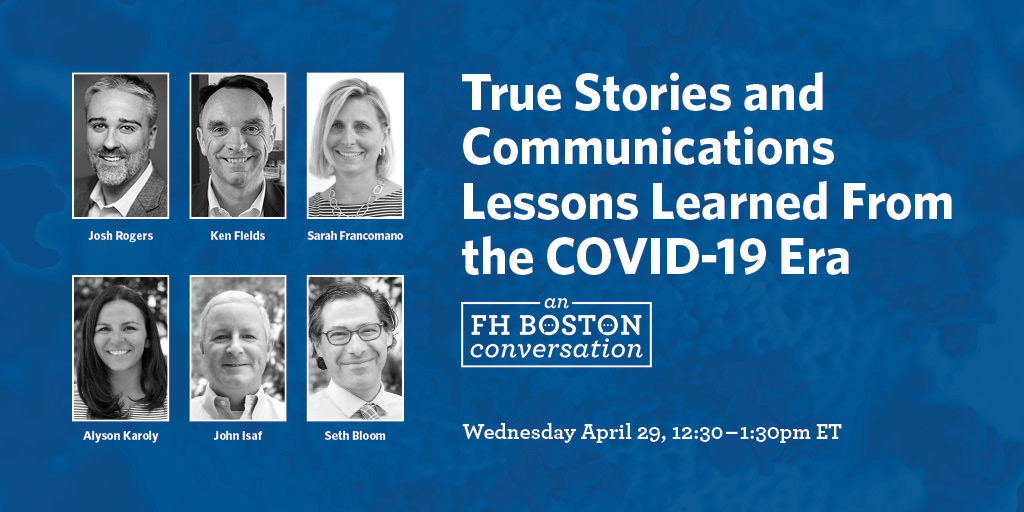
FleishmanHillard in Boston will host an hourlong virtual discussion providing communications counsel on navigating the COVID-19 pandemic and preparing for recovery. Topics will include employee communications, virtual event participation, traditional and social media behavior, and crisis preparedness — all amid the coronavirus crisis.
Senior FleishmanHillard counselors based in Boston and St. Louis will answer attendees’ questions based on the agency’s TRUE Global Intelligence consumer research, COVID-19 Taskforce and their extensive expertise.
Connect at the Intersection: Inclusivity During a Global Pandemic
April 23, 2020
By Bia Assevero
Share
COVID-19 is affecting us all – but not equally. Our experience of this pandemic depends in part on where we are in the world, what type of job we have, what our housing situation is and even how big our families are. The resilience of our healthcare systems and our ability to access care are also a determining factor as are the actions of our leaders as they work to address the public health and economic crises unfolding in tandem.
It’s often said that crisis reveals character and I find that this is as true of countries and cultures as it is of individuals. Here in the United States, it is difficult to deny that the pandemic has shone a harsh light on some of the inequalities and vulnerabilities that exist in our society.
Millions of Americans were living paycheck to paycheck before the pandemic hit to the point that, according to a study, only 29% of American households claimed to be financially healthy. We’ve seen disparities in broadband internet access impact students across the country, Asian-Americans experience greater discrimination and African-Americans die at disproportionate rates. The UN has warned that lockdown measures designed to combat the spread of the virus are also resulting in a surge of domestic violence.
None of these realities exist in a vacuum. In many ways they are the result of systemic challenges that have too often and easily been overlooked. Now that they are front and center for all to see, there is an opportunity for companies to lean into inclusivity and allow it to inform the compassionate leadership that many important stakeholders are looking for in these uncertain times.
Research from our TRUE Global Intelligence practice underscores the indelible importance of the actions taken by organizations now as well as the heightened expectations from employees and consumers that are likely to carry through once the pandemic recedes and businesses focus on recovery and resurgence.
In the global study, employers and major corporations scored at the bottom in terms of institutional response to the pandemic and 52% of those surveyed said employers taking better care of their employees is “very important” right now. A further 32% said they intend to buy from companies that took care of their employees during the crisis.
Placing diversity and inclusion at the center of strategic thinking can help meet and exceed these expectations, ensuring that organizations acknowledge the pain and challenges that might be specific to certain stakeholder groups.
Here are five ways to incorporate inclusive thinking and actions into your company’s COVID-19 recovery and resurgence efforts.
Prioritize Intersectionality — We all identify in different ways with gender, race, religion and sexual orientation being but a few. It’s the intersection of these identities that informs how we approach the world and are affected by it. A working mom may face different challenges than a stay-at-home dad; a multi-generational white family may have different concerns than a multi-generational Latino family. The key is to acknowledge the reality of these intersections while connecting back to shared experiences and common values.
Know What You Don’t Know — Don’t assume you know the full scope of your employees’ concerns without asking them for their input. If you have employee resource groups (ERGs) now is a crucial time to engage them so that employees can tell you in their own words what is top of mind and how you can be most effective in supporting them.
Act With Intent — Inclusivity requires intent; a dedicated effort to ensuring that you’ve considered all points of view. Think about the diversity of experiences across your company – for example, there may be more instances of personal loss among employees of color – and then make or tailor your decisions to be sensitive and responsive to what all of your people are going through.
Lead With Your Values — Consumers and employees are paying even more attention to the alignment between a company’s stated purpose and values and their actions. Now is the time to strengthen your commitment and show in meaningful ways that when you said diversity, equity, and inclusion (DEI) are important, you meant it.
Be Honest and Authentic — In this period of heightened uncertainty, no one has all the answers and it’s okay to say so. As much as possible, be honest about where you are in your DEI journey and how the current circumstances are impacting your priorities. If you keep it authentic, the occasional imperfection will be forgiven.
See what else is happening
You might also like
Expertise
Black Hat 2026: A Conference and Industry Transformed
August 10, 2026
Expertise
When Food Safety Crises Test Trust: A Guide for Communicators
July 24, 2026
Expertise
We Went to Cannes Lions: Where the Industry Is Trending
July 1, 2026
Expertise
Healthcare’s Moment Has Arrived. The Question Now Is: Will Your Organization Move Fast Enough?
July 1, 2026
Expertise
The Visible CEO: How Leadership Can Serve as a Strategic Asset
July 1, 2026
Expertise
How to Win the GLP-1 Food Industry Wake-Up Call
June 30, 2026
Expertise
Cannes Lions Exposed an Industry’s Transition of Power: Takeaways From Winning Work
June 26, 2026
Expertise
Lessons From Cannes: Don’t Let Speed Fail Storytelling
June 25, 2026
Expertise
Get Bold Work Out Into the World: How to Seize the Chaos Advantage
A few months ago, I would have bet on Earth Day 2020 being D-day for brands to prove their sustainability creds. The consumer mindset well and truly shifted to ‘green’ in 2019, with many changing lifestyle and consumption habits to reduce their personal impact on the climate.
Businesses had been put on notice: Either step up and address consumer sustainability demands on products and operations or risk being blacklisted.
But 2020 has taken a turn none of us could have predicted, not even on the night we said goodbye to 2019. In the days, weeks and months that have followed – life as we know it, in most countries around the world, has been turned on its head.
And so, this April 22 – the 50th Earth Day – is likely to be a novel one.
The climate crisis still exists of course, as does the passion and drive many around the world hold to protect this planet and the environment. But sustainability progress from businesses, and likewise demand from consumers, have largely been put on hold – replaced, for now, by the threat of the COVID-19 pandemic.
The fears of both individuals and businesses have justly narrowed. Most corporations are focused entirely on staying afloat during this time, as operations sharply decline or reach a standstill. Some are adapting, offering new products and services that meet the evolving needs of a world on lockdown. Others, who perhaps have more wriggle room in their bottom line, are announcing steps to support those wearing an unequal burden in this pandemic.
Consumers too have pivoted, with hygiene and health now taking precedence above all else to protect loved ones and the wider community.
A journalist at one of the U.K.’s national newspapers admitted to our team that sustainability has taken a back seat on its agenda over the past month, but clarified its ongoing significance. Sustainability remains second only to COVID-19 – and he knows it will once again take top priority once this crisis eases.
So for now we may continue to take each day as it comes. Marking Earth Day this time around a little differently perhaps, united across the world as we face a common enemy. Where it’s feasible for a brand, this calendar moment can still be leveraged – so long as it’s genuinely done for the environment. It’s not the time to push sales. But reiterating sustainability commitments or achievements, making new pledges or supporting relevant causes or organisations, even on a small scale, could help cement a brands position as a driver of positive change.
Because once the health of individuals is no longer threatened on such a scale, the health of our planet will take priority again amongst consumers. Businesses must be prepared for that next hurdle. When we emerge into a post-COVID-19 world, consumers will be significantly more conscious than before. Images of the environment thriving with less human interruption still fresh in their minds. Even if the positive environmental effects of lockdowns are only short-lived, that green consumer mindset will be back. Reduced consumption will have become the norm, and so too will reduced emissions and pollution albeit largely unintentionally. Reduced spending power will be a reality too, with many suffering losses to income.
Consumerism will change, likely for good. And brands will be facing a new fight for market share. Those built upon purpose, integrity and authenticity will thrive – and sustainability has a big role to play in each of those pillars. They’ll be held to simpler and yet higher expectations; we’ll remember and reward those who do good for the communities and world around them. Those who do good, not only with their product or service, but with their power.
So businesses are still very much on notice, in fact the stakes are now higher than ever before. Another new normal to adapt to – but an opportunity for brands, and all of us in the industry, to bring things back to what really matters. Bring brands back to Earth.
See what else is happening
You might also like
Expertise
Black Hat 2026: A Conference and Industry Transformed
August 10, 2026
Expertise
When Food Safety Crises Test Trust: A Guide for Communicators
July 24, 2026
Expertise
We Went to Cannes Lions: Where the Industry Is Trending
July 1, 2026
Expertise
Healthcare’s Moment Has Arrived. The Question Now Is: Will Your Organization Move Fast Enough?
July 1, 2026
Expertise
The Visible CEO: How Leadership Can Serve as a Strategic Asset
July 1, 2026
Expertise
How to Win the GLP-1 Food Industry Wake-Up Call
June 30, 2026
Expertise
Cannes Lions Exposed an Industry’s Transition of Power: Takeaways From Winning Work
June 26, 2026
Expertise
Lessons From Cannes: Don’t Let Speed Fail Storytelling
June 25, 2026
Expertise
Get Bold Work Out Into the World: How to Seize the Chaos Advantage
COVID-19: Recovery and Resurgence for the Food, Agriculture and Beverage Industry
April 21, 2020
By Emily Meyer
Share
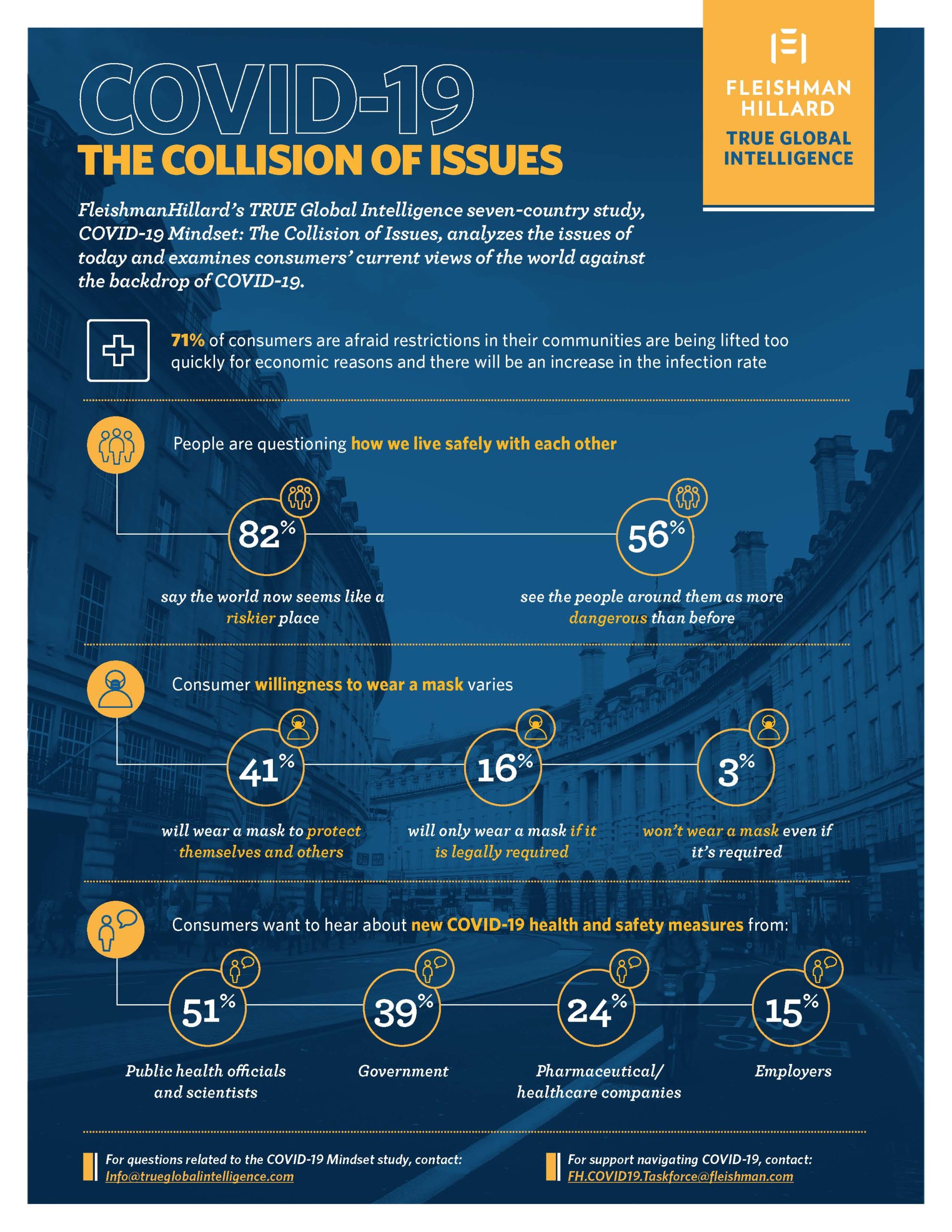
It’s clear the pandemic has forever changed the world. As the recent survey from FleishmanHillard‘s TRUE Global Intelligence practice revealed, the virus is reshaping perceptions, behaviors, values and societies. These changes will be longstanding, and they will touch every industry – including food, agriculture and beverage.
FleishmanHillard’s research, which was conducted in the United States, China, Germany, Italy, South Korea and the United Kingdom, provides a snapshot of the various stages and expectations of the crisis, voiced by a cross-section of the population. It does this on a macro level, and it offers insights applicable to the food and agriculture industry specifically. These include:
Dramatic proportions of the global population are concerned about their health and financial stability.
Consumers worldwide are concerned about the impact of this crisis on their health (78%) and their finances (74%). In fact, a full one-fifth are extremely concerned about its impact on health and finance.
Concern is higher in the U.S. for both health impact (83%) and financial situation impact (79%), and the level of concern varies by generation – with Baby Boomers and the Silent Generation expressing greater concern on the impact of COVID-19 on their health compared to young generations and Millennials and Gen X expressing greater concern about their financial situation compared to older generations.
This concern could lead to changing purchase behaviors, which could include cutting back on expenses but or purchasing foods, beverages and products they haven’t before, with the latter potentially displacing sales of their previous go-to foods and beverages.
From charitable support to new approaches to innovation, companies need to go beyond “business as usual.”
Consumers want companies to provide essential products outside of their normal offerings and create products and services that help people connect and feel less isolated. For FAB companies, this could mean restaurants offering groceries during this period and manufacturers producing products they’ve never made before, like hand sanitizer.
Many consumers also want companies to make charitable donations to organizations that are helping to lessen the impact of the crisis.
Consumer confidence will require new standards of cleanliness.
Expectations for specific standards to make restaurants, grocery stores and food safer will likely grow as the pandemic continues and recovery begins.
Already, 59% of consumers want companies to limit the number of people in a shopping or transportation locations at one time; 58% want employees to wear PPE while interacting with the public; and 40% want reduced hours to allow for deep cleaning.
It is key to recognize that these are operational changes, which will need to be factored into business models.
Employees matter.
52% of consumers described employers taking better care of their employees as “very important,” and 91% are willing to take action to support workers.
From the employees’ perspective, 82% expect social distancing measures to be implemented, 66% want better communication from their employers; 63% expect greater flexibility; and 63% want the new benefits currently implemented to remain permanent.
These findings, along with the desired safety changes, mean that changes implemented during the crisis will, at least in part, make up the “new normal” for employers and employees going forward. Companies should begin to understand how these changes will play out for themselves and their employees.
Experiences today will shape the realities of tomorrow.
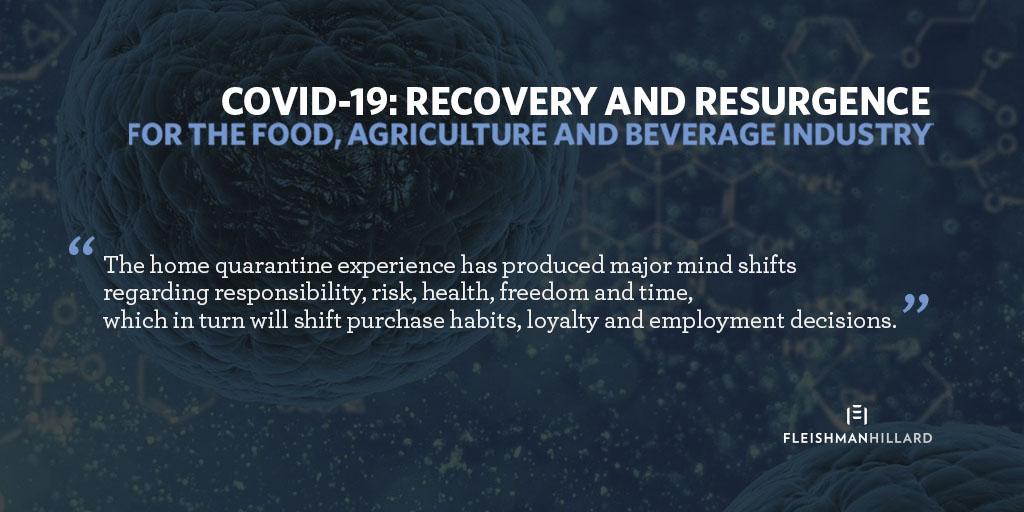
The home quarantine experience has produced major mind shifts regarding responsibility, risk, health, freedom and time, which in turn will shift purchase habits, loyalty and employment decisions.
This is particularly true for Gen Z who were not only the most likely to report that the quarantine has made them view people as more dangerous, altered their sense of time and changed their view of their living pace, but they are also the most likely to look for another job with an employer based on their support of its employees and consider how a company behaved during the pandemic when considering employers in the future.
FAB businesses should take these broader shifts into account now as they make and communicate decisions.
These insights reinforce the reality that the pandemic will have a lasting impact on the food and beverage industry. However, the specific impact will vary based on the industry sector. In the coming weeks, we’ll provide perspective from our network of in-house experts on the implications for the restaurant industry, consumer packaged goods, commodities and more.
Five Communications Imperatives for Overseas Asset Managers Eyeing a China Expansion
April 16, 2020
By Patrick Yu
Share
Strategic communications are crucial as asset managers compete to gain a foothold in China’s liberalized fund market.
China’s financial sector reforms are gathering pace despite the COVID-19 pandemic. The China Securities Regulatory Commission has just abolished foreign ownership limits for mutual fund managers on April 1, with limits for securities companies set to follow suit on December 1.
Major foreign players with a presence in China have acted swiftly to apply for majority control or full ownership of their China joint ventures. And others are expected to accelerate their market entry strategies. Given the scale of the opportunity, none of this is a surprise.
China is set to become the second-largest asset management hub in the next few years. The liberalization of the asset management space will improve foreign players’ opportunities to tap into the China market, but it has come much quicker than nearly all firms were planning for and obstacles remain.
Gaining a foothold
Foreign firms today account for only a tiny fraction of the mainland’s asset management business. The market is crowded, and local incumbents have trusted reputations, widespread distribution networks and critical local knowledge. Competition for talent, customers and fintech partners is acute.
The situation is even more difficult because of volatility due to macro challenges such as the lingering economic slowdown, trade war tension and the global COVID-19 pandemic.
There is good news in that investors in China are not biased towards local asset managers. A FleishmanHillard survey of Chinese investment professionals, conducted late last year and shared in The Future of Asset Management in China report, found that investors in China prioritize the credibility of the asset manager brand (74%) and investment performance (64%) over any considerations of the brand’s country of origin. While this indicates a more level playing field for foreign firms today, most are little known in China.
Communicating for impact
Foreign asset managers therefore need an effective brand-building strategy that helps them establish their authority and earn the trust of Chinese investors. Well-orchestrated strategic communications and reputation management are vital.
Drawing on the findings from The Future of Asset Management in China survey, here are five communications imperatives for inbound firms preparing to establish a solid foundation for growth in China.
Communicate differentiated investment strategies: Of those survey respondents who already invest in products from wholly foreign-owned enterprises or foreign-invested joint ventures, 68% said they chose to do so to gain access to unique investment strategies not otherwise available. Foreign players must therefore clearly communicate these strategies alongside evidence of their superior performance (valued by 72% of investors).
Use multi-channel communications: Similar numbers of survey respondents favoured independent financial advisors (IFAs), financial media, social media and websites for information on funds and investment products. While it can be a challenge to master multiple media channels, none can be ignored in any serious effort to engage mainland investors. The importance of people-to-people relationships and the need for trusted figures when it comes to important investment decisions also need to be taken into account.
Offer investor education: Some 82% of investment professionals in the survey want firms to offer investor education, while 76% mentioned participating in roadshows and conferences as important. This presents foreign asset managers with a clear way to build brand recognition in key locations through face-to-face interactions with investors.
Prioritize transparency: Transparency in communicating with clients is the most desirable trait of overseas asset management houses operating in China, with 60% of respondents considering it very important and a further 37% as somewhat important.
Showcase ESG expertise: More than half of respondents (52%) also identified expertise in environmental, social and governance (ESG) investment strategies as a very important requirement for fund managers, with 94% overall considering it either very or somewhat important. There is huge potential for sophisticated global firms to conquer thought leadership in this space based on their global expertise.
Earning good brand recognition in a market as large and complex as China is a challenge. But foreign asset managers that do so now have the opportunity not only to participate in the domestic retail market but also poisition themselves for success should China’s outbound investment rules be relaxed in the future.
See what else is happening
You might also like
Expertise
Black Hat 2026: A Conference and Industry Transformed
August 10, 2026
Expertise
When Food Safety Crises Test Trust: A Guide for Communicators
July 24, 2026
Expertise
We Went to Cannes Lions: Where the Industry Is Trending
July 1, 2026
Expertise
Healthcare’s Moment Has Arrived. The Question Now Is: Will Your Organization Move Fast Enough?
July 1, 2026
Expertise
The Visible CEO: How Leadership Can Serve as a Strategic Asset
July 1, 2026
Expertise
How to Win the GLP-1 Food Industry Wake-Up Call
June 30, 2026
Expertise
Cannes Lions Exposed an Industry’s Transition of Power: Takeaways From Winning Work
June 26, 2026
Expertise
Lessons From Cannes: Don’t Let Speed Fail Storytelling
June 25, 2026
Expertise
Get Bold Work Out Into the World: How to Seize the Chaos Advantage
Chinese Consumers Show All-Critical Resilience on the Road to Recovery
By Rachel Catanach
Share
“May you live in interesting times” is purportedly an old Chinese curse used ironically to indicate times of trouble. For me – and I suspect for many comms professionals – the COVID-19 pandemic potentially represents the most “interesting” project of a lifetime – both personally and professionally.
From a Hong Kong perspective, it was interesting to see how rapidly people in early February united in the fight against the virus, coming off the back of six months of civil unrest. The muscle memory from SARS 17 years earlier was quickly activated, with the masks coming out en masse almost instantly and the rules of social distancing etiquette dusted off with barely a blink of the eye.
Today, schools are still out but most businesses are endeavoring to find some mode of normality – either at their workplace or WFH. Brands are on to the next phase with questions like: When do we return to the market? And what tonality and channel is appropriate? There is recognition that full economic recovery is not likely in the near-term, but a cautious optimism that rebuilding may now be possible. There is also a realization that there will be setbacks as the virus takes hold for a second wave. But Hong Kongers are known for resilience and this pragmatic fighting spirit is probably why its COVID-19 numbers are still relatively low, despite the city’s density. Long may it last.
Globally, the road to recovery will not be a straight line so resilience will be critical. And it’s not just physical resilience but emotional as well. Nurturing this mental resilience will place a significant demand on leaders to paint a realistic picture while continuing to inspire hope. New Zealand prime minister Jacinda Adern is winning plaudits globally for her ability to reassure New Zealanders while making it clear what needs to be done to fight the virus. Another leader gaining praise for her courageous decisions is London Breed, San Francisco’s mayor, who declared a state of emergency in late February – earlier than her counterparts on the East Coast. This decision, which was politically unpopular at the time, is being heralded now as the reason for San Francisco’s flattening curve.
Employers should take note of these leaders’ strategies – as well as China’s “road to recovery” transition approach – as they start to consider back to work options. They should plan not only for ways to minimize health and safety risks for their employees but also provide them with realistic perspectives of the future, while recognizing that so many unknowns continue to exist. It will be a tough balancing act but those who do it best will be well-placed to reopen, reposition and reimagine in whatever recovery scenario they find themselves in.
So, what are cultural differences – and similarities – in global consumer sentiment as people grapple with the reality of this virus and what new restrictions on their lifestyle really mean? First, the similarities.
The panic buying of toilet paper
From Hong Kong, to Australia and Italy, the U.K. and the U.S., stock shortages of toilet paper seemed to be the psychological tipping point when information about the virus and its potential personal impact went from being intellectualized to internalized.
The slogan and song
Once the initial panic buying was over, people quickly realized that a strong mental attitude was as important as their physical health. In China and Hong Kong, people used the phrase Jia You or Ka You, which literally means Add Oil, as the rallying cry. In Italy, it was Andra Tutto Bene – all will be well. In the US and UK, stay strong and stay safe seem to be common sign-offs.
View of the world, their country and companies
According to a six-country study just released by FleishmanHillard’sTRUE Global Intelligence (TGI) COVID-19 Mindset: How Pandemic Times Are Shaping Global Consumers, the virus, in a few short weeks for some markets, has changed consumers’ view of the work, our country and companies as employers. It has upended our world views, reshaping our perceptions, behaviors, values and societies. In China, this is also true with 87% of people saying their view of the world had changed and 86% saying their view of their country had changed.
Belief in government and schools
The study revealed that consumers globally are most impressed with the response of government and schools (59% and 41% respectively) and least impressed with major corporates and employers (37% and 33% respectively). Chinese consumers had most faith in their government and local schools – 79% and 67% respectively. They also had more faith in employers than other markets, although they still rated them the lowest at 58%.
However, there are differences in attitudes and perspectives.
Chinese consumers trust each other more
According to the TGI study, Chinese consumers trust each other as individuals more with 61% believing their fellow individuals are doing “excellent” or “great” in fulfilling their role in this crisis. This is far above the global average of 34%.
However, while they trust each other, they do not think their current environment is conducive to major life decisions such as adopting a pet or having a baby. Ten percent of Chinese consumers said they were postponing adopting a pet because of the virus, more than the global average of 5%. In addition, 11% of Chinese consumers also said they were postponing having children, the second-highest group after South Korea at 28%.
Chinese consumers are also eager to get back to some semblance of normal
This perhaps is not surprising as the China government has been encouraging “back to work” since the end of February, a month after the virus really started to grip the nation. The TGI study revealed fewer Chinese consumers were practicing social distancing (44% versus global average of 74%), fewer postponing or cancelling medical or dental appointments (18% versus global average of 37%) and fewer not leaving the house except for necessities (48% versus global average of 74%).
Chinese High Net Worth consumers seem to be showing particular resilience. Supporting TGI’s findings, another study by consulting firm Agility research and strategy reveals that mainland millionaires continue to have an optimistic mindset, even after the unfolding of the COVID-19 outbreak. Out of the 81 millionaires that Agility spoke to in China, 82 percent of respondents still believed that their own economic wellbeing would improve in the future and 86 percent thought their own disposable income would grow in 2020. But they are spending their money on different things – on their health and that support a healthy lifestyle, like private health insurance.
Consumer sentiment will continue to shift as the impact of the virus moves through different phases in different markets. There is no doubt, however, an ability to withstand the pressure of uncertainty and changed living circumstances over the long haul will be one of the key markers of a nation’s, community’s, company’s and individual’s successful transition to a “new” normal.
See what else is happening
You might also like
Expertise
Black Hat 2026: A Conference and Industry Transformed
August 10, 2026
Expertise
When Food Safety Crises Test Trust: A Guide for Communicators
July 24, 2026
Expertise
We Went to Cannes Lions: Where the Industry Is Trending
July 1, 2026
Expertise
Healthcare’s Moment Has Arrived. The Question Now Is: Will Your Organization Move Fast Enough?
July 1, 2026
Expertise
The Visible CEO: How Leadership Can Serve as a Strategic Asset
July 1, 2026
Expertise
How to Win the GLP-1 Food Industry Wake-Up Call
June 30, 2026
Expertise
Cannes Lions Exposed an Industry’s Transition of Power: Takeaways From Winning Work
June 26, 2026
Expertise
Lessons From Cannes: Don’t Let Speed Fail Storytelling
June 25, 2026
Expertise
Get Bold Work Out Into the World: How to Seize the Chaos Advantage
That’s been a nearly universal theme over the past several weeks as companies around the world evaluate and reevaluate every aspect of their businesses in response to COVID-19.
Across every industry sector, global enterprises have pulled their 2020 projections and are scrambling to get their arms around how to communicate their companies’ financial stories as they’re being rewritten in real-time. In the midst of all this, a number of the companies we counsel are reworking their annual reports and rethinking their shareholder meetings to reflect their ongoing business transformation as a result of COVID-19.
As we work with them, we certainly don’t pretend to know what’s going to happen in the coming weeks and months. What we do know from long experience, however, is how to communicate authentically and transparently during tough times to a variety of stakeholders.
Here are a few things we’re suggesting that company leaders keep top of mind in their financial reporting during this most uncertain time:
It’s more important than ever to hear from corporate leadership in times of adversity.
As uncomfortable as it might be, your shareholders and investors need to hear from you.
You may be considering not publishing an annual report this year. But the changes your business is going through need to be addressed now more than ever. A strong letter from leadership can reassure audiences of your commitment and ability to leading through these difficult times.
Address shareholders directly, with an honest assessment of how the business performed leading up to this crisis and what to expect in the coming months.
You may not have all the answers. But there’s great benefit in having honest and transparent conversations with your audiences. Addressing business impacts openly can instill confidence in where the company is headed.
Set reasonable and realistic expectations.
We can’t yet predict the extent and duration of the COVID-19 pandemic, or its consequences. But it’s reasonable for shareholders and investors to expect companies to be able to articulate their expectations of the possible impacts on their businesses in different scenarios.
They also want a company to show resilience in the face of uncertainty and to lay out the key assumptions and judgments leadership is making as they adapt to a changing environment and prepare adjusted outlooks. Your annual report can be a powerful platform for articulating the company’s plan of action for dealing with the unpredictable months ahead.
Obviously, you don’t want to promise what you can’t deliver. Rather, take an honest look at your business outlook and communicate what you can, as clearly as you can.
Address COVID-19 openly and honestly.
COVID-19 has already made major changes across the entire business landscape. And it will be part of virtually every company’s story for some time to come. We suggest addressing this crisis from four angles in your annual report:
Leadership’s overall response to the pandemic
An assessment and overview of its impact on the markets you serve
How you’re addressing the needs of investors and other external stakeholders
How you’re looking out for your employees
That last point demands particular attention. There is more at stake here than just telling your financial story. Research FleishmanHillard has just released shows that how your company treats its employees will shape the public’s perception of you – for better or worse – for years to come.
Consider the opportunity video presents.
Video from senior leaders allows shareholders, investors, employees and media to hear personal messages from senior executives. In fact, as social distancing continues, it’s becoming the medium for a growing number of virtual shareholder meetings. Your key audiences crave directness and authenticity from leaders during this confusing time, and video is one way to speak more directly to them.
This could accompany the CEO letter to shareholders and include a transparent update on the business outlook and the steps your company is taking to address it.
Bottom line: no one can yet predict the full impact of this pandemic on their operations yet. Businesses are largely on common ground, navigating uncharted territory day by day. As you create your company’s operational playbook, just keep in mind that a sound, straightforward communications playbook is critical, too.
See what else is happening
You might also like
Expertise
Black Hat 2026: A Conference and Industry Transformed
August 10, 2026
Expertise
When Food Safety Crises Test Trust: A Guide for Communicators
July 24, 2026
Expertise
We Went to Cannes Lions: Where the Industry Is Trending
July 1, 2026
Expertise
Healthcare’s Moment Has Arrived. The Question Now Is: Will Your Organization Move Fast Enough?
July 1, 2026
Expertise
The Visible CEO: How Leadership Can Serve as a Strategic Asset
July 1, 2026
Expertise
How to Win the GLP-1 Food Industry Wake-Up Call
June 30, 2026
Expertise
Cannes Lions Exposed an Industry’s Transition of Power: Takeaways From Winning Work
June 26, 2026
Expertise
Lessons From Cannes: Don’t Let Speed Fail Storytelling
June 25, 2026
Expertise
Get Bold Work Out Into the World: How to Seize the Chaos Advantage
We’ve just come out of a frenzied decade of consumerism moving at such pace alongside social purchasing abilities that new vocabulary, jobs, scrolling injuries came into play – and that phenomena, in a nutshell, could be described as content. But what does the word even mean — so vapid in its usage we tagged on the word influence and slowly realised that that also, had lost all meaning.
So, it’s no surprise that when the world as we know it changed for the foreseeable future, not only did we bind together, we also seemed to beautifully regress back into the art of enjoying ‘things’. Poems, a play, a jigsaw and talking. Like an episode of The Golden Girls meets Question Time with a dash of the Brontë Sisters thrown in we all took stock of what mattered. And that my friends, was not celebrities and their ‘content’.
Take Gal Gadot’s crowd-sourced rendition of ‘Imagine’ being ridiculed by the masses for the idea that the superpowers of celebrity could save us all. We didn’t care and we moved on — the cult of celebrities and influencers seemed to exist pre-COVID-19 in a way we all know can’t continue post.
Culture happens below us like a subtle current, adapting and shifting with its societal hives forming together to be with like-minded souls. But what happened in these recent years was like a wash of worthless content that for some reason — none of us could tune out of.
Things will change and maybe for the better in the world of brand. People will still buy and we knew that they already wanted brands to give back — but maybe they will really consider what matters to them. Luxury accessories don’t seem so essential when you don’t have anywhere to go.
And let’s not forget the age-old gift of entertainment and being entertained. We all need light in the shade but that light can’t burn out our time or energy any longer.
In the rush to return to normal, use this time to consider which parts of normal are worth rushing back to…I know I certainly will be.
Please look out for the next Youth and Culture report looking at our new virtual reality across retail, food and drink spanning Gen Z and Boomer.
See what else is happening
You might also like
Expertise
Black Hat 2026: A Conference and Industry Transformed
August 10, 2026
Expertise
When Food Safety Crises Test Trust: A Guide for Communicators
July 24, 2026
Expertise
We Went to Cannes Lions: Where the Industry Is Trending
July 1, 2026
Expertise
Healthcare’s Moment Has Arrived. The Question Now Is: Will Your Organization Move Fast Enough?
July 1, 2026
Expertise
The Visible CEO: How Leadership Can Serve as a Strategic Asset
July 1, 2026
Expertise
How to Win the GLP-1 Food Industry Wake-Up Call
June 30, 2026
Expertise
Cannes Lions Exposed an Industry’s Transition of Power: Takeaways From Winning Work
June 26, 2026
Expertise
Lessons From Cannes: Don’t Let Speed Fail Storytelling
June 25, 2026
Expertise
Get Bold Work Out Into the World: How to Seize the Chaos Advantage
In this research we attempt to chart a path forward by asking difficult questions that show a new reality for companies, their narratives, their workspaces and how they are deeply interconnected with societal issues.
We must understand what we expect of institutions, each other and how this crisis is reshaping our perceptions, behaviors, values and societies before we can move forward.
At the start of lockdown, many of us were asking how we’d manage to remain in our homes for weeks. Conversations about returning to our workplaces centered on the logistical questions – how would we enable social distancing in our offices? How would they be cleaned and sanitized? There was perhaps an implicit assumption that once we solved these questions, we’d be able to return.
The conversations among and within companies and across the media changed when it became apparent some would not be able to return to the workplace when those issues were resolved. With schools closed, many reliant on public transit, and some workers and their families vulnerable, the conversation turned to how to accommodate the needs of the workforce.
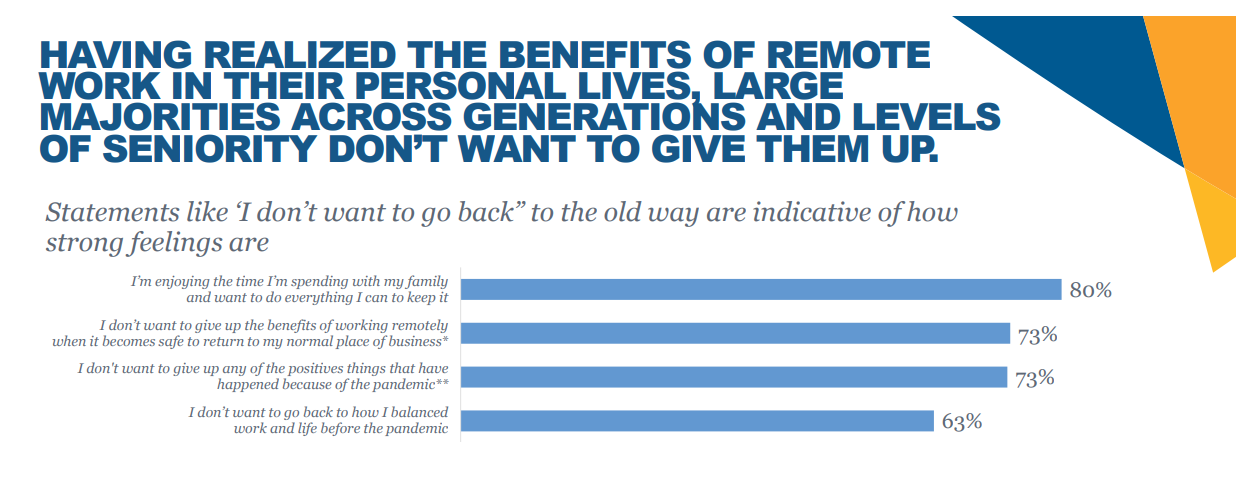
Another two weeks passed, and first in offhand remarks between colleagues and clients and then once more in media, the conversation turned again, this time to whether companies should return to the workplace, and the culture and behaviors built around it, at all because of the benefits many have found in remote work.
Those benefits haven’t been universal, and they don’t come without challenges. This is what we wanted to understand in our survey. How has telework changed the experience of work for those fortunate enough to be able to work remotely? How do they feel about the prospect of returning to their regular workplaces? What have they learned? And most importantly, how do they want work to fit into their lives from now on? The answers to these the higher-order questions will help determine the future of work.
In just a few short months, this pandemic has changed our perceptions of the world to a degree typically seen only over years and decades.
Our findings reveal changes in priorities, values and relationships driven by the role we all must play to mitigate the pandemic and its effects on society. As consumers and employees, this means a renewed focus on organizations as employers and places of public life. For brands and employers, this means the choices they make now will reverberate in consumers’ purchase decisions and workers’ employment decisions for years beyond the pandemic.
We face extraordinary uncertainty. We don’t know what work, home, school or public life will look like in the months and years ahead. To chart a path forward requires meaningful research and deep human compassion. We must understand what we expect of each other and how this crisis is reshaping our perceptions, behaviors, values and societies.
For questions relating to the COVID-19 Mindset studies, please contact [email protected] and for support navigating COVID-19, please contact [email protected].
See what else is happening
You might also like
Expertise
Black Hat 2026: A Conference and Industry Transformed
August 10, 2026
Expertise
When Food Safety Crises Test Trust: A Guide for Communicators
July 24, 2026
Expertise
We Went to Cannes Lions: Where the Industry Is Trending
July 1, 2026
Expertise
Healthcare’s Moment Has Arrived. The Question Now Is: Will Your Organization Move Fast Enough?
July 1, 2026
Expertise
The Visible CEO: How Leadership Can Serve as a Strategic Asset
July 1, 2026
Expertise
How to Win the GLP-1 Food Industry Wake-Up Call
June 30, 2026
Expertise
Cannes Lions Exposed an Industry’s Transition of Power: Takeaways From Winning Work
June 26, 2026
Expertise
Lessons From Cannes: Don’t Let Speed Fail Storytelling
June 25, 2026
Expertise
Get Bold Work Out Into the World: How to Seize the Chaos Advantage
Through the Looking Glass: What Today’s Conversations with Consumer Brands May Reveal about Trends Tomorrow
April 10, 2020
By Alyssa Garnick
Share
For the past month, we have been creatively brainstorming and strategizing with clients to reinvent our plans. While it’s difficult for many to look beyond the crisis, particularly when colleagues, friends and families have been personally touched, brands increasingly recognize that forge ahead they must.
Like many others, we have found friendship and humanity in our clients and media relationships. Some of us recall feeling similarly after 9-11 and the financial crisis of 2008: moments where we were dealing with the worst but behaving at our best.
But in this crisis, something stands out as very different as we talk to CCOs and CMOs in charge of growing consumer brands: there seems to be a call for ingenuity and confidence as we do comms planning for the near future. Although there is no firm date attached to every idea right now, and even as we may be hitting pause, we are dreaming big.
WHAT WE ARE SEEING AND HEARING RIGHT NOW
FORCED OPTIMISM — In our daily work with consumer brands, we are not seeing an undertone of doom and gloom. We are getting pushed to think differently, quickly and to match clients’ desires to market themselves and come of out of the gate appropriately and significantly when we enter the “reopen” and “recovery” stages. What really stands out is companies’ desires to do their part – and that means both giving back and not giving up.
(RE)PURPOSE AS THE NEW PURPOSE — Donating to causes or creating integrated programming is not new for global brands, however, re-interpreting the role and soul of your company in a matter of days is new. We have seen companies convert their factories, dedicate marketing efforts to support consumers, or donate to healthcare workers, and small businesses. Consumer brands are stepping up and playing a leading role in making valuable commitments to society.
AUTHENTICITY MUST INCLUDE EMPATHY — One encouraging shift is the receptivity of media to cover one-time moves or donations. Today’s approach to corporate giving is showing us that it doesn’t have to be a sustained program to be impactful so long as it’s authentic… and empathetic. Look for brands to continue to make generous offers, to cleverly demonstrate empathy, and to continue to get credit and coverage from media, even for one-offs.
FIVE TRENDS TO WATCH FOR
1) ‘TECH FOR GOOD’ GOES TO ‘TECH FOR SURVIVAL’ — Tech has just landed its permanent spot on Maslow’s Hierarchy of Needs as seniors log on to Zoom to attend religious services, five-year-olds host virtual play dates on Messenger Kids, consumers turn to apps to find supplies and stay in shape, and tenured teachers take to IGTV to share lessons. Our colleagues from China are reporting how live tech platforms are being used to keep luxury retailers selling right now as commerce re-opens, and how consumers from all age ranges are driving tech to be even more ubiquitous. Look to the near-term where stereotypes don’t stand in our way and tech tactics canvas broader audiences.
2) THE DEMOCRATIZATION OF ENTERTAINMENT, EDUCATION AND EXPERTISE — Just as singers, artists, performing arts centers, comedians, and experts are putting their talent on display for free and in new formats, they are also celebrating grassroots talent and performances as well. Watch for ongoing “gifts” to society from this creative class even long after our quarantine is over, and an ongoing reinvention of “live performances” where they still exist, but get experienced by the masses one screen at a time.
3) MARKETING BY CIRCUMSTANCE, NOT DEMOGRAPHIC — There is a very dark flip-side to our light chatter about the upcoming generation of ‘Coronials,’ to colleagues having ‘Quarantini’ Happy Hours, and to parents living with their quaran“teens” home from college. Younger generations will have a loss of innocence as loved ones fall victim to COVID-19 and jobs are lost, retirees will have bucket lists on hold or gone forever, and most Americans will find themselves as either patients or caregivers. Brands can think about micro-targeting and customizing programs for specific and unique audiences. Marketing by circumstance, not demographic, and doing hyper-targeted campaigns in 2020 and 2021 may be a good way to help your brand re-emerge and build relevance with consumers.
4) ‘EMPLOYER OF CHOICE’ AS THE NEW RATINGS & REVIEWS — Never before has the connection between the company and the brand been more important to, or more visible to consumers. In the recently released, FleishmanHillard’s COVID-19 global study, 52% of consumers described employers taking better care of their employees as “very important” right now and 32% intend to buy from companies that took care of their employees during the crisis. The workplace just got remodeled in an instant and the distance between “good employer” and “preferred brand” just got a lot shorter, so brands must articulate not just what they make but who they are – and start by evangelizing employees. When done properly, this will not only lead to better retention when the economy rebounds, but it will strengthen your public reputation and sales.
5) THE #GRATITUDE ECONOMY — Once recovery is in full effect, consumers who can spend will enthusiastically patronize small businesses and restaurants, but they will also shop brands that made a difference. Every brand will be asked by the media and consumers, “What did you do during the pandemic?” and every brand needs an answer. There is even a wiki-style website dedicated to tracking the corporate “heroes” and “zeroes” during this time. So whether your company protected jobs, delivered food to healthcare workers or made a $50 million donation, comms leads can gather the list and craft it into a statement that can live on your website (or just keep it to use reactively for when your CEO is asked the question) to document what you did to help society in its time of need. Putting your corporate empathy and generous actions on display (with modesty) will create added meaning for your products when consumers are ready or able to start their “revenge-spending.”
Bottom line: There will be widespread health and economic devastation due to the pandemic. Whether or not one fell ill to the virus in no way signals immunity from its impact. Marketing needs to reflect an understanding of consumers’ altered lifestyles and livelihoods. At the same time, rules are bending, there’s a push for optimism and an appetite for inspiration. Companies and brands that act with purpose – more proactively or positively now – will have expanded permission and credibility to reach and resonate with consumers during the long-term recovery.
See what else is happening
You might also like
Expertise
Black Hat 2026: A Conference and Industry Transformed
August 10, 2026
Expertise
When Food Safety Crises Test Trust: A Guide for Communicators
July 24, 2026
Expertise
We Went to Cannes Lions: Where the Industry Is Trending
July 1, 2026
Expertise
Healthcare’s Moment Has Arrived. The Question Now Is: Will Your Organization Move Fast Enough?
July 1, 2026
Expertise
The Visible CEO: How Leadership Can Serve as a Strategic Asset
July 1, 2026
Expertise
How to Win the GLP-1 Food Industry Wake-Up Call
June 30, 2026
Expertise
Cannes Lions Exposed an Industry’s Transition of Power: Takeaways From Winning Work
June 26, 2026
Expertise
Lessons From Cannes: Don’t Let Speed Fail Storytelling
June 25, 2026
Expertise
Get Bold Work Out Into the World: How to Seize the Chaos Advantage