In the constantly evolving COVID-19 environment, only one thing is certain: change. Change for you, your company and your employees. Among the myriad challenges the pandemic has created for employers, reductions in force (RIF) — whether temporary furloughs or permanent layoffs — are one of the most difficult and delicate to navigate.
Though sometimes a necessary tool in a company’s overall cost-reduction strategy, layoffs have potentially serious morale consequences that can cause productivity and quality issues, as well as unwanted talent drain — immediate and longer-term. Handling a RIF during a devasting global issue like COVID-19 significantly raises those stakes. According to recent FleishmanHillard COVID-19 research, 10 percent of employees will no longer be loyal to their employer because of how they behaved during the pandemic.
How employers communicate during these times of uncertainty — and how exiting employees are treated — will impact employee engagement moving forward. Applying best practices from FleishmanHillard’s three decades of RIF experience can help you maintain productivity and loyalty among remaining employees following layoffs.
Engage and align leaders. Employees are looking to their leaders for clarity and guidance. Ensure leaders, mid-level managers and HR specialists are trained, coordinated and prepared to consistently communicate the why behind these difficult, but necessary actions … and the measures in place to help impacted employees with their transitions.
Be compassionate — but clear. Any RIF is difficult for employees, whether temporary or not. With safety restrictions on in-person meetings, RIF notification conversations over video can feel particularly cold. To mitigate this, acknowledge the less-than-ideal circumstances. If individual notifications are possible, one-on-one conversations remain best practice. If a virtual group notification is required due to logistics, make it clear to employees that this is not an approach you would take in normal circumstances. Follow up with individual conversations with all impacted employees. Provide specific, straightforward information regarding the employee’s departure (length of furlough, guidance on qualification for unemployment benefits, severance packages, retirement benefits, career transition support, etc.) and a dignified exit. To those who remain, articulate a clear path forward that continues to build trust and provide hope for their future. If there is a plan for returning furloughed employees to work, clarify the criteria under which that will happen, how you’ll notify them and the timeline, if known.
Protect your employees and your company. Layoffs can be emotionally charged. Provide security that protects employees but does not communicate an “armed camp.” Be sure to protect your intellectual assets as well, safeguarding sensitive company information on employees’ computers or in their files and restricting their access to work-related information. If furloughing employees, be sure to understand and follow all applicable laws, regulations and labor agreements. Typically, employees cannot engage in any work on behalf of the company for any length of time, including taking calls or monitoring email, without receiving payment.
Engage furloughed employees regularly. Typically, employees on furlough can choose to voluntarily receive non-work-related company communications. Consider offering high-level company news updates, resources around wellness or training opportunities (if the training does not provide services to, or generate revenue for, the company) to ensure employees feel connected and supported professionally. To maintain personal relationships, consider hosting virtual happy hours or hobby-based social clubs, such as a virtual book club. Just be sure to avoid any work-related conversation.
Establish alternate channels to reach furloughed employees. While furloughed employees cannot be contacted via company email, collaboration tools or company-provided devices, there are ways to reach them. Personal devices and email accounts (with employee permission), direct mail, dedicated social channels and intranets scrubbed of project-related information can all be used to share recall information, such as changes in time frame and which roles and locations will return first.
Gather — and address — feedback. Informal conversations, focus groups or a dedicated email address for feedback can unearth RIF-related issues that management should address. These pulse checks can help gauge credibility, morale and engagement, and identify questions employees want answered. If your company must permanently downsize, restructure and/or pursue layoffs, review this checklist for a guide to communicating throughout the process. Each step ensures communications teams and stakeholders are aligned and prepared throughout the transition.
Consider the impact on your employer brand. For better or worse, your RIF or furlough approach will be a discussion topic and possible sticking point for potential new hires now and in the future. Fourteen percent of job candidates will look into how a company behaved during the pandemic when considering whether to work there. Your company’s treatment of its employees throughout COVID-19 will become a case study they will examine closely. How you handle a RIF or furlough is another piece of the employee puzzle you need to get right – for the sake of both current and future employees.
View additional COVID-19 counsel from the FleishmanHillard global network here.
See what else is happening
You might also like
Expertise
Black Hat 2026: A Conference and Industry Transformed
August 10, 2026
Expertise
When Food Safety Crises Test Trust: A Guide for Communicators
July 24, 2026
Expertise
We Went to Cannes Lions: Where the Industry Is Trending
July 1, 2026
Expertise
Healthcare’s Moment Has Arrived. The Question Now Is: Will Your Organization Move Fast Enough?
July 1, 2026
Expertise
The Visible CEO: How Leadership Can Serve as a Strategic Asset
July 1, 2026
Expertise
How to Win the GLP-1 Food Industry Wake-Up Call
June 30, 2026
Expertise
Cannes Lions Exposed an Industry’s Transition of Power: Takeaways From Winning Work
June 26, 2026
Expertise
Lessons From Cannes: Don’t Let Speed Fail Storytelling
June 25, 2026
Expertise
Get Bold Work Out Into the World: How to Seize the Chaos Advantage
Race and the Technology Sector’s Reckoning: Questions to Ask Now
June 30, 2020
Share
The technology sector has an outsized role to play in supporting health and economic outcomes, and in enabling people to live better lives. The industry itself has created that expectation, with the promise of improved well-being so often highlighted by tech leaders when they talk about their products and services, partnerships, job creation and investment growth.
But 2020 has brought with it the beginnings of a real reckoning that will see the tech sector grapple not only with its own industry challenges, but also with some of the most difficult moral and ethical questions of our time.
From the privacy concerns associated with the contract tracing tools needed to combat the COVID-19 pandemic, to active debates about the degree to which the lack of diversity in tech builds inherent bias into products and services, it is time for tech companies and leaders to ask themselves how serious they are about lifting up all people equally and improving society.
The research described in this report is focused on the recovery from the global pandemic, and its implications for business and society. But between the time our research was completed and released here, the reality of centuries-old, institutionalized racism and injustice has forced us to take a deep and painful look at our societies and demand that we take urgent action.
The murder of an unarmed Black American named George Floyd at the hands of police in Minneapolis on May 25, 2020, was brutal and shocking, but unfortunately, not a surprise to millions of Black Americans who know that they — or someone they love — could easily have been in his place.
Mr. Floyd’s name was brutally added to the list of killings that includes Trayvon Martin, Tamir Rice, Michael Brown, Eric Garner, Philando Castile, Breonna Taylor, Ahmaud Arbery and too many others over too many years. Sons, daughters, mothers, fathers, friends. Too often America — especially White America — has ignored the value of their lives and the truth of their deaths.
But George Floyd and the 8 minutes 46 seconds that ended his life have not been ignored. They have instead sparked outrage and, as momentum builds behind protests all over the world, the first seeds of optimism that this time change will be real and lasting. The cellphone video that bore witness to Mr. Floyd’s murder generated a call to action and a breakthrough in public awareness, evidence that technology will be instrumental in achieving meaningful change.
Every company has the obligation to take sustained action that will bring fairness and equity to people who have been attacked and excluded for no other reason than the color of their skin. However, as Henry Timms and Jeremy Heimans describe in their book on new power dynamics, the technology industry plays a part in transforming power into current rather than currency and making it available to people regardless of race, class and economic status. That can have a bigger impact on ideas, information and the economy, and thus creates a bigger ethical obligation for tech companies to use their strengths for good. They can do that through the visibility of their words and their substantial donations to good causes, but it must go much further and start with getting the industry’s house in order.
Actions that diversify talent pipelines, increase representation of Black and Brown people, offer pathways to executive leadership and create a true culture of belonging are no longer nice to have. They are central to building trust and reputation.
Here are some of the questions businesses and leaders must ask themselves in order to ensure they are fit for purpose now and in the future:
What actions are you taking to build a real pipeline for a diverse workforce?
What additional programs and resources will you put in place to recruit and develop more people of color as talent and leaders?
How are you defining diversity and considering intersectionality? Are you thinking about women of color and people of color in the LGBTQ+ community? Have you narrowed your focus to board diversity or are you thinking holistically?
Have you considered actions to help ensure you have diversity in your supply chain?
Are you thinking about converting your contract workers into permanent employees and offering them better compensation as one path to reducing economic inequality?
What other actions are you planning to take, if any, that will meaningfully contribute to justice and equity, internally and externally?
Are there policies and practices you need to address in order to be more inclusive?
Are you committed to regularly listening to your Black and Brown employees?
After listening, even if what you hear is unfavorable, are you committed to action?
Are you willing to use your voice (including executives), your platform, your channels and your influence to fight against injustices, stand in solidarity with Black and Brown communities and advocate for their rights?
Have you been present, passionate leaders or willful witnesses?
Have you as individual leaders or as an organization donated to political PACs or candidates that may be perceived as being at odds with commitments to inclusivity and justice?
At FleishmanHillard, we have committed to taking action and accountability in our own organization. We join with leaders in the technology industry calling for equity, and for an end to the passive expectation that things will change over time. Whether it is justice in a court of law, or economic and social justice, justice delayed is justice denied.
A highly infectious virus with global pandemic status doesn’t exactly lend itself to playing, viewing or hosting sport. Many sports necessitate extremely close contact, on and, of similar business and cultural importance, off the pitch.
Whether you’re in a rugby scrum or scrumming to get drinks at half time, social distancing and sport are at best, majorly inconvenient – at worst, totally incompatible.
COVID-19’s effect on sport, set against the backdrop of decades of rampant globalisation of tournaments, events and leagues, has therefore been particularly profound. Major global sporting events postponed, and almost all major leagues have been on hold for months.
It is thus an equally tumultuous time for sports marketers, for whom the value of nimble creativity has become business-critical. Simply put, short-term investment in creative resources can be the silver bullet of delivering both immediate impact in response to COVID and long-term brand affinity and recall – think a global footwear brand’s ‘Play inside, play for the world.’
As we move further into the unknown, yet closer to a return to sports, brands and rights holders must take a closer look at how to deploy their rights. Traditional sponsorship amplification won’t help bridge the connection between fans and a sport they can’t get close to. A more nuanced and creative approach has a unique opportunity to bring passion points to the fans.
The complexity and gravity of the situation we find ourselves in has led us to trace sports marketing success stories through the pandemic. What constitutes a timely, meaningful and effective campaign can be grouped into four simple principles – providing important lessons and guardrails as we move forward.
1. Be meaningful: Support struggling organisations with genuine purpose
The financial challenges which many clubs, leagues and administrations find themselves facing present brands with a unique chance to generate a long-standing and potentially valuable affinity with fans.
2. Be entertaining: Transport consumers to their happy place
While the gravity of COVID-19 cannot be overstated, it should in no way inhibit brands from providing light-hearted support to their audiences. Fans are desperate for fun and shareable content to alleviate the weight that everyday life now brings.
International governing bodies have stepped up to celebrate annual events and transport them into people’s homes, whilst partners have sought to get fans as close to the action as possible; leveraging branding rights and access to top talent – also hankering for some friendly competition.
3. Be nimble: Change is the only constant
Exploring cultural tension has always been crucial to a successful campaign. Currently, what is and isn’t feasible or acceptable is shifting on a near daily basis. As a result, the need to be flexible and react to these changes in a way that is both fast enough to retain relevance, but calculated enough so not to appear inconsiderate, is essential.
4. Above all — Be ruthlessly creative: Data-driven, creatively charged
Capturing the audience’s attention while sport is on live-pause means the usual playbook is out the window. There is just one rule. To simply give fans something to fill the COVID-19 shaped sporting hole in their lives. The data and insights are there as the yellow brick road, waiting for those brave enough to ideate, innovate and implement.
Recovery and Resurgence Communications: What Tech Sector Pros Need to Do Now
Share
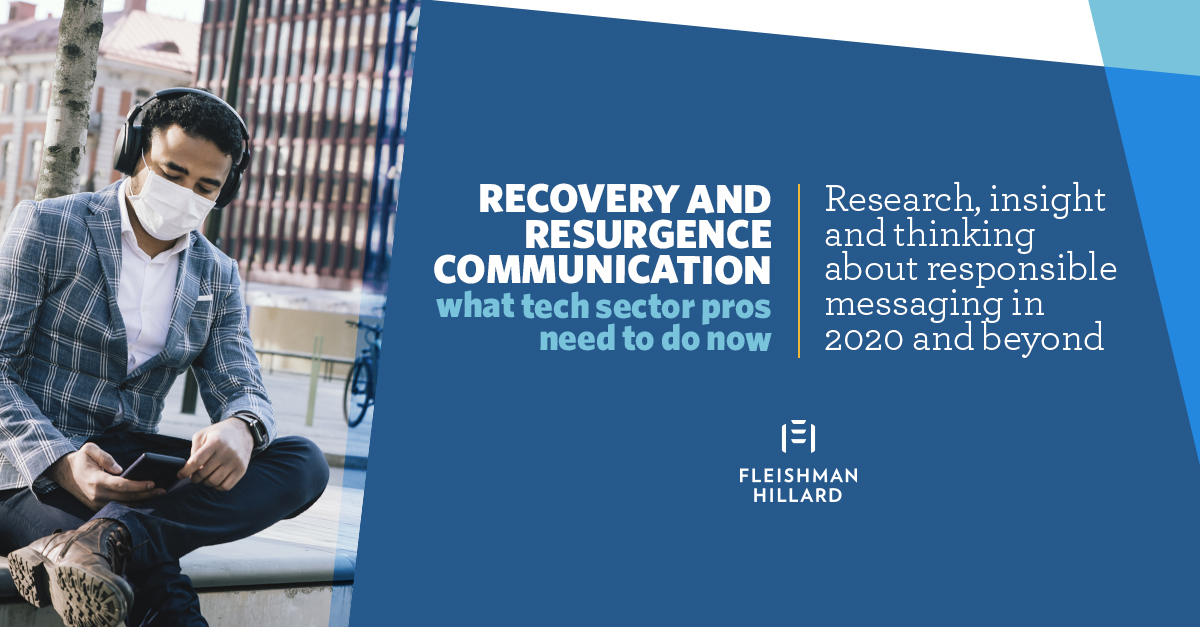
Research, insight and thinking about responsible messaging in 2020 and beyond
Today our president and CEO, John Saunders, is speaking at Collision, termed by Politico as “the Olympics of tech”, on the topic of ‘responsible messaging in a pandemic’.
And frankly, never has the concept of responsible messaging been more important to tech companies – and communications professionals in the tech sector – than it is today.
Working in communications in 2020 – grappling with a global pandemic, economic meltdown, and now an outpouring of righteous emotions focused on eradicating institutional and systemic racism – has left tech sector comms pros dealing with one of the most difficult communications, and frankly ethical, challenges of an entire generation.
On the one hand, so many organisations have been trying to save, adapt, pivot or reimagine their business – strategies less aimed at building a thriving, diverse and fair company, but more focused on surviving a global pandemic.
On the other hand, we’ve borne witness to the abhorrent deaths of George Floyd, Breonna Taylor and Ahmaud Arbery and are grappling with the social and economic impacts of a global pandemic. In this context, employees, customers, policy makers and community leaders all expect tech companies to take a stand, adapt and evolve their behaviors, and do everything possible to support the extraordinary demands and needs of this most critical of times.
So much of the narrative of 2020 is rightly about how tech companies are dealing with the sector’s deep-seated challenges around Diversity and Inclusion; how they’re treating employee needs; whether they’re making commitments to support front line workers; and where they’re providing their software or solutions to help customers deal with the challenging environment.
In short, recovery and resurgence communications in 2020 is not just about economic survival and revival. It is now about social reckoning, emotional recovery, the resurgence and emergence of doing what’s right, for all of society and all stakeholders.
Not surprising then, that research we commissioned at the start of May, even before race rightly became the focal point of our collective minds, outlines a renewed focus on values, culture and purpose on the part of employees. They are telling companies to rethink more than just financial expectations and immediate challenges like return to the workplace. There will need to be a new contract and a new responsibility-focused, values-led conversation between employer and employee moving forward. And race, diversity and inclusion will have to be core to that conversation.
So how do tech sector comms pros navigate all of this? How can they help shore up the company’s immediate term survival, while also keeping one eye not just to the people that will enable its long-term success – employees, customers, partners and the wider stakeholder community – but also on the critical importance of eradicating entire systems and structures that exclude or disadvantage certain communities?
Today, we have launched a report, titled Recovery and resurgence communications: what tech sector pros need to do now, to share practical insights and advice on how to navigate the rest of 2020. Clearly it does not have anywhere near all the answers. But in it, we acknowledge both the opportunities and challenges that lie ahead. There will be a reckoning for tech when it comes to race, diversity and inclusion. There is bound to be a re-appraisal of techlash. We’ll need to evolve comms team infrastructures. There will be an evolution of employees’ expectations on where, when and how they’ll work. And we know there is already a radically different media and events landscape to navigate.
In short, we look to help comms pros not only do what’s needed for business survival, but also do the right thing, on behalf of all stakeholders.
FleishmanHillard will host a webinar discussion about the legal, ethical and medical issues associated with various risk management approaches in returning to work and access to services during COVID-19.
FleishmanHillard’s Anne de Schweinitz, global managing director, Healthcare, and Mark Senak, senior vice president and partner, will be joined by Dr. Kristian Andersen, infectious disease expert at Scripps Research Institute, and attorney Chai Feldblum, former commissioner of the Equal Employment Opportunity Commission (EEOC) and Director of Workplace Culture Consulting at Morgan, Lewis & Bockius LLP.
Together, they will address the value of antibody testing, immunity passports, employee rights to privacy during a pandemic and many more issues stemming from the impact of COVID-19 on the workplace.
See what else is happening
You might also like
News
The Chaos Advantage: How Brands Win in a Volatile World
June 25, 2026
News
The Chaos Advantage: FleishmanHillard Research Finds Caution Has Become the Riskiest Strategy in Marketing
June 22, 2026
News
FleishmanHillard Releases U.S. ‘License to Lead’ Report, Revealing Sharp Confidence Gap Between Executives and Stakeholders
June 2, 2026
News
FleishmanHillard Launches the “America 250” Unit to Help Organizations Navigate a Historic Milestone
May 12, 2026
News
PRovoke Media Names FleishmanHillard a Top Agency in the UK and Europe
April 30, 2026
Expertise
Live from the PRWeek Sports Conference: A Team-First Approach to Communications
April 28, 2026
News
Rebecca Weinstein and Jonathan Arias Win the 2026 U.S. Young Lions Digital Competition
April 23, 2026
Expertise
The New Culture Gap Report: How Brands Stay Relevant for 100 Years
March 24, 2026
News
FleishmanHillard Named Among PRovoke Media’s Best Public Relations Agencies in the World
Moving to Remote Engagement with HCPs and Patients
June 11, 2020
By Corporate Marketing
Share
FleishmanHillard Ireland works with a wide variety of companies in the healthcare sector across Ireland, EMEA and globally, including pharmaceutical, devices and diagnostics, advocacy and consumer health. Working with our clients, we devise communications strategies that cover reputation management, product launch and life cycle management, public affairs and policy, and digital and social outreach. Traditionally […]
During a global pandemic and a nation-wide lockdown, consumers have been forced to change their daily routines. Not only are they spending more time indoors, but they’re also spending 50% more time online. As a result, shopper behaviour has changed and businesses are seeing the impact of this. […]
Returning to the U.S. Workplace in the COVID-19 Landscape
May 28, 2020
Share
Effectively managing the return of employees to the workplace is not a new topic for any of us, as we’ve all been planning for it since the beginning of the COVID-19 crisis, but it is entirely unprecedented. There never has been a situation – not a health event, terrorist attack or natural disaster – that has resulted in such widespread and significant disruption or change to our businesses.
It is important to remember that many employees are not returning to work, because work for them never stopped. Instead, we’re talking about returning to the workplace. There is no playbook for the complexities we are facing, and there is certainly no one-size-fits-all approach that will apply to every organization’s entire workforce or geographic footprint. This transition represents a complicated intersection of politics, public health, individual health, personal privacy and financial security.
We offer some insights and guiding principles below to help weigh these complex and often competing interests as employees begin returning to the workplace.
Take an Employee-Centric Approach
Returning to the workplace is the top priority for many organizations at this moment, as it should be. But managing this process can’t be done at the expense of keeping employees informed, engaged and aligned while navigating other COVID-19-related issues – such as pay cuts, furloughs and layoffs – or other “business as usual” internal communications and employee engagement challenges. That’s because missteps with your people can translate to big problems for retention, productivity, not to mention brand reputation issues and negative impacts on consumer and investor sentiment. These checklists will help you examine important considerations that will keep your people at the center of your return-to-the-workplace plans and mitigate some of those risks.
Mind the Evolving Privacy Landscape
Any kind of crisis demands a swift and decisive response, and often that response involves some type of change. Rarely has a crisis rolled across the globe as quickly or comprehensively as the COVID-19 pandemic. Some of the changes that come in its wake will be temporary, some may be permanent. But a number of them, if not approached thoughtfully, carry considerable reputational risk.
That’s true of any major changes in the way organizations gather or use sensitive personal data – but it’s especially true of changes in the use of health‑related data. Even asking for basic symptoms for each employee every day to allow access to the building will require a different standard of care, both in terms of how it’s stored and the expectations the individual and others will have of keeping it secure and private. How those changes are navigated will depend not only on the organization, but on the audiences that need to be engaged. And the reputational stakes are high. Public sentiment is likely to be volatile for the foreseeable future, as people weigh their willingness to surrender some measure of privacy against their desire for more freedom of movement or the ability to return to work.
The choices organizations will have to make carry a range of risks, from operational to legal and regulatory, and it’s critical to be fully prepared for the level of scrutiny under which new privacy-related measures may come. That’s why your communications team needs to be at the table as high-level decisions are made, playing an active role in thinking through how or where reputational risk may emerge. Just as important, they can help ensure that the organization communicates clearly and transparently with critical audiences about what changes they should expect and how long those changes will endure. This kind of straightforward communication can not only limit risk but has potential to grow trust with key stakeholders.
Expect Public Affairs Challenges and Opportunities
The COVID-19 crisis has created a tricky landscape for organizations because every move toward returning to the workplace is being scrutinized closely in a very fluid environment. At the same time, businesses are getting conflicting advice and requirements from the federal government, states and even local governments within the same state. Despite all the harm from the coronavirus, there is opportunity for companies that proactively solve societal challenges.
As always, companies need to monitor the situation, think steps ahead and plan for possible scenarios. Being prepared is more critical now for organizations to be able to adjust plans when the landscape shifts. This is a minimum.
To be positioned to navigate the current terrain successfully, our advice to companies is . . .
Know who you trust. Who and what guides your decisions about returning to the workplace? Pick the authority that you trust.
Stay above the political fray. It’s an election year and with government’s heavy role in the response, reopening has created yet more political fissures.
Keep audiences informed. Explain what you are doing, and why, in way that is true to your mission.
Look ahead and help solve what government cannot. What can you do that helps solve issues society will face? We will need partnerships to address the many issues that COVID-19 has exposed.
Anticipate the Next Crisis — Your Stakeholders Expect Preparedness
Some of the answers to the most critical questions surrounding return to the workplace are being hotly debated. Amidst this uncertainty and conflict-prone environment, it is on businesses to develop their own plans for reopening, including outfitting employees with personal protective equipment, enforcing social distancing between employees and customers, instituting testing in the workplace and navigating any ensuing hurdles.
We were all caught off guard to some degree by COVID-19 and some organizations’ stakeholders temporarily allowed for some leeway in terms of responding to issues or crises. Now, stakeholders universally have been impacted to varying degrees, from home-schooling to managing grief, and will have little tolerance for incidences in the future. While this is certainly not the “age of perfection,” stakeholders expect that companies have taken the time to prepare for a return and have the necessary mechanisms in place to handle potential crises.
Organizations must rise to the occasion and prepare accordingly. This requires that they build the necessary crisis response architecture, rank their vulnerabilities based on likelihood of potential damage or disruption, and proactively conduct scenario planning to prevent small incidents from becoming bigger crises.
As organizations embark on this uncharted territory, it is important to remember that history will remember how they behaved in this moment. Being proactive and intentional with communications planning will be essential in how businesses and their reputations emerge in the new normal.
See what else is happening
You might also like
Expertise
Black Hat 2026: A Conference and Industry Transformed
August 10, 2026
Expertise
When Food Safety Crises Test Trust: A Guide for Communicators
July 24, 2026
Expertise
We Went to Cannes Lions: Where the Industry Is Trending
July 1, 2026
Expertise
Healthcare’s Moment Has Arrived. The Question Now Is: Will Your Organization Move Fast Enough?
July 1, 2026
Expertise
The Visible CEO: How Leadership Can Serve as a Strategic Asset
July 1, 2026
Expertise
How to Win the GLP-1 Food Industry Wake-Up Call
June 30, 2026
Expertise
Cannes Lions Exposed an Industry’s Transition of Power: Takeaways From Winning Work
June 26, 2026
Expertise
Lessons From Cannes: Don’t Let Speed Fail Storytelling
June 25, 2026
Expertise
Get Bold Work Out Into the World: How to Seize the Chaos Advantage
The impact of COVID-19 has accelerated the future of work and the need for flexible working, increased diversity, inclusion and collaboration, and the digital transformation of the communications industry. Many communicators find themselves looking for resources to prepare for this ambiguous ‘new normal.’
Join The Drum and Deltek’s webinar to learn tactics, strategies and opportunities for communications agencies and their employees to brace for and thrive in the future of work. FleishmanHillard Fishburn‘s Christopher Onderstall will join Chris Sutcliffe of The Drum Network, Sera Holland of The Fawnbrake Collective and René Praestholm of Deltek Agency Solutions in this virtual discussion.
See what else is happening
You might also like
News
The Chaos Advantage: How Brands Win in a Volatile World
June 25, 2026
News
The Chaos Advantage: FleishmanHillard Research Finds Caution Has Become the Riskiest Strategy in Marketing
June 22, 2026
News
FleishmanHillard Releases U.S. ‘License to Lead’ Report, Revealing Sharp Confidence Gap Between Executives and Stakeholders
June 2, 2026
News
FleishmanHillard Launches the “America 250” Unit to Help Organizations Navigate a Historic Milestone
May 12, 2026
News
PRovoke Media Names FleishmanHillard a Top Agency in the UK and Europe
April 30, 2026
Expertise
Live from the PRWeek Sports Conference: A Team-First Approach to Communications
April 28, 2026
News
Rebecca Weinstein and Jonathan Arias Win the 2026 U.S. Young Lions Digital Competition
April 23, 2026
Expertise
The New Culture Gap Report: How Brands Stay Relevant for 100 Years
March 24, 2026
News
FleishmanHillard Named Among PRovoke Media’s Best Public Relations Agencies in the World
After the Lockdown: Health Data Privacy and Reputational Risk
May 26, 2020
Share
Any kind of crisis demands a swift and decisive response, and often that response involves some type of change. Rarely has a crisis rolled across the globe as quickly or comprehensively as the COVID-19 pandemic. Some of the changes that come in its wake will be temporary, some may be permanent. But a number of them, if not approached thoughtfully, carry considerable reputational risk.
That’s true of any major changes in the way organizations gather or use sensitive personal data – but it’s especially true of changes in the use of health‑related data. How those changes are navigated will depend a great deal not only on the organization, but also on the audiences that need to be engaged. And the reputational stakes will be high. Public sentiment is likely to be volatile for the foreseeable future, as people weigh their willingness to surrender some measure of privacy against their desire for more freedom of movement or the ability to return to work.
The choices organizations across the board will have to make carry a range of risks, from operational to legal and regulatory, and it’s critical to be fully prepared for the level of scrutiny new privacy-related measures may come under. That’s why your communications team needs to be at the table as high-level decisions are made, playing an active role in thinking through how or where reputational risk may emerge. Just as important, they can help ensure that the organization communicates clearly and transparently with critical audiences about what changes they should expect and how long those changes will endure. This kind of straightforward communication can not only limit risk but has potential to grow trust with key stakeholders.
Further, making sure any new measures are communicated in a way that aligns with your organization’s values and that focuses broadly on health and safety will make the difference in whether the days ahead enhance or undermine that stakeholder trust.
Based on our experience, we see the path forward on COVID-19-related data privacy issues as a four-step process:
Make sure a reputational lens is placed on decisions about how personal data will be collected and where it will be shared.
Think through and prepare for reputational risks these new measures and policies may present.
Maintain as much transparency about any new data collection methods and data sharing policies as possible; that includes setting expectations about how long they may be in place.
Have a clear plan for communicating changes and expectations to employees and other audiences that frequently interact with your organization.
As part of that communications planning, the following are some of the most critical questions to anticipate from key stakeholder groups.
Employees
Key Question: What’s going to be different and what will it mean for me?
In the end, employees will be your most critical audience to engage with and the most important to get right. They will likely be the ones who experience the most change and who will probably be volunteering the most personal data. The most important considerations will be to make sure you maintain as much transparency as you can regarding any changes in the way their data will be shared and collected, and that you also make clear any and all steps being taken to maximize employee health and safety. Transparency can be tricky in some instances. But being as open as you can initially, while also being open to and prepared for questions, will go a long way to earning both near- and long-term trust.
Customers and Clients
Key Question: Can I trust this organization to do the right things to keep me and others safe?
This will obviously depend on how your organization interacts with your customers and clients, but it should be relatively straightforward, as well. If you implement extra measures that involve gathering or using more customer or client data – and particularly if those measures aren’t readily apparent – you’ll need to set very clear expectations with your clients or customers. If data is being collected or shared in ways that might surprise them, they should be proactively informed. In some cases that might be as simple as a sign at an entrance. The primary goal is to ensure that they get this critical information from your organization and not someone else.
Regulators and Lawmakers
Key Question: How much do we define for our constituents and how much do we leave for them to decide in terms of what data is collected for public health purposes and how?
In some cases, the dynamics with this audience will be very different. With a few exceptions, most interactions organizations have had with regulators and lawmakers regarding the use and collection of personal data have either been either by law or have been in reaction to an inquiry of some kind. Given the scope of the COVID-19 response, there may be many instances that require more engagement with this audience, but there are opportunities for collaboration, as well. There’s no playbook for how to respond to a public health crisis of this size and scope, so this collaboration will be key – not in the sense of agreeing to everything regulators or officials ask for, as much just having an idea of where the limits of cooperation might be for your organization.
Interest Groups
Key Question: How far is “too far” in allowing access to personal data?
The response to this question may differ significantly depending on an individual group’s agenda. Labor groups, for example, will require active, collaborative and, ideally, transparent engagement. But the key point is this: The rules of engagement with many of these groups will largely be set by how your organization manages these changes with employees and customers in the first place. Engaging effectively with those core audiences will help mitigate any potentially contentious issues interest groups may raise. Absent that, these groups may be more primed than usual to push back directly and, potentially, in more public ways.
Data Privacy Activists and Reporters
Key Question: Who is getting it wrong in terms of the use and collection of personal data?
Just as with interest groups, how you handle your other core audiences will help to shape the dynamics of your interactions with journalists. So far, many activists have been willing to cede the fact that public health needs demand significant changes to how personal data is used and shared. However, that may not hold for long, and there’s no doubt they will be looking for examples they can portray as “bad actors” in their use or collection of personal data. Journalists, even many in the security and privacy space, have largely been focused on COVID-19. But as they return to their normal beats, they too will be looking for similar examples. To handle any contentious engagement with either of these audiences, it’s critical to ensure that your communications team has a clear view into the roll-out of your changes, a well as a sound plan for communicating those changes and staying ahead of potential issues.
See what else is happening
You might also like
Expertise
Black Hat 2026: A Conference and Industry Transformed
August 10, 2026
Expertise
When Food Safety Crises Test Trust: A Guide for Communicators
July 24, 2026
Expertise
We Went to Cannes Lions: Where the Industry Is Trending
July 1, 2026
Expertise
Healthcare’s Moment Has Arrived. The Question Now Is: Will Your Organization Move Fast Enough?
July 1, 2026
Expertise
The Visible CEO: How Leadership Can Serve as a Strategic Asset
July 1, 2026
Expertise
How to Win the GLP-1 Food Industry Wake-Up Call
June 30, 2026
Expertise
Cannes Lions Exposed an Industry’s Transition of Power: Takeaways From Winning Work
June 26, 2026
Expertise
Lessons From Cannes: Don’t Let Speed Fail Storytelling
June 25, 2026
Expertise
Get Bold Work Out Into the World: How to Seize the Chaos Advantage