The COVID-19 pandemic has substantially impacted businesses globally. Even as governments begin to ease lockdown restrictions and restart economies, the crisis will have a lasting effect. For organizations, their business, customers and employees will attempt to navigate this uncertain “new normal” while adjusting to new health and safety regulations.
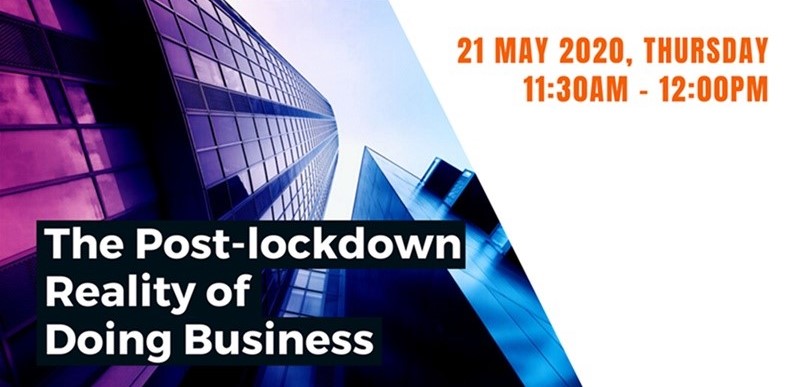
Brian West, managing director of FleishmanHillard’s Crisis Communications practice, will explain how companies can prepare for business and organizational communications in the COVID-19 recovery phase.
See what else is happening
You might also like
News
The Chaos Advantage: How Brands Win in a Volatile World
June 25, 2026
News
The Chaos Advantage: FleishmanHillard Research Finds Caution Has Become the Riskiest Strategy in Marketing
June 22, 2026
News
FleishmanHillard Releases U.S. ‘License to Lead’ Report, Revealing Sharp Confidence Gap Between Executives and Stakeholders
June 2, 2026
News
FleishmanHillard Launches the “America 250” Unit to Help Organizations Navigate a Historic Milestone
May 12, 2026
News
PRovoke Media Names FleishmanHillard a Top Agency in the UK and Europe
April 30, 2026
Expertise
Live from the PRWeek Sports Conference: A Team-First Approach to Communications
April 28, 2026
News
Rebecca Weinstein and Jonathan Arias Win the 2026 U.S. Young Lions Digital Competition
April 23, 2026
Expertise
The New Culture Gap Report: How Brands Stay Relevant for 100 Years
March 24, 2026
News
FleishmanHillard Named Among PRovoke Media’s Best Public Relations Agencies in the World
Post-COVID-19 Reboot Offers Ideal Chance to Reimagine Inclusion
May 20, 2020
Share
Isolated. Excluded. Inconvenienced. You probably have experienced one or more of these emotions due to COVID-19 and the rigid restrictions it has forced into our lives.
In recent weeks, nearly everyone has battled the ongoing challenges these conditions pose. But for one part of the population, it’s nothing new. That adds needed emphasis to today, Global Accessibility and Awareness Day. The day is dedicated to talking, thinking and learning about digital access and inclusion for people with different disabilities.
Many persons with disabilities (PWDs) – including 61 million in the United States and more than 1.3 billion worldwide – have battled against isolation, exclusion and inconvenience for a lifetime.
The onset of this virus only further complicated things:
Consider a deaf person who may rely on lip-reading to follow a conversation and facial expression to determine tone, two social cues lost to face masks.
Think about a person with mobility issues, particularly those with limited hand coordination. Just getting supplies can be a challenge. How then will they effectively disinfect themselves AND their supplies?
Thankfully, for the mask example, a solution is available: add a transparent strip around the mouth of the mask. It’s an innovation born of necessity. And a proof point that overcoming inclusion challenges can be done.
It also may be a silver lining to COVID-19. We’ve each caught a tiny glimpse into the isolation and inconvenience that so many in the disabled community live with every day. While certainly not apples-to-apples, this experience surely opened our eyes – and hopefully our minds – motivating us to move inclusion forward.
More than meets the eye
While I don’t think of myself as such, I fit the definition of a PWD due to a partial hearing loss and rheumatoid arthritis. Both are rarely obvious. Even so, I may need a little help on occasion from things like a wireless mouse or an external mic to limit my typing.
But whether our conditions are obvious or not, many PWDs struggle to find a comfortable place within society. PWDs are resourceful and resilient; we have to be because so many times we are left to provide our own solutions to issues with everything from housing to transportation to employment. And as society works to survive a pandemic, real assistance with those efforts may draw less attention. Consider the prevailing attitude as protests pop up all over the country: We need to focus on reopening economies and restoring jobs. True enough. But in tackling these priorities, it’s likely that everything else fades into the background.
That’s why inclusion warrants our attention more than ever.
Rewriting the requirements
Almost every challenge presents an opportunity, including COVID-19. There may be no greater opportunity than in the workplace.
One thing the global pandemic quickly proved is that millions of people can work remotely. And if they can, why can’t more PWDs? (Workplace accommodations are often cited by employers as a leading reason they don’t hire more PWDs.) According to the U.S. Bureau of Labor Statistics, in 2019, 19.3% of PWDs were employed, while for persons without a disability, that number was 66.3%.
Thousands of companies are already rethinking how – and even IF – they will bring their employees back to the workplace. Every one of these plans is going to require a multitude of changes, special processes and things that will require some level of difficulty to achieve.
And yet, to keep everyone safe, it must be done. How then can we make sure that everyone is actually a part of those plans? It can’t be enough to put so much effort into reshaping society collectively and workplaces specifically while leaving this vital part of our population behind.
Let’s turn the frustration of having been cooped up at home for months into energy that transforms our world into one that everyone can be part of. Let’s not allow the need for social distancing to make us emotionally distant where inclusivity is concerned.
As our nation slowly returns to the workplace or chooses other work arrangements, if you’re a decision-maker, inject inclusion into those plans. Talk to your employees with disabilities or even partner with the disabled community in the planning process.
If the decisions aren’t yours, make your voice heard. Hold tight to what you experienced during the spring of our discontent. Ask how your company is including those for whom the battle against exclusion continues.
See what else is happening
You might also like
ESG
Navigating Conflicting Demands to Advance Climate Action
January 20, 2025
Opinions
Supporting St. Louis Institutions Dedicated to Empowering Youth Through FH4Inclusion
January 15, 2025
Awards
FleishmanHillard Earns Perfect Score on 2025 Human Rights Campaign Foundation’s Corporate Equality Index
January 7, 2025
Opinions
Revitalizing the San Francisco Community with the Downtown Volunteer Coalition
December 23, 2024
Expertise
Responsible Business: Navigating Today’s Challenges and Opportunities
October 22, 2024
Inclusion
Recognizing the power of the LGBTQ Community in Advertising & Media with GLAAD
October 11, 2024
Opinions
FleishmanHillard and FH4Inclusion Teams Shine at the Cannes Lions International Festival of Creativity
August 28, 2024
Opinions
Bridging the Generational Divide with Generative AI
August 27, 2024
Expertise
How to ensure access and opportunity for Black and diverse students and professionals interested in working in sports
Turning to Esports to Keep Our Sports Dreams Alive
May 15, 2020
By Brett Cummings
Share
What to know as communicators looking to expand into esports
As sports fans, we’re yearning for the days when we were inundated with live sports around the world and around the clock. Despite the infiltration of replacement content coming at us – sports documentaries, classic game replays and at-home athlete content – the void remains.
But for all the challenges COVID-19 brought to the sports community, it’s also created a huge and unique opportunity for esports. FleishmanHillard Sports has been working across esports for years with publishers, event organizers and first-mover brands that saw the potential of esports early on. Recognizing the pandemic as a potential accelerant to the category, we conducted an esports deep-dive analysis to assess the evolution and key drivers in traditional and social media conversation with the help of our TRUE Global Intelligence practice.
Unsurprisingly, our research found that esports conversation nearly doubled from February to March 2020. The most prominent topics driving the conversation centered on watching pro-athletes compete, betting on esports, enjoying live commentary around competitions and overall support for beloved streamers. The ability of esports to more seamlessly transition to virtual community engagement and online tournament play has translated into enormous audience reach, captivating audiences who are able to unlock immediate access. As adoption and engagement rates continue to grow, it’s clear that this period will undoubtedly be remembered as a catalyst for the category that helped it reach mainstream relevance.
So, how can we as communicators help brands climb aboard the rocket ship?
For enterprising brands, there are many ways to show up – but the risks are also heightened. The esports community has high standards and will be quick to call out companies that appear to be taking from, versus contributing to, it. As in traditional sports marketing, brands must keep authenticity and reciprocal value firmly top of mind. Here are some other keys for consideration:
Expand esports storytelling to non-endemic audiences to grow your base
As consumers continue looking for new ways to socialize and connect, many are moving into gaming for the first time. Be a part of a solution that helps them do so, providing entertainment and social connection now, and on a global scale.
Meet fan demand by mirroring traditional live sports experiences
Fans are craving the competition and pageantry that live sports provide. Create esports experiences that offer these same elements and be rewarded with positive conversation. Can your brand play a role in providing popular sports commentators, half-time shows or pre- and post-event content that brings authenticity and drives greater engagement?
Lean into talent to drive conversation
Our analysis found pro-athlete and pro-gamer involvement in esports competitions dominates the conversation. Fans are hungry to know what their favorite athletes are doing in quarantine and esports is an excellent opportunity to blur the lines between esports and traditional sports. Deliver this to them, but use caution when enlisting pro-athletes or celebs for the first time and make sure their connection to the game is real.
Don’t alienate the core community, stay true to your purpose
While the opportunity for expansion to new audiences is ripe, make sure that your storytelling is grounded in how your brand is supporting gamers right now. Gamers expect seamless gameplay and a competitive experience, and disruptions to what can be considered the basics can overshadow larger initiatives.
See what else is happening
You might also like
Expertise
Black Hat 2026: A Conference and Industry Transformed
August 10, 2026
Expertise
When Food Safety Crises Test Trust: A Guide for Communicators
July 24, 2026
Expertise
We Went to Cannes Lions: Where the Industry Is Trending
July 1, 2026
Expertise
Healthcare’s Moment Has Arrived. The Question Now Is: Will Your Organization Move Fast Enough?
July 1, 2026
Expertise
The Visible CEO: How Leadership Can Serve as a Strategic Asset
July 1, 2026
Expertise
How to Win the GLP-1 Food Industry Wake-Up Call
June 30, 2026
Expertise
Cannes Lions Exposed an Industry’s Transition of Power: Takeaways From Winning Work
June 26, 2026
Expertise
Lessons From Cannes: Don’t Let Speed Fail Storytelling
June 25, 2026
Expertise
Get Bold Work Out Into the World: How to Seize the Chaos Advantage
The direct health impact of COVID-19 is flashed in front of us every day in the staggering numbers of infections, hospitalizations and deaths recorded around the globe. But the indirect impact of the pandemic due to the massive disruption in the healthcare delivery system – the cancelled surgeries, delayed appointments and undiagnosed illness – will only be fully revealed over time. Sadly, it’s likely to tell another tragic story.
Results from a new study of primary care doctors in the U.S. released by the Primary Care Collaborative (PCC) shows that 60% believe that some of their patients will experience avoidable illness, and 38% believe there will be non-COVID-19 related deaths among their patients after the pandemic ends due to diverted or avoided care.
As health systems quickly pivoted to COVID-19 triage, doctors’ offices closed and elective, non-emergency procedures were postponed – the whole system turned its attention to the critical issue at hand. But what happens when the acute phase of the virus response recedes? Will patients quickly come back?
The PCC study shows that many clinicians fear that patients’ trust in the healthcare system is eroding. A quarter of respondents say that they anticipate the pandemic will result in “a broken sense of trust between the public and the medical world.” Are these doctors right? Will people feel it’s just too risky to visit hospitals and clinics – the “ground zero” of the COVID-19 crisis?
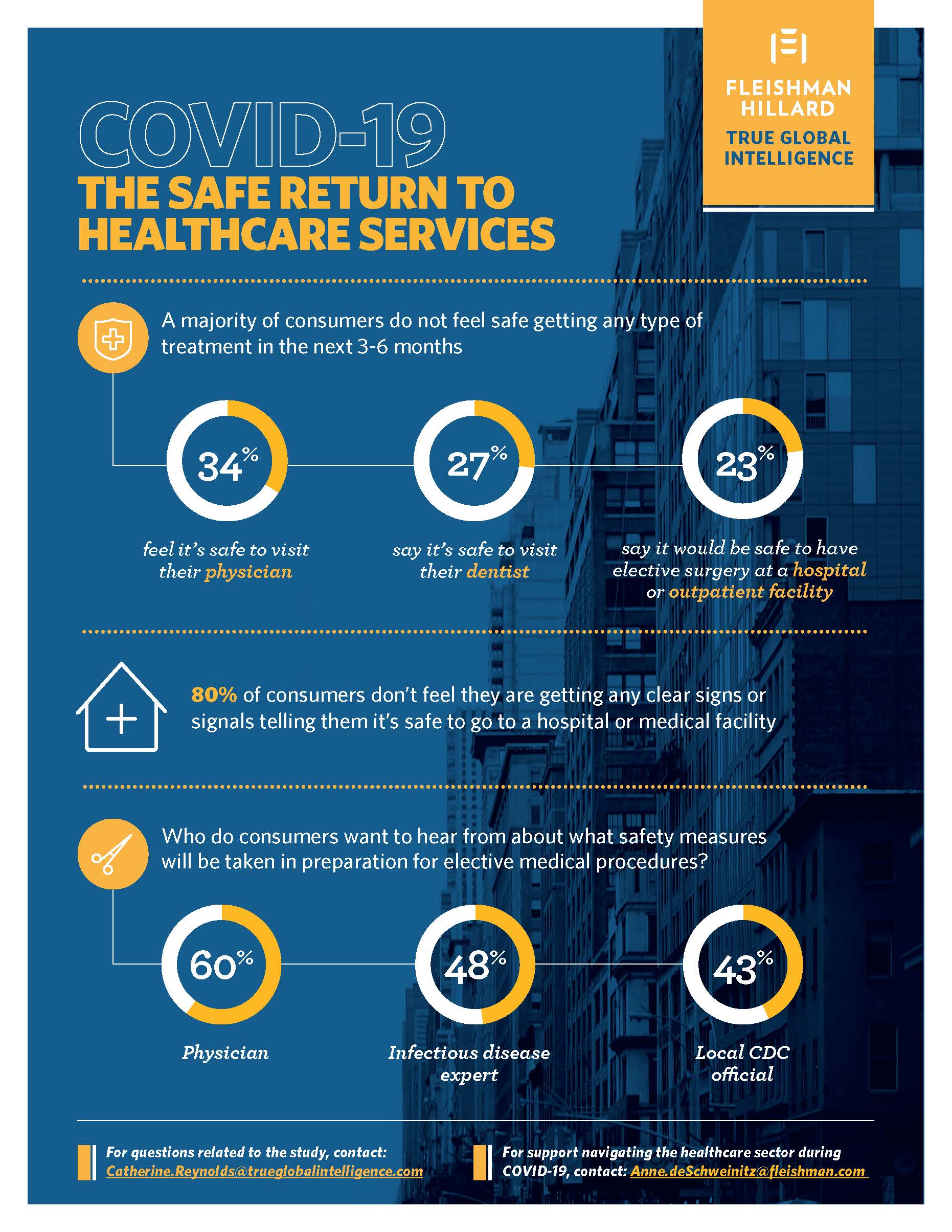
A FleishmanHillard TRUE Global Intelligence study of 600 U.S. consumers fielded May 3-4 backs up the concerns of physicians showing that a majority of consumers would not feel safe getting any type of medical treatment in the next 3 to 6 months. It showed that 76% do not feel safe having elective surgery at an outpatient facility; 73% don’t feel safe visiting their dentist; and 66% say the same about visiting their primary physician. Notably, women and those over 60 feel the least safe in accessing care.
It’s clearly going to take a lot of reassurance to convince us that the very places we used to view as places to get well are safe enough to set foot in again.
How will we know when it is safe to get care? Who will we trust to tell us? What signs and signals will we be looking for to reassure us that necessary precautions for our safety have been put in place? The results of the TRUE Global Intelligence study give us some helpful clues:
Consumers want simple ways to be assured that it is safe to return to healthcare settings. Of those surveyed, 80% say they “do not feel that there are clear signs or signals that tell patients that it is now completely safe to go to a hospital or any other medical facility unless it is an emergency.”
They want to hear information about the safety of electively returning to healthcare facilities directly from their physicians (60%), top infectious disease experts (48%) and local CDC officials (43%).
And they want tangible signals and signs that every precaution is being taken to make a medical visit safe. Sixty percent want confirmation that hospital/outpatient staff is being routinely tested for COVID-19. They want to hear directly from a physician that social distancing and disinfection procedures are in place at outpatient facilities (54%).
After months of lockdowns and constant messaging about the risks of going anywhere outside our homes, it’s no wonder we’re apprehensive about seeking care. How healthcare facilities communicate that they are “open for business” again will be critical to helping people overcome their fears and get back to care. Our health depends on it.
On the Record with Elizabeth Yuko, PhD: The Press Industry in the Time of COVID-19
May 13, 2020
By Caitlin Teahan
Share
‘On the Record’ is a new series where we sit down with our colleagues and friends who are often at the receiving end of our pitch emails – journalists. We will be tackling hot topics, learning and growing from their perspective and thoughtful advice.
For the first ‘On the Record’ post, Caitlin Teahan explores the impact COVID-19 is having on freelance journalism with seasoned freelancer and notable bioethicist, Elizabeth Yuko, PhD. Their candid Q&A session took place at a safe distance (video chat), at the time it was conducted, New York City was still on a strict quarantine lockdown.
CT: How do you think COVID-19 has impacted freelance journalists for better and for worse?
EY: First, for worse. I have lost my main sources of income – specifically my three main clients. For two of them, I still contribute but it is no longer a daily guaranteed income. That has completely changed everything because now, everything I am doing is based on pitches, and it has never been harder to have a pitch accepted or even acknowledged by editors. I have editors say they think a pitch is great and will assign it and then hear nothing for two months. Even a rejection at this point is nice!
CT: That rejection comment speaks to me as a PR person!
EY: Exactly! Also, so many people have lost their staff jobs and now have become freelancers. So now, am I not only competing with the pool of normal full-time freelancers, there is an extra group of people with whom I compete. Almost all publications have slashed their freelance budgets and are saying they only assign stories to staff writers … but are laying them off. I am at a loss as to where things are coming from. In terms of coverage itself it is weird, because some publications only want COVID content, other places say they want other topics but when you pitch anything else, their feedback is that the content isn’t relevant right now, which is obvious, because it isn’t related to COVID. Basically, it is a no-win situation. But it isn’t just about having less work to do. Publications I have written for, for a while now, have cut their rates. So even if you do get a yes, some are only able to offer half the usual rate – which at any other time, is a no. But right now, it may be the only thing I am doing this week so, OK. I am concerned about that because it sets a dangerous precedent moving forward and I am worried we are never going to make it back to pre-COVID rates. No one is in a position now to take major salary cuts.
Now, good things. For me personally, and very specifically me, it has been a good time to be a bioethicist. I have had a PhD since 2012 and there have been a lot of advancements in science and medicine, but nothing on a global scale that affects everyone, like this, so there hasn’t been that much interest in my work until now. All of sudden, everything we do is raising these moral questions, and everyone says, “Great! Let’s ask her!” My recent work with one particular outlet is something I am most proud of because it has been very ethics focused which is so bizarre to me (as it is not on brand for the outlet). They are on an ethics kick at the moment and it is based on what people are clicking on. That is what they want to read right now. If you had told me three months ago, I would be writing one ethics article after another for them, I would have told you that you are incorrect. In that way it has been good. On the other hand, again very specific to me, there are other publications where I normally would have been asked to write the article but am now being interviewed (as the expert). Which is fine – it is my same thoughts as if I were writing and my time – but I am not getting paid for it.
CT: That seems like a doubled-edged sword?
EY: Yes! Everything I am doing is in the hopes of getting more work in the future. Right now, live speaking isn’t a thing and paid lecturing during COVID is limited. It is something I do during ‘normal times’ so there is always the idea that this could lead to a lecture that could help pay my rent. Everything is weird right now.
CT:Besides layoffs, how do you think COVID-19 has impacted staff journalists for better and for worse?
EY: I think they have to write a lot more of their own content because their budgets have been cut. It is stretching them even thinner than they were previously. They have their normal responsibilities including the same amount of content to produce but with significantly less money to do it. I also think because everyone is working remotely, it is not like your boss is seeing you work from 6 a.m. to 11 p.m. every day. They may assume, but it is different when they see it, you are all in the office starving and it is nine o’clock. Stuff like that. So, I know they are stretched and so much of it comes down to advertisers who are pulling advertising money. It is all connected. The editors are now under pressure to produce ‘the clickiest’ stories possible, which is always the case, but right now with everything, it is more the case. Every section has been pivoting to COVID, so there is that. As someone who has worked as a health journalist for years, it is interesting that everyone else is thrown into that mix in certain capacities. In some ways it’s good and in some ways it is not great. You have had a lot of reporting for example, on new research that has an extremely small sample size or things that are preliminary findings that lack tests. Things have been disseminated that people are taking now as absolute truths, but the testing could be wrong.
CT:That can be a very dangerous game – misinformation. This could impact the quality of reporting, right? People who aren’t health journalists for example, don’t necessarily know they should look for strict methodology requirements, etc. because they have to overcompensate and keep pumping out content.
EY: Yes, it is! But it isn’t their fault either. They are under pressure, strict time constraints.
CT:This could be the tenth article today they have written, right?
EY: Totally. I absolutely don’t blame them. When I was a health editor in a previous on-staff role, I had no staff writers. I wrote the content and anything I didn’t write I assigned to freelancers – with a very small budget – and the freelancers I worked with received an extensive document from me that was essentially a training. It would share things like: if you see a study make sure it has these three things or if it involves a doctor, make sure it is this type of doctor versus this type. Not everyone has that type of background or training, which can perpetuate things. But alternatively, this gives other journalists work debunking the bad reporting! So, it is a weird, weird cycle.
Personally, I have been getting nonstop phone calls from family and friends about who to believe, trust. Because everything now is so weird and unbelievable, even far-fetched things seem remotely plausible. I don’t blame them for wanting to cling to something, but staying on top of that sort of thing is a lot of work.
CT: With so many press no longer on staff at publications, do you feel there will be an influx of freelancers? Will that impact your business?
EY: 100%. Even without layoffs, the budget cuts alone (to freelance budgets) have made everything more competitive.
CT: So really, it’s multiplied by two. You have experienced freelance budget cuts and there are more people in the freelance pool. It is a true scarcity.
EY: Yes! Yes.
CT:How has the pandemic changed what you write? Are you considering beats that you hadn’t beforehand?
EY: Usually when you pitch you have to sell yourself and your idea: why now, why I am the person to write and why people care about this. You still have to do all of that, but you also have to account for how COVID fits into this. Even if the story has nothing to do with the pandemic, you have to justify the idea and someone spending money on it by saying how it fits into our current situation. Travel is the most obvious example of that. I was finally getting more travel-related work and that all just … you know. But now general publications that have travel sections have pivoted. A notable news outlet was very public about switching their travel section to a home section. I submitted travel articles to a national consumer magazine long before the pandemic and now they are just not running them. I have several travel articles in limbo that were commission and submitted before the pandemic that just never ran. You don’t get paid until it runs! So, it isn’t like I am just losing work now, but I am not being paid for work I did in some cases months ago. One publication did pay me for an article they decided to hold, for which I am very grateful, but that is only one out of many.
When it comes to beats, I have dabbled in writing about architecture and design but really in the historical context. I had written a few things over the past maybe four years. I think the topic is very interesting but have absolutely no training in that area. It isn’t something I do regularly but because the aspect of design that I focus on is at the intersection of health, whether it is public health and an environment or design within homes, that tiny area that I do know, is all people care about. For example, I wrote an article about how infectious diseases have shaped the modern American bathroom.
CT: THIS IS SO COOL. Please write a book!
EY: Thank you! People are really interested in learning about this. I did two NPR interviews about it, one with the Australian Broadcasting Company. For some reason it has just totally blown up! I am working on a similar story now. For me, it has been an area that was a teeny tiny part of my overall beat to a much more prominent part of it. But all of a sudden now, I am getting TONS of pitches from interior design brands. So many. But I am really only writing about historical context, so I don’t really have any use for it.
CT: You don’t want to know about the latest in rugs, is what you are saying?
EY: Yes, exactly. It is historical. I try to say it in a nice way. Yes, I am writing about bathtubs but, from a hundred years ago, so … there are some brands that are relevant then and now. One of my favorite PR people works with that brand and we talk about their history, etc. but because they happened to be an industry leader then and are still around. So for me, it is this design space. I think because I do not have any formal training on this subject the way I approach it is different. I am working on the history of the home office in America right now. There is no history on this, so I have had to take it apart piece by piece. It is definitely different.
CT: Please make this book. I will read this book.
EY: It is good! But maybe I need more background. And here is the PR perspective – I am not ‘unpitchable’ but because I am not doing anything new, it is difficult. Unless you have an architectural historian, which no one is, it is tough.
CT: As quarantine starts to lift and we begin to come together, what do you predict will change in terms of your work?
EY: I don’t think it will. Because I have been working from home or remotely for a year now or while traveling, this is how I have been used to working. In that sense, it isn’t that different. One thing that will be harder after this is over – it has been so much easier to get interviews with people because everyone is at home all of the time. A lot of people are bored. That does not hold true when I am interviewing public health experts – they are NOT bored. Other people tell me to call them any time, they can talk for hours. That is not the norm! I have been able to get stuff done faster because sources have been responding to email more than usual and are more agreeable to interviews. It is just faster. They don’t need to check with a person to check their schedule. People have been more accessible, in a good way. Also, depending on who I am interviewing, it is probably pretty beneficial to them to get exposure right now. It is another kind of win-win situation.
CT: Thank you for taking the time! Always good to chat.
EY: Thank you!
For information about Dr. Elizabeth Yuko’s bioethics work or journalism, head to elizabethyuko.com.
See what else is happening
You might also like
ESG
Navigating Conflicting Demands to Advance Climate Action
January 20, 2025
Opinions
Supporting St. Louis Institutions Dedicated to Empowering Youth Through FH4Inclusion
January 15, 2025
Opinions
Revitalizing the San Francisco Community with the Downtown Volunteer Coalition
December 23, 2024
Opinions
FleishmanHillard and FH4Inclusion Teams Shine at the Cannes Lions International Festival of Creativity
August 28, 2024
Opinions
Bridging the Generational Divide with Generative AI
August 27, 2024
Inclusion
Success on Repeat: Alumni of the Alfred Fleishman Diversity Fellowship Discuss Promotions and How to Get Them
May 29, 2024
News
EU climate policy: The new borderlines?
May 27, 2024
News
Achieving the Evolving Duality of Loyalty and Loyalty Programs
April 1, 2024
Expertise
TickTockTech: Mobile World Congress 2024 — What’s the Verdict?
Reimagining the Future of Work Requires Leadership and Chutzpah
May 11, 2020
By Ryan Brack
Share
We’re now months into a fundamentally changed economy and society where the nature, quality and structure of work has had to rapidly change with facts on the ground. But in truth, COVID-19 is simply accelerating the evolution of work, which was well underway already. What would have taken years to digitally transform industry, writ large, has been accomplished in a matter of months. Factors like automation and artificial intelligence, employee-employer trust, mobility, purpose and reskilling-upskilling have moved from serious considerations to drivers of change.
While too many variables remain to accurately predict the future of work, we can search for clues about what’s next from previous paradigm shifts and trends that were already in motion.
PHOENIX RISING
The success of open markets, and capitalism itself, relies on the idea of creative destruction – where one new idea, product or service replaces the old one. The catalyst for said newness occurs organically in free societies but is supercharged when a major event injects widespread variability into the mix. The more disruptive the event, the more difficult it is for the status quo to remain intact and the wider the opening for new entrants. What follows in these scenarios is a blossoming of solutions.
The 2008 recession birthed many of the direct-to-consumer services you know and love today. World War II catalyzed Silicon Valley’s already growing tech dominance and led to significant advances in computation and telecommunication technologies. The Flu Pandemic of 1918 provided major leaps in medical technologies and innovations in transportation.
Necessity is the mother of invention and COVID-19 has certainly presented massive volatility in need of navigation. We don’t yet know which companies will successfully steer themselves through a fundamental rethink of products and services to meet the challenges of this reality, but we do know the movement is afoot and so is an emerging workforce powering those innovations. In this environment, clients should balance the need for a consistent workforce experience against their appetite for experimentation with emerging solutions.
WORKING, 9 TO 5?
Remote working, pre-COVID, was acceptable but not a deeply established practice with only 7% of US workers having a flexible workplace benefit. Now, 74% of CFOs expect that at least 5% of their workforce will stay in permanent WFH status versus returning to the workplace. A recent study from FleishmanHillard’s TRUE Global Intelligence revealed that 61% of those who would normally need to be at their place of business to do their job are now working from home.
Entry-level, back- and mid-office positions with little critical need for physical interaction fall into this category – and are most likely to integrate automation in the near future. Further analysis of what functions can be performed onsite or offsite reveal two additional categories of jobs of the future. Some jobs, especially those in services industries, will continue requiring sensible physical contact and are at minimal risk of major disruption. Are you eager to visit a tele-salon or get a haircut via robot, after all?
The third category of jobs will require intermittent physical interaction and are especially critical to those in leadership positions and in industries that require serendipity, discovery and continual collaboration in the workplace. A crude parallel exists in how businesses approached cloud migration, which now blend on-premise, off-site and hybrid solutions to find the right mix of physical and virtual.
In all of the above cases, a decreased dependence on the physical workplace increases the demand on programs and tools that build culture and strengthen internal communications. Our experts are ready to assist clients who understand the importance of frequent and meaningful communication, especially important to younger generations within the workforce.
TRANSITIONING FROM REMOTE WORK TO TELEPRESENCE
While necessary and certainly up to the task, the collaboration solutions we’re currently using are only one part of recreating the workplace. They will continue to evolve and further redefine the future of work as competition to be the platform of choice intensifies and deepens. 5G, augmented and virtual reality, the Internet of Things and quantum computing have the potential to pull our 2D WFH experience into something richer and fulfilling.
The convergence of these powerful, paradigm-shifting technologies will be leveraged by a visionary (who’s possibly said, “You’re on mute” one too many times) to approximate what it’s like to share a physical space with someone. This could be picking up on nonverbal and environmental cues, being available for quick engagement versus connecting in rigid on-camera meetings, overhear a conversation that inspires or collaborate on the fly with seamless synchronization. These telepresence solutions will be delivered though emerging technologies like digital proxies, avatars, mirrored setups, and yes, even holograms.
You may guffaw at the idea and think that 2020 is not the future we were promised when these solutions should’ve already been in place. You’re right. But technology capacity, computation, bandwidth, complexity and even user sophistication aren’t the limiting factors anymore. Instead it is our failure of imagination, leadership and chutzpah that will prevent us from delivering the future of work we deserve in new, creative, inclusive and sustainable ways.
See what else is happening
You might also like
Expertise
Black Hat 2026: A Conference and Industry Transformed
August 10, 2026
Expertise
When Food Safety Crises Test Trust: A Guide for Communicators
July 24, 2026
Expertise
We Went to Cannes Lions: Where the Industry Is Trending
July 1, 2026
Expertise
Healthcare’s Moment Has Arrived. The Question Now Is: Will Your Organization Move Fast Enough?
July 1, 2026
Expertise
The Visible CEO: How Leadership Can Serve as a Strategic Asset
July 1, 2026
Expertise
How to Win the GLP-1 Food Industry Wake-Up Call
June 30, 2026
Expertise
Cannes Lions Exposed an Industry’s Transition of Power: Takeaways From Winning Work
June 26, 2026
Expertise
Lessons From Cannes: Don’t Let Speed Fail Storytelling
June 25, 2026
Expertise
Get Bold Work Out Into the World: How to Seize the Chaos Advantage
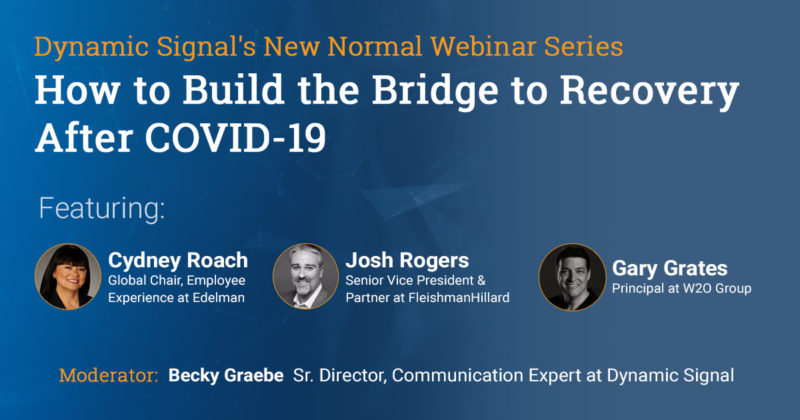
Join Becky Graebe, a communication expert from Dynamic Signal, as she sits down with leaders from some of the world’s top PR agencies for a conversation around how companies are preparing for the rebound of their businesses in the second half of 2020. The group will discuss stories from companies that are successfully preparing for their post-COVID-19 comeback, insights into deciding recovery priorities and strategies, and best practices for how to prepare your workforce for the transition back to “normal.”
FleishmanHillard’s Josh Rogers will participate in the webinar along with Cydney Roach of Edelman and Gary Grates of W2O.
Marjorie Benzkofer, chief strategy officer and global managing director of FleishmanHillard’s Reputation Management practice, will be discussing ‘return to work’ in this Coffee & Connect Session. The discussion will include what organizations should be thinking and communicating about as they embark on the path of recovery and resurgence. Emphasis will be on how to ensure the health and safety of an organization’s workforce, while at the same time strengthening the culture and employee engagement.
See what else is happening
You might also like
News
The Chaos Advantage: How Brands Win in a Volatile World
June 25, 2026
News
The Chaos Advantage: FleishmanHillard Research Finds Caution Has Become the Riskiest Strategy in Marketing
June 22, 2026
News
FleishmanHillard Releases U.S. ‘License to Lead’ Report, Revealing Sharp Confidence Gap Between Executives and Stakeholders
June 2, 2026
News
FleishmanHillard Launches the “America 250” Unit to Help Organizations Navigate a Historic Milestone
May 12, 2026
News
PRovoke Media Names FleishmanHillard a Top Agency in the UK and Europe
April 30, 2026
Expertise
Live from the PRWeek Sports Conference: A Team-First Approach to Communications
April 28, 2026
News
Rebecca Weinstein and Jonathan Arias Win the 2026 U.S. Young Lions Digital Competition
April 23, 2026
Expertise
The New Culture Gap Report: How Brands Stay Relevant for 100 Years
March 24, 2026
News
FleishmanHillard Named Among PRovoke Media’s Best Public Relations Agencies in the World
Difficult Realities Related to Antibody Testing as a Tool in COVID-19 Recovery
May 6, 2020
By Mark Senak
Share
In the 1980s as the AIDS epidemic took root in America, there was no test for Human Immunodeficiency Virus (HIV), the cause of Acquired Immune Deficiency Syndrome (AIDS). Rather, once developed, the HIV-antibody test was used as a surrogate marker to identify the infected. Particularly before there was a treatment, an antibody test became a marker for discrimination, resulting in lawsuits. As a disability, it became illegal to discriminate against a person with AIDS and an HIV-antibody test under most circumstances could not be compelled.
In the COVID-19 America of 2020, an antibody test – this time to assess exposure to Sars-COV-2 – is being contemplated as a tool in the toolbox of those planning return to work scenarios and the notion of “immunity passports” has been reported by the media to be under consideration by some policymakers in Europe and by some employers in the U.S. The notion raises legal, communications and public health implications that loom large.
What is the practical value of the test? One of the foremost considerations in using an antibody test is a practical one. What does a positive test result tell us? Whether or not the development of an antibody confers immunity on the part of the person tested is not clear. If there is immunity as a result, it does not tell us how long that immunity may last or whether all people who develop an antibody have an equal amount of protection or whether it depends on the level of the individual’s exposure.
What are the legal implications? Can an employer compel an employee to take a test as a pre-condition to coming to work? And is there a health privacy consideration, either at a federal or state level, at stake in freely identifying – or compelling those who test positive – to publicly identify their antibody status. Can an employee demand antibody tests of co-workers? Can access to a doctor’s office or daycare center be premised on antibody status? Can a person’s livelihood or access to services or other venues be put on the line based on an antibody test?
Is there a public health concern? Use of an antibody test as a “passport” to employment, to access to services, or to attend a theatre or sports event puts a premium on being antibody positive (the exact opposite of the HIV/AIDS days). Does this possibly mean that there will be people who purposely expose themselves to the virus in order to get their passport? It may sound farfetched. It isn’t.
Finally, there is the communications lift that is associated with explaining all the nuance associated with this. Use of the antibody test as a tool at first glance sounds easy and neat. It is hard and it is messy.
At this stage of the COVID-19 pandemic, there are two tectonic plates pushing up against one another. One represents the enormous pressure to return to some state of economic normalcy with the freer flow of commerce and return to work and school. The other is the innate desire for safety — for a minimization of risk not only to one’s own person, but as a society in containing and diminishing infection and mortality. The pressure on each plate is tremendous with much at stake. These plates are in sharp relief when it comes to envisioning a return to the workplace. In a rush to get back to some state of normalcy the issues raised by antibody testing as a means for allowing freer and safer movement cannot be ignored. It should not be rushed into without a thorough consideration to the outstanding questions and potential ramifications.
See what else is happening
You might also like
Expertise
Black Hat 2026: A Conference and Industry Transformed
August 10, 2026
Expertise
When Food Safety Crises Test Trust: A Guide for Communicators
July 24, 2026
Expertise
We Went to Cannes Lions: Where the Industry Is Trending
July 1, 2026
Expertise
Healthcare’s Moment Has Arrived. The Question Now Is: Will Your Organization Move Fast Enough?
July 1, 2026
Expertise
The Visible CEO: How Leadership Can Serve as a Strategic Asset
July 1, 2026
Expertise
How to Win the GLP-1 Food Industry Wake-Up Call
June 30, 2026
Expertise
Cannes Lions Exposed an Industry’s Transition of Power: Takeaways From Winning Work
June 26, 2026
Expertise
Lessons From Cannes: Don’t Let Speed Fail Storytelling
June 25, 2026
Expertise
Get Bold Work Out Into the World: How to Seize the Chaos Advantage
Last year, small businesses employed nearly half of the United States’ workforce, driving job creation and economic growth. Under normal circumstances, we would celebrate the accomplishments of the small business community this National Small Business Week.
The coronavirus pandemic has upended those plans, with the Small Business Administration indefinitely postponing the annual commemoration. Meanwhile, small business owners are grappling with the increasing financial and emotional toll of the global health crisis, making now a critical time for companies with a small business customer audience to support them.
FleishmanHillard’s COVID-19 study found that 88% of respondents said that local businesses play a role in responding to the crisis. Larger brands that cater to entrepreneurs are in a unique position to help small businesses do just this.
Over the years, our work with clients with a small business focus has taught us the value of communicating with these special customers. Here’s what we’ve learned:
Be empathetic. Creating and maintaining a small business was always hard work, but today’s pressures are causing new challenges and struggles. Express empathy in your communications, acknowledging the situation while reaffirming your commitment to support them.
Give advice. Small businesses are looking to various sources to figure out how to stay afloat. Use your branded or owned content to give guidance and help build your own reputation among the small business community.
Celebrate entrepreneurship. Find unique ways to recognize entrepreneurs for their ingenuity and hard work. From a campaign encouraging individuals to patronize local shops to a nationwide contest investing in start-ups, brands have put the spotlight on small businesses with success in the past. It’s always inspiring to see the enduring spirit of entrepreneurship.
These tips go beyond the current situation. During the recovery and resurgence phase, small businesses will be key to bringing the economy to life once again. Establishing yourself as a thought leader and supporter of small businesses now builds trust in the future. Create goodwill now; be rewarded later.
See what else is happening
You might also like
Expertise
Black Hat 2026: A Conference and Industry Transformed
August 10, 2026
Expertise
When Food Safety Crises Test Trust: A Guide for Communicators
July 24, 2026
Expertise
We Went to Cannes Lions: Where the Industry Is Trending
July 1, 2026
Expertise
Healthcare’s Moment Has Arrived. The Question Now Is: Will Your Organization Move Fast Enough?
July 1, 2026
Expertise
The Visible CEO: How Leadership Can Serve as a Strategic Asset
July 1, 2026
Expertise
How to Win the GLP-1 Food Industry Wake-Up Call
June 30, 2026
Expertise
Cannes Lions Exposed an Industry’s Transition of Power: Takeaways From Winning Work
June 26, 2026
Expertise
Lessons From Cannes: Don’t Let Speed Fail Storytelling
June 25, 2026
Expertise
Get Bold Work Out Into the World: How to Seize the Chaos Advantage