‘On the Record’ with Dan Frommer: The Newsletter Business
December 17, 2020
By Ephraim Cohen
Share
‘On the Record’ is a series where we sit down with our colleagues and friends who are often at the receiving end of our pitch emails — journalists. We tackle hot topics to learn and grow from their perspectives and thoughtful advice.
For this ‘On the Record’ post, Ephraim Cohen spoke with Dan Frommer, founder and editor-in-chief of The New Consumer, on Dan’s career since starting his own independent publication. Additionally, Dan discusses how to be an analyst first and a reporter second, the evolution of e-newsletters, using data to understand the ‘how’ and ‘why,’ and creating meaningful connections with PR counselors.
View their candid discussion here:
See what else is happening
You might also like
ESG
Navigating Conflicting Demands to Advance Climate Action
January 20, 2025
Opinions
Supporting St. Louis Institutions Dedicated to Empowering Youth Through FH4Inclusion
January 15, 2025
Opinions
Revitalizing the San Francisco Community with the Downtown Volunteer Coalition
December 23, 2024
Opinions
FleishmanHillard and FH4Inclusion Teams Shine at the Cannes Lions International Festival of Creativity
August 28, 2024
Opinions
Bridging the Generational Divide with Generative AI
August 27, 2024
Inclusion
Success on Repeat: Alumni of the Alfred Fleishman Diversity Fellowship Discuss Promotions and How to Get Them
May 29, 2024
News
EU climate policy: The new borderlines?
May 27, 2024
News
Achieving the Evolving Duality of Loyalty and Loyalty Programs
April 1, 2024
Expertise
TickTockTech: Mobile World Congress 2024 — What’s the Verdict?
Biden and Britain: Can the Special Relationship be Built Back Better?
By Michael Hartt
Share
Fireworks in London, church bells in Paris, and celebrations in the streets of Berlin. While the reaction across Europe to the election of Joe Biden and Kamala Harris may have been exaggerated. […]
On the Record with Nona Tepper: Unpacking Ethical Technology
October 27, 2020
Share
‘On the Record’ is a series where we sit down with our colleagues and friends who are often at the receiving end of our pitch emails – journalists. We will be tackling hot topics, learning and growing from their perspective and thoughtful advice.
For this ‘On the Record’ post, Kamilla Rahman explores what ethical technology is, the impact it can have on society and if it even exists at all. Social impact advocate and tech writer at Built In, Nona Tepper, had a candid conversation with Kamilla on her take on the enigmatic term.
Kamilla Rahman (KR):In your own words, how would you explain ethical technology and the importance of it?
Nona Tepper(NT): To me, developing ethical technology means thinking one step ahead and understanding the impact that deploying products, services and making investments might have on underrepresented or marginalized communities. It means questioning the effect, whether good or bad, it will have in all stages of development. None of us have a crystal ball, so it must go beyond this, too — brands must also be responsible for monitoring how their goods and services are used in the market. Developing ethical technology also depends on hiring workers from diverse backgrounds.
Also, I think more companies use the term “responsible technology” rather than “ethical technology.” The term “ethical technology” can sound overly intellectual or intimidating for organizations, making some shy away from its adoption since it sounds too far-reaching or unattainable.
KR: Do you think ethical tech is a buzzword or do you think it’s something people are taking seriously?
NT: I think it’s a bit of both. When companies hire someone to oversee responsible tech, it can be seen as PR, a crisis or even an HR move. However, the companies that are taking ethics seriously are the ones that give tech ethicists real power and influence over day-to-day operations and decision making.
Working in tech is a privilege and I think we’re increasingly seeing tech workers reflect on their own impact in creating responsible tech; not just waiting for the C-suite to join the cause. It’s great to see this increase on a micro level, but to attain responsible technology, the sentiment also needs to come from the top down. The C-suite needs to want to create responsible products and services, and create a culture where workers are empowered to provide their own insights on whether something could damage society or our environment or bring equity and advantages to a specific group. Essentially, workers have more perspective on the outside world than a single companies’ processes and procedures. Every worker has their own identity and background, and incorporating their input into how these products and services are carried to market could lead to a more inclusive world.
KR: As a tech journalist, I’m sure you hear people and brands talking about ethical tech all the time. What makes an initiative on this topic genuine?
NT: A genuine approach to responsible technology is three-pronged: A company must commit to a concrete and actionable plan, it must be public and they must be transparent in their progress and results, which should be audited by a third party.
Commitments to responsible technology should not be one-off. Companies need both short-term and long-term goals to ensure the move to responsibility is actionable in the moment but also consistent in the future.
KR: Do you think ethical tech exists?
NT: Yes, but I also think every organization or technology could be better. There are so many well-intentioned initiatives by organizations, and while that’s important, some businesses just fundamentally damage society. Instead of just making a one-off donation, companies should rethink how their business, product or culture impacts our society.
Responsible tech depends on responsible people. The bottom line is that everyone could do more, but we’re all still learning and implementing; responsible technology will always be a learning process. It’ll never be 100% perfect, but everyone in the industry should aspire to be responsible while understanding that readjusting and re-learning is key.
KR: Do you think ethical technology has the potential to really fix the problems we’re facing today?
NT: I think technology can contribute to a solution, but at the same time it’s also created, or exacerbated, a lot of those problems. Ultimately, it’s people that are responsible for fixing the problems we face today. In particular, those in power should commit to being a part of something bigger than themselves and that starts with looking at who they’re selling to and the structure of their businesses. However, responsible tech is also dependent on workers and end users. Corporations are beholden to many, many priorities so we shouldn’t just sit around and wait for companies to right their wrongs. End users also have the responsibility to reflect who they work for, buy from and how they spend their time.
KR: Do you enjoy reporting on impact topics like ethical tech, if so, why?
NT: Yes! I learn something every day, which changes my opinion and outlook constantly. In my perspective, responsible tech sits at the intersection of business and politics, which is the reason why I went into journalism. I wanted to report on the power structures that are impacting our evolving world, so it’s truly an exciting time to be able to connect with all these influential movers and shakers.
See what else is happening
You might also like
ESG
Navigating Conflicting Demands to Advance Climate Action
January 20, 2025
Opinions
Supporting St. Louis Institutions Dedicated to Empowering Youth Through FH4Inclusion
January 15, 2025
Opinions
Revitalizing the San Francisco Community with the Downtown Volunteer Coalition
December 23, 2024
Opinions
FleishmanHillard and FH4Inclusion Teams Shine at the Cannes Lions International Festival of Creativity
August 28, 2024
Opinions
Bridging the Generational Divide with Generative AI
August 27, 2024
Inclusion
Success on Repeat: Alumni of the Alfred Fleishman Diversity Fellowship Discuss Promotions and How to Get Them
May 29, 2024
News
EU climate policy: The new borderlines?
May 27, 2024
News
Achieving the Evolving Duality of Loyalty and Loyalty Programs
April 1, 2024
Expertise
TickTockTech: Mobile World Congress 2024 — What’s the Verdict?
What’s going to be in the Better Regulation Communication?
October 26, 2020
Share
The Ursula von der Leyen Commission will soon set out how it intends to improve on the EU’s Better Regulation agenda. The Communication on Better Regulation led by Maroš Šefčovič, the Commissioner for Interinstitutional Relations, is now scheduled to be adopted on 24 November by the College of Commissioners. […]
We all rang in this year with a twenty-plenty mindset but for many, this has been one of the toughest years that we’ve had to contend with. Facing the fragility of life, business uncertainty and juggling both career and home responsibilities as we all work from home. […]
India has always gleamed with the honor of being a diverse country – be it geographical, cultural, ethnic, religious, environmental or political. That said, seldom does a day go by without a celebration in this country. All it takes is a quick web search and you’ll discover how celebration is in the DNA of every Indian – we’re either commemorating a religious festival, a day of national or historical significance, reveling in a seasonal or art festival, or even observing celestial events (yes, we do celebrate the phases of the moon!). India’s vibrancy can be credited to its people, wanting to honor their culture and heritage with sheer enthusiasm and devotion. Indian festivals are a true mosaic of people’s spirit of celebration!
If you look back at the Indian civilization era, you will find that multiple cultural and social activities were organized as a part of these festivities. These activities fostered communal harmony and brought a sense of unity among its people, which can be seen today as well. It is no wonder that tourists from all over the world visit the Indian peninsula to get immersed in its culture and celebrations. Apart from the cultural significance, every Indian festival also holds a true spiritual enlightening. For example, the festival of lights ‘Diwali’ is not just about lighting the external lamp, it is illuminating the inner-consciousness. Believing in your true self and celebrating life is what Indian festivals are truly about.
Here’s a round-up of some of the popular Indian festivals celebrated in the past months:
Eid al-Adha (July 21, 2020)
Eid-al-Adha, or the ‘Feast of Sacrifice’ is a festival celebrated by the Muslim community all over the world. In India, it is commonly known as Bakra Eid or Bakrid, as the male goat – ‘bakra’ is the most popular animal for Qurbani in this subcontinent. It is also one of the most important festivals for more than 14% of the country’s population who are adherents of Islam.[1]
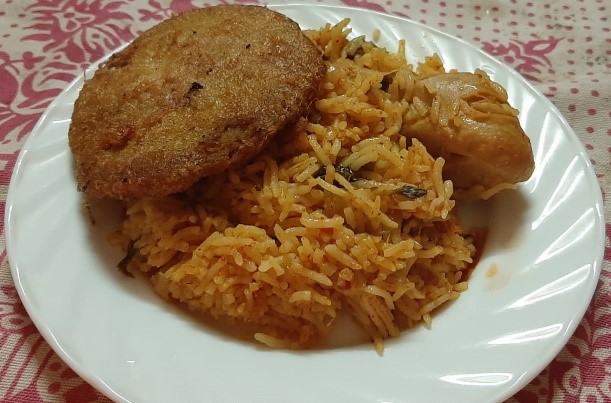
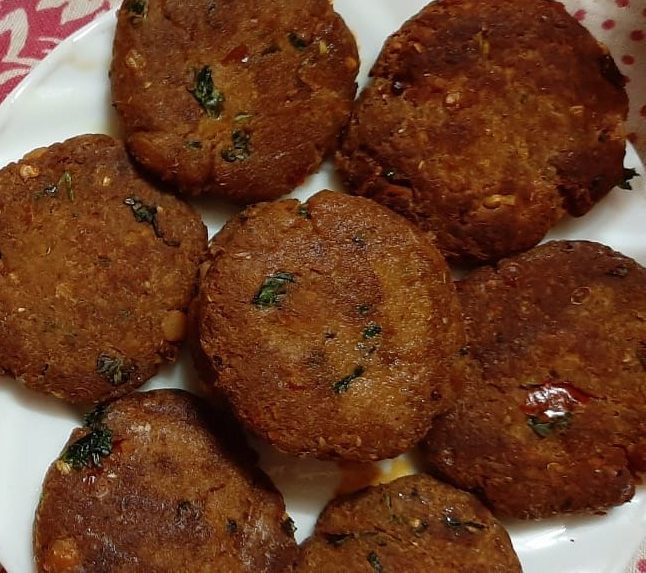
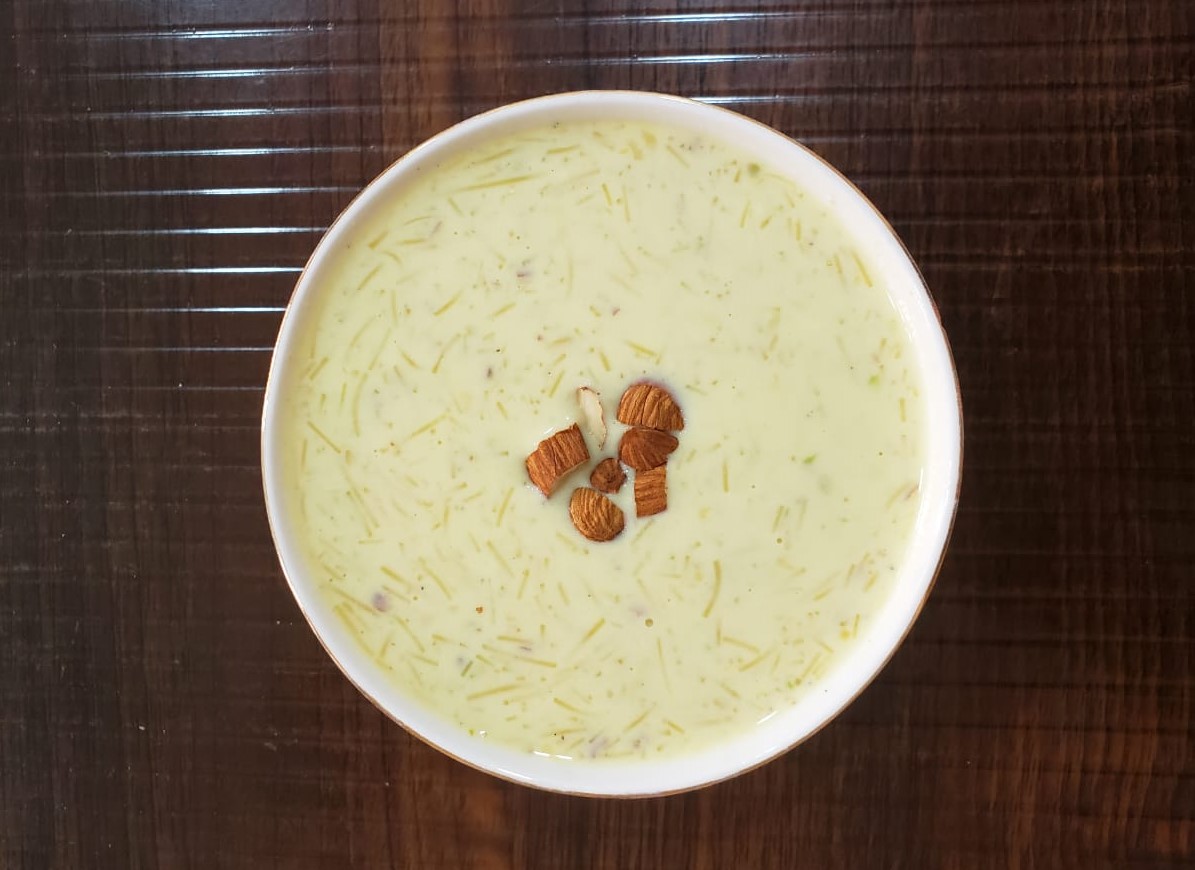
Post the morning sacrifice ritual, people greet each other with ‘Eid Mubarak’ and exchange gifts. A culinary fanfare of meat dishes is cooked, from traditional delicacies such as biryani, nalli nihari, kebabs, keema and many more which is served amongst family and friends. Sweet dishes such as sheer kurma, shahi tukda, zarda rice is also prepared to compliment the meat dishes.
A spread of Eid delicacies to tantalise your taste buds.
Biryani
Kebabs
Sheer kurma
Images courtesy of Tamkeen Shaikh and Aneeza Gangani
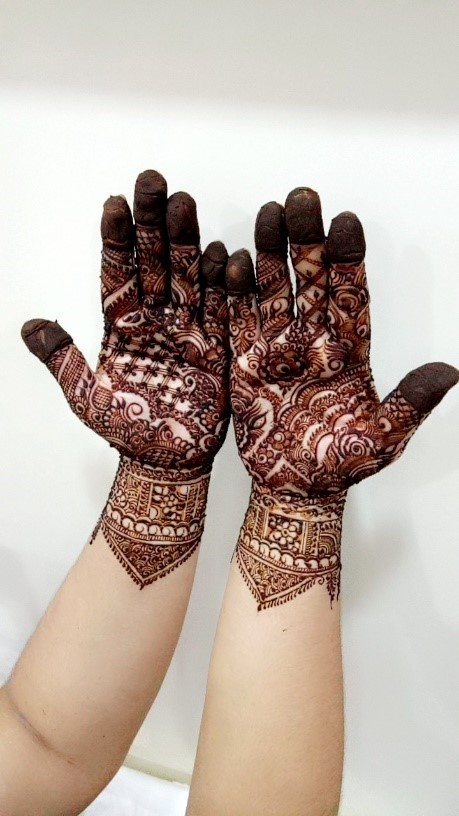
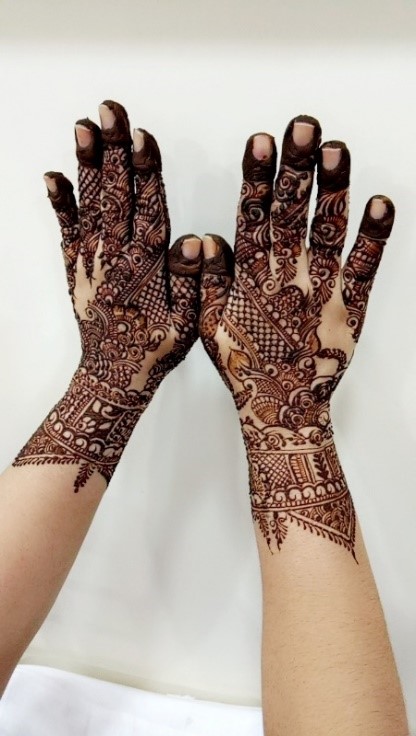
Children are usually given Eidi or money as a token of love and blessings. While men proudly wear their traditional kurta pajamas or Pathani suits on Eid, women adorn their ethnic salwar kameez and shararas. Applying heena or mehendi is another important custom of this festival, where women paint their hands with intricate designs for enhanced beautification. Above all, people express their gratitude to God for all that they possess – family, friends and blessings.
Eid al-Adha in India withstands the spirit of brotherhood and compassion where neighbors come together irrespective of religious sects, caste and creed, to uplift the festive spirit and inspire us to create a just, harmonious and inclusive society.
Intricate mehendi designs on palms marked as an important custom on Eid al-Adha.
Images courtesy of Rukaiya Madraswala
Janmashtami (August 29, 2020)
Janmashtami, or Gokulashtami, is one such Indian festival which is celebrated with much grandeur and fervor. One of the oldest festivals in India, Janmashtami commemorates the birth of Lord Krishna, who is believed to be the eighth incarnation of Lord Vishnu, the preserver of our world. According to Hinduism, Lord Krishna’s birth signifies the end of evil and the beginning of a new era of unified reformation.
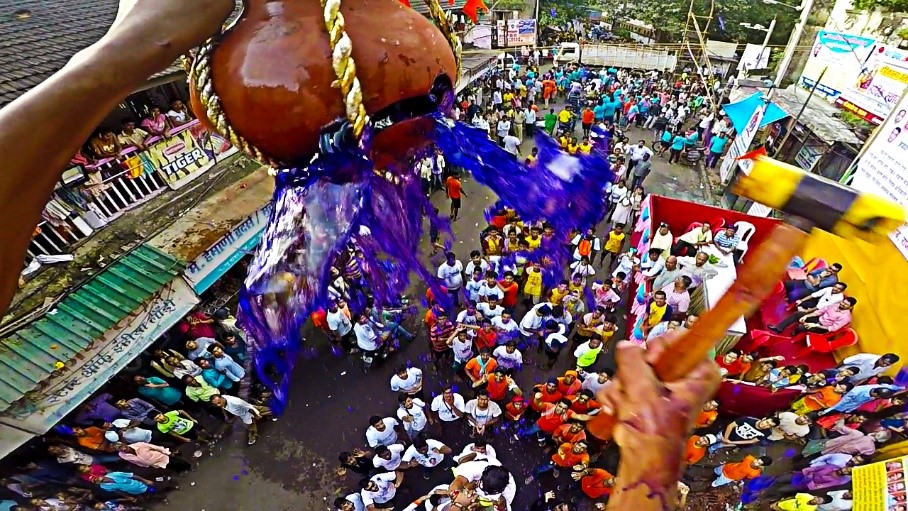
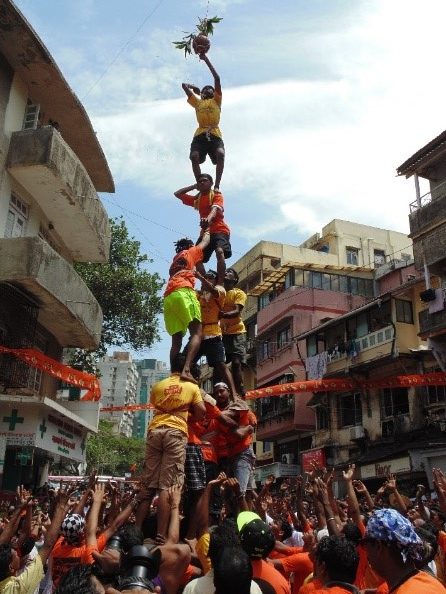
The birth celebrations usually begin at 12:00 midnight with devotees visiting decorated temples, sharing traditional foods, singing devotional songs, organizing dance-drama acts called ‘Rasa Lila’ and offering their worship to baby Lord Krishna. Another popular tradition is the Dahi Handi (curd in an earthen pot) ritual, which mirrors the efforts by mischievous Lord Krishna trying to steal makhan (white butter) along with his group of friends during his adolescent years. This has now transformed into an adventure sport which is practiced most often in states of Maharashtra and Gujarat, along with the twin cities of Vridavan-Mathura in Uttar Pradesh.
A close-up shot of the breaking of the Dahi Handi with the local crowds cheering the Govinda from the street.
A nail-biting moment when the human pyramid breaks the Dahi Handi.
Images courtesy of Heetej Kondkar
Onam (August 22 to 31, 2020)
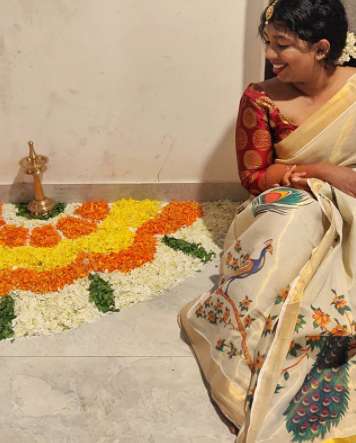
Onam is a 10-day long annual harvest festival celebrated in the state of Kerala by the natives (Malayalees) regardless of religion, caste or creed. It commemorates the annual visit of a mythical king named ‘Mahabali’ who is believed to have ruled ancient Kerala and boosted its prosperous agrarian culture. With an array of traditional spreads, Keralites celebrate this festival with sports such as boat races (vallam kali), folkdances (thumbi thullal, pulikali and kummattikali and other intricate floor designs with flowers (pookalam).
A flower arrangement called pookalam is created to uplift the festive spirit and welcome the mystical king.
Images courtesy of Sandhya Verghese and Bijin Zachariah
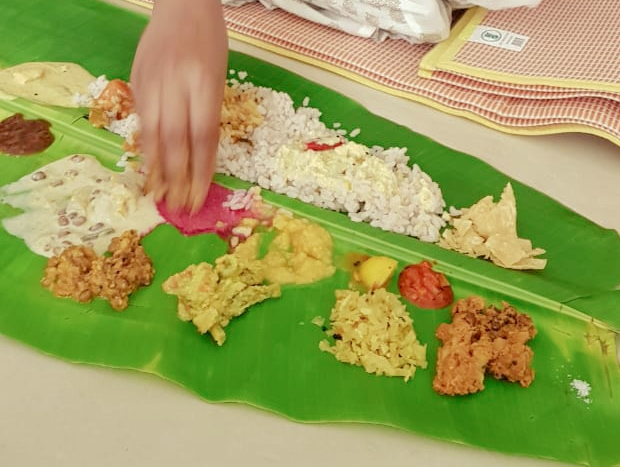
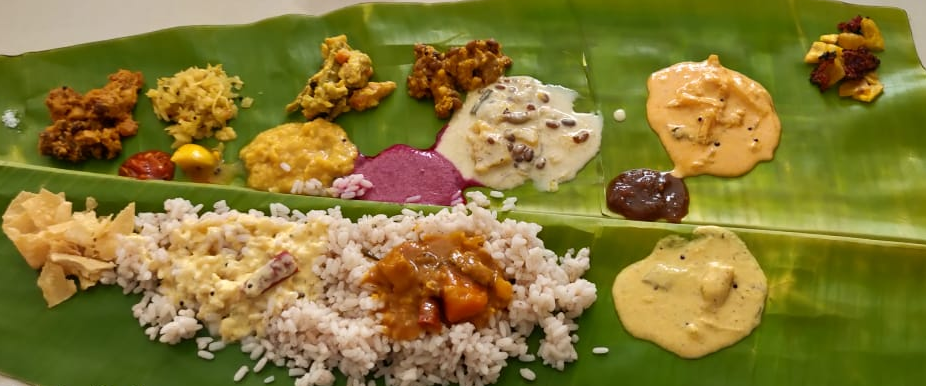
Sadhya, or Onasadhya, is a sumptuous vegetarian meal cooked with a plethora of South Indian flavors.
Images courtesy of Bijin Zachariah
Signing off with a quote from the revered Indian poet, Rabindranath Tagore, “You are invited to the festival of this world and your life is blessed.”
Himani Sharma is a Senior Account Executive based on our Mumbai team and supports our digital and planning team.
Breaking Down the Label: Hispanic, Latino, Latina or Latinx?
October 14, 2020
By Amelia Gomez
Share
As a young girl, when friends would ask me “where are you from?” I’d respond, “I’m Cuban.” Until one day, my mother – a Cuban exile who fled the island at 17 years old to escape Fidel Castro’s dictatorship – heard me and quickly corrected me. “Amelia, you’re not Cuban. You are Cuban-American.” As a child, I struggled to understand the difference, but I abided and listened to my mother.
Growing up, I reflected on my label of “Cuban-American” and my mother’s fervent correction. Over time I internalized the great pride my parents and grandparents held with the badge of calling oneself an “American.” Much of my family fled Cuba, an experience filled with trauma and the hope of seeking freedom as U.S. citizens. The title of “American” did not come easy, which explains why my mother wanted to ensure I didn’t default to only Cuban or American – but as a U.S.-born Hispanic. It was my first revelation about the experience Hispanics, Latinos and Latinas like me encounter when trying to label ourselves.
Today, in a world of evolving and increased conversation of inclusivity in talk and practice, brands are scratching their heads on what is best when speaking to the U.S. Hispanic consumer. Is it Hispanic, Spanish, Latino or Latina, or more recently, Latinx?
Unfortunately, there is no straight answer. The truth is, how a U.S.-born Hispanic self-identifies is deeply personal. For me, Hispanic or U.S. Hispanic always sufficed. Why? I speak Spanish, and my ancestry stems from Cuba and Spain. But those factors may not completely determine the appropriate label or individual preference for others.
Most recently, across media, pop culture and academia, Latinx is becoming more prevalent as a gender-neutral, nonbinary and inclusive alternative to Latino and Latina. The term has gained momentum and praise, especially within the LGBTQIA+ communities. Today, it’s primarily adopted by U.S. millennials and Gen Z’ers, with few older Hispanics or those outside the United States claiming the moniker.
But the relatively new term comes with its own bit of controversy and confusion due to the perception that English speakers are imposing social norms on other cultures and language; and for challenging the masculine/feminine noun structure of the Spanish language (i.e. Latino/Latina). It has also been challenged for fostering elitist language, reinforcing colorism or marginalizing those with Indigenous or African origins.
Despite the increased chatter of the term, only 3% of Hispanics identify with and use Latinx, according to a recent Pew Research study.As a compromise, some are turning to the term Latine to make pronunciation and adoption of an inclusive term more intuitive.
So, with all that said, how does a brand choose? Which is right? The FleishmanHillard Hispania team frequently counsels clients that there simply is no one-size-fits-all. The U.S. Hispanic audience requires care, research and cultural sensitivity, and the foundational best practice of “knowing your audience” stands true. Brands must consider the demographics, cultural nuances and most-importantly countries of origin of the audience they seek to communicate with; and the best way to do that is not only through data, but through understanding — by talking, listening and asking questions.
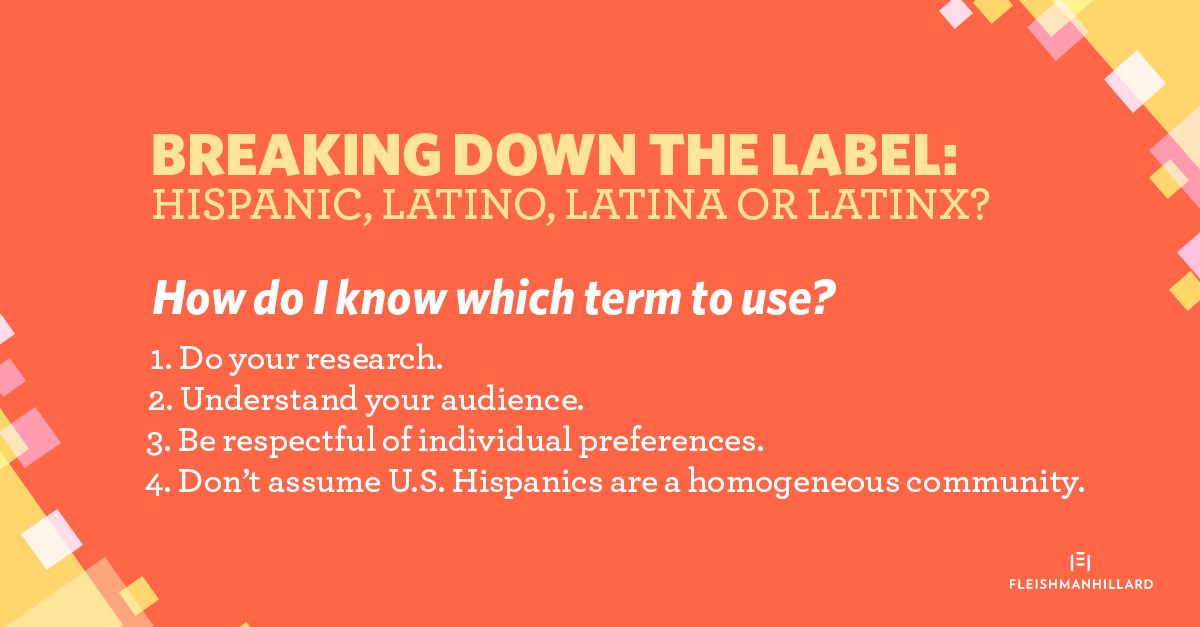
How do I know which term to use?
1. Do your research. Understand the defined meanings of the terms before using any of them.
Hispanic: Focuses on Spanish-speaking origin. This includes Spain, but does not include Brazil, where Portuguese is spoken. Additionally, calling someone “Spanish” only refers to an individual who originates from the country of Spain.
Latino/Latina: Focuses on geographic location and refers to those of Latin American origin. This includes Brazil but does not include Spain.
Latinx: A gender-neutral term used in lieu of “Latino” or “Latina” to refer to a person of Latin American descent.
2. Understand your audience. Recognize that age, countries of origin and life experiences will help make an informed decision on how to refer to the audience.
3. Be respectful of individual preferences. When speaking with someone in this community, follow their lead. Ask what term they prefer and be respectful of their preference.
4. Don’t assume U.S. Hispanics are a homogenous community. Puerto Ricans, Mexicans, El Salvadorians, Chileans, Panamanians, Hondurans, Colombians, Argentines, Cubans and many more have distinct cultures and traditions that defy categorization into one bucket.
See what else is happening
You might also like
Expertise
Earning Your License to Lead: UNGA, Climate Week and Beyond
September 17, 2026
Expertise
Black Hat 2026: A Conference and Industry Transformed
August 10, 2026
Expertise
When Food Safety Crises Test Trust: A Guide for Communicators
July 24, 2026
Expertise
We Went to Cannes Lions: Where the Industry Is Trending
July 1, 2026
Expertise
Healthcare’s Moment Has Arrived. The Question Now Is: Will Your Organization Move Fast Enough?
July 1, 2026
Expertise
The Visible CEO: How Leadership Can Serve as a Strategic Asset
July 1, 2026
Expertise
How to Win the GLP-1 Food Industry Wake-Up Call
June 30, 2026
Expertise
Cannes Lions Exposed an Industry’s Transition of Power: Takeaways From Winning Work
June 26, 2026
Expertise
Lessons From Cannes: Don’t Let Speed Fail Storytelling
On the Record with Ben Golliver: Working from Inside the Bubble in Orlando
October 13, 2020
Share
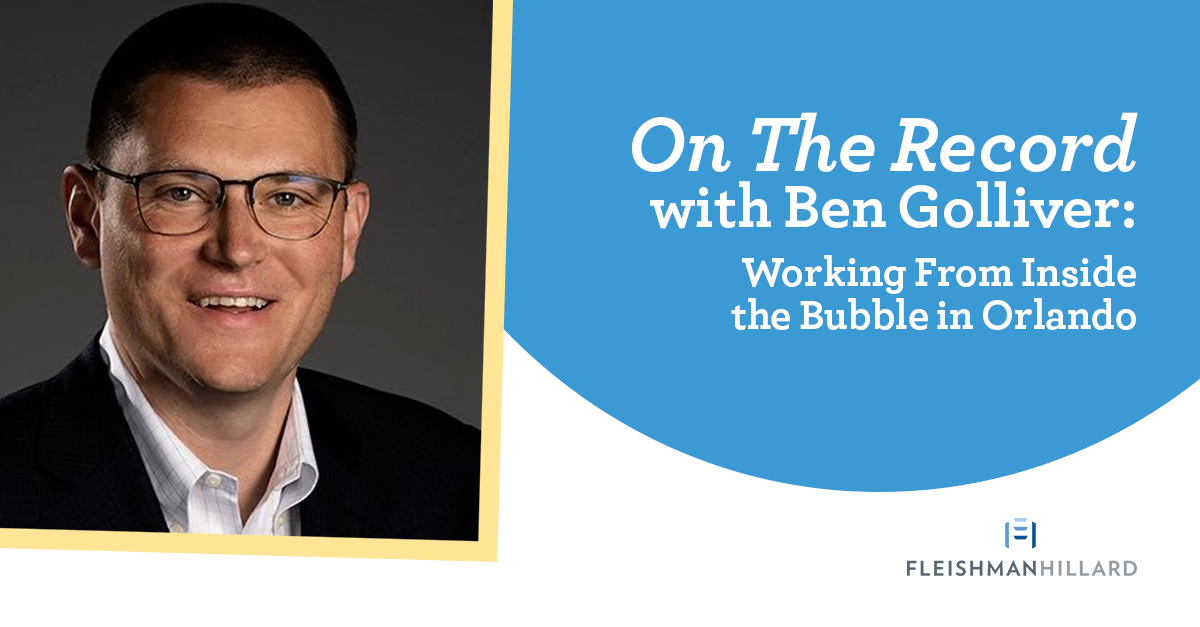
For this ‘On the Record’ Q&A, Matt Fox chats with Ben Golliver, National NBA Writer for the Washington Post, about his unique experience reporting from inside the basketball bubble in Orlando, Florida. The discussion also explores sports industry shifts on athletes speaking to social justice, working with PR professionals, and the future of newsrooms.
Note: This interview took place during the playoffs, a few weeks prior to The NBA Finals.
Matt Fox (MF): Can you walk me through the process for how this opportunity came together? What were your biggest concerns heading into the bubble?
Ben Golliver (BG): If you go back to March, we’re just sitting there missing basketball and thinking about how long this might drag out. Our paper essentially went away from independent sports and style sections because there wasn’t enough to write about. We were really scrambling – different writers were getting assigned to different beats – some even taking on sports temporarily. Everyone was really looking at their long-term job prospects and also worrying about what might happen if there’s no more games this season.
Pretty quickly I had put out the idea of a bubble and wrote a story a couple of days after the shutdown walking through how the NBA could pull it off based on what had just been done in China. Then we just sat around and waited for two months speculating on whether they would try to do it, how they might put it together – it was very nerve-wracking.
Once it finally started to come together, I was very apprehensive just because they’re playing indoors, and playing close contact seemed like pretty high-risk behavior. The big turning point was when they released the health and safety protocols – it was such an extensive document, and it was clear they had really put a lot of thought and energy into every aspect of life. That was able to put me at ease a little bit.
We understood pretty quickly that we were going to have a good shot at it as a national paper, as well as having a long track record of covering the league. The actual application process was pretty extensive – you had to fill out a lot of information for yourself and had to cover thousands of dollars for housing, testing, and food for up to 90-plus nights. You also had to make a commitment to be there for at least three months.
For me, thankfully I don’t have any children I’d have to worry about and I didn’t have any health issues with my parents that I needed to be tied up with, so it was a pretty easy decision. I think I would have been bummed if I wasn’t able to go, but at the same time, it was a real process just to get comfortable from a health standpoint because the fear back in April, May, June was really high. Florida was a major hot spot, along with the idea that if you’re going to have employees who come to the campus and leave the campus at night, that could add to the exposure risk.
So it definitely took a while but once you start going through the testing process and getting negative results back every single day, it really gives you a sense of security to feel taken care of and monitored to give you some structure. But it took a while for that to set in.
MF: Your social content has been really entertaining. How have you been passing the time and what’s the sense of community among the reporters and staff down there every day?
BG: [We’re always down] to the tightest possible package in terms of free time. I was able to go on a two-hour fishing expedition on a Saturday and squeeze in one haircut so far, but otherwise it’s just been nonstop basketball. We have up to four back-to-back games in any given day, and then we also have access to the postgame press conferences to all those players. You could have a day of interviews with Giannis [Antetokounmpo], LeBron [James], James Harden, Anthony Davis which just isn’t possible during a typical regular season or playoffs. Just one of those guys can provide material for a full story, so you wind up choosing which one of these superstar players is the story of the day or have multiple stories.
In playing seven days a week, the [NBA’s] goal is to get as much content on television as possible – as reporters, we just have to go along with that model. There hasn’t been much downtime, but typically I go for a walk for about an hour to an hour and a half every single day. There’s a little walking trail around our hotel property and I’ve seen Brad Stevens, Erik Spoelstra, Nick Nurse, Michael Malone, and a whole bunch of other NBA coaches. You’ll give them a head nod – it feels like a little bit of a community because you’ll see the same people out there every single day.
There’s definitely a comradery with the media, but everyone’s also working really hard. We’re encouraged to stay socially distant too – it’s not like we’re throwing pool parties every single night! But you see the same faces every day and there’s a lot of collegiality. Sometimes in the playoffs it can get to be high stress and there’s more tension between PR and reporters over access. I think here it’s been a little bit more relaxed – we all realize that we’re in it for the long haul. You get the access when you can – the players are going to be here and we’re going to get the time, so it’s maybe not as tense as it typically gets during the playoffs.
MF: What do you attribute to the success for how safe things have been throughout your time there?
Note: As of this posting, there were zero confirmed COVID-19 cases for all bubble attendees through the full duration of the schedule.
It’s definitely the financial resources – testing more than 1,000 people per day for 90 straight days is extraordinarily expensive. The NBA made a very conscious decision to invest that money in the upfront, but they also put a lot of thought into the program. Money doesn’t get you to the end.
The league put in place daily monitoring – every morning we give them our temperature and fill out a questionnaire. If we have any symptoms and if anyone reports something, they immediately follow up on that. We also get tested every single day with the results back within 24 hours. That’s really big because if someone were to test positive, they would be able to limit how many people that person came into contact with because the testing is so rapid from a turnaround perspective.
They’re very strict with the rules. When you’re on campus, you have to wear a mask and stay socially distant. We even have these little buzzers that sound like smoke detectors if you get too close to other people. During interviews, they have it marked down on the ground where you can stand so that you don’t get too close to the players.
And ultimately they’re holding the players to those same rules too. You’re not going to see your favorite superstar walking around campus without a mask on. All the players have really bought in – they realize their paychecks really rely on this whole thing being successful. For the guys who really want to win titles, they have every reason to follow the rules because they want to have the opportunity to win. I think that’s been the most critical part of buy-in, but it’s definitely the finances. If they didn’t have the money and didn’t have the vision to spend the money wisely, we’d all in a very different spot.
MF: How has the pandemic changed the way that you interview athletes?
BG: The most obvious impact is that it’s taken us out of the locker room as well as giant media scrums. It’s a perfect contrast as right after Kobe Bryant’s death earlier this year, there was extraordinary media interest in talking to guys like LeBron [James] and the Lakers in the days following. So we would go to scrums where there would be almost 200 people. Sometimes there would be almost physical altercations for cameramen trying to get certain angles and everybody jockeying for position – it almost feels like a mosh pit. I always joke that in those situations, I’m bringing my sharp elbows, just in case you need to hold your ground.
It’s a much more relaxed environment now. At most, 10 people are in a post-game interview and we don’t ever visit the locker room because that would be a confined space. There’s also the virtual element – a lot of these questions are taken through a video screen. That takes away some of the personal nature of the interviews which is a little bit unfortunate, but most of these guys are so famous culturally and internationally that they had to make it work to bring in media from around the globe.
I would say it’s less personal, less intimate, smaller crowds. There’s still opportunities for one-on-one interviews which is good. I think the biggest question all the writers are weighing now is how many of these rules are going to stick once the pandemic passes. For a while being in the locker room was seen as a non-negotiable point, especially for the more traditional reporters. I think everyone wants to know when we’re going to be able to get back to a locker room, if ever.
MF: You’ve written a lot of social justice so far, given it’s become such an important topic around the league. Do you feel like players are more receptive to talking with you about it, recognizing not just the power of their platforms, but yours as well to provide new perspectives on what’s unfolding in society?
All the players who are really passionate about this came down to the bubble wanting to have a concerted effort to put their messages out. So you’re seeing coordinated statements about Breonna Taylor, Jacob Blake, George Floyd and many more.
There’s a lot of high-powered media entities here – they’re all covering this story in addition to the basketball story and also realize they have a lot of power to dictate what people are speaking about. You’ll see players start their interviews without answering basketball questions. In some cases, they refuse to answer basketball questions at all and just speak freely about what’s on their mind. Ultimately it’s newsworthy so we’re going to talk about it.
There’s discussions about how to best protest when you’re stuck inside the bubble. These kinds of things are very relatable to an average fan who feels like they can’t go outside because it’s not safe, but still feel very frustrated by a lot of these issues.
I think the players have done a really good job of speaking passionately about this while juggling other priorities. A lot of the credit goes to Chris Paul (President of the NBA Players Association and Oklahoma City Thunder guard) because he’s the one who led the players’ association in these negotiations. They were able to secure Black Lives Matter signage on the court, jerseys, t-shirts. Most importantly they were able to put together a $100 million foundation with NBA owners that’s going to provide funds to black communities over the next 10 years. Those are the steps that they’re making and they’re constantly looking for more.
Every time an event happens you can kind of feel the hopelessness on the players’ side. There’s that moment where it hits them hard, they take a step back and feel pain, and then the next day resolve comes back and they say, “Okay, now we’ve got to do more.” It’s a constant part of life down here.
MF: You’ve been pretty remote even before all this happened. Where do you see the pandemic shifting the landscape of traditional newsrooms?
BG: It’s been really hard for people who work regularly in the newsroom because that’s the only life they’ve ever known. It was a major adjustment for some of my colleagues and they were really missing the office environment. Not just the chit-chat and laughter, but also the collaborative planning aspect where you can just go over to somebody’s desk if you have an idea and bat it out in real time. You’ve got programs to help with those things, but it’s just not the same thing and I think everyone has to adjust.
For me, my life hasn’t really changed in that aspect except for that I didn’t really travel for the first three or four months of the pandemic. That was a major change because we basically stockpiled all non-essential travel to doing a lot more phone and video interviews.
In terms of my day-to-day life, most of my work takes place at the arena or at home – that’s still the case and I think it will continue going forward. In terms of when we get “back to normal”, we’re going to be fully remote at The [Washington] Post, at least through the end of the calendar year and perhaps longer. They’ve been pushing it out more aggressively than a lot of media companies, more in sync with tech companies who have been leading the way on that.
Speaking from my experience, I think we’ve kind of adjusted to this environment. While people are still looking forward to being back in a newsroom, they’re not trying to rush it at all.
MF: What’s some of your favorite content you’ve been able to produce while in the bubble?
BG: First I was able to do a big profile of Rudy Gobert (Utah Jazz center), essentially “patient zero” who shut down professional sports. He was very candid in how tough of an experience that was. He was caught on video touching all those microphones and being kind of careless right before everybody realized how rapidly the virus spread – that wound up giving him a lot of criticism. He still has COVID-related symptoms to this day and doesn’t have his sense of smell back. He’s very close to his mother and because she lives in France, they were not able see each other since he tested positive. He got pretty sick from a severity standpoint and it’s just hard to imagine being in that situation thousands of miles from the people you care about, and how difficult that would be especially when everyone is piling on you online. That was our preview story for the restart – he wound up scoring the first points in the bubble and hitting game-winning free throws in the bubble, so it really did come full circle there.
I did a story with Michelle Roberts, head of the NBA Players Association. She announced plans for a succession plan five days before the NBA shutdown, just coincidentally. She’s 63-years-old and was ready to retire – the coronavirus just pulled her back in like a mob movie. She’s been down here living and working with the players and plans to stay here through the duration. Now she has a big labor negotiation she’s preparing for as well because they’re trying to determine the framework for next season, which remains very much up in the air.
LeBron [James] has been very vocal – whether it’s been about Breonna Taylor, Black Lives Matter, Jacob Blake – the list goes on. I think his words carry more weight than anyone else in the league so to hear him refine his message is very powerful.
But I’ll be honest, it’s not about one specific story – it’s all a blur, like basketball in fast forward. When we think about getting back to normal down the road, the NBA season might feel slow after this. This is the most condensed, overwhelming version we’re ever going to get.
MF: Has your relationship changed at all with PR people on the brand side? Any stories you’ve been able to weave in more organically during this time?
BG: This is definitely a different environment because agents are not in the bubble, and team PR and player PR staffers are very limited. Pretty much every team has one PR contact per team. Some reporters call that friction in getting to your subject – I would say it’s been a more streamlined situation where it’s more about basketball rather than the outside world that other players are working on.
A great example – look at how players are dressing before games. They’re dressing in sweats, hanging out – people may sit courtside on their day off and watch the Lakers game. It’s a much more relaxed, put-together vibe versus the Staples Center where people are showing up with perfectly manicured outfits. There’s just been less of that presence because there’s no fans or crowd to cater to and also because guys are away from their families and stores where they’d go shopping for that stuff. They’re away from personal assistants, more or less on their own or just with the team. It’s been a much more basketball-focused environment.
There is this warping effect – if you hear from people outside the bubble, it’s almost always on the back burner because there’s always so much going on here. Our game is always dictated by when does LeBron [James] play next, when does the next game tip-off. If a company says they have a new store opening up in New York, it feels so far away from the bubble – especially right now. That’s something that I think will go back – we know how the NBA works, it’s much bigger than just the sport on the court. That will return, but right now it’s been a big adjustment.
See what else is happening
You might also like
ESG
Navigating Conflicting Demands to Advance Climate Action
January 20, 2025
Opinions
Supporting St. Louis Institutions Dedicated to Empowering Youth Through FH4Inclusion
January 15, 2025
Opinions
Revitalizing the San Francisco Community with the Downtown Volunteer Coalition
December 23, 2024
Opinions
FleishmanHillard and FH4Inclusion Teams Shine at the Cannes Lions International Festival of Creativity
August 28, 2024
Opinions
Bridging the Generational Divide with Generative AI
August 27, 2024
Inclusion
Success on Repeat: Alumni of the Alfred Fleishman Diversity Fellowship Discuss Promotions and How to Get Them
May 29, 2024
News
EU climate policy: The new borderlines?
May 27, 2024
News
Achieving the Evolving Duality of Loyalty and Loyalty Programs
April 1, 2024
Expertise
TickTockTech: Mobile World Congress 2024 — What’s the Verdict?
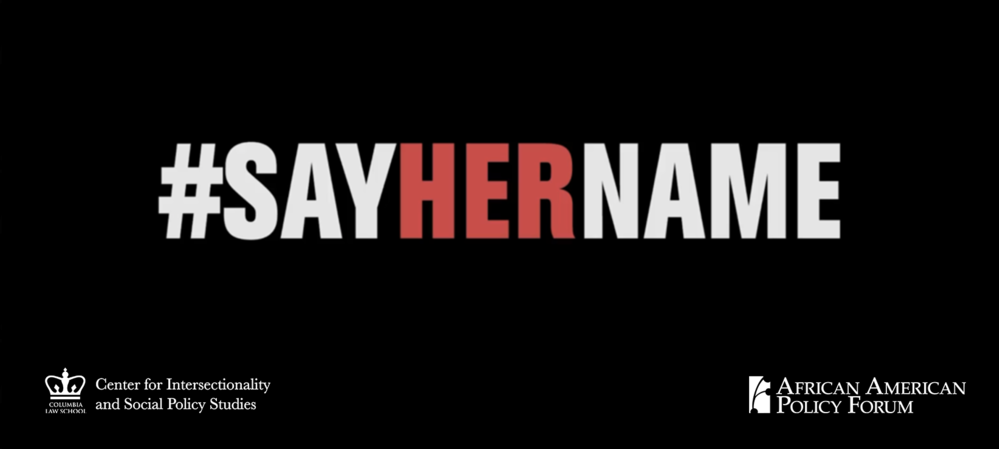
Bridging the Gap Between #SayHerName and the African American Policy Forum
October 7, 2020
Share
Earlier this summer, as the murder of George Floyd flooded our news, companies around the world were forced to reflect on our country’s history of structural racism, prompting long-overdue conversations and action across all levels. At FleishmanHillard, the protests around Floyd’s murder inspired several notable actions, including recurring and reflective all-staff conversations, the launch of a new client offering focused on diversity, equity and inclusion (True Mosaic), and the naming of our first chief diversity officer, Emily Graham.
But, one of the actions I’m especially proud of is the launch of a pro bono FH4Inclusion and True Mosaic partnership with the African American Policy Forum (AAPF), the organization that founded the #SayHerName campaign. Founded in 1996, AAPF is a Washington, D.C.-based think tank that convenes academics, activists and policymakers to promote efforts that dismantle structural inequality. Following the police killings of Eric Garner and Michael Brown in 2014, AAPF joined thousands of other protestors and advocacy groups to protest anti-Black police brutality. Marching under a banner with the names of Black women who were killed by police, the group began chanting, “Say! Her! Name!,” giving rise to the #SayHerName campaign that’s since taken over the nation. AAPF was able to clearly articulate that people often knew the names of Black male victims, but unfortunately few knew the names of Black female victims.
Despite the success of the #SayHerName campaign (the hashtag has gone viral) and well-known stature of AAPF Executive Director Dr. Kimberle Crenshaw, AAPF has struggled to connect the founding institution back to the #SayHerName campaign. Leveraging talent from across the global Omnicom network, FleishmanHillard was tasked with closing the gap between AAPF and #SayHerName using traditional media, fundraising and high-profile partnerships, social media and website improvements.
As our country continues to reckon with and address structural inequity, our work with AAPF is even more important. This partnership serves as an immense opportunity for both our firm and individual colleagues to create the difference we all collectively want to see.
Below are a few quotes from our team that showcase just how meaningful this work really is.
“We must continue to shed light on the racial injustices occurring within our country and police departments. We must continue to #SayHerName. That is the only way we will see change.” – Francesca Weems, account supervisor, San Francisco, California
“There’s nothing like seeing someone who looks like me make a significant change when it comes to diversity, equity and justice, and being able to be a part of the work Dr. Crenshaw and AAPF are doing has already made my time at FH an impactful experience.” – Chichi Osunkwo, Alfred Fleishman Diversity Fellow, San Francisco, California
“Fostering change and elevating voices within underserved and underrepresented populations is essential to addressing systemic racism, and AAPF is doing just that.” – Matt Shinabarger, senior vice president, Detroit, Michigan
“Racism is a fight we can’t afford to lose. I’m so proud to be a part of a project that addresses the urgent and important issues of today.” – Malia Eley, account supervisor, San Francisco, California
“As storytellers, the most impactful stories we can tell are the ones from overlooked or silenced voices. AAPF gives us this opportunity.” – Jennifer Tam, account executive, San Francisco, California
“I read Dr. Crenshaw’s work on intersectionality in college, and now I get the chance to actively support her through AAPF. It feels so good to combine my skills in PR with my passion for diversity, equity and inclusion.” – Elizabeth Comtois, account executive, Raleigh, North Carolina
“I’m passionate about this work and the opportunity to participate because if not now, when? I can be a voice for someone else who can benefit and act as the advocate I always needed.” – Gaetane Joseph, senior administrative assistant, Atlanta, Georgia
“Systemic racism has always existed in the history of the U.S., and what AAPF does directly targets the problem. I’m passionate about uplifting underrepresented groups, so I’m super excited to be part of the team that’ll make fundamental change happen.” – Jerry Yan, Alfred Fleishman Diversity Fellow, San Francisco, California
Photo Credit: The African American Policy Forum (AAPF)
Malia Eley is a member of our Corporate Reputation team in our San Francisco office.
See what else is happening
You might also like
ESG
Navigating Conflicting Demands to Advance Climate Action
January 20, 2025
Opinions
Supporting St. Louis Institutions Dedicated to Empowering Youth Through FH4Inclusion
January 15, 2025
Awards
FleishmanHillard Earns Perfect Score on 2025 Human Rights Campaign Foundation’s Corporate Equality Index
January 7, 2025
Opinions
Revitalizing the San Francisco Community with the Downtown Volunteer Coalition
December 23, 2024
Expertise
Responsible Business: Navigating Today’s Challenges and Opportunities
October 22, 2024
Inclusion
Recognizing the power of the LGBTQ Community in Advertising & Media with GLAAD
October 11, 2024
Opinions
FleishmanHillard and FH4Inclusion Teams Shine at the Cannes Lions International Festival of Creativity
August 28, 2024
Opinions
Bridging the Generational Divide with Generative AI
August 27, 2024
Expertise
How to ensure access and opportunity for Black and diverse students and professionals interested in working in sports
Safety as a Goal: Five Principles of Public Policy Responses to Risks
September 21, 2020
Share
Whether responding to a global pandemic or hazardous chemicals, the fundamental policy goal is essentially the same: maximise safety/minimise risks. This policy goal may sound simple, but it is far from straightforward how to maximise safety. Something the wide array of different policies around the world in response to Covid-19 have shown. […]