Consumer Expectations Are Ramping Up, but Companies Need to Know When to Step Up
August 26, 2019
Share
We live and work in a world where a single tweet can trigger significant reputational damage — to people and to brands. That’s partly because social media and other technology help information and ideas spread around the world faster now than at any other time in human history. The benefit of increasing the reach and speed of our interconnectivity is also resulting in an increasingly polarized and unforgiving landscape where media and public opinion are deeply divided by political extremes and social intolerance.
For businesses, today’s complex issues landscape creates challenges. But it also presents opportunities.
Companies are feeling pressure to take a stand on a wide range of divisive issues. Taking a stand can pose risks to business continuity, share price and corporate reputation. However, our research found that consumers don’t expect companies to act on and fix everything, but more specifically those issues most under their control. Three out of four consumers globally expect CEOs in particular to take a stand on issues that have an impact on the company’s customers (74%), products and services (72%), and employees (71%).
Companies that engage authentically on issues that are aligned with their business objectives can enhance their financial performance, strengthen their connections to consumers and make themselves more attractive to top talent. To get to that point — where corporate values and purpose guide policy and practice — takes time, careful thought and a fully integrated approach.
If silence is no longer golden and brands are expected to be part of the conversation and part of the solution: What issue(s) should you focus on? When and how should you respond? How do you decide?
Our approach is grounded in four principles that are essential to managing reputation today: 1) staying socially attuned, 2) being transparent and accountable, 3) ensuring alignment across relevant business and communications functions and 4) preparing for potential negative impacts. This leads to informed decisions and positions that are true to a company’s values.
FleishmanHillard Named to Holmes Report’s 2019 Asia Pacific Consultancies of the Year Shortlist
August 20, 2019
Share
ST. LOUIS, Aug. 20, 2019 — FleishmanHillard earned three spots on the Asia Pacific Consultancies of the Year shortlist, presented by The Holmes Report. The global PR and marketing agency was named a finalist in the Regional Consultancy of the Year (Large) category. The firm was recognized for its significant growth in the region, leadership retention and notable client campaigns.
Additionally, the firm was shortlisted in the Greater China Consultancy of the Year and Healthcare Consultancy of the Year categories.
These awards honor outstanding communications firms across the APAC region. Winners will be announced at the Asia Pacific SABRE Awards in Singapore on September 12, 2019.
FleishmanHillard (Asia-Pacific Regional Consultancies of the Year (Large))
FleishmanHillard (Geographic, Greater China Consultancies of the Year)
FleishmanHillard (Specialist, Healthcare Consultancies of the Year)
View the complete list of finalists on The Holmes Report.
See what else is happening
You might also like
Expertise
The New Culture Gap Report: How Brands Stay Relevant for 100 Years
March 24, 2026
News
FleishmanHillard Named Among PRovoke Media’s Best Public Relations Agencies in the World
March 10, 2026
News
FleishmanHillard Integrates Porter Novelli to Form a Stronger, More Specialized Global Communications Consultancy
February 9, 2026
News
From Ragan: Elizabeth Cook on Rethinking Preparedness in Crisis Response
January 21, 2026
Global Executive Advisory
Insights From Davos: Building Credibility Through Storytelling
January 20, 2026
News
FleishmanHillard Unveils ‘License to Lead’ Research, Revealing a Growing Confidence Gap Between Executives and Stakeholders
January 13, 2026
News
FleishmanHillard Wins 2026 Innovation Awards for Data-Driven Strategy
January 12, 2026
Expertise
When the World Gets Noisy, Great Storytelling Breaks Through
December 3, 2025
News
Ellie Tuck Appointed Chief Creative Officer of the Americas
Gen Z is spending more of their own money on back-to-school shopping. Rather than leaving it to mom or dad, teens and pre-teens are making product decisions, mostly on clothing and accessories, and are willing to spend their own cash. Each teen will spend an average of $36.71 and each pre-teen $26.40.
College students want to show their spirit! Spending on college-branded items has increased 17% year over year. College goers will spend an average of $66.22 each on collegiate gear. However, the college shoppers will spend the most on electronics, followed by clothing and accessories, dorm and apartment furnishings and food items.
Fundamentals matter. Deloitte’s 2019 back-to-school survey showed that (regardless of shopping age) consumers are crystal clear on their top three purchase motivations: 1) price 2) product and 3) convenience. Most start shopping four to six weeks before school starts, but they are willing to wait for the highest discount.
Brick-and-mortar stores are still winning. Among back-to-school shoppers, 88% plan to visit brick-and-mortar mass-market retailers. Rounding out the other top four retailers are online, dollar stores, specialty retailers and off-price.
Going back to school also means giving back. Thirty-one percent of consumers plan to donate school supplies and other needed items while they are doing their own back-to-school shopping — in fact, around $51 per family.
See what else is happening
You might also like
Expertise
Why Trust is the Real Competitive Advantage in Ag Tech
April 2, 2026
Expertise
Notes From the Road: RSA Conference 2026 Edition
April 1, 2026
Expertise
Why Your AI Rollout Is Stalling (And What Actually Moves the Needle)
March 25, 2026
Expertise
Get the Report: Inside China’s 2026 Two Sessions
March 24, 2026
Expertise
The New Culture Gap Report: How Brands Stay Relevant for 100 Years
March 24, 2026
Expertise
The Tech Industry’s License to Lead Problem: How Tech Companies Made Themselves Vulnerable to the AI and SaaS Apocalypse Doubt
March 4, 2026
Expertise
The Five Principles of Decision-Ready Intelligence: A Framework for Making Hard Calls in an AI-driven Environment
March 3, 2026
Expertise
The Patient Engagement Gap Your Competitors Are Closing
February 26, 2026
Expertise
AI is Reshaping Communications: Inside FleishmanHillard’s Enterprise-Wide Approach
Consumers Increasingly Expect Business to Step Up in a World Where the Stakes Have Ramped Up
August 18, 2019
Share
Research in Six Global Markets Across More Than 30 Industries Reveals Where There are Opportunities for Companies to be More Authentic
ST. LOUIS, August 19, 2019 – Against the backdrop of immigration, trade wars and polarized governments, FleishmanHillard’s 2019 Authenticity Gap study explores what role consumers believe business should take in addressing societal, political and business challenges in different parts of the world.
Consumers expect companies to take a stand on those issues that companies either create, impact directly or control. In particular:
Improved data security and privacy topped more than 20 issues consumers ranked as being important to see companies more actively address. There’s an expectation for companies to do the right thing and self-police – 73% of consumers want to see protection practices that go beyond regulatory mandates.
69% of consumers globally say, to be more credible than competitors, a company must talk about its behavior and impact on society and the environment, not just the customer product benefits it offers.
Perhaps in response to a growing tide of automation and AI, 77% of consumers globally said it was most important that their employer help further develop their skills and career opportunities.
Consumers don’t care about CEOs’ personal beliefs, rather they want them to stick with issues that have an impact on the business’ customers (74%), products and services (72%) and employees (71%). Consumers know companies can’t fix everything, but they expect them to be active on those issues most under their control.
“By identifying what their consumers care about most and where they’re expected to take a stand, businesses can plan ahead, developing an authentic position,” said Marjorie Benzkofer, chief strategy officer and global managing director of the Reputation Management practice, FleishmanHillard. “Our research found that more than half of what shapes consumers’ perceptions and beliefs about a company comes from how its management behaves and how the organization impacts society. Companies that are willing to stand up for their values on issues important to their stakeholders can unlock opportunities and position themselves for success.”
The Authenticity Gap study analyzes insights from engaged consumers in six countries, examining their expectations and experiences with more than 300 companies in nearly 30 industries. The study provides organizations across industries actionable data they can use to shape their brands and business initiatives — uncovering where they’re meeting or falling short of audience expectations in the areas of society, management behavior and customer benefits.
“Our expectations of what companies and organizations should be undertaking is more expansive than ever before. We want companies to be stepping up and speaking up in new ways. In this new environment, it’s too easy for an organization’s brand promise to fall flat, or worse, badly misstep. Smart insights can save companies money and avoid market-share-eroding crises down the road, ensuring they understand the very different, and sometimes conflicting, expectations within each unique audience group,” Benzkofer said.
While this year’s study shows remarkable differences by country, global insights across industries include:
Protecting data and privacy is vital
Consumers are hesitant to share their data even when it benefits them – only 41% of consumers reported being willing to have their data collected for greater convenience
Consumers are becoming increasingly wary of companies’ use of their personal data, with 63% saying they’re less likely to support companies that use data for their own benefit
What makes a great place to work is evolving
Three-fourths of respondents noted the importance of both having a work environment that is inclusive and equal, and a robust benefits program that meets healthcare needs
73% are interested in a workplace that institutes practices that protect the environment
71% want their employer to provide opportunities to use new technologies and innovations
Coming toward the bottom of the list of importance was a place with work practices that accommodate a flexible lifestyle, though 65% still say it’s important
Just because it’s important to a consumer, doesn’t mean they expect a business to act
Consumers care about affordable, quality healthcare, violence against women and access to affordable quality education, but do not have high expectations for companies to take a stand on those issues
Consumers most often expect companies to take a stand on issues like protecting the environment, income and wage gaps, and the minimum wage
FleishmanHillard has developed new strategies to help businesses navigate the current environment, ranging from communicating around new expectations of corporate purpose, addressing emerging trends in talent and transformation as well as dynamic approaches to issues management. To learn more, download the Authenticity Gap Global Report, Authenticity in Action.
The Authenticity Gap study was conducted by FleishmanHillard’s TRUE Global Intelligence™ practice. The survey included a total of 7,364 engaged consumers in Brazil, Canada, China, Germany, UK and the US, 18 years of age and older. Engaged consumers represent on average 29% of the population of adults. The survey was fielded online between April 19 and May 22, 2019.
About FleishmanHillard FleishmanHillard specializes in public relations, reputation management, public affairs, brand marketing, digital strategy, social engagement and content strategy. FleishmanHillard was named Agency of the Year at the 2017 and 2018 North American Excellence Awards; 2017 and 2018 ICCO Network of the Year for the Americas; 2019 PRWeek U.S. Outstanding Large Agency; 2019 Holmes Report North America Large Agency of the Year; 2018 Large Consultancy of the Year by PRWeek UK; PR News’ Best Places to Work in PR 2016-2018; Human Rights Campaign Best Places to Work for LGBTQ Equality for 2018 and 2019; PR Awards Asia 2017 Greater China Agency of the Year; and NAFE’s “Top Companies for Executive Women” for 2010-2019. The firm’s award-winning work is widely heralded, including at the Cannes International Festival of Creativity. FleishmanHillard is part of Omnicom Public Relations Group, and has more than 80 offices in 30 countries, plus affiliates in 43 countries.
About Omnicom Public Relations Group
Omnicom Public Relations Group is a global collective of three of the top global public relations agencies worldwide and specialist agencies in areas including public affairs, marketing to women, global health strategy and corporate social responsibility. It encompasses more than 6,300 public relations professionals in more than 370 offices worldwide who provide their expertise to companies, government agencies, NGOs and non-profits across a wide range of industries. Omnicom Public Relations Group delivers for clients through a relentless focus on talent, continuous pursuit of innovation and a culture steeped in collaboration. Omnicom Public Relations Group is part of the DAS Group of Companies, a division of Omnicom Group Inc. (NYSE: OMC) that includes more than 200 companies in a wide range of marketing disciplines including advertising, public relations, healthcare, customer relationship management, events, promotional marketing, branding and research.
Think about the last decision you made about something you knew would impact your organization’s reputation. Was it based on years of experience and good instincts?
If so, you likely missed the mark.
For years, we have forged our craft and our careers with the lessons we learned through hard-won experience. But that collection of experiences is singular to us as individuals.
Today, the best in our industry don’t make decisions based on experience and gut instinct. They counsel with data and insights. None of us has the breadth of experiences to fully prepare an executive, or an entire company, for how to behave in these very polarized times.
It’s against that backdrop that we introduce this year’s Authenticity Gap Study, which explores consumers’ views on today’s most discussed topics and trends from six points around the globe (China, Germany, UK, Brazil, Canada and the U.S.). We also unpack consumers’ expectations and their experiences with more than 300 companies in nearly 30 industries.
With an established track record of doing this study, I thought I had pretty good instincts for what we’d find. Once again, there is no substitution for real data to better understand the world around us. Included here are just a few of the headlines we’ve found interesting.
WHERE AND WHEN TO TAKE A STAND:
There has been much written this past year about how and when companies are taking a stand on societal issues. Turns out, the issues consumers most care about (and it varies quite a bit by country) isn’t exactly the same list as the issues where consumers expect companies to speak out. Driven by a sense of realism, consumers know companies can’t fix everything, but they expect them to be most active on those issues most under their control.
WHO’S A GREAT EMPLOYER?:
Engaged consumers care about a company’s employees. How businesses treat their workers has skyrocketed up the list of consumers’ concerns. When it comes to employers being a great place to work, offering experiences to develop skills and pursue new career opportunities skyrockets upward as engaged consumers put it at the top of their list. In fact, employees may have turned the expectations of how companies treat their employees on their head, as having flexibility for greater work/life balance now comes in last.
HOW TO PLAY IN A NEW SPACE:
Today, when companies expand into new industry segments, they are asking what it takes to win the hearts and minds of consumers in a space where they don’t have a track record. The answer from consumers: Demonstrate a greater positive impact on society than the incumbent companies when launching a new product or service. Consumers believe that for a company to be more credible than competitors, it must talk about how its leaders behave and how the company impacts society and the environment, not just the product benefits it offers.
CEOS, DON’T MAKE IT PERSONAL:
We see a growing tide in companies engaging more in societal issues and more notoriety around the personality of CEOs. But consumers don’t want CEOs to mingle the two. They don’t care about the personal views of the CEO, but rather how he or she is activating the company to show what the company does and doesn’t value.
TELL THE COMPLETE STORY:
While most companies want to spend most of their time and resources talking about what they sell, consumers say less than half of their perceptions of a company are shaped by its products and services. The other half is shaped by information on how leadership behaves and how the company is having an impact on society. People, not products, are what consumers care about. They want to know how companies are:
Understanding customers’ unique needs
Reducing their impact on climate change/environment
Impacting consumers’ health and well-being
Taking care of their employees
It can be easy to think that conducting a little bit of research is a luxury only suited for large initiatives. But smart insights can save you money and avoid market-share-eroding crises down the road, by ensuring you understand the very different expectations of your very different audiences. So, the question becomes, are you willing to stake your company and your own reputation on your gut instinct?
A Little Financial Literacy Can Go a Long Way on the Road to Retirement
August 13, 2019
Share
We’ve all seen or heard the stats about how unprepared Americans are for retirement, and frankly, they are scary. It’s no secret that there’s a growing problem with Americans’ retirement funds and savings overall, but solutions require more than simply telling people to save more. Each generation experiences its own set of issues and challenges – including large sums of credit card debt, massive student loan balances, stagnant wages, underemployment and rising housing costs in many urban areas.
Additionally, the long-term effects of the Great Recession are still with us, both in terms of personal financial outcomes, as well as emotional scars – much like the lasting effects that the generation that lived through the Great Depression experienced. However, as we’ve seen through the work of many of our banking clients, with a little financial literacy and the courage to take small steps to address these challenges, we can all eventually become better at saving, and in turn, have more stable financial futures.
A look at the problem
A recent study by Northwestern Mutual found that 21% of Americans have nothing saved for retirement and another 10% have less than $5,000 in savings. Equally alarming is that one-third of Baby Boomers currently in or approaching retirement age have between $0 and $25,000 set aside.
These numbers are a big reason why the financial services industry runs awareness campaigns encouraging people to save more. These firms collectively spend millions of dollars on financial literacy programs to help educate people about the problem, make them feel more secure in their financial decision-making and inspire them to act. Granted, it is also in these companies’ best interest for people to save and use their accounts, services and mutual funds to help manage their assets and generate fees, but they are also trying to be part of the solution to a growing problem.
Small solutions lead to big rewards
So, how do we tackle this problem when many financial advisors believe that the average 65-year-old should have between $1 million and $1.5 million saved for retirement to maintain a reasonable standard of living? To many that seems like a huge number that is completely out of reach. Many experts in behavioral finance will tell you when a financial goal seems out of reach, that instead of trying, many give up and don’t make the sustained effort it takes to move the needle – even when it is in their own best interest.
Below are a few things to keep in mind that demonstrate incremental steps can make a big difference over time:
1. The Power of Compounding: Saving $1 million can seem like an impossible task. However, if you put just $3,000 a year into an IRA and invest it in a S&P 500 index fund, and that fund generates just an 8% annual return (which the index has averaged since 1988, even factoring in the Great Recession) you will have $1,069,000 at age 65. So, it is possible, but if you wait until age 32 to start saving the same $3,000 a year, you’ll only have $473,000 at age 65. Starting early can turn a molehill into a mountain … of cash.
2. The Power of Tiny Behavior Changes: Many people are strapped and can’t think of where they would come up with $3,000 a year to put into an IRA. Start with tracking your spending. Find out where you are spending your money today and the changes you can make to reach your objective. Say, for example, you spend $2 a day on a morning coffee and $10 on lunch on work days. If you can brew your morning coffee at home and bring a lunch you would save roughly $10 a day or $50 a week. Over the course of a year that would be about $2,500 – you have now nearly reached your goal and haven’t really had to make too drastic a change. Imagine where else you could turn wasteful spending into savings if you kept track.
3. The Power of Financial Apps: There are tools aplenty, and many are free. A quick visit to the App Store and a search of financial tools produces a treasure trove of online financial assistance. There are apps for budgeting, banking, education and investing. Investing through several online apps can put the power of buying stocks, bonds or mutual funds in your hands with real-time quotes and instant trade execution. In addition, the fees and account minimums for online trading are approaching zero, with some firms already using that approach. It has never been easier for an investor with a relatively small amount of capital to participate in building long-term wealth.
Two famous quotes taken together really sum this up. Ben Franklin is oft-quoted that “a penny saved is a penny earned.” Albert Einstein, by varying accounts, either called compound interest “the most powerful force in the world,” or “the eighth wonder of the world.” It can be pretty amazing to see how quickly those saved pennies can turn into dollars that can multiply themselves – and with enough time create a meaningful nest egg for you and your loved ones. The good news is that today there are more resources than ever to help you on your journey of financial literacy.
See what else is happening
You might also like
Expertise
Why Trust is the Real Competitive Advantage in Ag Tech
April 2, 2026
Expertise
Notes From the Road: RSA Conference 2026 Edition
April 1, 2026
Expertise
Why Your AI Rollout Is Stalling (And What Actually Moves the Needle)
March 25, 2026
Expertise
Get the Report: Inside China’s 2026 Two Sessions
March 24, 2026
Expertise
The New Culture Gap Report: How Brands Stay Relevant for 100 Years
March 24, 2026
Expertise
The Tech Industry’s License to Lead Problem: How Tech Companies Made Themselves Vulnerable to the AI and SaaS Apocalypse Doubt
March 4, 2026
Expertise
The Five Principles of Decision-Ready Intelligence: A Framework for Making Hard Calls in an AI-driven Environment
March 3, 2026
Expertise
The Patient Engagement Gap Your Competitors Are Closing
February 26, 2026
Expertise
AI is Reshaping Communications: Inside FleishmanHillard’s Enterprise-Wide Approach
Brands Are Couch Surfing Their Way Into The Screens Of Consumers – Here’s Why
August 9, 2019
Share
Tomorrow, many consumers will be taking advantage of National Lazy Day. Couches will be surfed and screens – this includes phones, tablets and TVs – will be lit up. For brands, this means more opportunities for exposure, higher engagement and awareness in consumers’ homes, as more and more individuals opt for In Your Home (IYH) experiences over In Real Life (IRL) ones.
Here, FleishmanHillard’s Brand and Consumer Marketing experts dive into the ways brands can win over consumers this National Lazy Day – IYH vs. IRL.
From Sidelines to Screens: Staying Relevant in the Streaming Era
In this era, where consumers are binge-watching or cheering on their favorite teams from the comfort of their own couches, brands are having to find unique and tailored ways to get in front of their audiences on the platform of choice.
Streaming and subscription-based services have skyrocketed during the past few years and have quickly become the solution to Millennial (and neighboring generations) desires for quality content, cost and – the big one – convenience.
With streaming increasingly becoming the cultural norm, the reality is that for modern-day consumers, some of the biggest events in entertainment now take place in their homes and on their couches. And can you blame them? Accounting for expensive tickets, transportation and food, not to mention the long lines and cramped seats, it’s no wonder they’re gathering their squad at home for unlimited chips, dips and viewing options. The champions of the IRL roar of a stadium, the laughter in a theater or the chest-rattling bass of your favorite band are dwindling as live streaming creates more tailored options for the at-home viewer – 45% of whom said they would pay for live, exclusive or on-demand video from a favorite team, speaker or performer.
With no escaping the influence that streaming now has, brands need to identify broadcasted moments that fit their values, generate relevant, attention-getting content, and seek out audiences that see eye-to-eye.
Our on-demand lifestyles are now, more than ever, defined by what we can access. But how does a seemingly endless library of curated content impact what we choose to watch, listen to and experience IRL? As we explore this new cultural norm – the duality of experiencing entertainment IRL vs. IYH – it’s important to look at the human truths and brand implications associated with this shift.
Sports, movies, shows, music – these are all forms of streamable at-home experiences that have joined the cultural shift. As consumers increasingly take advantage of their “lazy days,” we’ll continue to see brands form creative partnerships, sponsor activations, encourage live social sharing and promote on-screen engagements in order to stay relevant with these two co-existing forms of entertainment – IRL and IYH.
Madison Wood, a member of the Brand Marketing practice in our Dallas office, also contributed to this piece.
See what else is happening
You might also like
Expertise
Why Trust is the Real Competitive Advantage in Ag Tech
April 2, 2026
Expertise
Notes From the Road: RSA Conference 2026 Edition
April 1, 2026
Expertise
Why Your AI Rollout Is Stalling (And What Actually Moves the Needle)
March 25, 2026
Expertise
Get the Report: Inside China’s 2026 Two Sessions
March 24, 2026
Expertise
The New Culture Gap Report: How Brands Stay Relevant for 100 Years
March 24, 2026
Expertise
The Tech Industry’s License to Lead Problem: How Tech Companies Made Themselves Vulnerable to the AI and SaaS Apocalypse Doubt
March 4, 2026
Expertise
The Five Principles of Decision-Ready Intelligence: A Framework for Making Hard Calls in an AI-driven Environment
March 3, 2026
Expertise
The Patient Engagement Gap Your Competitors Are Closing
February 26, 2026
Expertise
AI is Reshaping Communications: Inside FleishmanHillard’s Enterprise-Wide Approach
For nearly 30 years, our Dublin team has maintained a relationship with Special Olympics and other causes supporting people with intellectual disabilities. In 2003, the team was immensely proud to have played an important role in the hugely successful Special Olympics World Summer Games in Ireland – the first time the Games had been held outside of the United States.
When FH4Inclusion launched in 2016, members of FleishmanHillard’s Dublin office looked at a number of causes to support but we were drawn to a unique organisation responsible for many of Ireland’s Special Olympians – Lakers.
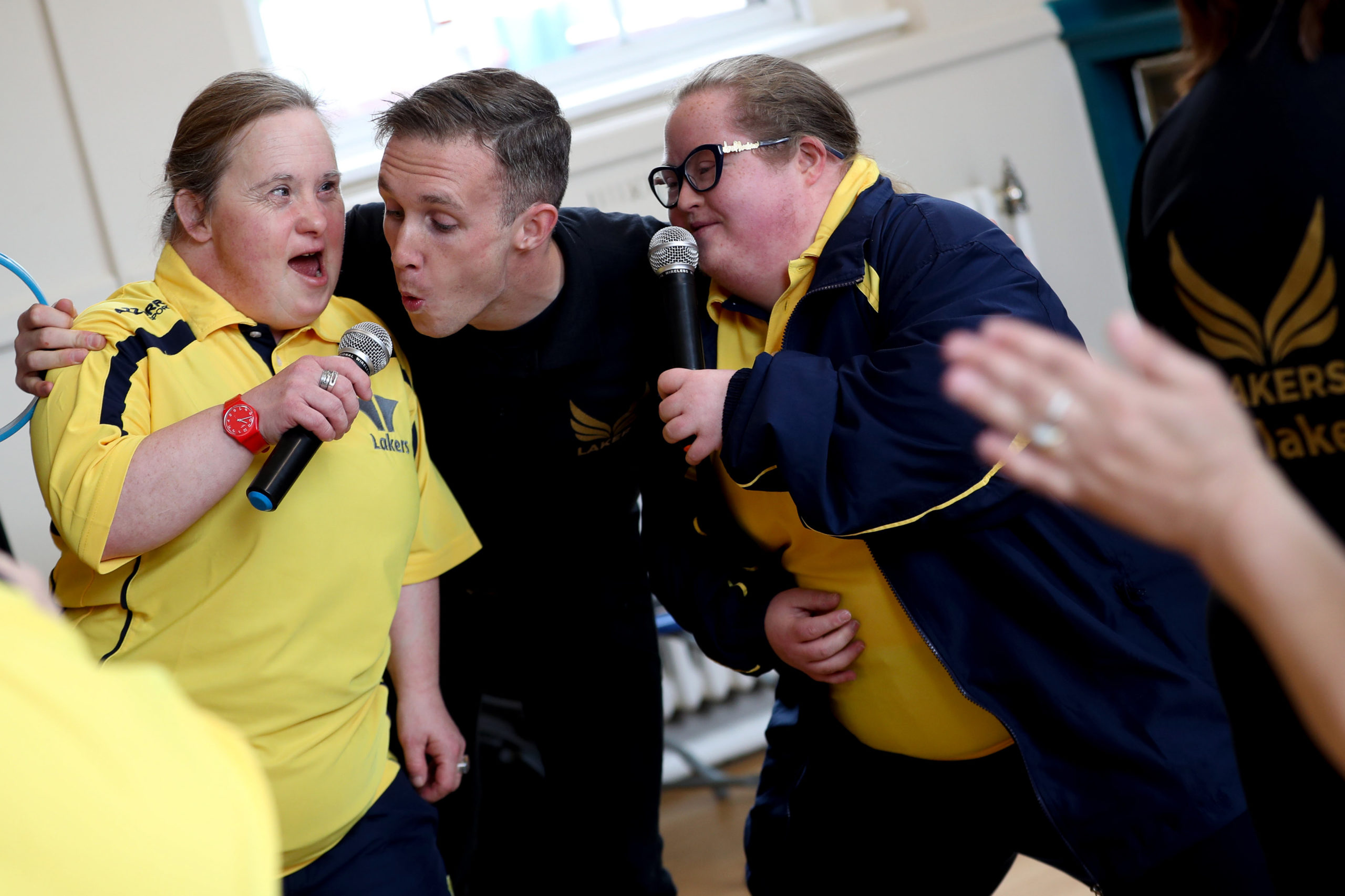
Lakers, so named because their founder, Claire Brady, loved the Los Angeles Lakers, began as a vibrant sports club but has transformed into so much more. The organization now offers cookery, art, music and drama, in addition to various sports, as part of the weekly programme . Lakers is almost entirely run and organised by volunteers from the local community who give up their time to ensure services are available for members, seven days a week. The unique sports club differentiates itself by allowing its members to choose the provided program activities.
Lakers members singing at the launch of their new premises.
In October 2018, a devastating fire ripped through the Lakers’ clubhouse, rendering the facility unsafe for use. The fire also destroyed Lakers’ fleet of four buses, which were essential for transporting members to and from the club. From what appeared to be a situation where Lakers very existence was in jeopardy, began an extraordinary community response. Within hours of the fire, the community’s response was extraordinary. Locals rallied to find a temporary location and busses for transportation, so the program could continue.
We were one of the local organizations that connected with Lakers after the fire to offer our support. Initially, their focus was to find a new permanent location as the fire had completely destroyed the old clubhouse and left no possibility to rebuild on that location. Fortunately, a local church had recently and offered its old facilities to Lakers as a new long-term home. Over the past six months, this location has been redeveloped into a magnificent new home for Lakers, equipped with meeting rooms, an art room, kitchen, sports and recreation hall, an outdoor five-a-side soccer pitch, a golf putting green and a spacious garden with a barbeque and outdoor stage.
Apart from very small state support, all the funding comes from local fundraising – hence Lakers’ success and sustainability is dependent on awareness of the services they provide. Their first ask of us was to help them drive publicity for the relaunch of their new location. We devised an integrated communications programme to help deliver on this, but first we invited several members and volunteers to come to our offices for one of our regular ‘Lunch & Learn’ sessions to tell their story first hand.
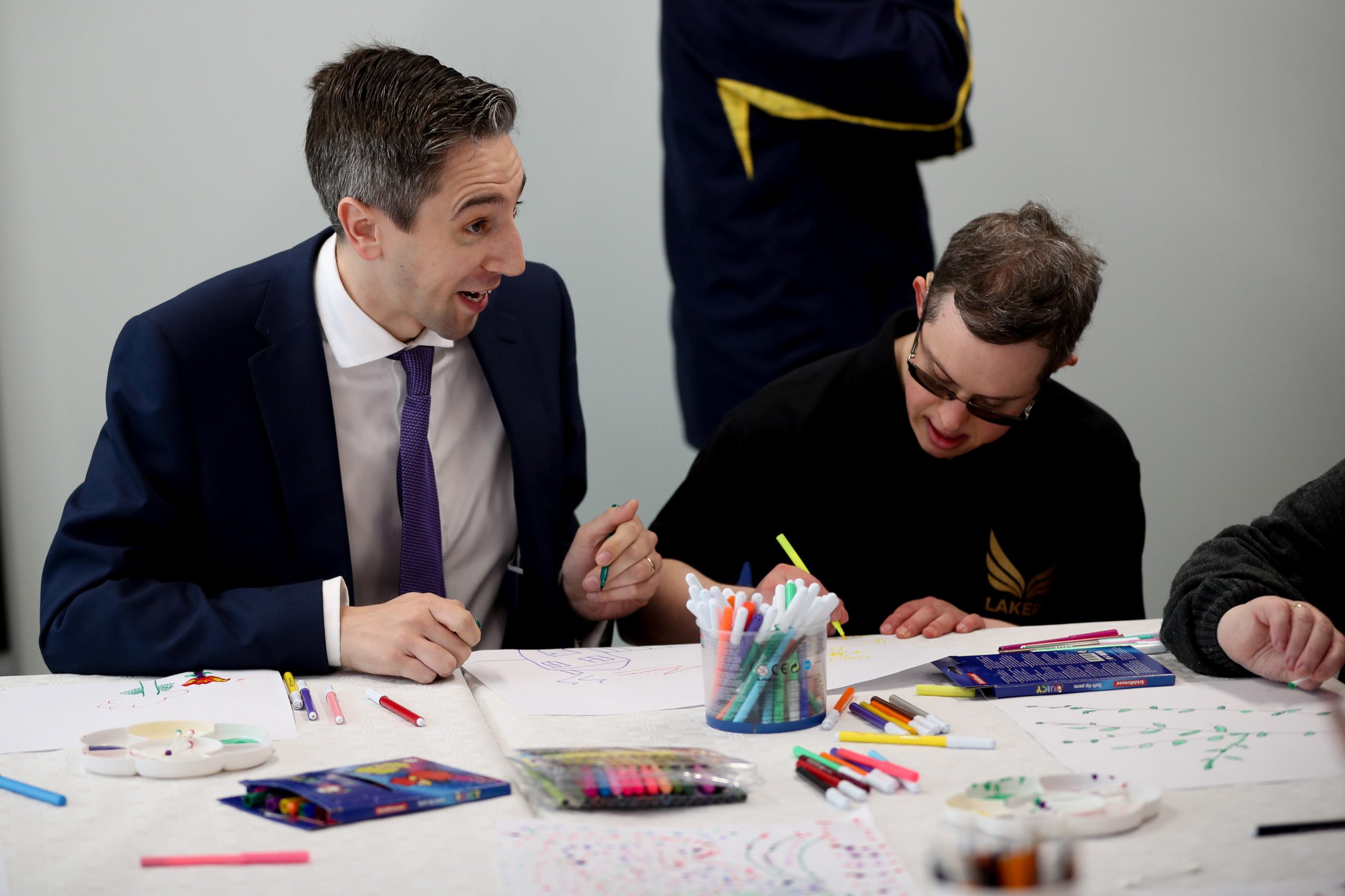
On the day of the Lakers’ clubhouse grand opening, our Dublin office was on-site from beginning to end and ensured the Lakers received the media attention the organization deserved. The launch was even attended by Ireland’s Minister for Health, Simon Harris, as well as other local dignitaries.
Irish Minister for Health Simon Harris T.D., at the official opening of the new Lakers premises.
In addition to supporting the Lakers with the kick-off celebrations of their new home, we’ve also had the pleasure to support them with other non-communication efforts since our partnership began. This includes volunteering time to events and participating in special activities, including sports, cooking and music. Our last big opportunity to support Lakers was at their annual Summer Barbeque and Awards Day. A large team of FleishmanHillard employees, family members and friends volunteered during the event. We prepared the venue, cooked and served food for more than 400 members and their families.
Later this year, we’ll host a fundraising Celebrity Table Quiz Night where FleishmanHillard staff, friends and clients can play alongside local celebrities and sports personalities. Our plan is to raise €5,000 – bring it on!
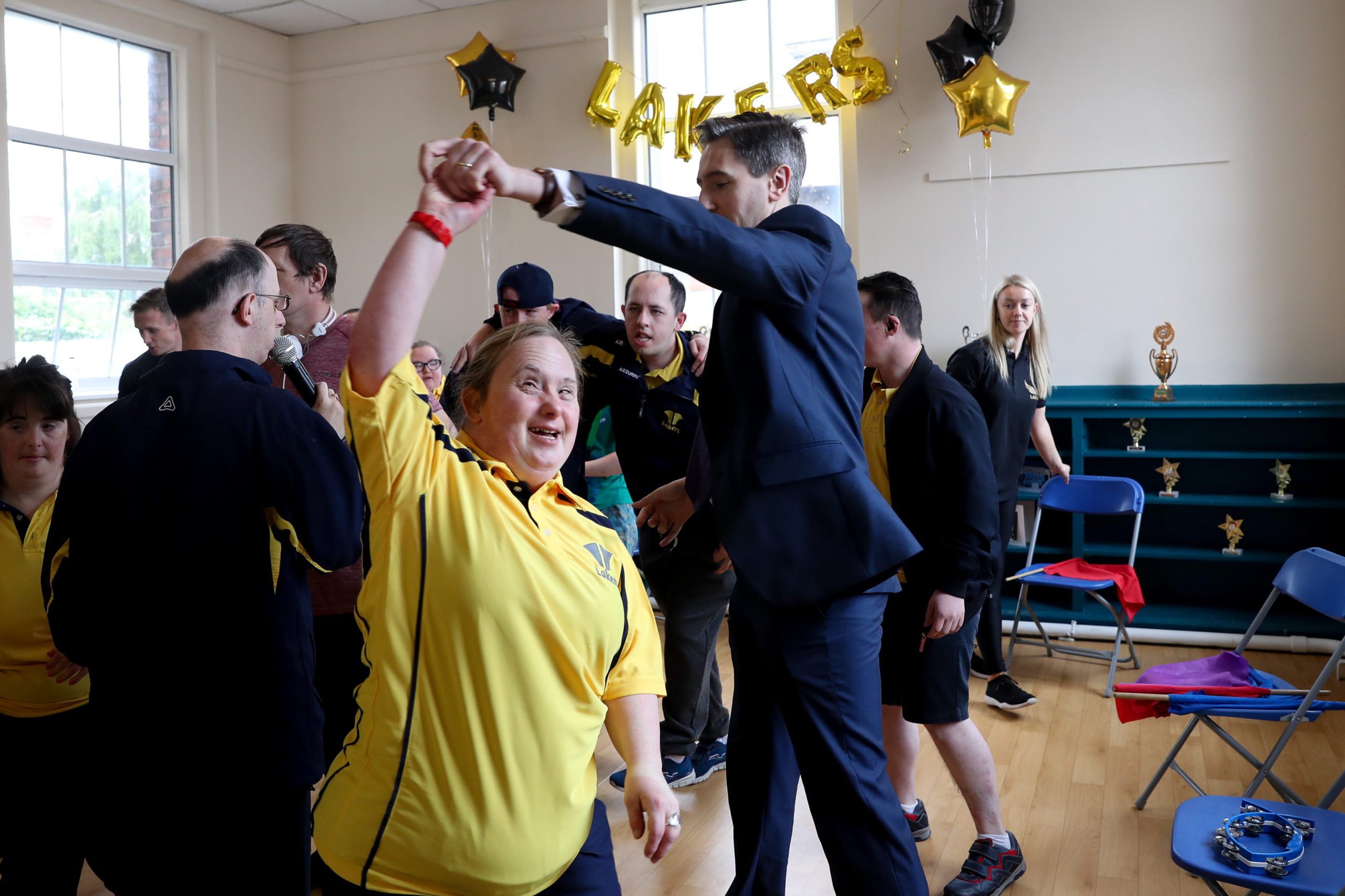
Minister for Health Simon Harris T.D., with Lakers, member Janet White, as they celebrated the open of their new club in Bray.
Lakers is a truly unique club. There is no other member-run club supported by the community in this country. For all of us in our Dublin office, it has been a privilege and a true learning experience. We hope our work and service for Lakers continues into the years to come because we have formed a bond that we don’t plan to let go of any time soon.
Julian Davis helps lead the social and innovation practice in FleishmanHillard’s Dublin office.
See what else is happening
You might also like
ESG
Navigating Conflicting Demands to Advance Climate Action
January 20, 2025
Opinions
Supporting St. Louis Institutions Dedicated to Empowering Youth Through FH4Inclusion
January 15, 2025
Opinions
Revitalizing the San Francisco Community with the Downtown Volunteer Coalition
December 23, 2024
Opinions
FleishmanHillard and FH4Inclusion Teams Shine at the Cannes Lions International Festival of Creativity
August 28, 2024
Opinions
Bridging the Generational Divide with Generative AI
August 27, 2024
Inclusion
Success on Repeat: Alumni of the Alfred Fleishman Diversity Fellowship Discuss Promotions and How to Get Them
May 29, 2024
News
EU climate policy: The new borderlines?
May 27, 2024
News
Achieving the Evolving Duality of Loyalty and Loyalty Programs
April 1, 2024
Expertise
TickTockTech: Mobile World Congress 2024 — What’s the Verdict?
FleishmanHillard’s Alexandra Foutch named to PRWeek 40 Under 40 2019 list
July 29, 2019
Share
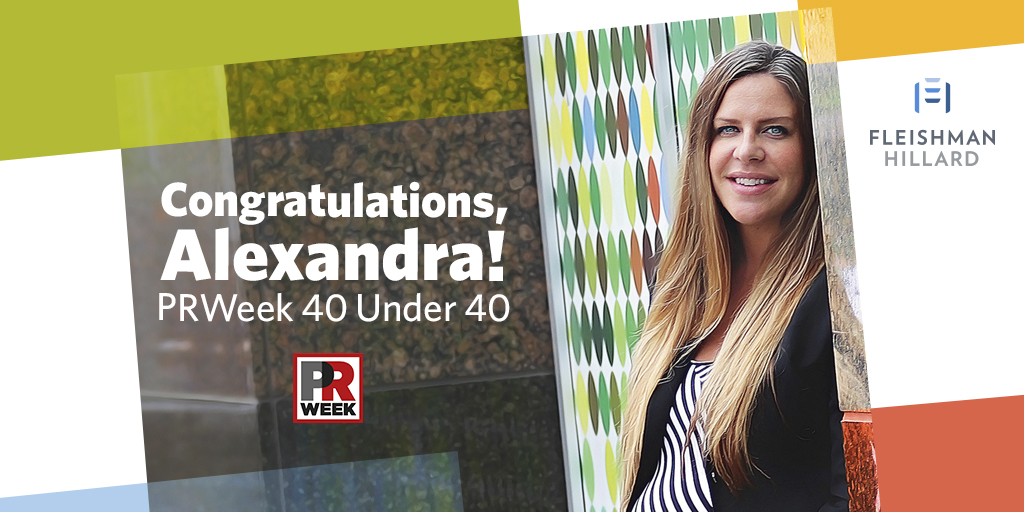
ST. LOUIS, July 29, 2019 – FleishmanHillard‘s Alexandra Foutch has been named to this year’s PRWeek 40 Under 40 list. This award recognizes PR professionals whose forward-focused vision is helping to shape the future of the industry, all while being under the age of 40.
Foutch, senior vice president and senior partner, is a global leader and trusted counselor based in FleishmanHillard’s Detroit office. She leads the General Motors business for FleishmanHillard across the global network. Under her guidance, the General Motors client teams have won several awards, including coveted Cannes Lions. She is also an active board member for GearUp2Lead, a Flint, Michigan-based nonprofit that aims to educate and inspire students to develop the necessary skills to discover purpose and satisfaction in their lives.
Foutch will be honored at PRWeek’s 40 Under 40 ceremony in New York City on October 24, 2019. Read more about the honorees and the program here.
Alexandra Foutch, PRWeek 40 Under 40 honoree
See what else is happening
You might also like
Expertise
The New Culture Gap Report: How Brands Stay Relevant for 100 Years
March 24, 2026
News
FleishmanHillard Named Among PRovoke Media’s Best Public Relations Agencies in the World
March 10, 2026
News
FleishmanHillard Integrates Porter Novelli to Form a Stronger, More Specialized Global Communications Consultancy
February 9, 2026
News
From Ragan: Elizabeth Cook on Rethinking Preparedness in Crisis Response
January 21, 2026
Global Executive Advisory
Insights From Davos: Building Credibility Through Storytelling
January 20, 2026
News
FleishmanHillard Unveils ‘License to Lead’ Research, Revealing a Growing Confidence Gap Between Executives and Stakeholders
January 13, 2026
News
FleishmanHillard Wins 2026 Innovation Awards for Data-Driven Strategy
January 12, 2026
Expertise
When the World Gets Noisy, Great Storytelling Breaks Through
December 3, 2025
News
Ellie Tuck Appointed Chief Creative Officer of the Americas
RP Week is the largest PR-focused conference in Brazil. Now in its fifth year, the conference will focus on the role of communicators in the ever-evolving business world. Discussions will offer insights on the impact of communications and PR on business. Attendees will learn from industry leaders working in multiple industries and participate in roundtable discussions, workshops and agency tours. The conference will take place in São Paulo from July 24-July 28, 2019.
Carlos Graieb
Carlos Graieb, director of Public Affairs and Advocacy in FleishmanHillard’s São Paulo office, will discuss his experiences as a PR professional working at a global agency in “The Executive as a Communicator.”