Adding your voice to the discussion on “The Future of Work”
January 10, 2019
By Sheila Rose
Share
I know many of FleishmanHillard’s clients have innovative programs to address and enhance the changing nature of the workplace. This is a top-of-mind topic that provides a multitude of opportunities for forward-thinking companies to join the discussion in Tier 1 media.
As just one example, Reuters sponsored a panel – The Future of Work: An Exploration of the Transforming World of Work – just before the holidays that underscored the media’s interest in what employment will look like in the next decade. Moderated by editor Lauren Young, the panel included experts from top companies and professional services firms who took a deep dive into the subject.
Here are some key takeaways:
The rise of “new collar” jobs. No longer white or blue, new collar jobs are all about the skills of a worker. Companies are looking to match employees to jobs that best fit their skills.
The half-life of job skills is getting shorter. The time that a job is in demand before it’s “innovated away” is getting exponentially shorter and companies and employees must adjust. Spoiler alert: Tech and automation in the workplace will impact not just some of our jobs, but all of our jobs.
Companies must help employees reinvent themselves. This should not be a random or ad hoc process – companies should build systems and programs to help employees transform and reinvent themselves on an ongoing basis.
Tech is not replacing jobs, it’s enhancing jobs. Tech may drive the process, but forward-thinking companies understand that change is supported by people. People and technological innovation should work hand-in-hand and not be viewed as a zero-sum game.
Many tech jobs don’t require years of experience. Certain jobs in AI, data and coding, for example, don’t require a lot of experience or special degrees. Many can be learned in an apprenticeship program with a person going from an out-of-date job to a new and more relevant position.
Future of work literacy. What today’s jobs require in terms of skills and experience is something that needs constant and close attention. It’s something companies must address for their own good and for the good of their employees.
Keeping employees engaged and aligned during transformation
It’s also worth noting that all of these tech advances with people impacts are a result of the rapid business transformation happening across every industry and sector – and that the pace and breadth of change is only going to increase.
The companies that will successfully navigate their transformations are those that will take time to listen to employees about what they need and want from their employee experience, and then go the extra mile to connect with them personally, especially as AI plays more prominently in our daily lives.
Younger millennials and Gen Z workers, in particular, will continue to crave more face-to-face interaction. That means communications training for managers will be more important, including guidance on how to communicate via video. And the most effective leaders will know how to lean into their soft skills – the things that AI can’t replace just yet, such as empathy and persuasion – which may require closer working relationships with HR.
Sheila Rose is a Senior Vice President and Partner in the New York office specializing in corporate and financial media relations.
See what else is happening
You might also like
Expertise
Why Trust is the Real Competitive Advantage in Ag Tech
April 2, 2026
Expertise
Notes From the Road: RSA Conference 2026 Edition
April 1, 2026
Expertise
Why Your AI Rollout Is Stalling (And What Actually Moves the Needle)
March 25, 2026
Expertise
Get the Report: Inside China’s 2026 Two Sessions
March 24, 2026
Expertise
The New Culture Gap Report: How Brands Stay Relevant for 100 Years
March 24, 2026
Expertise
The Tech Industry’s License to Lead Problem: How Tech Companies Made Themselves Vulnerable to the AI and SaaS Apocalypse Doubt
March 4, 2026
Expertise
The Five Principles of Decision-Ready Intelligence: A Framework for Making Hard Calls in an AI-driven Environment
March 3, 2026
Expertise
The Patient Engagement Gap Your Competitors Are Closing
February 26, 2026
Expertise
AI is Reshaping Communications: Inside FleishmanHillard’s Enterprise-Wide Approach
Yesterday Commissioner Scott Gottlieb was to take the podium to address attendees at the J.P. Morgan 36th Annual Healthcare Conference being held in San Francisco. Unfortunately, due to the current government funding impasse, he did not make it. But had he been there, it is fair to say that he would have had a lot to say. In the past one and a half years since he became commissioner FDA has seen many “firsts”- the first “smart pill” that can track patient adherence, the first time that the immune system has been harassed to fight cancer, the first prescription mobile app, to name only a few. Also in the course of the past year, FDA set new records in approving not only new molecular entities but also generic drugs.
It is evident that Dr. Gottlieb’s tenure at FDA has represented substantial change – not only in what the agency is doing, but in the way it is doing it. Implementation of the 21st Century Cures Act coupled with a long-standing conviction in modernization approaches that could speed up new approvals, support innovation and, as he has often said, do so without compromising the agency’s gold standard for safety.
But it is another significant change at FDA –the way it communicates agency milestones and policy direction – that might be overlooked. With past FDA Commissioners, it was a relative rarity to issue special statements to the public. The office of the Commissioner had a public face only insofar as it could be perceived from public testimony before Congress or from speeches like the one he is delivering to the J.P. Morgan Healthcare Conference. That is no longer the case.
In 2017, FDA issued a total of 164 press releases, which was more than the year before when 122 were issued. This year, FDA dwarfed that number by issuing 289 press releases, or on average 24 a month. Moreover, the primary driver of the increase came from the Commissioner himself. Of the 2018 releases by FDA, nearly 44 percent were made up of Special Statements from the Commissioner – or about 2 such statements on average a week. Not only have agency communications become more frequent, they are more personalized and represent a seismic shift in style and content.
The topics of those special statement not only mark milestones for the agency – special new approvals, e.g., but they also signal developing policy along a wide spectrum. He stakes out direction. Perhaps no other area saw more comment from him than did that of matters related to the opioid epidemic. He has also made an effort to signal his thinking for the e-cigarette industry. In short, when there is an emerging policy matter that is important, he is not waiting for the opportunity to provide testimony or outline his thinking in a speech, nor through the issuance of warning letters – he is doing it in real time. That represents a big change for FDA and for the way the industries it regulates to understand policy development within the agency.
It is not only in his liberal use of special statements, but also his use of social media. Twitter, which the agency was slow to embrace, is now liberally used by various offices in the agency and the Twitter feed of the Commissioner has been one of the primary means for getting information about how FDA is operating during the current government shutdown. Since December 21, he has issued dozens of tweets, often as a string, to provide updates and clarify what the agency will be doing and what it will not.
The change in communications represents more than a counting game. It provides a real insight as to where policy is headed, but also with reasoning as to why it is going there. Up until these statements, FDA delivered facts. Now the Commissioner adds reasoning and thinking to the mix.
Finally, FDA has become not only a more robust playing field in terms of communications, but has become a more “real-time” regulatory body. The agency has joined the ranks coming to the realization that providing information and reasoning to the industries it regulates actually benefits that oversight, and does not hinder it. That does not mean that Dr. Gottlieb’s words from the podium at this conference are not worth listening to – he is also a prolific speaker – but it does mean that when we hear those words, if we have been listening between the speeches, we will have a good idea of the directions in which we are going. Everyone wins.
See what else is happening
You might also like
Expertise
Why Trust is the Real Competitive Advantage in Ag Tech
April 2, 2026
Expertise
Notes From the Road: RSA Conference 2026 Edition
April 1, 2026
Expertise
Why Your AI Rollout Is Stalling (And What Actually Moves the Needle)
March 25, 2026
Expertise
Get the Report: Inside China’s 2026 Two Sessions
March 24, 2026
Expertise
The New Culture Gap Report: How Brands Stay Relevant for 100 Years
March 24, 2026
Expertise
The Tech Industry’s License to Lead Problem: How Tech Companies Made Themselves Vulnerable to the AI and SaaS Apocalypse Doubt
March 4, 2026
Expertise
The Five Principles of Decision-Ready Intelligence: A Framework for Making Hard Calls in an AI-driven Environment
March 3, 2026
Expertise
The Patient Engagement Gap Your Competitors Are Closing
February 26, 2026
Expertise
AI is Reshaping Communications: Inside FleishmanHillard’s Enterprise-Wide Approach
The Increasing Importance of Accountability and Expectation Setting
By Natasha Kennedy
Share
While I am passionate about accountability and expectation setting, I haven’t always understood them. Once, when I was young, I was supposed to be watching my brother, but instead, I was on the phone for an hour talking to my friends (the days when you would pull the cord as long as it would go and find a closet or room to talk in privately). My brother was busy during that hour. He found a snake and released it into the house. For my punishment, I had to do his chores for a week and was grounded. And, we never found the snake… #accountabilityfail.
During my professional career, I was lucky to be mentored by a few people who helped me bridge my youthful understanding of accountability and expectation setting into the workplace. When you work and serve clients and customers in a highly matrixed and global environment, trust matters. And to build and maintain trust, I argue you must:
Set clear expectations to your key stakeholders on who you are, what you will deliver and what your values are
Hold yourself accountable to the expectations you set
FleishmanHillard TRUE Global Intelligence, the global strategy and intelligence practice I lead, surveyed 2,000 engaged U.S. and U.K. consumers in July 2018 for our #authenticinsights survey and we found that lack of face-to-face accountability is arguably the most important expectation on which a company needs to take a stand: 70% of U.S. consumers think a lack of face-to-face accountability is extremely or very important as a cultural issue. Over half of those expect companies to take a stand on accountability. Moreover, the most important actions a company can take to improve consumer opinions of it are:
Being committed to doing the right thing (77%)
More important to females and the silent generation (73+ years old)
Contributing to society to make a positive impact on the community (74%)
Agreeing to be held accountable for behaving, and acting in support of its position on social issues (71%)
U.S. consumers expect the companies that they buy products and services from to take a stand on many issues that are important to them. Perhaps it is time for another “P” in the marketing mix: “position” on issues. Businesses need to understand how those hot-button issues intersect with their corporate values and demonstrate accountability according to those values by addressing them proactively and authentically.
If you don’t hold yourself accountable, your key stakeholders surely will.
See what else is happening
You might also like
Expertise
Why Trust is the Real Competitive Advantage in Ag Tech
April 2, 2026
Expertise
Notes From the Road: RSA Conference 2026 Edition
April 1, 2026
Expertise
Why Your AI Rollout Is Stalling (And What Actually Moves the Needle)
March 25, 2026
Expertise
Get the Report: Inside China’s 2026 Two Sessions
March 24, 2026
Expertise
The New Culture Gap Report: How Brands Stay Relevant for 100 Years
March 24, 2026
Expertise
The Tech Industry’s License to Lead Problem: How Tech Companies Made Themselves Vulnerable to the AI and SaaS Apocalypse Doubt
March 4, 2026
Expertise
The Five Principles of Decision-Ready Intelligence: A Framework for Making Hard Calls in an AI-driven Environment
March 3, 2026
Expertise
The Patient Engagement Gap Your Competitors Are Closing
February 26, 2026
Expertise
AI is Reshaping Communications: Inside FleishmanHillard’s Enterprise-Wide Approach
What to Watch at the 2019 J.P. Morgan Healthcare Conference
January 7, 2019
Share
The annual J.P. Morgan Healthcare Conference in San Francisco starts today. More casually known as “JPM,” it is the year’s must-attend event of the healthcare world.
Billions of dollars are at stake. At JPM, leaders of healthcare companies and organizations stand in front of investors to persuade and demonstrate why they should risk capital. Say the right thing at the right time to the right people, and your company’s fortunes could change.
The competition is high and the noise is loud. It’s not easy to get in front of the “right people” when your competitors do, too. In addition, journalists are a crucial conduit to reach far beyond conference halls and meeting rooms. With so much information – hundreds of companies will flood communication channels with information – it’s hard to know what really matters.
Lastly, while it’s sometimes forgotten, what happens at JPM has a real impact on anyone who depends on a medicine to stay healthy, a hospital to perform a surgery, or a chemist or biologist who wants to invent a therapy that will save someone’s life.
Here’s what we’ll be watching, and stay tuned for more.
The news cycle for JPM already started. How long will it last, and will early announcements drown out other companies’ news?
On Thursday, Bristol-Myers Squibb announced it would acquire Celgene in a cash and stock transaction with an equity value of approximately $74 billion. According to the trade publication BioWorld, if the acquisition is completed, it would be the largest M&A deal in biopharma history.
For JPM attendees, it’s almost a yearly tradition to hope for a large M&A announcement but leave disappointed. Perhaps this deal, judging by the amount of media attention it’s already received, bucks the trend. But what will “Part 2” of the story beat JPM, and can other companies breakthrough? Celgene is historically the first company to present at JPM, and this year is no different. You can bet their presentation on Monday at 7:30 a.m. PT will be standing-room only.
The FDA can’t continue its record-setting pace if it isn’t open for business.
The FDA was extremely productive last year, approving 59 new molecular entities, an all-time high for the agency. New drug approvals make or break a company’s business. But with the government experiencing a partial shutdown, the FDA, and the companies who depend on it, is at a distinct disadvantage.
Commissioner Scott Gottlieb, who has (as well-documented by my colleague Mark Senak) been an excellent, even prolific, communicator, hasn’t let the shutdown stop him. He’s used Twitter extensively over the last week to issue “guidance by tweet.” But even he cannot prevent some activities from grinding to a halt. Most importantly, a government shutdown means the FDA cannot accept any regulatory submissions for new drugs, biologics or medical devices that require a fee payment – unless the required fee was paid before Dec. 22 when the last continuing resolution expired.
Who can grab our attention?
As professional communicators, we’re always looking for who can execute what we feel is a vitally important skill. We’ve seen plenty of smart, capable executives get in front of a packed room that may as well have been empty. Minutes in, attendees are scrolling through their phones or checking their laptops. For many CEOs, their JPM presentation is the most important one they’ll make in 2019. Who will take full advantage? Who will grab our attention and not be afraid to take a risk by using video, interactive images or other engaging tools? And who will also be deft enough to use social media to make sure the company is visible beyond the walls of the conference room?
FleishmanHillard will be on the ground in San Francisco this week. As communicators, we’ll be paying close attention to how companies communicate and what captures widespread attention. Our healthcare team will be sharing a daily report highlighting announcements and conversations at the conference. If you’d like to receive the updates, send an email to[email protected].
See what else is happening
You might also like
Expertise
Why Trust is the Real Competitive Advantage in Ag Tech
April 2, 2026
Expertise
Notes From the Road: RSA Conference 2026 Edition
April 1, 2026
Expertise
Why Your AI Rollout Is Stalling (And What Actually Moves the Needle)
March 25, 2026
Expertise
Get the Report: Inside China’s 2026 Two Sessions
March 24, 2026
Expertise
The New Culture Gap Report: How Brands Stay Relevant for 100 Years
March 24, 2026
Expertise
The Tech Industry’s License to Lead Problem: How Tech Companies Made Themselves Vulnerable to the AI and SaaS Apocalypse Doubt
March 4, 2026
Expertise
The Five Principles of Decision-Ready Intelligence: A Framework for Making Hard Calls in an AI-driven Environment
March 3, 2026
Expertise
The Patient Engagement Gap Your Competitors Are Closing
February 26, 2026
Expertise
AI is Reshaping Communications: Inside FleishmanHillard’s Enterprise-Wide Approach
Web Summit – Building Real Trust in the Age of Disinformation
November 7, 2018
Share
As day two of Web Summit draws to a close, we’ve heard a tremendous amount of conversation and debate about fake news – as Sophie Scott wrote about yesterday.
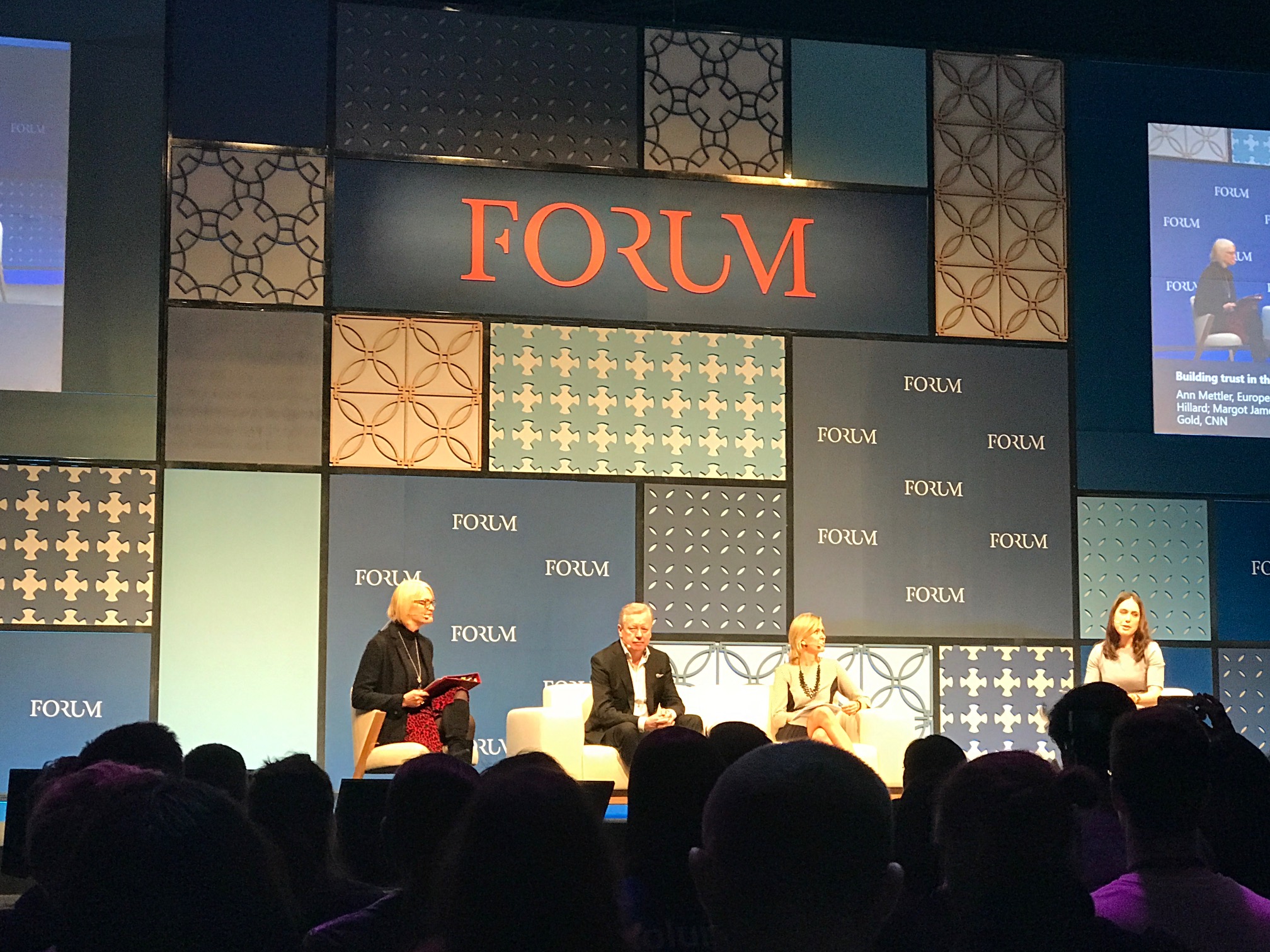
Today our CEO & President John Saunders took part in this debate, joining a fascinating panel with Margot James, UK Minister of State for Digital and the Creative Industries; Ann Mettler, Head, European Political Strategy Centre, European Commission; and Hadas Gold, Reporter, Media and Business, CNN.
The discussion, as well as the news cycle this morning around the US mid-term elections across the board, got me thinking about the dual challenge institutions face today. They need to defend themselves against political, legal and cultural attacks, while at the same time rebuilding trust amongst the public. They need to be defensive and proactive at the same time. And their solutions need to address all at once a polarized political environment, the influence of business and government outside of national levels, and the unprecedented opportunity to mobilize specific population segments.
From L-R: Margot James, John Saunders, Ann Mettler, Hadas Gold
As we’ve counseled clients in a variety of countries on how to respond to this complex challenge, the following areas of focus have come to the fore.
Engage Young People
Part of the solution must involve engaging and mobilizing young people. This was something that came across in the panel debate John participated in today.
The younger population are more supportive of multilateral approaches to problems, and they’re also more likely to differentiate between facts and ‘fake news’. According to the Pew Research Center, for example, younger Europeans are more left-leaning than older voters, but they don’t hold positive views of traditional centre-left parties. As a result, they may not associate with the organizations that traditionally defend multilateral institutions, even though they themselves are significantly more likely to support those institutions.
Young people also need to play a central role in the fight against fake news. When another Pew Research Center study evaluated whether Americans could distinguish between statements of fact and opinions, 32 percent of 18- to 49-year-olds correctly identified the factual statements as factual, versus 20 percent of 50-plus respondents. And 44 percent of 18- to 49-year-olds identified the opinion statements as opinions, compared with 26 percent of those 50-plus.
Use the Process of Reform to Restore Trust
Supporters of multilateralism need to use the reform process to create stronger institutions and help rebuild public trust. Simply put, the institutions don’t just need to be better, they need to recreate themselves in a more inclusive way.
UN Secretary General António Guterres has called for reforms that will refocus the UN on its core mission of preventing conflict. Similarly, EU leaders have engaged in an ongoing dialogue about how to make European institutions more effective.
But in an environment of distrust, these discussions often revert to opaque debates about rules and systems. This reinforces the public’s sense of detachment, particularly among those who feel that those rules and systems are biased against them. The reform process should therefore be far more transparent and open, with wide-ranging involvement from the public.
Leverage the Power of Communications
Populist movements have harnessed the power of social media to mobilize large numbers of passionate supporters. Defenders of multilateralism and international institutions have tended to rely upon traditional media outlets alone, and don’t always leverage the full power of digital and social communications to inform, motivate and activate supporters. Simultaneously, and as Ann Mettler so pointed out today, media is – and has to be – the backbone of democracy.
If international institutions want to rebuild trust, communications must play a central role in several ways:
First, supporters of multilateralism, rules-based trade, and shared standards on human rights need more clearly defined spaces – especially on the internet – where they can convene and collaborate.
Second, they should evolve a narrative that shows how shared values lead to shared positive outcomes. Populist movements are often powered by messaging about the threats to values, reinforced with tangible examples related to economic security, immigration, terrorism and other issues. In the face of all that, defenders of multilateralism too often talk only about intangible values that don’t acknowledge and address the fears or needs of their skeptics. This clearly needs to change.
Third, international institutions need to broaden their base of support to better include people in emerging markets.
Leaders in the BRICS countries and many other emerging markets have committed multilateral arrangements. Their support can be rallied in order to establish stronger global support for institutions that are currently under attack.
See what else is happening
You might also like
Expertise
The New Culture Gap Report: How Brands Stay Relevant for 100 Years
March 24, 2026
News
FleishmanHillard Named Among PRovoke Media’s Best Public Relations Agencies in the World
March 10, 2026
News
FleishmanHillard Integrates Porter Novelli to Form a Stronger, More Specialized Global Communications Consultancy
February 9, 2026
News
From Ragan: Elizabeth Cook on Rethinking Preparedness in Crisis Response
January 21, 2026
Global Executive Advisory
Insights From Davos: Building Credibility Through Storytelling
January 20, 2026
News
FleishmanHillard Unveils ‘License to Lead’ Research, Revealing a Growing Confidence Gap Between Executives and Stakeholders
January 13, 2026
News
FleishmanHillard Wins 2026 Innovation Awards for Data-Driven Strategy
January 12, 2026
Expertise
When the World Gets Noisy, Great Storytelling Breaks Through
December 3, 2025
News
Ellie Tuck Appointed Chief Creative Officer of the Americas
Web Summit – Rebuilding Trust in a Fake News World
November 6, 2018
Share
Today has been an incredible day. Despite having been to numerous large conferences in my time — Mobile World Congress, Cannes Lions, CES, Dreamforce to name a few — nothing could have prepared me for the quality, depth and scale of Web Summit.
At a time of great uncertainty for industry upon industry and the world itself, Web Summit has a mission to gather founders and CEOs — including our own CEO John Saunders — fast-growing startups, policymakers and heads of state to ask a simple question: Where to next? The event is called the “Davos for geeks” and you really can see why, when 70,000 people descend on Lisbon for the week to discuss some of the most pressing topics of our age.
And the topic that seems to be at the top of the agenda this year is fake news.
I had the pleasure of attending a discussion between John Saunders and Steve Clemons, Washington editor-at-large of The Atlantic, this morning, as well as a host of other discussion and panels throughout the day.
Here’s what I learned: There’s always been fake news, a tension between the teller and the listener or reader.
Ever since the invention of language, stories, gossip, tattletale, belief, disbelief, lies and truth have been part of the human condition. In the 17th Century, England fell victim to the “Popish plot,” whereby lies about a Catholic plot to kill King Charles II led to the execution of 22 innocent men — fake news was causing devastation hundreds of years ago.
So, what’s changed?
First, the sheer volume of disinformation out there. Today, we are subject to an overwhelming tsunami of news. People check their phones about 150 times a day in the developed world, according to the Center for Humane Technology. This equates to once every 6.4 minutes in a 16-hour day. And more than 2 billion people use Facebook — which is staggeringly about the number of conventional followers of Christianity.
Second, there’s a profound change in the way we access information and news.
Here are some scary stats for you:
Research shows that fake news headlines about the 2016 US elections fooled American adults 75% of the time.
False news stories are 70% more likely to be shared on social media than legitimate news stories [NBC News source]
Young and old are susceptible: the oldest and youngest cohorts are the most susceptible to fake news — 41% of consumers aged 18-34 and 44% of consumers 65 and older admit to falling for fake news.
66% of people in the US believe that outside groups or agents are actively planting fake news stories [com]
Third, much of the argument around fake news is about more than just whether content is true or not. I’ve heard a lot of discussion today about intent. Is a story trying deliberately to mislead? Is it imposter content or manipulated content, such as a doctored video or picture? Or pure fabricated content, which is 100% false. You only have to consider Deepfake videos that show an altered reality that can make it virtually impossible for viewers to distinguish propaganda from reality — this Obama example probably being one of the most famous Deepfakes in recent times.
So, what can we do? John talked today about a five-point plan to mitigate against fake news that I think is great advice to all of us — as communications professionals, as well as everyday consumers, voters, parents and (probably) concerned citizens.
John Saunders’ 5-point Plan to Fight Fake News:
Number 1: Break out of our bubble.
We all need to escape the confines of confirmation bias and shine a light on our unconscious bias. We should embrace the views of others and acknowledge the other side in our own communications. We should stimulate and participate in debate and remember that social media platforms only give us more of the same. It’s up to us as individuals to change that pattern.
Number 2: Support true news content.
One of the beacons of hope is the revitalization of quality journalism. Subscriptions to newspapers are up, viewing figures of quality news programs are up, new news services are launched daily (Axios, Quartz) or added to existing platforms (Buzzfeed). We should all support this. We should buy or subscribe to a newspaper (in Bezos and Benioff’s cases, they literally did just that). We should support channels and platforms that do a good job. In short, we should part with some money…
Number 3: Bash the bad.
We need to call out “fake” when we see it. And not just let it go. We should be offended/outraged — and do this vocally and loudly, not just accept it and move on.
Number 4: Find an authentic voice.
To be taken seriously, we all need to find our authentic voice. This may sound a little new age, but this is essentially work we do with our clients to find:
A clear sense of purpose (what we are for).
A worked through point of view.
The courage to express it.
These are essential qualities. They build an authentic voice — trusted, believed — which has the weight to make a difference.
Number 5: Be alert. But positive.
This isn’t going away. So, we have to pay attention. Be skeptical, but positive. Take it seriously and don’t let things go.
We need to remember the significant benefits that the rapid dissemination of news can bring, too. Just look at the incredible example of The Blue Planet (searches of “plastic recycling” rose 55% off the back of that program), which made a massive, positive impact on people’s use and attitude towards plastic in a small amount of time.
See what else is happening
You might also like
ESG
Navigating Conflicting Demands to Advance Climate Action
January 20, 2025
Opinions
Supporting St. Louis Institutions Dedicated to Empowering Youth Through FH4Inclusion
January 15, 2025
Opinions
Revitalizing the San Francisco Community with the Downtown Volunteer Coalition
December 23, 2024
Opinions
FleishmanHillard and FH4Inclusion Teams Shine at the Cannes Lions International Festival of Creativity
August 28, 2024
Opinions
Bridging the Generational Divide with Generative AI
August 27, 2024
Inclusion
Success on Repeat: Alumni of the Alfred Fleishman Diversity Fellowship Discuss Promotions and How to Get Them
May 29, 2024
News
EU climate policy: The new borderlines?
May 27, 2024
News
Achieving the Evolving Duality of Loyalty and Loyalty Programs
April 1, 2024
Expertise
TickTockTech: Mobile World Congress 2024 — What’s the Verdict?
FleishmanHillard Named Agency of the Year by North American Excellence Awards
November 5, 2018
Share
ST. LOUIS, November 5, 2018 — FleishmanHillard secured top honors from this year’s North American Excellence Awards. The global public relations and marketing firm earned the Agency of the Year award for its success in embracing challenges and exceeding clients’ expectations.
The North American Excellence Awards honor the most outstanding achievements of communications professionals in their field. The awards also present an excellent opportunity for networking and take a comprehensive look at communications achievements across North America.
The award ceremony will take place in Dublin on December 6 to celebrate the winners.
View the other Best Of 2018 award winners on North American Excellence’s Winner list.
See what else is happening
You might also like
Expertise
The New Culture Gap Report: How Brands Stay Relevant for 100 Years
March 24, 2026
News
FleishmanHillard Named Among PRovoke Media’s Best Public Relations Agencies in the World
March 10, 2026
News
FleishmanHillard Integrates Porter Novelli to Form a Stronger, More Specialized Global Communications Consultancy
February 9, 2026
News
From Ragan: Elizabeth Cook on Rethinking Preparedness in Crisis Response
January 21, 2026
Global Executive Advisory
Insights From Davos: Building Credibility Through Storytelling
January 20, 2026
News
FleishmanHillard Unveils ‘License to Lead’ Research, Revealing a Growing Confidence Gap Between Executives and Stakeholders
January 13, 2026
News
FleishmanHillard Wins 2026 Innovation Awards for Data-Driven Strategy
January 12, 2026
Expertise
When the World Gets Noisy, Great Storytelling Breaks Through
December 3, 2025
News
Ellie Tuck Appointed Chief Creative Officer of the Americas
At a time of great uncertainty for industry and the world itself, Web Summit 2018 gathers the founders and CEOs of technology companies, policymakers and heads of state to ask a simple question: where to next? With over 800 speakers, 70,000 people in attendance and conversation ranging from technology and data science to environmental sustainability, Web Summit offers vast networking and learning opportunities.
Our own John Saunders, FleishmanHillard Global CEO and president, will instruct brands and agencies on rebuilding trust in a so-called “fake news world.” In a session with Steve Clemons, Editor at Large for The Atlantic, attendees will learn about the steps which must be taken to rebuild consumer trust from a PR and marketing perspective, as well as a journalistic point of view. Rebuilding trust in a fake news world on Tuesday, Nov. 6 at 12:10 p.m. UTC +1 will be one of the presentations at the PandaConf, a facet of Web Summit and one of the world’s premier marketing conferences, which will feature marketing-focused roundtables and workshops to explore the trends influencing the future of marketing.
Additionally, Saunders will participate in a panel discussion regarding building trust in the age of disinformation on Wednesday, Nov. 7 at 10:45 a.m. UTC +1. In this Forum discussion, a track of Web Summit which discusses technology’s impact on today’s world, Saunders and speakers from the European Commission, CNN and the United Kingdom government will delve into the best methods of rebuilding trust in the era of post-truth politics.
Saunders will also hold a collaborative, in-depth roundtable discussion on restoring trust in today’s world on Tuesday, Nov. 6 at 8:00 p.m. Registration for roundtables must be completed separately.
See John Saunders’ complete Web Summit schedule here.
See what else is happening
You might also like
Expertise
The New Culture Gap Report: How Brands Stay Relevant for 100 Years
March 24, 2026
News
FleishmanHillard Named Among PRovoke Media’s Best Public Relations Agencies in the World
March 10, 2026
News
FleishmanHillard Integrates Porter Novelli to Form a Stronger, More Specialized Global Communications Consultancy
February 9, 2026
News
From Ragan: Elizabeth Cook on Rethinking Preparedness in Crisis Response
January 21, 2026
Global Executive Advisory
Insights From Davos: Building Credibility Through Storytelling
January 20, 2026
News
FleishmanHillard Unveils ‘License to Lead’ Research, Revealing a Growing Confidence Gap Between Executives and Stakeholders
January 13, 2026
News
FleishmanHillard Wins 2026 Innovation Awards for Data-Driven Strategy
January 12, 2026
Expertise
When the World Gets Noisy, Great Storytelling Breaks Through
December 3, 2025
News
Ellie Tuck Appointed Chief Creative Officer of the Americas
FleishmanHillard Fishburn Named 2018 PRWeek UK Large Consultancy of the Year
October 17, 2018
Share
LONDON, October 16, 2018 — FleishmanHillard Fishburn brought home top honors at this year’s PRWeek UK Awards, where the UK operations of FleishmanHillard earned the Large Consultancy of the Year award. The public relations agency was recognized for its commitment to both client and employee satisfaction, thought leadership, cutting-edge client campaigns and excellent business results.
The agency also won for a campaign on behalf of client Crocs in the FMCG, Health, Beauty, Retail and Fashion category. The winning campaign, “CROCing the Front Row at London Fashion Week,” showcased the much-lauded collaboration between Crocs and fashion designer Christopher Kane.
FleishmanHillard Named to 2018 PR News’ Top Places to Work in PR List
October 9, 2018
Share
ST. LOUIS, October 9, 2018 — FleishmanHillard has been named to this year’s Top Places to Work in PR List, presented by PR News. The annual award recognizes communications and marketing organizations which surpass business and client expectations while holding employees’ growth and success sacred. FleishmanHillard, the global public relations and marketing agency, celebrates this accolade for the third straight year as a testament to its workplace culture.
The award ceremony will take place in New York City on November 28 to honor the 84 winning companies.
Proud FleishmanHillard employees pose for a photo.
Learn more about the honor and other Top Places to Work in PR winners on PRNews.
See what else is happening
You might also like
Expertise
The New Culture Gap Report: How Brands Stay Relevant for 100 Years
March 24, 2026
News
FleishmanHillard Named Among PRovoke Media’s Best Public Relations Agencies in the World
March 10, 2026
News
FleishmanHillard Integrates Porter Novelli to Form a Stronger, More Specialized Global Communications Consultancy
February 9, 2026
News
From Ragan: Elizabeth Cook on Rethinking Preparedness in Crisis Response
January 21, 2026
Global Executive Advisory
Insights From Davos: Building Credibility Through Storytelling
January 20, 2026
News
FleishmanHillard Unveils ‘License to Lead’ Research, Revealing a Growing Confidence Gap Between Executives and Stakeholders
January 13, 2026
News
FleishmanHillard Wins 2026 Innovation Awards for Data-Driven Strategy
January 12, 2026
Expertise
When the World Gets Noisy, Great Storytelling Breaks Through
December 3, 2025
News
Ellie Tuck Appointed Chief Creative Officer of the Americas