Employee Login

Enter your login information to access the intranet

Enter your credentials to access your email

Reset employee password

Article

Productive Constraint: How Japan is Leveraging AI to Overcome Limitations
January 21, 2025
By Nick Ashley

As global policymakers and business leaders gather in Davos this week for the 2025 Annual Meeting of the World Economic Forum discussing “Collaboration for the Intelligent Age,” AI is set to dominate the conversation. Because this transformative technology has the potential both to unite and divide, FleishmanHillard is looking to examples of where AI has been applied successfully to overcome boundaries, taking Japan as a case in point.

To start, the country’s geographical isolation has often been connected to a “Galapagos effect,” which leads to unique and unusual innovations. Now, in the Intelligent Age, demographic, economic, cultural and regulatory constraints still paradoxically have the potential to drive rather than hinder sustainable innovation. With AI as a catalyst across sectors, Japan presents an opportunity and model for leaders to innovate beyond limitations and accelerate social change.

Mobility is one area that has seen significant change, not only in the growing interest in electric vehicles but also the rapid adoption of micro-mobility solutions. Companies like LUUP, the largest player in the industry in Japan with over 10,000 stations, use AI to manage fleets and create a new urban infrastructure empowering customers to travel more freely, addressing issues of car ownership costs, limited parking spaces and last-mile transportation gaps in public transit. While the government has updated its regulations in response to the scooters’ popularity, LUUP manages identity and age verification again through AI-driven technology.

Sustainable agriculture is also approaching a tipping point in Japan, supported by the government’s Midori strategy. Technology is being embraced as a catalyst for change to overcome constraints such as the lack of arable land, aging farmer population and knowledge gap for younger generations. AgriTech startup Agrist, for example, which was valued at 1.6 billion yen two years after founding, leases AI-powered harvesting robots that address labor shortages while determining optimal crop harvesting times. Meanwhile the National Agriculture and Food Research Organization has developed an AI-based pest recognition system to support inexperienced farmers.

A third sector that is undergoing significant change is sustainable housing and energy solutions, which are gaining more interest considering Japan’s rising utility costs and dependency on imported energy. New building codes and solar energy mandates are driving AI-integrated home energy management systems, zero-energy building innovations and smart construction techniques. Domestic giant Sekisui House is now the world’s largest seller of Zero Energy Homes (ZEH), with 95% ZEH compliance in fiscal 2023. The company’s Platform House concept goes beyond home management to use AI as a way of linking home to health, learning and other elements of lifestyle.

While some view Japan’s restrictions with caution, these examples show that AI deployment can spark sophisticated innovation within patterns of ‘productive constraints.’ The Japanese market demonstrates how highly regulated or culturally restrictive environments can become testbeds for AI solutions that address universal challenges. From aging populations in Europe to urban density in Southeast Asia, the lessons from Japan’s approach have broad applicability. The key lies in identifying constraints early, embracing them as innovation catalysts and deploying AI strategically to overcome systemic challenges while respecting societal and regulatory boundaries.

Article

Navigating Conflicting Demands to Advance Climate Action 

January 20, 2025
By Hugh Taggart

At a time of widening global discord, few topics produce as much tension as the climate crisis and the role of business in combatting it through sustainability and ESG activities. Even the terms themselves are now laden with implied divisiveness. 

Much of the noise in the current debate is coming from the United States, as companies prepare for the inevitabilities of a second Trump administration amid activist pressure from all sides, shareholder scrutiny and more. But the imperatives from Europe and China are no less significant in the global picture.  

European policymakers and investors still expect businesses to be part of the climate solution, move towards net zero, and work to decarbonize even faster. Stronger EU regulations will force greater transparency and more detailed disclosures that American multinationals will not be able to avoid, exacerbating the transatlantic divergence over corporate decisions and corporate engagement. 

Europe and China both see huge economic upside to accelerating the growth of new businesses and technologies required to combat carbon, which is why climate action is increasingly framed as an economic imperative, not solely a societal one. On a recent trip to Hong Kong, I was blown away by the number of Chinese EVs on the road. China’s move to dominate the EV and battery markets and other “green” industries will, in its view, help further its broader economic strategy and strengthen its geopolitical positioning. 

But after a decade of sustainability investment being seen as financially and reputationally low risk, the calculus has changed for businesses. The failure of the COP process to significantly accelerate action has taken some of the pressure off. Financial institutions are walking away from net-zero finance commitments. Aggressive, public positioning on climate-related policies might draw the ire of populist politicians or activist investors, even though the climate imperative has, if anything, grown stronger and more acute.  

As a result, at the World Economic Forum meeting in Davos, sustainability is high on the program agenda but seems to have fallen far down most CEO’s priority list. Most discussion is confined to experts, specialists and leaders already convinced of the need for action. While that’s essential to make progress, it could be a big, missed opportunity. 

Inaction or softening on prior commitments are just as likely to attract criticism that poses reputational and commercial risk. The provisions of the Inflation Reduction Act in the United States remain law, and many will be difficult to roll back. Regulation in the EU and UK will grow stricter. China will pursue green policies for economic benefit and wider global influence. And even populist politicians may come to appreciate the economic upside in the emerging green economy. 

A more nuanced approach will be required. For most global businesses, that will need to include greater flexibility at the country level, with sufficient oversight and policy consistency to guard against charges of hypocrisy and contradiction.  

Steering a safe course in the spotlight at Davos will be challenging. While climate action will undoubtedly create long-term benefits for companies, the landscape will remain one of conflict, complexity and heightened scrutiny.  

Article

FleishmanHillard Appoints Thomas Skelton as Regional Lead of TRUE Global Intelligence in APAC

ST. LOUIS, Jan. 20, 2025 – FleishmanHillard today announced the appointment of Thomas Skelton as the regional lead of its award-winning research and analytics practice – TRUE Global Intelligence (TGI) – in the Asia Pacific (APAC) region. Based in Singapore, Skelton will oversee the growth and operations of TGI in APAC, driving the agency’s expanding research and analytics capabilities to deliver data-driven insights and solutions for clients across the region. He will report to Joanne Wong, APAC president and senior partner at FleishmanHillard.

“Tom’s deep understanding of the region and proven expertise in research and analytics will be invaluable to the team as we continue to elevate the impact of our TGI offering and better serve clients in APAC,” said Wong. “His appointment is also a testament to our strategic focus on embedding data and intelligence in every aspect of our work, seamlessly blending data, communication expertise and creative brilliance to create outcomes that truly matter to our clients’ businesses.”

Wong continued, “Our clients are navigating an increasingly complex business ecosystem, requiring communications to be more bespoke and outcome driven than never before, which is only possible with the power of data. As we work to elevate our unique position as the communications advisor who can deliver both intelligence-informed strategy and impactful execution in 2025, Tom’s leadership and the entire TGI team will play a key role in driving this vision forward.”

Marjorie Benzkofer, global lead of TGI, added, “Data and analytics are at the heart of our global strategy to drive value and innovation for clients worldwide. Tom’s leadership will be instrumental in further integrating these capabilities into our APAC operations, equipping our teams to deliver transformative, market-specific solutions. We’re excited to welcome him to the TGI team and leverage his unique experiences and insights from the APAC perspective, which is increasingly vital to our clients and business globally.”

With extensive experience across consultancies and in-house roles in the UK, China and Singapore, Skelton brings a proven track record of developing and implementing data-driven strategies for global and local organizations in the APAC region. Before joining FleishmanHillard, he led the APAC Consultancy Practice at TEAM LEWIS, including its research and analytics team across six markets in the region. Prior to that, he held the role of Senior Manager, Communications Strategy, APAC at Cision, a consumer and media intelligence company.

FleishmanHillard’s TGI practice reveals the truth about clients’ stakeholders, their competitive landscape and impact on desired outcomes. These insights ensure resonant connections with audiences to help clients realize goals and sustain success. The practice offers a range of consulting offerings, enabled by the OPRG Data Stack – our suite of digital tools designed to meet critical intelligence needs, including:

  • Audience offerings: journal mapping, data-driven media mapping, KOL/influencer identification and intelligence to enhance the profiling and targeting of a client’s key stakeholders.
  • Business offerings: industry outlook and competitive research, media research and monitoring services to better understand the business environment in which a client operates.  
  • Reputation offerings: issues indexing and tracking, crisis assessment and narrative gap analysis to help clients identify top opportunities to build reputation and mitigate risks.
  • Assessment offerings: KPI framework development and message/creative concept testing to effectively evaluate communications outputs and outcomes.

The TGI practice operates in key APAC markets, including Singapore, Hong Kong, Japan, South Korea and India. 

Article

From Davos Man to Corporate Diplomat 

January 17, 2025
By Michael Hartt

The Geopolitical Shift Facing Business Leaders 

The days of the ‘Davos man’, the billionaire business leader leveraging the rules-based, international capitalist system for gain defined in Peter Goodman’s 2023 book, seem numbered. With geopolitical disruption reshaping the world, he will soon be replaced by the ‘corporate diplomat’, a new breed of executive – gender irrelevant – who needs a deft touch and different strategic approach to manage the forces out of their control.  

The 2025 Davos agenda includes catalyzing growth amid geopolitical shocks, investing in people and supporting the energy transition. But topics on CEOs’ minds are far broader. International security and conflict. Populist and nationalist movements. Protectionism and trade barriers. The climate crisis’s human and economic impacts. Radical technology disruption.  

The issues are complex and nuanced. So is the cast of protagonists and antagonists that need to be addressed by the corporate diplomat, a concept introduced by Deloitte in 2024. It is not always clear which ones are friend or foe. 

The landscape is being shaped by a surge of influence from new powers and alliances, including many of the markets that are most attractive for investment as Western economies stagnate. But these new powers may not be beholden to the rules-based system the Davos man knows well. Navigating and negotiating between business and political leaders operating to different standards becomes a test of diplomatic skill and communication capabilities that may be unfamiliar to the CEO and C-suite members.  

Simultaneously, the divergence among traditional allies presents growing risk for business leaders.  

The gulf on climate action between the Trump administration and the EU and UK will create strain around investment and transparency. Different approaches to technology regulation versus enablement may complicate decisions on scaling AI usage or leveraging data. And the challenge of securing Chinese investment while managing the potential perceived threat of China’s security and economic agenda will be more difficult, given the White House’s likely demands and expectations of U.S. allies regarding China.  

For the corporate diplomat, effective communication is key to success.  

Messages on business strategy, corporate values and operational choices will face more scrutiny, needing more care to ensure consistency and cultural sensitivity when delivered across markets.  

Companies will need to incorporate a wider range of stakeholders’ views in decisions, requiring a better understanding of non-American or non-Western perspectives to reflect their full supply chain or sales footprint. 

Stronger relationships with stakeholders will be vital. Politicians, partners, employees or customers in far-flung markets – particularly for companies operating with a “U.S.” and “rest of world” mentality – will be more influential, requiring them to be embraced by the corporate diplomat, not just managed. 

Finally, leaders must brace for new levels of transparency about business decisions, relationships and impact that may be uncomfortable or disruptive. Beyond regulations like the EU’s Corporate Sustainability Reporting Directive (CSRD), multinational companies may face greater exposure to domestic political dynamics, media scrutiny and societal expectations around the world. They will all add complications to the CEO’s efforts to drive business growth. 

The Davos man may struggle to adapt to this new environment. But the corporate diplomat will see the opportunity for business growth and will rise to the occasion, at forums like Davos and in their work every day around the world. 

Article

Preparing for Trump 2.0’s First Moves and the New Era in Washington 

January 16, 2025
By Ron Boehmer

Ahead of Inauguration Day on Monday (Jan. 20), President-elect Donald Trump continues to offer new comments regarding his plans for governing. These announcements include executive orders he intends to sign on Day 1, as well as other shifts in policy that have significant implications for the global economy. As with every presidential transition, there are policy changes and priorities for the incoming administration that will shift the narrative and business climate in Washington and around the country. 

Every four years, these announcements should inform an organization’s planning to navigate shifts in the business, political and regulatory environments. Equally, leaders must consider how (and if) they communicate about the new administration’s policies with customers, employees, investors and other stakeholders. 

Though President-elect Trump and his team are planning to take widespread action through already proposed executive orders on Day 1, there is a high likelihood of unanticipated directives to executive agencies, remarks he makes in his inaugural address and posts on social platforms that have additional implications for organizations. 

Organization leaders, risk managers and communications teams should be prepared to monitor actively, and plan responses across a range of scenarios based on business objectives and organizational values. Special attention should be given to those scenarios that are closest to the intersection between the organization’s goals and the new Trump administration’s priorities. 

Immigration and trade are two of his highest priorities and action on these issues in particular will permeate the national narrative, and may have a substantial impact on people, organizations and their employees, and industries in the U.S. and around the world. Audiences that are important to an organization’s success may respond in a sharply polarized and highly emotional way. Communications planning is critical. 

Immigration and Undocumented Individuals 

President-elect Trump, his nominees and his allies have made clear that one of his immediate priorities will be the deportation of undocumented individuals. These efforts have the potential to impact nearly every industry in some way because they will impact workforces, customers, supply chains and families. 

Although many businesses and institutions do not employ undocumented workers directly or through contract labor providers, even organizations that are not affected by immigration action may experience a knock-on effect because of impacts to supply chains, workforces and communities. Although the incoming administration has said it believes it can take actions without undue disruption to business and the economy, the scale of proposed deportation is very large and untried.   

Leaders at employers of all sizes should understand their organization’s vulnerabilities and, in addition to business continuity planning, should also have scenario-based communications plans in place. For example, executive orders for the immediate deportation of undocumented workers and expanded U.S. Immigration and Customs Enforcement actions, may lead to staffing challenges as both documented and undocumented workers stay home out of fear. This could compound challenges to organizations’ labor supply during a time of low unemployment. Organizations across sectors – especially those in agriculture, food and beverage, manufacturing, construction and hospitality – may also face increased scrutiny from immigration authorities. 

Even if an organization is not directly impacted by these changes, they may be asked questions by employees, the media, elected officials or the local community. Communications teams should anticipate and address these questions now to be prepared.  

Tariffs and Trade 

Another top Trump priority is to install steep tariffs to advance his trade, economic and political priorities. 

U.S. organizations will face increased financial pressure once U.S. tariffs impact the cost and availability of imported materials. They are likely to become more complicated if foreign countries enact their own retaliatory tariffs on U.S. imports, as some have promised. Businesses in the U.S. and abroad will need to consider how they address these costs, including whether they pass them onto their customers. 

Regardless of size or sector, almost all organizations will be impacted in specific ways by the tariffs because they will have a sizeable impact on supply chains, consumer behavior and global trade. In some cases, organizations may realize a market advantage if competitors are more significantly impacted by tariffs. Communications leaders must prepare now for how to communicate these changes and consider how different audiences will respond. 

Preparing for Communications 

Understanding potential impacts – which may occur as early as Jan. 20, or at any point during the administration – and continually readying plans to activate against realistic positive and negative scenarios will help support business continuity and bolster corporate positioning and brand reputation efforts. 

It is critical to have a finger on the pulse of sentiment among an organization’s most-important audiences, map scenarios based on shifting political and economic dynamics and be prepared to activate communications at a moment’s notice. Organizations will need to determine positions on the administration’s expected actions, and consider how their public positions may differ from privately expressed positions in the context of important relationships, such as with regulators or business partners. 

Management teams and communications leaders will need to determine protocols for rapid, accurate response to both anticipated and unexpected situations, deciding in advance the principles and processes for how to communicate. These include decision-making around whether to respond – and if so, when – identification of priority audiences, staging and priority of internal and external communications, and choices of spokesperson, timing and channels. 

Importantly, organizations must carefully evaluate if and how they will react given the organization’s (potentially polarized or easily activated) stakeholder groups, including employees, customers, partners, shareholders and local communities. In many cases, the best course of action will be to engage an industry organization to magnify support or deflect negative attention on a particular policy. 

While this is normal practice, it is important for every organization to refresh its understanding of the current and expected positions their industry organizations will take on their members’ behalf on key issues. Organizations should also monitor and analyze how competitors and detractors are using industry and other groups for leverage or protection, and what they are saying and doing individually. It may be necessary to join new alliances or create new groups to achieve the desired results over the next four years. The time to make that evaluation is now, before a new affiliation is needed. 

More broadly, mapping of risks, stakeholders and relationships coupled with an action plan and protocols will help organizations navigate what will be a rapidly changing political landscape during this second Trump term. Integrating this work into a strategic public affairs plan will ensure that communications responses are agile, rapid and protect an organization’s ability to operate and support its aims in Washington. 

A wide range of government actions and policies will create opportunities and risks for every organization that is based in, operates in or does business with the United States. FleishmanHillard’s public affairs leaders, issue specialists and business sector experts are well prepared to help clients navigate today’s new era in Washington.  

For more information, please contact FleishmanHillard’s public affairs team at [email protected]. 

Article

Supporting St. Louis Institutions Dedicated to Empowering Youth Through FH4Inclusion

January 15, 2025
By Terry Hoffmann

Al Fleishman and Robert Hillard opened the agency’s first office more than 78 years ago in St. Louis. And from the beginning, supporting the local St. Louis community has been a priority for our headquarters office. Our founder Al Fleishman was heavily involved in the community as a member of the Urban League and the Jewish Federation. He was instrumental in promoting human rights, connecting people from all backgrounds and breaking down communications barriers.

Today, the St. Louis office continues to build on that tradition and commitment through a range of pro bono partnerships and volunteer activities. Launched in 2016, FleishmanHillard’s FH4Inclusion initiative engages our colleagues around the world to lend their time and talents to champion and advance inclusion in their communities. A key priority for our St. Louis office in recent years has been supporting two local organizations focused on empowering youth and giving them the skills and confidence they need to thrive.

Starkloff Disability Institute

We’re proud to partner with the Starkloff Disability Institute, a local nonprofit dedicated to empowering people with disabilities and helping them succeed in competitive professions, along with work to improve inclusive hiring practices. Since 2018, FleishmanHillard has participated in the organization’s annual Dream Big Career Camp that helps high school and college students learn about professional opportunities across sectors and inspire them to pursue fulfilling careers.

FleishmanHillard colleagues develop and facilitate annual half-day workshops with the students to spotlight PR careers and skillsets, share tips on building resumes and LinkedIn profiles and explore best practices in accessibility communications and design. We also facilitate breakout groups where students develop ideas for brand campaigns and activations.  

“Our students always have a fantastic time interacting with FleishmanHillard,” shared Lori Becker, CEO, Starkloff Disability Institute. “Youth with disabilities are not always given the same opportunities as their nondisabled peers, but Starkloff Disability Institute’s Dream Big program helps empower them by fostering disability confidence and pride. Through partnerships with inclusive companies, we introduce high-demand careers in various industries.”

Becker noted, “FleishmanHillard does an outstanding job of showcasing career opportunities in the PR and marketing fields. Each year, they challenge our campers to develop a marketing campaign for one of their clients. This provides our students with valuable, hands-on experience, allowing them to collaborate, organize their ideas and understand what it’s like to work in a PR and marketing firm. It’s a wonderful way for our students to gain real-world skills and see the impact of their creativity.”

Jenn Ackels, an account supervisor at FleishmanHillard, shared, “I’ve had the privilege of supporting our partnership with Starkloff’s Dream Big Career Camp for the past three years, and it’s absolutely been a highlight of my time at FleishmanHillard. Engaging with the students and witnessing their creativity as they learn about our industry is extremely special, and I’m grateful to be part of that experience, seeing their confidence grow alongside such wonderful colleagues.”

Cardinal Ritter College Prep

As the only Catholic co-ed African American high school in the United States, Cardinal Ritter College Prep is recognized for academic excellence and preparing the next generation of leaders. The school has a 100% graduate rate and college acceptance rate. Their athletic program has also won 11 state championships in 10 years. Our St. Louis office works with the school to provide communications counsel and PR support. We’ve also hosted a workshop to prepare students for internships in college and beyond.

In 2022, our colleagues helped to amplify and spotlight a viral LinkedIn post from the school’s president. The post featured a photo of all the Black male teachers at the school, making up 40% of their staff compared to the national average of 2%. Our FleishmanHillard team jumped in to help pitch and support outreach, helping Cardinal Ritter secure coverage with NBC News and The Grio. The coverage helped to spotlight the school’s success in recruiting Black male teachers and why representation is so important in education. It also inspired a school in Massachusetts to visit Cardinal Ritter College Prep to learn more about their strategy (KMOV).

“Through FH4Inclusion, I have been given the opportunity to align the work we do for Cardinal Ritter to my passion for storytelling and giving a voice to those making an impact in the St. Louis community,” shared Tiffany Byndom, a vice president at FleishmanHillard. “While visiting the school, I was able to witness the student experience that is defying the odds and addressing achievement gaps for Black students, which brought me closer to this important work. I feel privileged to tell their story on national media platforms.”

Cardinal Ritter College Prep President and CEO, Tamiko Armstead, shared, “We have been so fortunate to work with the great team at FleishmanHillard. Cardinal Ritter has been thrust into the national spotlight from NBC to the TODAY show and many national publications since our partnership began. We are beyond grateful for this opportunity to work alongside FleishmanHillard.”

Advancing FH4Inclusion partnerships is a priority focus for our St. Louis office and we continually evaluate ways to expand our efforts. Engaging with local institutions that are dedicated to creating pathways for inclusion not only helps to strengthen our region but also provides meaningful opportunities for our FleishmanHillard colleagues to connect with their passions, share their expertise and give back to the community.  

Article

FleishmanHillard Earns Perfect Score on 2025 Human Rights Campaign Foundation’s Corporate Equality Index

January 7, 2025

ST. LOUIS, January 7, 2025 – FleishmanHillard has been recognized with the Human Rights Campaign Foundation’s (HRCF) 2025 Equality 100 Award for earning a top score on this year’s Corporate Equality Index (CEI). With a score of 100 on the CEI survey, the nation’s leading benchmark for LGBTQ workplace equality, the agency has demonstrated unwavering dedication to diversity, equity and inclusion and a shared commitment to creating a workplace where everyone can bring their whole selves to work and thrive.

The HRCF’s CEI provides a clear, transparent and actionable framework for leading policies and practices, focusing on four key pillars: non-discrimination policies, equitable healthcare benefits, inclusive internal workplace culture and corporate social responsibility. FleishmanHillard made the ranks of 765 leading companies that have exhibited exemplary efforts in these four areas.

View the Corporate Equality Index 2025 and the complete list of recipients here.

Article

FleishmanHillard Appoints Mary Kosinski as Global Managing Director of Health and Life Sciences

Agency Expands Sector Leadership Team Announcing Additional Senior Roles

ST. LOUIS, Jan. 7, 2025 – FleishmanHillard today announced that Mary Kosinski has joined the agency as global managing director of Health and Life Sciences effective immediately. Kosinski will lead FleishmanHillard’s largest sector and be responsible for driving transformation, expanding focus and delivering integrated solutions for clients.

“Mary’s energy and deep regulatory and policy experience will bring tremendous insights to our clients and fresh perspectives to our team,” said Mark Mortell, global head of practices and sectors for FleishmanHillard. “Her background in government agencies complements FleishmanHillard’s strong healthcare credentials and expertise across the sector.”

Before joining FleishmanHillard Kosinski served in multiple regulatory, advocacy and public health advisory roles. Most recently as the head of global corporate affairs for Pi Health and previously at the Pharmaceutical Research and Manufacturers of America. For nearly 15 years, Mary worked both domestically and overseas with the U.S. Department of Health and Human Services, including the Centers for Medicare and Medicaid Services, the Assistant Secretary for Preparedness and Response, and was the first chief of staff at the Biomedical Advanced Research and Development Authority.

In addition to Kosinski’s appointment, the agency announced three new leadership roles within Health and Life Sciences:

  • John Gisborne as the sector’s global head of strategic client partnerships expanding client relationships and building strategic opportunities.
  • Marc Longpre as global head of strategy and insights for the sector, building up agency capabilities and key areas of expertise.
  • Jenyne Engelhardt as global head of operations and integration for the sector, driving efficiency, service integration and talent engagement.

These senior leaders bring deep industry expertise, have led client teams and have served as counselors for clients across FleishmanHillard’s global health network. Kosinski and the new sector leadership team will work to diversify the business, ensure career development for agency colleagues and cultivate a culture of client experience excellence.

Kosinski and the leadership team will be working closely with other global and regional health leaders across OPRG agencies.

“I’m excited to join such a dynamic organization and talented team at such a pivotal moment for the healthcare industry,” said Kosinski. “The pace of change is unlike any other in healthcare’s history – digital transformation, Gen AI, patient-centered care and novel drugs and therapeutics are all contributing to a new era where communications is vital in helping clients meet patient and consumer expectations. FleishmanHillard’s deep health and life sciences experience will ensure we’re ready to help clients achieve their goals and navigate the challenges they face with the agility, thought leadership and expert support they need.”

FleishmanHillard’s Health and Life Sciences sector is FleishmanHillard’s largest, providing expert counsel and communications support for healthcare clients’ needs across reputation, product brand building, patient and healthcare professional engagement, public affairs, crisis communications, social and innovation, research and media relations. 

Today’s announcement follows the appointment of J.J. Carter to president and CEO of the agency in October 2024, and his new global leadership team in November 2024, reflecting FleishmanHillard’s transformation and expanded focus on the use of intelligence and technology. Kosinski’s appointment marks the agency’s continued commitment to deliver specialist senior counsel and leadership in key sectors.

Article

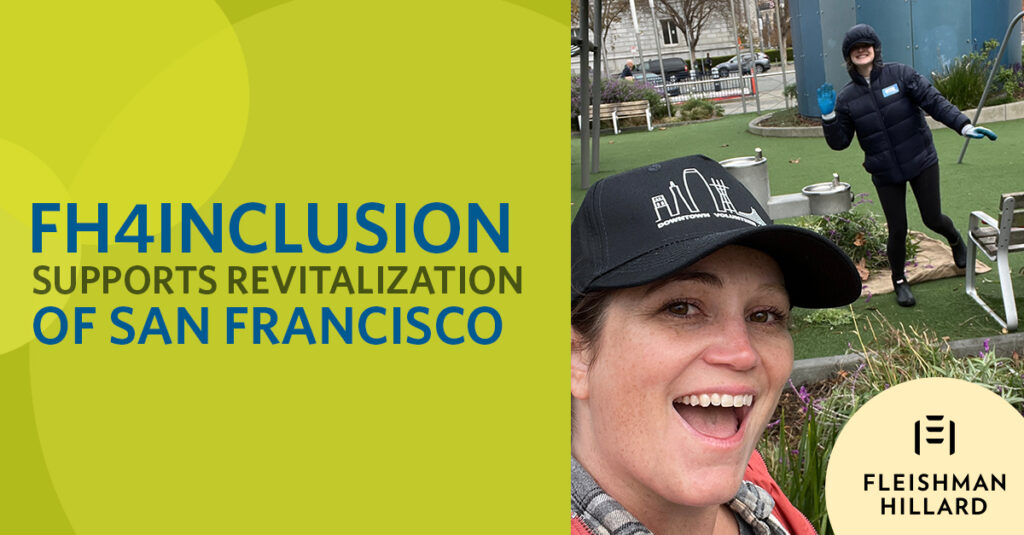
Revitalizing the San Francisco Community with the Downtown Volunteer Coalition

December 23, 2024
By Mandy McAnally

This year, as part of FleishmanHillard’s FH4Inclusion pro bono and volunteer initiative, our San Francisco office joined a growing coalition of local companies helping to drive corporate volunteerism and engagement in service of revitalizing San Francisco. The Downtown Volunteer Coalition (DVC) develops cross-company volunteer events in partnership with the city, local nonprofits and small businesses to clean up neighborhoods, restore parks and provide services to communities most in need.

Recently, we joined more than 90 employees from locally based companies and nonprofit partner HandsOn Bay Area for an afternoon of community service.

One group of volunteers partnered with the San Francisco Recreation and Parks Department to clean up and restore areas of the City Hall Plaza. Together, they filled two truck beds with leaves and brush from the plaza, about 25 bags of green waste to be processed into compost. Stephanie Moore, a managing supervisor at FleishmanHillard, said, “We had a great time volunteering with HandsOn Bay Area and fellow DVC companies. It was wonderful to spend some time with the SF Rec and Parks Department cleaning up Civic Center Plaza. One staff member from the Rec and Parks team said that what we did in just an hour would’ve taken him the whole day. We were honored to help out and can’t wait for the next opportunity!”

Another group made 20 blankets for San Francisco’s unhoused population supported by Glide, a nationally recognized nonprofit that helps individuals, families and children to achieve stability and thrive through integrated comprehensive services and more. Tiffany Black, a senior vice president in our Media and Platforms team, said, “What Glide is doing is critical for San Francisco and the Bay Area. I’m grateful that we had the opportunity to support local people and families who will need to stay warm during these chillier months. Volunteering alongside my colleagues and employees from other companies made it even more worthwhile.”

It has been a pleasure getting to know and volunteer with this dedicated group of companies. We’re excited to continue supporting communities in San Francisco next year. Learn more about the Downtown Volunteer Coalition, and, if you are a Bay Area company, consider joining in 2025.

Article

Fifth Consecutive Year: FleishmanHillard Honored on PRNews Agency Elite List

December 17, 2024

It’s a five-peat for FleishmanHillard as it announces it has once again made the PRNews Agency Elite Top 120 list. Annually, this list features the top PR and communications firms with the most innovative products, services, employee initiatives/activities and core agency offerings.

PRNEWS highlighted the agency’s global data certification series for its employees in 2024, in addition to its 370-plus training sessions covering 135 topics. The outlet also called out FleishmanHillard’s work addressing ageism through research-backed insights shared at major events, contributing to a nine-point year-over-year increase in DEI client work.

Learn more about the Agency Elite Top 120 list here.