Six Steps to Bridge Generational Gaps in the Workplace
October 25, 2022
Share
I’ve been with FleishmanHillard for a little over a year now and while there are many perks, my co-workers are my favorite part of the job. Naturally, I appreciate the things I have in common with my colleagues. At the same time, I’ve also learned to enjoy what makes us unique – including the lived experiences that come with the variety of generations in the workplace today.
A generational gap is defined as the different thoughts and worldviews held by different generational cohorts. And with five unique generations currently coexisting in a constantly evolving workplace environment, considering the generational gaps among your workforce may be a crucial missing piece of your current internal communications planning strategy.
Generally speaking, each of the generations listed below tends to have a different set of values, motivations, communications preferences and workplace expectations:
Traditionalists (born before 1946)
Baby Boomers (born between 1946 and 1964)
Generation X (born between 1965 and 1976)
Generation Y, or Millennials (born between 1977 and 1997)
Generation Z (born after 1997)
While generational differences are not always apparent, their effects can be. In fact, according to Harvard Business Review, ignoring generational differences in the workplace has been shown to limit collaboration, spark emotional conflict and lead to higher employee turnover and lower team performance.
As employers continue to recover from the pandemic and address its lasting impacts, attempting to bridge generational gaps may be the missing link that better aligns, connects and engages a workforce.
But how do you bridge the gap between employees who seem to differ in so many ways? Consider these six simple approaches.
1.Assess communication preferences. Each generation gravitates toward a unique communication style. While communication preferences will vary from person to person, the list below provides commonly preferred channels and formats by generation. Tailoring your communication style to best fit their preferences can help drive awareness and understanding of business-critical information:
Traditionalists and Baby Boomers generally prefer formal and direct communication, either face-to-face or through phone calls.
Generation X generally prefers less formal communication through email or text.
Millennials generally lean toward immediate communications through instant messaging platforms.
Generation Z generally appreciates visual, face-to-face communications, in person or via video chatting apps.
While these preferences can help guide your communications with each generation, you should always strive to understand your employees on an individual level.
2. Focus on flexibility and empathy. Flexibility is no longer a nice-to-have, it’s a must. The pandemic has made it undeniably clear that employees want and need greater autonomy. As employees continue to adapt to new ways of working, ensure you’re cultivating a culture of flexibility and empathy. Some employees may be slower to adapt to flexible work arrangements, new technology and updated processes than others, and you should encourage everyone to be understanding of that.
3.Cultivate trust and belonging. Recognizing and acknowledging the value each generation brings to the table is critical to building trust and belonging within your workforce. Fostering a culture where employees are encouraged and empowered to share their unique perspectives and experiences is effective as both a business and people strategy.
4. Provide mentorship opportunities. Mentorship is a great way to connect employees of different ages and experiences. It provides employees a chance to learn and teach as they continue to grow in their careers. Consider establishing a program that connects senior leaders with junior talent and matches employees based on their work interests. To build trust with, and confidence in, younger generations, consider a reverse mentoring program that allows junior employees and new hires to play the role of mentor.
5.Connect employees beyond work. Create opportunities for employees to connect outside of work and get to know each other. While hosting events like happy hours, coffee chats and team dinners isn’t groundbreaking, employees are craving these activities as the world continues to reopen. These events provide employees the opportunity to build personal relationships that make work fun and help cultures thrive.
6.Show appreciation. Acknowledging employees who go above and beyond helps to close generational gaps. Be sure to thank those who go out of their way to learn about their colleagues in and out of the workplace, who take extra time to train or onboard those who aren’t adapting as quickly as others, or who come to you with new ideas to better connect the workforce. Let them know you appreciate their effort to create a better, more inclusive and welcoming workplace.
Generational gaps can present challenges in the workplace. However, a generationally diverse workforce also allows employers to enhance employee satisfaction and drive increased collaboration and innovation through employees’ unique perspectives, experiences and ideas.
And by cultivating a workplace culture where all generations are appreciated, trusted and given the opportunity to teach and learn from each other, employers convert generational gaps into bridges.
See what else is happening
You might also like
Expertise
The Visible CEO: How Leadership Can Serve as a Strategic Asset
July 1, 2026
Expertise
How to Win the GLP-1 Food Industry Wake-Up Call
June 30, 2026
Expertise
Cannes Lions Exposed an Industry’s Transition of Power: Takeaways From Winning Work
June 26, 2026
Expertise
Lessons From Cannes: Don’t Let Speed Fail Storytelling
June 25, 2026
Expertise
Get Bold Work Out Into the World: How to Seize the Chaos Advantage
June 25, 2026
Expertise
The Action Gap: Leaders Know Bold Work Wins. They’re Just Not Moving Fast Enough.
June 23, 2026
Expertise
From Storytellers to Strategic Advisors: Sports Leaders Provide Valuable Lessons for Communicators
June 23, 2026
Expertise
The AI Readiness Gap Series: How to Build a Culture of Experimentation
June 22, 2026
Expertise
Introducing The Chaos Advantage: Why Playing It Safe Is the Riskiest Move
FleishmanHillard UK wins at the PRWeek Awards 2022
October 14, 2022
Share
Delighted to have won the award for ‘Best Marketing Communications: Culture, Media and Sport’ at the 2022 PRWeek Awards for our work to launch #Wethe15 for the International Paralympic Committee (IPC) alongside adam&eveDDB, Portland and Porter Novelli.
The kids are back in school, pumpkin spice lattes are widely available at coffeeshops across North America and Europeans have returned from their summer holidays. As we settle into the rhythm of this new season, now is the right time for Environment, Social and Governance (ESG) leaders to begin crafting communications strategies for 2023.
Each year, pundits comment that the stakes for ESG “have never been higher.” While this statement is cliché, it holds true. Here are three insights ESG leaders should keep in mind as they initiate planning for the new year.
‘Showing Your Receipts’ Can Help Brands Differentiate Themselves as we Race Collectively Toward Net Zero
It wasn’t long ago that a brand announcing their intention to align with a net zero commitment was a newsworthy event. Now that over a fifth of the world’s largest companies have shared net zero commitments, corporate pledges to tackle the worst outcomes associated with climate change have become table stakes. In the past two years, reporters focused on environmental sustainability have become less interested in pitches about new private sector climate goals.
So, what is driving news? As the private sector rushes toward net zero, pitches that highlight the progress brands are seeing and the creative solutions others can leverage are becoming increasingly resonate. Radically transparent, externally-facing progress reports that provide visibility into ways brands are building unexpected partnerships to address industry-wide issues could be a way to cut through the noise in the new year.
Enhancing ESG Disclosures Now Will Help Brands Prepare for New SEC Requirements
In May 2022, the SEC issued a new proposal for climate-related disclosure rules designed to increase transparency and make it easier for investors to navigate and compare ESG claims. For publicly traded companies in the food and agriculture sector, a significant part of the disclosure requirements will be the mandate that brands over a certain revenue threshold who have set targets around carbon emissions disclose Scope 3 emissions when these emissions are material.
The comment period recently closed and – while details are still being finalized – it seems evident that new standards which will better align the U.S. approach with European markets will be enacted by 2024. Recognizing the intricate value chains endemic to the food and agriculture sector, now is the time for B2B brands to put into place necessary structures to report these emissions to customers and for CPG brands to start the process of requesting emissions data from suppliers and working with their Chief Financial Officers to ensure these reports are externally validated and held to a level of scrutiny required for inclusion in an annual 10-K. Instituting these practices before disclosure requirements are officially handed down could provide points of distinction amongst competitors and even an opportunity for thought leadership. Why wait to share, but also why stop at reporting? Sharing the story behind the numbers can also differentiate companies in a crowded conversation.
Leaning into the Intersections Between Business and Environmental Goals will Help Brands Best Serve Customers
Innova Market Insights’ top trend for 2022 was the concept of Shared Planet. Innova reports that 44% of global consumers indicate sustainability is extremely or very important when it comes to their diet and notes a +121% year-over-year growth of on-pack carbon footprint and reduced emissions communication in food and beverage launches.
As consumers increasingly cite the health of the planet as one of their top concerns, linking ESG initiatives with business objectives will become vitally important to maintaining or increasing market share. ESG must be viewed as part of both broader business and communications strategies and not as a discrete initiative.
While the ESG landscape has never seen higher stakes, strong business opportunities exist for brands that are willing to think creatively about how they can show up differently as we work together for a more sustainable future. A willingness to prioritize transparency and unexpected partnerships and continued efforts to align ESG with business goals can make all the difference for brands in the food and agriculture industries.
See what else is happening
You might also like
Expertise
The Visible CEO: How Leadership Can Serve as a Strategic Asset
July 1, 2026
Expertise
How to Win the GLP-1 Food Industry Wake-Up Call
June 30, 2026
Expertise
Cannes Lions Exposed an Industry’s Transition of Power: Takeaways From Winning Work
June 26, 2026
Expertise
Lessons From Cannes: Don’t Let Speed Fail Storytelling
June 25, 2026
Expertise
Get Bold Work Out Into the World: How to Seize the Chaos Advantage
June 25, 2026
Expertise
The Action Gap: Leaders Know Bold Work Wins. They’re Just Not Moving Fast Enough.
June 23, 2026
Expertise
From Storytellers to Strategic Advisors: Sports Leaders Provide Valuable Lessons for Communicators
June 23, 2026
Expertise
The AI Readiness Gap Series: How to Build a Culture of Experimentation
June 22, 2026
Expertise
Introducing The Chaos Advantage: Why Playing It Safe Is the Riskiest Move
When a personal crisis strikes, even employees with the best work-life boundaries can find themselves struggling to stay afloat amidst the storm they’re experiencing. And at some point in your career, you’ll likely be called to support a team member through these murky waters.
Be it a death in the family, severe illness, miscarriage, medical diagnosis, or other event, when things go awry in an employee’s personal life, how you and your organization respond can make a big difference in that individual’s (as well as observers’) employee experience.
Having supported my husband through a cancer diagnosis, reoccurrence, and corresponding treatment twice in the last three years, I’m all too familiar with this. With the benefit of hindsight, there are a few things I’ve learned that can help organizations in supporting their employees through a personal crisis.
1) Synthesize and share benefits information. While your organization may offer a host of benefits that could support an employee through a difficult time, combing through a benefits site to locate or better understand the offering requires the mental capacity that most won’t have in the middle of a life-altering event or diagnosis.
Managers can simplify this process by connecting with HR representatives to understand what benefits are available and most helpful to the employee’s specific situation. Doing this will help engage the right business partner(s) and make an already daunting process seem less overwhelming to the impacted employee.
As you relay options for leave, emotional well-being or mental health support, fertility benefits, employee advocacy programs, etc., take some of the work off the impacted employee’s shoulders by addressing head-on what they’re eligible for, what is needed to use a relevant benefit, and who is their point-of-contact for each benefit.
Particularly for those who are on short- or long-term leave, ensure that you – and the team member – know what documentation requirements exist and communicate any known deadlines for end of coverage, paperwork submissions, etc. to minimize added stress during the actual leave period.
2) Let the impacted employee dictate how much of their situation is shared. I’ve personally found being transparent with team members about my situation as the best approach to ensuring business continuity despite periods of increased absence from work or need for additional flexibility. However, that should not be the expectation of all employees going through a tough time.
If you’re the employee’s manager and they’ve shed light on what’s happening, ask them explicitly when – if at all – it’s appropriate to share what’s going on with other colleagues and/or clients, and what level of detail they’re comfortable with you sharing.
When in doubt, err on the side of caution and stick to “[NAME] is [OUT OFFICE UNTIL WHEN, WORKING A DIFFERENT SCHEDULE FOR THIS TIME PERIOD, ETC.] due to personal circumstances.” and do not budge if probed for more information without explicit permission.
3) Show your humanity. Whether you know details of a teammate’s circumstances or not, small acts of support and kindness go a long way. We spend so much of our lives with our co-workers. If a teammate’s situation is known, silence can cause them to question the work community that they’re investing so much of their time and effort into.
A few of the most memorable human-centric moments I’ve experienced were:
Managers who remembered big appointment dates and sent encouraging texts ahead of those.
Teammates who took on extra tasks, calls or assignments without grumbling and often at the drop of a hat when a new “bad news” call or appointment popped up.
Teammates who sent “thinking of you” cards, texts and emails – I know your time is valuable, so the thought does count.
Teammates who supported our family with contributions to fundraisers, meal trains, gas and travel money, etc.
Co-workers who asked how things were going instead of assuming I didn’t want to talk about it.
4) Support a slower or flexible re-entry period. For employees who have been on leave or working a sporadic schedule, don’t expect them to be back to 100% on their first day – or week – back to regularly scheduled programming.
As a manager, ensure their workload is still distributed for the first week (or more) of re-entry. If appropriate and assuming the requests have been handled, assure them they don’t need to address the overwhelming amount of unread emails they probably have in their inbox.
Respect that life has likely drastically changed for your teammate and give them the space to process that transformation however needed.
At the end of the day, empathetic leadership and giving grace can go a long way. Balancing work and life is always hard, but when tragedy strikes, priorities will likely skew toward “life.” At a time when more employees are asking for their whole self to be prioritized by their employer, how you respond and support them through a personal crisis can have a major impact on their morale, engagement and perception of your organization as a whole.
See what else is happening
You might also like
Expertise
The Visible CEO: How Leadership Can Serve as a Strategic Asset
July 1, 2026
Expertise
How to Win the GLP-1 Food Industry Wake-Up Call
June 30, 2026
Expertise
Cannes Lions Exposed an Industry’s Transition of Power: Takeaways From Winning Work
June 26, 2026
Expertise
Lessons From Cannes: Don’t Let Speed Fail Storytelling
June 25, 2026
Expertise
Get Bold Work Out Into the World: How to Seize the Chaos Advantage
June 25, 2026
Expertise
The Action Gap: Leaders Know Bold Work Wins. They’re Just Not Moving Fast Enough.
June 23, 2026
Expertise
From Storytellers to Strategic Advisors: Sports Leaders Provide Valuable Lessons for Communicators
June 23, 2026
Expertise
The AI Readiness Gap Series: How to Build a Culture of Experimentation
June 22, 2026
Expertise
Introducing The Chaos Advantage: Why Playing It Safe Is the Riskiest Move
Beyond Hispanic Heritage Month: Four Ways to Expand Your Strategy
October 6, 2022
By Amelia Gomez and Ana Hernandez Quiros
Share
Each year, when Hispanic Heritage Month (HHM) rolls around, it isn’t uncommon to see inquiries come in with the question, “What can we do this year to honor the Hispanic and Latino community?”
It’s a fair question to ask, and one that our U.S. Hispanic counselors happily provide guidance on. We always start with: “What else is the brand doing beyond Hispanic Heritage Month?” or “What is the brand commitment to the U.S. Hispanic and Latino segment and how is the company advocating for or supporting the Hispanic community after Oct. 15?”
HHM is a timely, relevant moment to celebrate, connect with and elevate the voices of Hispanics and Latinos. Many brands have nailed some great campaigns centered around the annual celebration – but it shouldn’t be the only time you’re engaging with this audience.
While recognizing the day is important and, in some ways, can be a launchpad, it shouldn’t stand alone as the only annual initiative. As marketers and communications specialists, we understand the value of authentic, ongoing, consistent investments in the Hispanic segment. So, what can you be doing throughout the year to celebrate U.S. Hispanics and Latinos in a credible and meaningful way?
Four ways to celebrate U.S. Hispanics and Latinos in a meaningful way year round
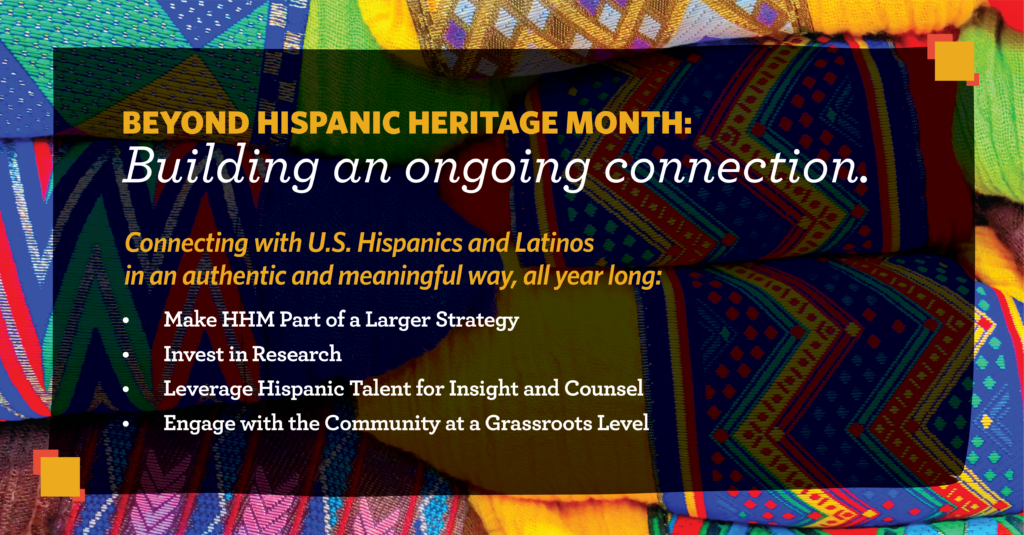
Make HHM Part of a Larger Strategy: Brands are often looking for creative ways to activate during HHM. However, authentic, long-term connections are at the center of success, which is why it’s key to look beyond HHM and implement a U.S. Hispanic/Latino strategy rooted in consistency that aims to create meaningful engagements with the community throughout the year beyond a moment in time.
Invest in Research: If launching a campaign, major product or partnership is not in the plan right now, that’s OK. Instead, invest in getting to know your audience. Hispanic consumers are not a monolith, and there is vast diversity within the community – each with their own story, culture and experience. Investing in primary research will more accurately inform exactly which segments within the Hispanic community engage or could potentially connect with your brand. This will allow you to tailor a bespoke message and campaign that resonates and helps create stronger connections with this brand loyal audience.
Start from Within: Making sure there’s diverse Hispanic representation top to bottom within your organization is critical. Having appropriate representation from those leading any multicultural work is important to recognize and address the expansive diversity among Hispanic cultures. Input from members of the community is key to ensure inclusive messaging and culturally appropriate tactics are considered.
Connect with the Community: Identify partners, community events or organizations that are making strides and stepping up for the Hispanic community. Many of them look to brands to help provide resources, funding and employee support to keep their mission alive and it will offer an opportunity to work closely with those committed to making a difference.
Recognizing Hispanic Heritage Month is a good first step in acknowledging and celebrating the community, to shine a light on the impact of Hispanics in the U.S. and to support and inspire continued progress. However, activating beyond this moment in time should be a mainstay, to not only earn loyalty, but to be a true advocate and champion for Hispanics.
See what else is happening
You might also like
Expertise
The Visible CEO: How Leadership Can Serve as a Strategic Asset
July 1, 2026
Expertise
How to Win the GLP-1 Food Industry Wake-Up Call
June 30, 2026
Expertise
Cannes Lions Exposed an Industry’s Transition of Power: Takeaways From Winning Work
June 26, 2026
Expertise
Lessons From Cannes: Don’t Let Speed Fail Storytelling
June 25, 2026
Expertise
Get Bold Work Out Into the World: How to Seize the Chaos Advantage
June 25, 2026
Expertise
The Action Gap: Leaders Know Bold Work Wins. They’re Just Not Moving Fast Enough.
June 23, 2026
Expertise
From Storytellers to Strategic Advisors: Sports Leaders Provide Valuable Lessons for Communicators
June 23, 2026
Expertise
The AI Readiness Gap Series: How to Build a Culture of Experimentation
June 22, 2026
Expertise
Introducing The Chaos Advantage: Why Playing It Safe Is the Riskiest Move
Introducing the Culture Gap – New FleishmanHillard Report Uncovers Generation Divided and Explores How to Bridge Society’s Divisions
October 4, 2022
Share
This Global research report, backed by renowned brand expert and Columbia University lecturer Kai D. Wright, points to new cultural dividers in society causing brands need to rebuild and readjust.
With global respondents split on brands needing to be bold and brave (52%) versus sensible and conservative (54%), the time for brands to pay attention and act is now.
ST. LOUIS, October 4, 2022 – Brands are finding themselves paralyzed in a landscape driven apart by culture wars, but new research released today by FleishmanHillard shows businesses must be braver in bridging these issues to stay culturally relevant without losing authenticity to consumers.
The latest study from FleishmanHillard, Authentic Insights: The Culture Gap, Introducing Gen D made in partnership with Columbia University’s Kai D. Wright, puts cultural issues at the heart of the research report to further understand how brands can move out of paralysis on today’s most pertinent topics and find a path forward in closing the current cultural divides in society.
The study unpacks a new generation, Generation Divided (Gen D), at a time when people aren’t just feeling divided within communities; they are feeling a divide within themselves. The context of a polarized world has been well established in recent times, with clear societal divisions increasingly influencing both business and personal lives. The state of divide around us has a clear impact on our internal state of flux and on what’s right and what’s not. Sixty percent of consumers today feel that people are compromising their true self by being too politically correct, and almost half (47%) believe it’s becoming more difficult to get along with people who hold contrasting views. Generation Divided was uncovered by FleishmanHillard’s unique research screening process that moved away from the standard demographic splits based on age and gender. Instead, it examined a range of factors including socioeconomic indicators, gender identity and religious and political beliefs to ensure that all aspects of humanity are reflected within the research.
“In this woke, people power era, action and words are the minimum expectations for ongoing connections to your business and brand,” said Candace Peterson, global head of Brand at FleishmanHillard. “We find many brands in a state of arrested development, unsure of how to move forward amid so much cultural division and so much reputation at stake. The latest study from our Culture Unit at FleishmanHillard explores this tension. It spotlights not just how companies should view culture, but how these cultural divides can be used as a springboard to strengthen their brand reputation and remain, or even become, culturally relevant.”
Key survey findings include:
While 67% of respondents wanted brands to be empathetic, 78% felt being authentic was even more important.
More than half (55%) think brands should release fewer upgrades/new products over the next year.
Although 61% of consumers would choose an employer based on its willingness to take a stand on societal issues, almost as many also agree that employers often fake their interest in DE&I and other societal issues (55%).
“Ultimately, brand and business leaders must prepare to be uncomfortable — ready to shift the practices, processes and policies of producing, releasing and evaluating efficacy of work,” said Columbia University lecturer Kai D. Wright. “No one leader knows the best path for each community, and no business team belongs to every global culture. Continual learning is inherent in leadership to be culturally relevant. Through this report and study, we explore the drivers fueling a growing cultural divide between communities; understand how to anticipate, thrive in and accelerate through the ever-constant of ‘change’; and dive into the role that brands and businesses play in bridging the cultural gap to solve societal issues.”
The Authentic Insights: The Culture Gap, Introducing Gen D reportwas developed by FleishmanHillard’s Culture Unit, a global team of macro culture strategists that enable brands to be brave and take action whilst being thoughtful of the cause they are communicating. The report comes in the wake of the Unit’s industry-first partnerships with the inclusive talent agency Zebedee, and the United Nations’ Unstereotype Alliance. Ongoing partnerships such as these create authentic behavioral change that enable FleishmanHillard to help shape a better world.
The research was conducted by FleishmanHillard TRUE Global Intelligence, the agency’s in-house research practice, together with an accredited third-party vendor, which surveyed 5,000 adults – 18 years old and older – across the U.S., UK, China, Germany and Brazil (1,000 per country). The research survey was designed to move away from standard demographic splits based on age and gender, and instead looked at communities through commonalities on a range of factors, including socioeconomic indicators, gender identity, religious beliefs and political leanings to ensure all conditions of humanity are reflected within the research. The survey consisted of two separate 25-question surveys, which were answered online by respondents September 15-20.
About FleishmanHillard FleishmanHillard specializes in public relations, reputation management, public affairs, brand marketing, digital strategy, social engagement and content strategy. FleishmanHillard was named 2021 PRovoke Global Agency of the Year, 2021 ICCO Network of the Year, 2021 Campaign Global PR Agency of the Year, 2022 PRWeek U.S. Agency of the Year and Outstanding Extra-Large Agency of the Year; 2021 PRovoke APAC Consultancy of the Year; 2021 PRWeek UK Large Consultancy of the Year; Human Rights Campaign Best Places to Work for LGBTQ Equality 2018-2021; and to Seramount’s (formerly Working Mother Media) “Top Companies for Executive Women” list 2010-2021. FleishmanHillard is part of Omnicom Public Relations Group and has nearly 80 offices in more than 30 countries, plus affiliates in 45 countries.
About Omnicom Public Relations Group Omnicom Public Relations Group is a global collective of three of the top global public relations agencies worldwide and specialist agencies in areas including public affairs, language strategy, global health strategy and change management. As the largest group of communications professionals in the world, our employees provide expertise to companies, government agencies, NGOs and nonprofits across a wide range of industries. Omnicom Public Relations Group delivers for clients through a relentless focus on talent, continuous pursuit of innovation and a culture steeped in collaboration. Omnicom Public Relations Group is part of the Communications Consultancy Network, a division of Omnicom Group Inc. (NYSE: OMC).
About Omnicom Group Inc. Omnicom Group Inc. (NYSE: OMC) (www.omnicomgroup.com) is a leading global marketing and corporate communications company. Omnicom’s branded networks and numerous specialty firms provide advertising, strategic media planning and buying, digital and interactive marketing, direct and promotional marketing, public relations, and other specialty communications services to over 5,000 clients in more than 70 countries. Follow us on Twitter for the latest news.
About Kai D. Wright
Kai D. Wright is a strategic advisor to C-suite executives, founders, and celebrities. He advises on subjects including brand building, digital, and DEI/culture. He has been recognized as a global leader by Thinkers50, Business Insider, Bloomberg, Black Enterprise, Forbes, and the Advertising Research Foundation. A frequent speaker at major conferences and Fortune 500 companies, Wright is an author and lecturer at Columbia University. Kai graduated with a masters in strategic communication from Columbia University and a bachelors in economics from The University of Chicago. An avid traveler, he lived in Germany during his childhood, and has visited over 20 countries.
See what else is happening
You might also like
Expertise
The Visible CEO: How Leadership Can Serve as a Strategic Asset
July 1, 2026
Expertise
How to Win the GLP-1 Food Industry Wake-Up Call
June 30, 2026
Expertise
Cannes Lions Exposed an Industry’s Transition of Power: Takeaways From Winning Work
June 26, 2026
News
The Chaos Advantage: How Brands Win in a Volatile World
June 25, 2026
Expertise
Lessons From Cannes: Don’t Let Speed Fail Storytelling
June 25, 2026
Expertise
Get Bold Work Out Into the World: How to Seize the Chaos Advantage
June 25, 2026
Expertise
The Action Gap: Leaders Know Bold Work Wins. They’re Just Not Moving Fast Enough.
June 23, 2026
Expertise
From Storytellers to Strategic Advisors: Sports Leaders Provide Valuable Lessons for Communicators
June 23, 2026
Expertise
The AI Readiness Gap Series: How to Build a Culture of Experimentation
Cyber-attacks in the changing world of cyber communication
Share
High-profile cyber-attacks seem to be hitting the headlines even more regularly in 2022. For every incident you see in the press, there are many more that never become public. We’ve spent an awful lot of time responding to ransomware attacks this year, and we have spotted some emerging trends. Cyber-attack tactics All ransomware attacks have […]
Making ends meat: How the cost-of-living crisis is impacting consumer dietary habits
October 3, 2022
Share
As the real impacts of the cost-of-living crisis unfold and the food and drink sector finds itself facing a perfect storm of issues, the FleishmanHillard UK Food, Agriculture and Beverage team is exploring the implications for brand and communication teams in our new ‘Cost-of-Living Bites’ series. Cameron Elliott, from FleishmanHillard UK’s Consumer team, takes a […]
FleishmanHillard UK named finalists in The Drum PR Awards
September 22, 2022
Share
Delighted to share that we are finalists in three categories in The Drum PR Awards! Not-For-Profit/Charity FleishmanHillard UK and adam&eveDDB for the International Paralympic Committee (IPC), WeThe15 Travel/Leisure/Tourism and Sport FleishmanHillard UK and adam&eveDDB for the International Paralympic Committee (IPC), WeThe15 Hospitality FleishmanHillard UK, Fleet Street Communications and UKHospitality, Saving the Hospitality Sector The Drum Awards […]
TickTockTech: Addressing the talent gap crisis in cybersecurity
September 21, 2022
By Miranda Sanders
Share
From Bletchley to Biden
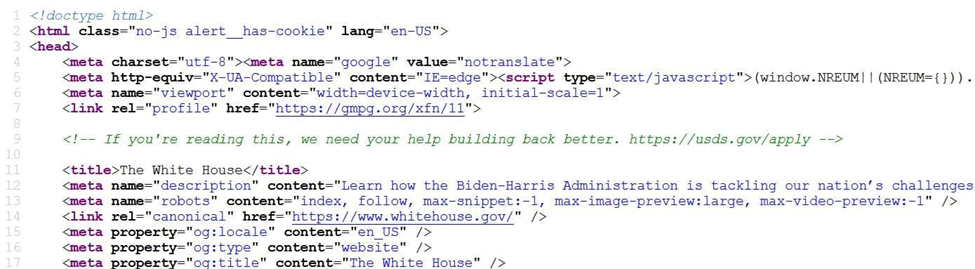
In 2021, the Biden administration slipped a digital Easter Egg into the software code for the newly updated White House website. Buried within the site’s HTML was a message encouraging tech workers to apply for jobs within the U.S. Digital Service, an executive branch division whose staff builds and improves digital tools used by people interacting with the federal government online. The hidden message stated, “If you’re reading this, we need your help building back better.”
The effort was part of President Biden’s $1.9T COVID-19 relief plan, which included $200M in funding for hiring support employees. It was also part of the administration’s commitment to do more in response to the SolarWinds hack that made private organizations and many government agencies victim to Russian nation-state security threats . And the cyber threats haven’t stopped coming – more recently, the U.S. Justice Department indicted Iranian hackers for attacks on our country’s critical infrastructure. Two weeks ago, the U.S. government warned that ransomware attacks on schools are likely to increase. Conservative estimates on the cost of cyberattacks on government agencies alone sits at around $13.7B per year. The costs – both financially and economically – will skyrocket if the talent gap remains unaddressed.
A screenshot from Reuters obtained in January of 2021 showing HTML code on the White House’s website containing an invitation to join the U.S. Digital Service, the White House’s tech team.
This may have been the first time in modern history that the U.S. federal government laid an Easter Egg for recruiting purposes, but the recruitment tactic wasn’t the first of its kind. During WWII, British intelligence agencies circulated crosswords and other puzzles in newspapers to recruit code breakers, hiring those candidates to work in top-secret locations such as Bletchley Park in the UK. Today, companies like Microsoft regularly drop Easter Eggs into their products to attract the best talent and encourage recreational enthusiasts to engage with its products. Soon after the White House’s revamped website went live, the U.S. Digital Service reported that it received a “large number of applications.”
Fast Forward to 2022…
But…did it work? Did the large number of applications from the Easter Egg stunt of 2021 result in meaningful hires to help address the cybersecurity talent gap? And what are some of the other tactics the U.S. government (and companies partnering with it) is using to address this challenge?
The answer to those questions is not crystal clear, but it’s apparent that the talent gap is a serious concern and has the Biden administration’s attention. As of August, there were over 714,000 cybersecurity jobs open in the U.S. and the president has characterized the talent gap as the country’s “core national security challenge.”
In July, National Cyber Director Chris Inglis hosted the National Cyber Workforce and Education Summit at the White House, which included participation from top White House officials and executives from the private sector and the academic community. Attendees discussed solutions to several specific topics within the cybersecurity talent gap, including the need to create new skills-based pathways to cybersecurity jobs in schools and training programs; improve Diversity, Equity, Inclusion and Accessibility in the cyber field and use the talent shortage as an opportunity to build pipeline for historically untapped talent; bring together entities both public and private who employ, train and educate cyber professionals; and examine how to improve practices in cyber adjacent fields that are not focused solely on cyber but are still impacted by it, are related to it or benefit from it.
Most importantly, the White House shared significant programming coming out of the summit to close the talent gap, such as developing a National Cyber Workforce and Education Strategy, creating a 120-day Cybersecurity Apprenticeship Sprint and an effort to strengthen the K-12 system to prepare students more effectively for cybersecurity job opportunities. Additionally, 16 organizations made substantial announcements, commitments or pledges in connection with the summit, including Accenture, Cisco, The Cyber Readiness Institute (CRI), Girls Who Code, IBM and The Linux Foundation, among others.
Why it matters + what to do about it
This is an excellent start to addressing our country’s critical cybersecurity talent shortage, but it’s important to note one key — and missing — link: the value of communications in the effort to close the cybersecurity talent gap. Here’s how organizations can help:
Leadership within organizations must not only identify the size of their cybersecurity talent gap, but also clearly communicate to internal and external stakeholders about how they will address it. This should be a clear missive with specific steps and performance metrics.
Regularly report on progress toward those goals and cultivate an employer brand that attracts the top talent. This means not only reporting hard numbers, but clearly communicating about specific challenges the organization is seeing and what they are doing to adjust the strategy for recruiting talent as a result.
Identify employee champions who can speak to cross-functional roles. For example, communications plays a key role for most cybersecurity actions a company may take. In many cases, these employees are already baked into the organizational structure around threat intelligence research, employee trainings, incident response and much, much more. So why aren’t we also putting these individuals to work to try and help close the security talent gap? This will not only establish a new skills-based pathway to cybersecurity jobs in training programs but could also improve practices in cyber adjacent fields – hitting not one but two key suggestions for leaders coming out of the White House Summit.
With the start of Cybersecurity Awareness Month just over a week away, this looming talent gap remains top of mind and will certainly be a central conversation topic. There is still much work to be done but finding creative ways to inspire interest in the field is the first, most critical step.
See what else is happening
You might also like
Expertise
The Visible CEO: How Leadership Can Serve as a Strategic Asset
July 1, 2026
Expertise
How to Win the GLP-1 Food Industry Wake-Up Call
June 30, 2026
Expertise
Cannes Lions Exposed an Industry’s Transition of Power: Takeaways From Winning Work
June 26, 2026
News
The Chaos Advantage: How Brands Win in a Volatile World
June 25, 2026
Expertise
Lessons From Cannes: Don’t Let Speed Fail Storytelling
June 25, 2026
Expertise
Get Bold Work Out Into the World: How to Seize the Chaos Advantage
June 25, 2026
Expertise
The Action Gap: Leaders Know Bold Work Wins. They’re Just Not Moving Fast Enough.
June 23, 2026
Expertise
From Storytellers to Strategic Advisors: Sports Leaders Provide Valuable Lessons for Communicators
June 23, 2026
Expertise
The AI Readiness Gap Series: How to Build a Culture of Experimentation