Employee Login

Enter your login information to access the intranet

Enter your credentials to access your email

Reset employee password

Article

Announcing Our Global Corporate Affairs Leadership Team

August 7, 2025

New leadership strengthens integration across regions and capabilities, helping clients navigate uncertainty, reputation, risk and transformation at speed.

As companies face rising volatility, stakeholder scrutiny and operational complexity, the role of corporate affairs has become an increasingly critical issue for the C-suite. To meet this moment, FleishmanHillard today announced a new Corporate Affairs Practice leadership structure to deliver more connected, insight-driven counsel and stay ahead of the demands of today’s global business environment.

Rachel Catanach has been appointed global managing director, corporate affairs, unifying the firm’s advisory offerings across seven core pillars: corporate reputation; financial and M&A; crisis and issues; executive positioning; public affairs and geopolitical strategy; talent and transformation; and responsible business. Catanach will also ensure FleishmanHillard’s Global Executive Advisory network provides strategic guidance to senior leaders navigating high-stakes issues and transformative change. She continues to lead the agency’s New York and Boston offices.

“Rachel is a visionary leader who understands how to drive business results through modern, reputation-centered communications,” said J.J. Carter, FleishmanHillard president and CEO. “Her leadership of corporate affairs will elevate the impact FH delivers to global clients navigating extraordinary uncertainty and strategic challenges.”

To support this global capability, the agency has also named three regional leaders:

  • Michael Moroney, managing director, corporate affairs, Americas – A trusted counselor on regulatory complexity and executive visibility, Moroney will guide strategy across the Americas while continuing to shape the Executive Advisory portfolio and lead key client relationships.
  • Yvonne Park, managing director, corporate affairs, APAC – Based in Seoul, Park brings two decades of experience in litigation communications, stakeholder engagement and CEO succession planning. She will drive consistency and innovation across Asia, aligning with global capability and sector leads.
  • Hanning Kempe, managing director, corporate affairs, EMEA – With a track record advising multinationals and government stakeholders across Europe, Kempe will leverage his expertise in change management, corporate strategy and crisis to lead the region’s growth and service excellence.

(From left to right: Yvonne Park, Hanning Kempe, Rachel Catanach, Michael Moroney)

FleishmanHillard’s global corporate affairs practice leverages a powerful combination of counselor-driven solutions and advanced intelligence infrastructure that enables teams to respond to client challenges with greater speed, precision and business impact. Counselors across the network are empowered to design and deploy real-time solutions that integrate proprietary tools, institutional knowledge and advanced audience insights, no engineering background required.

  • Risk Radar: An AI-powered early warning system that flags reputational, legal and operational vulnerabilities, helping clients identify and respond to meaningful risks before they escalate.
  • SAGE (Strategic Audience Generation Engine): A predictive audience intelligence tool that simulates stakeholder reactions to messaging and positioning, enabling teams to test and refine strategies for maximum impact.
  • Connectivity Diagnostic Agent: A solution that analyzes how a brand’s story aligns with shifting cultural, regulatory and reputational forces, revealing areas of strategic misalignment and opportunity.

These capabilities, combined with FleishmanHillard’s Global Executive Advisory network of more than 50 senior counselors, enhance the firm’s ability to deliver high-impact counsel at the intersection of risk, reputation and growth. Corporate affairs teams routinely collaborate across brand work and all FleishmanHillard centers of excellence, ensuring clients lead with confidence in their most consequential moments.

These appointments follow several recent FleishmanHillard market leadership announcements, including Mei Lee in Singapore, Madhulika Ojha in India, Adrienne Connell in Canada, Kristin Hollins across California and Marshall Manson in the United Kingdom — as FleishmanHillard continues to invest in regional leaders who deliver trusted counsel and measurable impact on a global scale.

With this next chapter, FleishmanHillard’s corporate affairs leadership is uniquely positioned to help leaders anticipate risk, accelerate transformation and build enduring reputation in a world defined by complexity and change.

Article

The Real Reason Your AI Rollout is Stalling

July 30, 2025
By Zack Kavanaugh

When it comes to the success of AI rollouts and adoption, there’s a notable delta between the perspectives of a company’s leaders and its employees.

About a quarter of leaders say their AI rollout has been effective. Only 11% of employees agree.

That’s not just a signal that implementation is lagging – it’s a signal that alignment is lacking. And that gap likely isn’t due to tech – at least not tech alone. More likely, it’s about trust, clarity, consistency, relevance … even identity.

You can launch the right tool with a solid rollout plan behind it. But if employees don’t understand why it matters – or where they fit in – behavior change stalls before it has the chance to take root.

Why Behavior Change Stalls: The Distance Between Intention and Action

Behavior change doesn’t just happen because a tool is available – it has to be intentionally built into the experience. Early. Clearly. With a level of resourcing and support commensurate with what the company has invested in the platform itself.

That means embedding behavior-shaping touchpoints from day one – not waiting for adoption to happen organically. What does this look like in action? Continuous feedback loops to surface and address employee hesitations, leaders modeling new behaviors in visible ways, regular moments of reflection woven into team rhythms, and dedicated roles focused on coaching and practical support – among other things.

People pull back when things feel vague. When the shift doesn’t connect to what they care about, or how they see their role. Even the best tools get overlooked if the environment around them doesn’t support the change they’re meant to create.

Where Behavior Change Breaks Down: The Subtle Signs of Resistance

But where exactly does the friction show up?

Resistance doesn’t always show up as vocal opposition – more often, it shows up in silence. A tool gets rolled out, but questions go unasked. Team conversations sidestep it. Some employees disengage or quietly revert to old habits like manually analyzing large swaths of data or generating meeting summaries and first drafts from scratch.

This refusal isn’t manifested as loud rebellion. It’s slow fade. And in AI transformation, that quiet drift is one of the biggest threats to sustained impact.

Left unchecked, that disengagement can erode tool ROI – dragging down productivity, creating adoption gaps across teams and limiting the career growth of those who hesitate, especially in roles where fluency with AI is quickly becoming table stakes. In short, when employees don’t buy in, the business can’t move forward at the pace it needs to.

The good news? These signals are visible – if you know where to look. Spotting and addressing them early can protect your investment, align your people and accelerate progress where it matters most.

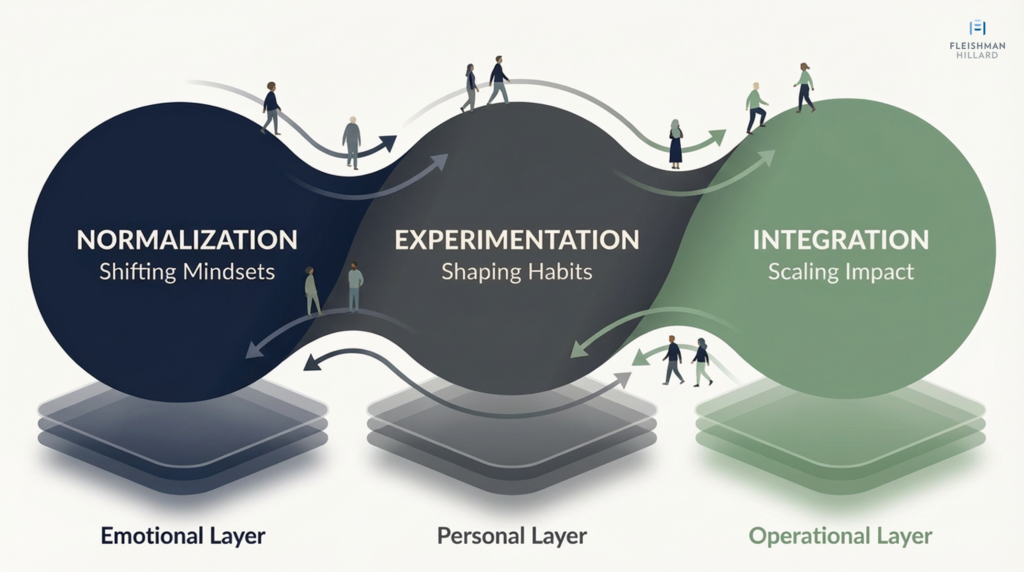
The Three Layers of Hesitation: Enterprise, Team and Individual

For companies struggling to drive AI adoption, this is the moment to step back and start asking simple questions like the ones here.

While the tools will get better and the use cases will expand, none of that guarantees impactful adoption.

Right now, most organizations don’t need a newer generation of the technology. They need better feedback loops. More storytelling and open conversation. A stronger bridge between AI strategy and lived experience.

And more honest signals from leaders – that this isn’t just about the next tool, it’s about how the work is changing, why that matters and how the organization is committed to making space for people to come along with it.

The Final Takeaway: Change Sticks When Conditions Are Right

Adoption doesn’t accelerate just because the tools get better. And AI doesn’t scale well in confusion. These things happen only when the environment is ready – when culture, clarity and context catch up to the ambition.

That’s when change starts to feel real. And when people decide it’s worth leaning in.

Article

Leading Through Complexity: What Higher Ed Communicators Are Saying

July 25, 2025

What one word best describes your day-to-day work? 

That was the icebreaker posed by FleishmanHillard’s Sarah Francomano, who hosted and moderated a candid dinner conversation among senior higher ed communications and marketing leaders. Responses like “firefighter,” “pivot” and “controlling chaos” weren’t said for dramatic effect—they reflected the current state of the higher ed landscape. The group all concurred that leading communications in higher education today is intensely complex, often chaotic and always high stakes.

The conversation was twofold, starting with discussions around what senior leaders are currently seeing in higher education. Then, the conversation moved to what’s next and how higher-ed professionals can leverage AI and other emerging tools to support them in their roles.

The Current Reality: Complexity and Constant Pressure

Communications leaders in higher education are facing unprecedented, often competing demands—with the stakes higher than ever. A single misstep can trigger consequences ranging from trustee backlash to federal scrutiny. Plus, in an environment where issues are deeply personal and highly visible, it’s often the job of the communications team not just to respond, but to cut through the noise, determine whose voices matter most in a given moment and identify which relationships need to be prioritized in order to guide the institution through crisis or change.

Participants shared their experiences managing a high volume of inquiries on a consistent basis from students, parents, alumni, donors, faculty, media and the general public on issues pertaining to their schools. One participant described a case where their team received more than 10,000 emails in response to a global crisis. After sorting through all of the messages, they found that only a small fraction came from individuals actually affiliated with the institution. It was a telling example of how the general public’s perspective does not always reflect the opinions of key stakeholders who have an impact on a university.

Others spoke about the weight of deciding when—and whether—to issue public statements. Choosing to speak up on a cultural or political moment may be the right call in one case, but it often sets expectations for the next moment. The act of staying silent can also become a message, leaving universities at risk of receiving backlash. One communications leader noted that even a simple interaction with a reporter can draw the institution into a larger story, whether they want to be part of it or not.

Enrollment also surfaced as a key pressure point. Some schools are dealing with declining numbers and budget shortfalls; others are seeing higher-than-expected demand. Several attendees commented on the long-term risks of tuition discounting—the idea that while short-term financial aid boosts can help meet yield goals, they may also chip away at perceived brand value over time. Once an institution begins competing on price, it becomes difficult to return to a different model.

The Future: How AI is Shaping Strategic Readiness

Toward the end of dinner, the conversation shifted to some of the solutions now available to address the challenges that come with working in higher education. The group was introduced to a live AI-powered crisis simulation, led by FleishmanHillard’s Alex Lyall. The FH Crisis Simulation Lab draws from real-world crisis events and FH simulation methodologies and presents users with unfolding scenarios in the form of projected stakeholder reactions. Unlike traditional simulations, which are static, this AI-powered tool is dynamic in nature, responding to the real-time decisions of participants by evolving the crisis scenario to reflect how stakeholders might respond.

When the demo immersed participants in a campus protest scenario, the group decided to put the tool through its paces and selected the most aggressive response, forcing demonstrators to disband by a set deadline. The result generated backlash, escalation and reputational fallout in the form of emails, social media posts and media coverage, mirroring how a crisis team would experience these types of situations.

Participants were quick to note how well the tool captured the complexity and pace of an actual crisis. The AI agent mapped out the often-conflicting reactions across stakeholder groups—students, faculty, alumni, media, donors—and showed how quickly one decision can lead to a cascade of consequences. Later in the simulation, when the team chose how to correct course, the tool was prompted to generate internal and external holding statements that offered strong, usable drafts that could be easily customized to fit the voice of an institution.

Participants saw clear potential for the AI agent as both a training and planning resource—especially in conversations with boards or leadership teams. It provided a structured, precedent-informed way to explore how crisis scenarios might unfold, helping teams evaluate why one communications path might be more effective than another.

Alex shared that while this particular demo was generic, the FH Crisis Simulation Lab can be tailored to reflect each school’s culture, governance structure and audience. Even those in the room who were skeptical about AI said they could see its value in this kind of application—not to replace human instincts, but to sharpen and support them.

Going Forward: Navigating Reputational Complexities

The evening was a chance to connect with peers, swap stories and explore fresh ideas about what the future of higher ed looks like. It was an invigorating conversation that left many in the room feeling energized and inspired.

Higher ed communications may be complex, sometimes chaotic and full of tough calls—but it doesn’t have to be faced alone.

Article

What America’s AI Action Plan Means for Leaders Now

July 24, 2025
By Josh McConnell

Don’t think of this as just a policy reset. It’s a reputational crossroads. In a deregulatory moment, the real challenge isn’t compliance. It’s communication plain and simple: how to explain, defend and lead through what comes next.

The U.S. government has issued its clearest signal yet that it intends to lead the world in AI through acceleration over regulation.

America’s AI Action Plan, unveiled this month, reframes U.S. tech policy around three pillars: innovation, infrastructure, and international competitiveness. It rolls back many of the Biden-era safety and fairness frameworks, instead emphasizing open-source development, rapid deployment and private-sector partnership. For CCOs and CMOs, this isn’t just a policy update. It’s a pressure shift. With fewer federal rules in place, the burden of defining and defending responsible AI now falls squarely on companies themselves. That means your narrative, transparency and readiness matter more than ever.

How To Respond Ahead of the Spotlight

1. From frameworks to frontline comms, you can feel scrutiny shifting
With Biden-era guardrails rolled back, there’s more ambiguity and reputational risk. Review your systems, filtering practices and content neutrality positions ASAP. Comms teams need clarity and defensibility, especially where DEI, safety filters and model transparency intersect.

2. Prepare your public narrative before the news cycle tests it
Build messaging that goes beyond launches and investor decks. Emphasize ethical foresight, safety, training transparency and societal value in your comms. Assume watchdog groups, press and policymakers are already watching and look at your narrative through their eyes and position accordingly. Even consider a virtual audience simulation that will pressure test messaging for different mindsets. It’s ultimate defense as offense.

3. Make your company part of the national story
This plan isn’t just tech policy. It’s economic and diplomatic strategy. Companies that align their messaging with national priorities like innovation, infrastructure and workforce development will carry more weight with policymakers, partners and procurement leaders.

And in today’s generative search environment, those narratives aren’t just for press releases. They’re a crucial part of brand discovery. Organizations are can shape how they are surfaced, summarized and evaluated in search. If your brand isn’t telling a clear story, it’s likely that AI will try to do it for you or ignore you completely.

4. Engage now, not later
If your teams haven’t opened dialogue with NIST, OSTP or other agency stakeholders, now is the time to start. Participation in federal consultations and comment periods will shape procurement standards and signal leadership. You don’t want silence to be interpreted as an absence of a point of view.

5. Signal leadership through your talent
AI-readiness isn’t just about model performance. This is all about workforce planning. Use this moment to communicate investments in retraining, apprenticeships and education. This is reputational insulation and long-term eligibility for federal partnerships.

6. Strengthen your risk and compliance narrative
This plan includes stricter export controls, national security filters and new expectations for “secure by design” standards. Global comms must now reflect both regulatory divergence (EU, China) and internal alignment across legal, engineering and policy.

7. Know where your infra story fits
For companies in data centers, chips or energy, this is also an opportunity moment. Comms teams should coordinate early with government affairs, bid teams and legal to ensure eligibility positioning aligns with public messaging.

8. Plan for federal-state friction
As state-level bias audits, content governance and privacy laws expand, tensions with federal policy will grow. Your public narrative and internal compliance playbook must account for that dual reality.

So what comes next?

The companies that lead through this moment won’t be those that publish the longest policies. They’ll be the ones who explain their role with the most clarity, credibility and consistency both internally and externally.

The policy shift is clear: the U.S. is betting on speed, scale and innovation. But for communications leaders, the implications run deeper.

The questions coming next about explainability, bias, security and global alignment won’t be answered by engineers alone. They’ll require strong narratives, clear values and messages that hold up under scrutiny. Communications team won’t follow this story. They’ll help define it.

Josh McConnell  Josh McConnell is a VP of Technology based in New York where he helps companies navigate complex narratives at the intersection of innovation, reputation and culture. He brings over 15 years of experience across journalism and corporate comms, with leadership roles at Uber and Xero. As a journalist, he regularly interviewed tech leaders including Tim Cook, Satya Nadella and Jack Dorsey.

 
Article

The Friends You Never Knew You Needed: Why IT and Communications Must Team Up

By Scott Radcliffe

Trust is at the heart of every successful organization. In today’s digital landscape, that trust is built—and sometimes shattered—by how well you protect the data on your network. Reputation is hard-won and easily lost, making it a favorite pressure point for cybercriminals and regulators alike.

Over the past several years, threat actors have shifted tactics. Rather than relying solely on operational disruptions driven by ransomware, groups like Lapsu$ have gone as far as exposing sensitive corporate data without warning or attempted extortion, as seen in their attacks on some of the tech industry’s top companies.

At the same time, regulators and government officials are turning to more and more public responses related to cybersecurity, tightening their grip on corporate reputations through new rules and public scrutiny. With more stringent regulations and increased public reporting, organizations are being held accountable for how they manage and protect sensitive information. Meanwhile, a more cyber-savvy and skeptical public is quick to notice, and react to, any missteps.

Reputation and Technical Cyber Risk: A New Partnership

As the link between reputation and cyber risk grows stronger, IT and Communications teams can no longer afford to operate in silos. Their collaboration should go far beyond crafting post-incident press releases. Here’s how these two critical teams can—and should—work together:

  1. Translate Complexity into Clarity:
    Technical teams understand the risks. Communications teams know how to craft messages that resonate. Together, they can ensure clear, concise explanation of core policies, risks, and responses both internally and externally.
  2. Build a Culture of Security:
    It’s not just about what you say, but how you make it stick. Developing a thoughtful strategy for culture change ensures that security messages are truly internalized throughout the organization.
  3. Plan for the Unexpected:
    Effective scenario planning for data security and privacy risks requires tight coordination. Legal, technical, and Communications teams must work hand-in-hand to prepare for—and respond to—potential crises.

The Benefits of Collaboration

When IT and Communications join forces, the results are tangible:

  • Stronger organizational alignment and buy-in
  • Increased compliance with policies and regulations
  • Faster, more effective crisis response

The specifics of this collaboration will vary but the playbook begins with early alignment on goals, KPIs, desired outcomes and a plan for communicating information to the appropriate stakeholders. Starting before a crisis hits ensures everyone in the organization is working towards shared outcomes.

The threat landscape is only growing more complex and dangerous. While technical defenses are essential, they’re not enough on their own. Real security comes from building awareness, engagement and trust across every level of your organization.

If cybercriminals are evolving their tactics, organizations must evolve, too—not just in how they defend against attacks, but in how they think about and communicate cyber risk.

Scott Radcliffe width= Scott Radcliffe is FleishmanHillard’s global director of cybersecurity, leading the firm’s Cybersecurity Center of Excellence and advising clients on rising cyber risks. He recently rejoined FH from Apple, where he led cybersecurity communications and previously served as the agency’s senior global data privacy and security expert.

 
Article

Closing the Innovation Gap With FH Fusion, Our Data and AI-Powered Solutions Suite

July 14, 2025

Our new solutions suite designed by and for communications professionals builds on Omnicom’s agentic AI platform, Omni, by integrating institutional communications knowledge with advanced audience data and technology capabilities. FH Fusion gives every FleishmanHillard counselor and team the ability to create real-time, agentic AI solutions that deliver sharper insights, more precise activations and stronger business outcomes—no engineers required.

FleishmanHillard today launched FH Fusion, a first-of-its-kind communications solution suite that puts the full range of AI models, institutional knowledge and a proprietary data toolset directly into the hands of communications professionals. Unlike tech-first applications built by developers, FH Fusion was created by—and for—counselors, enabling them to design and deploy real-time solutions backed by Omnicom’s secure, scalable intelligence layer.

Already in use by more than 1,000 FleishmanHillard strategists, FH Fusion reduces ramp-up time, accelerates delivery and improves outcomes across crisis, stakeholder messaging, media intelligence and brand strategy.

“FH Fusion closes the innovation gap—the distance between what communicators envision and what most tools actually enable,” said Ephraim Cohen, global head of data and digital. “It gives every strategist the power to turn expertise into action, combining insight, data and AI to build exactly the solution they need. We designed it so communicators can move at the speed of their ideas, with technology that’s trained to think the way they do about how people react, how issues evolve and how strategy needs to shift in real time.”


A Peek Inside: How FH Fusion Works

Today’s communicators don’t just need insights. They need infrastructure. FH Fusion leverages Omnicom’s industry-leading investments in AI and data to bring together four critical components – data, generative AI, knowledge bases and subject matter expertise in building custom agentic solutions for each client. FH Fusion combines:

  • 🔗 A full range of AI models and agentic AI technology – Omni’s AI layer enables users to create custom, multi-agent workflows from a full range of generative AI modes.
  • 📊 Industry leading data stack – The data layer of FH Fusion combines Omnicom’s collective data-driven intelligence across audience and commerce inputs from Omni and Flywheel, with corporate and consumer media, influencer, and other critical communications data from OPRG and FleishmanHillard.
  • 📚 FleishmanHillard’s institutional knowledge – FleishmanHillard’s considerable institutional knowledge and collection of proven, proprietary methodologies are being organized into a growing library of knowledge bases accessible to any agent.
  • 🧠 Subject matter experts trained in developing agentic AI solutions – Solutions are built not by engineers, but by FH counselors trained in creating AI agents, resulting in agentic solutions with communications expertise at the core.


A Smarter Model for the Future of Communications

FH Fusion is already being used by FleishmanHillard subject matter experts to build client solutions across three capability areas—each one modular, extensible and designed to integrate seamlessly with existing client workflows. The tools below are just a few of the expert-built components being combined to create end-to-end, outcome-driven solutions.

1. Predictive Audience Intelligence with Synthetic Audiences

Solutions include SAGE (Strategic Audience Generation Engine) that simulates how key stakeholder groups—from policymakers to employees—respond to messaging, content or positioning. Using AI-modeled virtual audiences built on deidentified and aggregated behavioral and attitudinal data, teams can test multiple approaches, identify what resonates and refine strategy before going live.

As AI becomes the new filter for information, SAGE helps communicators shape how messages are interpreted before they’re summarized, surfaced or amplified by algorithms. In a recent pilot, SAGE uncovered shifts around trust and transformation, informing a Fortune 100 client’s rollout across six markets.

2.  Storytelling and Strategic Alignment

Solutions include the Connectivity Diagnostic Agent that analyzes how a brand’s story aligns with shifting cultural, regulatory and reputational forces. Trained by messaging experts, it goes beyond keyword scans to reveal strategic misalignment—helping teams fine-tune positioning before small gaps become larger problems. The Communications Function Builder helps leaders optimize team structure and workflows using benchmarking and best practices—turning institutional knowledge into scalable systems.

3. Crisis Management and Corporate Communications

Solutions include Risk Radar that flags reputational, legal and operational vulnerabilities using AI trained by FleishmanHillard’s crisis experts. It filters out noise and false positives, helping teams identify and respond to meaningful risks early, serving as a calibrated early warning system built for decision-making rather than a cry-wolf dashboard.

These solutions build on FleishmanHillard’s long-standing commitment to democratizing access to data—now extended through new forms of intelligence, including curated knowledge bases (KBs), scenario-trained agents and secure, segmented workspaces that adapt to each client’s needs. FH Fusion is powered by a flexible intelligence layer that enables any employee to build multi-agent workflows tailored to real-world communications challenges, drawing from a full range of top-performing AI models. FH Fusion also taps into the depth of Omnicom’s data ecosystem, combining audience and cultural intelligence from Omni, commerce insights from Flywheel, and integrated streams of media, social, influence, and business signals—calibrated for strategic communications.

“Too many tools treat communications like an engineering problem. FH Fusion starts from a different premise: strategy is a human discipline,” said Cohen, who will host the FH Fusion Summit in September featuring live builds, cross-functional demos and client use cases. “We’ve spent years expanding data fluency across the agency—and now we’re applying that same model to AI. We’re training every FHer to be a builder, not just a user. Communications expertise alone isn’t enough anymore. What we need is that expertise plus deep data fluency—and the ability to train AI agents just like we train people. That’s the real shift with FH Fusion.”

Disclosure: This post was developed in collaboration with a custom agent trained for the communications industry—guided by FleishmanHillard counselors and built using Claude 3.5 Sonnet, one of seven major models FH Fusion can switch between on the fly. It drew from a curated knowledge base of communications research to focus on the capabilities clients care most about right now. Want to see what else it can do? Let’s talk.

How FUSION WORKS
Article

Kristin Hollins Named FleishmanHillard California General Manager

July 10, 2025

Agency Veteran and Strategic Advisor to Global Brands Will Lead Growth and Innovation Across West Coast

FleishmanHillard today announced the appointment of Kristin Hollins as general manager for California. In this role, Hollins will oversee the agency’s strategy and operations across San Francisco, Los Angeles, San Diego, Orange County and Sacramento, with a focus on client experience, growth, talent development and cross-market integration. She will report to Della Sweetman, president, Americas and chief strategy officer.

Hollins brings more than 30 years of experience advising organizations across sectors that define California’s economy — including technology, health and life sciences, energy and commerce. Recently, she led FleishmanHillard’s San Francisco office. She is also the Page Up co-chair of the Western Region for the Arthur W. Page Society, the leading global association for senior communications executives.

“California is one of our most influential markets where innovation and industry intersect daily,” said Sweetman. “Kristin brings superior business acumen, depth of market, sector and discipline expertise, and a client- and people-centric focus that will help deliver against a ‘One California’ strategy with confidence.”

FleishmanHillard’s sector expertise across California is a strong representation of the region’s business and growth opportunities spanning technology, health and life sciences, food and agribusiness, and retail, sports and lifestyle, which is noteworthy with the Super Bowl, FIFA World Cup and Olympics all taking place in California over the next few years. The team leads advisory and modern communications capabilities, including business transformation, corporate affairs, brand impact, influencer, digital and social, strategic planning and creative.

Hollins previously served as CEO of Revere (a division of Edelman), where she expanded the firm’s integrated marketing capabilities with sector-leading clients in AI and e-commerce and launched its European business. Earlier in her career, she led some of FleishmanHillard’s largest technology accounts and served as the corporate reputation lead for the Americas, helping companies develop data-driven positioning and executive visibility platforms.

In San Francisco, Hollins built the agency’s corporate reputation team with a full-service practice spanning corporate brand, internal communications, issues management, executive thought leadership and high-impact media relations. Her work has helped shape the reputations of organizations across industries and geographies. Hollins is also an experienced convenor of thought leadership platforms, having led activations at the World Economic Forum in Davos, the Milken Institute, the Aspen Ideas Festival and more.

“I entered communications at a time when technology was utterly transforming the way we communicate, commerce was conducted and businesses operated,” Hollins said. “There was no better place to be than at an agency in California in the heart of that transformation. Today, technology, particularly AI and access to vast amounts of audience data, is again reshaping our field. I can think of no better place than FleishmanHillard in California to lead in this moment. I’m incredibly excited for what the future holds for our teams and our clients.”

Hollins’ appointment reflects FleishmanHillard’s continued investment in market leadership that combines regional fluency with global insight. It follows a series of strategic leadership announcements across key markets, including Atiwat Krisintu in Bangkok, Mei Lee in Singapore, Madhulika Ojha in India, Adrienne Connell in Canada and Marshall Manson in the United Kingdom — underscoring the agency’s commitment to delivering business-critical communications strategy for the world’s most ambitious brands.

Kristin Hollins, California General Manager

Article

As Seen at Cannes Lions: To Break Through, You Have to Earn It

June 26, 2025
By J.J. Carter

In a time of uncertainty and saturation, attention isn’t given. It’s earned through simplicity, creative craft and AI grounded in reality.

Cannes Takeaways

You could feel it in every conversation. The C-suite under pressure. Creators calling for accountability. Agencies asked to solve faster, smarter, more intentionally. What cut through in the award winners and on the stages was a clear focus driven by data and human insight. What earned attention never felt like trend-chasing. It was about clarity and credibility, driven by a truth that set creative teams loose. For all the talk about AI and cultural disruption, what stood out was that brands want to move with confidence through complexity. And in a year defined by volatility, that confidence is earned, not bought.

Now that Cannes Lions is in the rearview mirror, here’s what’s clear to me:

Earned attention is the new baseline.
“E” has, at times, felt like a silent vowel in the traditional PESO model. But that’s changing fast. As generative platforms reshape how brands are surfaced, summarized and shared, it’s earned media that’s proving to be one of the most powerful drivers of visibility. Credible coverage doesn’t just build trust. It improves discoverability. And in a world increasingly shaped by GEO (generative engine optimization), earned media helps brands control not just if they show up, but how they show up. When sharp campaigns are celebrated by trusted voices, they generate stronger engagement and deeper response. That’s earned attention you can’t buy and it’s what increasingly separates noise from positive reputational impact.

Creativity without credibility doesn’t travel.
Culture can’t be expected to resonate when it’s bolted onto a campaign at the last minute. The best work at Cannes was in conversation with the cultural moment, often spoken by creators serving as constant partners instead of rented voices. They proved essential to telling a brand story in a genuine way and were worth far more to campaigns than the amplification they brought to the table. Creators helped build these programs from the inside, developing a community voice and a deeper connection to cultural truths.

Simplicity and a return to IRL wins.
The boldest campaigns were the sharpest ones, not the biggest. Simple ideas that felt personal and true. Smart executions that scaled across channels and continents because they tapped into universal truths, united communities and delivered considered solutions. This year, many of those executions signaled something deeper: digital reach alone is no longer enough to break through. Many celebrated campaigns reintroduced physicality into the brand experience: tactile moments, IRL activations and shared cultural touchpoints that audiences could feel. There’s a pull back toward the tangible and when simplicity meets sensory, the connection was stronger.

AI is already shifting expectations.
The conversation around AI has quickly evolved from “what’s possible” to “what’s useful.” Less wow, more right now. CMOs and CCOs demand tools that move creative ideas forward with speed and clarity and that introduce infrastructure that fits with their own creative workflows. That reinforces the path we’re on, building tools shaped by the lived professional experience of communicators and grounded in human context.

Precision beats prediction.
Everyone is navigating the same uncertainty. What matters is how you respond. The work that stood out didn’t dance around complexity. It met it head-on by reframing risk, cutting through noise and moving audiences with purpose.

Cannes reminded us: this isn’t just the age of creativity. It’s the age of earned attention. And in a time when breaking through is fragile, attention is fragmented and AI is rewriting the rules, the brands that lead will be the ones who stop talking at people and start showing up for them with bold ideas grounded in truths that meet this uncertain moment.

That’s what our craft makes possible. That’s what we’re here to build.

More Cannes Takeaways: Creativity in the Age of Uncertainty | How Cultural Connections Build Brand Credibility | What Will You Build With Creators? | What Cannes Revealed About AI

J.J. Cartner width= J.J. Carter is President and Chief Executive Officer of FleishmanHillard.

 
Article

Adrienne Connell Appointed Managing Director of FleishmanHillard Canada 

June 24, 2025

FleishmanHillard announced the appointment of Adrienne Connell as managing director of its Canada operations. Connell will oversee strategic direction, growth and client service across the agency’s Canadian markets as the firm continues to evolve its presence in the region. She will report to Della Sweetman, president, Americas and chief strategy officer. 

The appointment coincides with the agency’s rebrand from FleishmanHillard Highroad in the region to FleishmanHillard, aligning with a renewed global strategy focused on leveraging data, AI and executive advisory solutions to help C-suite leaders navigate a complex, multi-stakeholder environment. 
 
“Adrienne’s ability to integrate data, strategic planning and creativity with trusted counsel is exactly what clients need in this moment,” said Sweetman. “Our colleagues in Canada play a critical role in our growth priorities and Adrienne’s appointment reflects our commitment to empowering this market with the full breadth of FleishmanHillard’s global capabilities — delivered through strong, locally attuned leadership.” 

Connell brings more than 25 years of experience in marketing and communications, working with some of Canada’s most recognized brands to drive business and brand outcomes. Since 2022, she has led core service offerings for FleishmanHillard Highroad, helping integrate strategy, digital and analytics across client work. She also led the agency’s Brand Marketing practice, delivering measurable results in sectors including Consumer, Food, Agriculture and Beverage, Health and Life Sciences and Financial and Professional Services. 

“I am excited to lead FleishmanHillard in Canada at such an important moment for our company and country,” said Connell.“At a time when our clients are seeking support to manage uncertainty all around them, we are leading with innovation to solve problems and seize opportunities.” 

“Canadian leaders are navigating complex challenges shaped by international dynamics. The way organizations communicate — internally and publicly — plays a critical role in whether they lead with hesitation or confidence. Every business decision is tied to communication. We empower our clients by combining expert guidance with data-driven insights, innovative AI and our proprietary virtual audience platform, SAGE.” 

Earlier in her career, Connell held marketing, digital and business development roles within the agency and at Torstar Corporation, one of Canada’s leading media and data organizations. She earned a Bachelor of Business Administration from the Schulich School of Business in Toronto. 

Her appointment follows several recent market leadership announcements — including Atiwat Krisintu in Bangkok, Mei Lee in Singapore, Madhulika Ojha in India and Marshall Manson in the United Kingdom — as FleishmanHillard continues to invest in regional leaders who deliver trusted counsel and measurable impact on a global scale. 

Article

What Cannes Lions 2025 Revealed About AI

June 20, 2025
By Emily Frager

This year at Cannes Lions, the AI conversation shifted. I heard it move from fascination with endless applications to a deeper reckoning with what it means for how people connect, tell stories and navigate being human.

One moment that grounded me came from the Behavior, Beauty and Power of Connection session with Malcolm Gladwell, who reminded us it took 20 years for the telephone to be used for personal conversations. The full effect of AI on our world and our work is still unfolding. But here’s what we do know and what I heard reinforced all week long:

1. Change Is Hard. Creativity Is How We Get Through It.

Gladwell said it best: “You can talk about a problem, admire a problem or you can find a solution.” Accepting that change is necessary is one thing. Acting on it is another. What I heard is that creativity is the essential catalyst. It’s how we bridge uncertainty and unlock new thinking. In today’s environment, there’s a premium on it. Not just for campaigns, but for transformation. We’re seeing AI play a growing role in this shift, where the best applications are helping teams reframe how they work and how quickly ideas can be tested, improved and deployed.

2. This Is an Exciting Time for the Courageous

In a world where the rules keep shifting, courage looks like curiosity, experimentation and a willingness to get it wrong before getting it right. As Gladwell put it, “try more crazy s—.” He’s right. Now is not the time for perfection. It’s the time for boldness, play and progress over polish. And when new tools allow you to model outcomes or test messages before launch, you create space to take these bigger swings.

3. The Gen AI Era Favors PR

LLMs (large language models) are trained on PR and editorial content. They’re designed to recognize and value what we create but they can’t replicate our ability to influence the sources, shape the narrative or make emotional connections that change hearts and minds. And this comes at a time when real-world PR activations are also in high demand, offering a tactile, human counterbalance to online brand experiences.

4. How To Gain an Advantage

Across client work, I’ve seen AI be most effective when it mirrors how people actually make decisions. From message testing to rapid-response issue tracking, the value lies in building tools that fit into how teams already work, not forcing them into rigid systems. Proof-of-concept work is showing real results and that momentum is only growing. The investments in the tech and the teams of communicators powering it are smart, strategic and set us up for long-term value.

5. Creativity Is the New Competitive Edge

If Cannes made anything clear to me, it’s this: AI is reshaping how information is collected and shared. But we still shape the sources and we still create new ways for people to connect.

The more creatively we do that, the more essential we become. Let’s keep moving with curiosity, courage and a belief that PR is not just relevant in the GenAI era. It’s essential.

Emily Frager Emily Frager is FleishmanHillard’s Chief Client Officer.

 
On the Ground at Cannes