Overcoming the Authenticity Challenge Facing Financial Services
November 11, 2021
Share
The past 18 months has been an intense period of disruption, scrutiny and change for corporations and business leaders – and some have emerged with their reputations enhanced, while others have been lambasted and hauled over the coals. As we hopefully emerge from the throes of the pandemic and see economies around the globe return to growth, it is vital financial services examine their strategic priorities, re-assess their key reputational drivers and understand what their audiences truly care about. Both now and in the future.
What are the drivers of reputation in financial services?
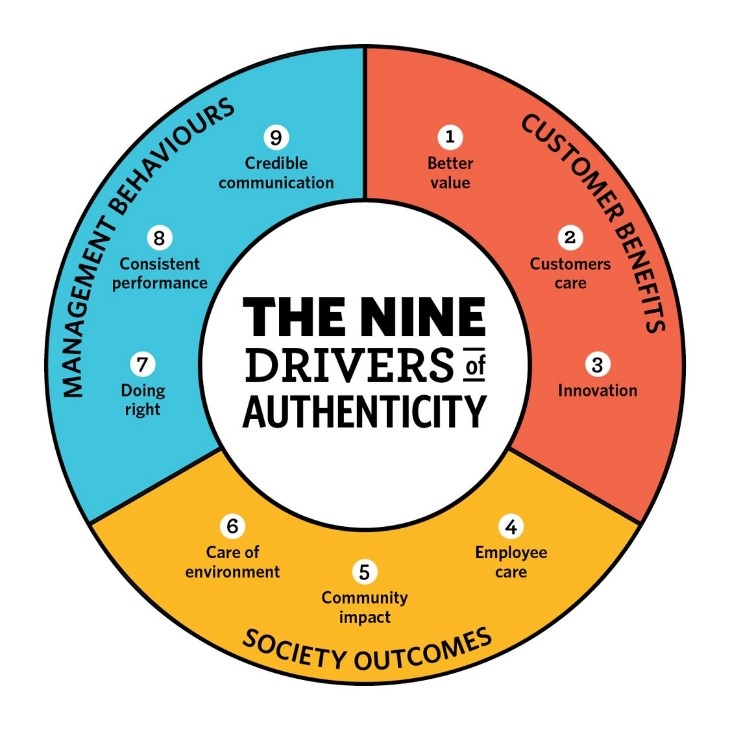
FleishmanHillard’s Authenticity Gap research has found that in the financial services sector overall, only half (52%) of consumer perceptions and beliefs about a company are shaped by attributes related to a company’s customer benefits, while the other half is shaped by a company’s impact on society (23%) and how a company’s management behaves (25%).
In recent years, we’ve observed a swing in relative importance to ‘society outcomes’ – how a firm takes care of its staff, its contribution to its communities and taking better care of the environment.
Looking at the Nine Drivers of Authenticity, the biggest reputational drivers for financial services firms are focused around delivering better value, doing right, showing consistent performance and having good customer and employee care. Interestingly, the relative importance of innovation differs by market, with it being a slightly more important reputational driver in China than it is in either the UK or U.S.
There are also some significant nuances between subcategories of financial services – for example, people expect banks to take better care of their customers, while in the investing space, companies are expected to deliver better value – which along with customer care, make up half of consumer expectations in the category.
How is the financial services industry faring against the nine drivers of reputation?
The financial crisis caused an enormous trust barrier, especially with younger demographics, and ever since, the entire industry has consistently fallen short of expectations. On the whole, this remains true in 2021.
Our Authenticity Gap trend tool presents a mixed picture when it comes to how financial services brands are performing against consumer expectations. In the UK, banks are struggling to meet expectations on value and the customer experience. Similarly, in the U.S., the majority of banks and investing firms studied also fall short of expectations on value.
Conversely, the pandemic may have aided and improved some banks and investment companies’ reputations on innovation, after adapting to a new, digital norm. In the UK, six of eight tracked brands are now outpacing expectations and overall in the U.S., brands are exceeding expectations on innovation.
Innovation and digital technology are most powerful when used to enhance, improve or repair the customer experience through intuitive new solutions, whilst also being used to shrink cost bases and increase profitability. If financial services firms can effectively marry the two, then they may come out favorably in the digital arms race that lies ahead. But it is also vital firms don’t simply rely or place too much emphasis on innovation to remain competitive. Without a positive customer experience and a stellar reputation, the glossy sheen of technology could wear off and firms could see themselves once again caught in the crosshairs.
Financial services brands stepping up on the environment and the ESG agenda
With all eyes on the 26th UN Climate Change Conference (COP26) in Glasgow, there is intense focus on the environment, the ESG agenda and the role of the financial services industry in driving change. Interestingly, in every market studied, banks are exceeding expectations on caring for the environment – which has no doubt been influenced by the influx of ESG-focused products and various green commitments.
However, there are inconsistent perceptions on the extent to which financial services firms are inherently ‘doing the right thing’, with four of eight brands exceeding informed consumers’ expectations and four falling behind.
With the ESG agenda firmly here to stay, it’s vital financial brands recognize their role in society and the extent to which consumers scrutinize their credentials – especially when nearly two-thirds (64%) of them believe a company must talk about its behavior and impact on society to be more credible than its competitors. But talk must indeed be backed by action, and people expect firms to commit to regular and transparent ESG reporting and demonstrate tangible progress against goals or targets.
What’s next for financial services?
For financial services communications leaders looking to make hard choices about where to focus their attention or shape brand campaigns, understanding authenticity has become a vital tool – and just as it always has been, solid communications are one crucial part of the complex reputational jigsaw.
It’s important to remember that consumers don’t necessarily expect financial services companies to fix everything. But they will continue to intensely scrutinize them to make a positive difference and take responsibility for issues under their control. More than ever, it’s not enough to talk a good game. Corporates must be able to back it up with behavior, show tangible impact and effectively communicate progress. To that end, the role of intelligence and research in communication strategies has never been more critical.
See what else is happening
You might also like
Expertise
Watch Now: Make Smarter, Calculated Bets – Live From ADWEEK
October 8, 2026
Expertise
The Three Barriers Holding Brands Back From Bold
October 7, 2026
Expertise
The Boldest Brands Turn Chaos Into Competitive Advantage
October 6, 2026
Expertise
Earning Your License to Lead: UNGA, Climate Week and Beyond
September 17, 2026
Expertise
Black Hat 2026: A Conference and Industry Transformed
August 10, 2026
Expertise
When Food Safety Crises Test Trust: A Guide for Communicators
July 24, 2026
Expertise
We Went to Cannes Lions: Where the Industry Is Trending
July 1, 2026
Expertise
Healthcare’s Moment Has Arrived. The Question Now Is: Will Your Organization Move Fast Enough?
July 1, 2026
Expertise
The Visible CEO: How Leadership Can Serve as a Strategic Asset
COP26 – The view from New York, from Colin Hart, Vice President, FleishmanHillard New York. IS “GREENWASHING” THE NEW CLIMATE DENIAL IN THE UNITED STATES? | COP26 – The view from New York “The titans of finance wouldn’t be in Glasgow if they hadn’t been having discussions with their grandkids, nieces and nephews”, said Rachel […]
Effectively Communicating Vaccine Requirements Amid a Heated Political Environment
November 10, 2021
By Geoff Mordock and Josh Rogers
Share
The U.S. Department of Labor issued new rules for vaccination and regular testing developed by the Occupational Safety and Health Administration (OSHA). The OSHA guidance covers organizations with 100 or more employees. When coupled with previously introduced rules for Federal Contractors and healthcare workers, the guidance covers nearly 100 million Americans. There are significant penalties for each infraction. More details on the guidelines are available on the Federal Register.
Can employers require COVID-19 vaccinations?
Vaccine requirements aren’t new. For example, public schools have a broad slate of vaccines that are required for admission. Healthcare systems have long required vaccines for workers in patient-facing environments, if not their entire workforce. Depending on risk and occupation, the U.S. Military requires more than a dozen vaccines for service members.
Amid the current political environment, COVID vaccine requirements are a heated issue with a vocal minority dissenting (reflected by polling that indicates fewer than 15% of Americans would not get the vaccine). While many companies are concerned about losing employees who refuse the vaccine, the order will similarly apply to a broad range of companies. To date, organizations applying their own or previously issued guidelines have recognized very high levels of compliance.
We’ll leave the details of implementation to the legal and HR experts but given the heated political environment we can provide insight into how to communicate as effectively as possible to encourage high participation with minimal disruption. Regardless of the political lean of your own company’s workforce, pointing to the order to ensure adherence to the guidelines can be the most effective and rational message. In short: you are simply enforcing an order to ensure that your company does not face significant penalties.
How to communicate with employees about the COVID-19 guidelines
Here are a few things to consider as you develop your own communications program related to the COVID-19 guidelines:
The separate Federal Contractor and OSHA guidelines provide “air cover” for employers. Use it. There are penalties that could lead to significant consequences directly for companies and indirectly for their stakeholders. Most employees, customers and other business partners will understand this.
Communications should not be apologetic or wade into politics, instead focusing on fact-based details and the importance the organization places on safety for employees and other stakeholders.
At the same time, understand that those most resistant to the vaccine may consider the vaccine itself unsafe. Regardless of reasoning, they will need to have sources of information available for them to help reduce this fear or concern. Third-party resources – whether it be from government agencies or other evidence-based, well-respected medical authorities – may help.
Some employees – and potentially external stakeholders – who oppose the vaccine or the new guidelines may protest or voice their concern. Think through the scenarios you are likely to encounter, including those involving dissenting employees, and develop a response so you’re prepared if the situation does arise. Include your HR, Legal and Labor Relations teams, as applicable.
If your corporate culture encourages engagement and discussion, keep in mind that conflict drives attention and any interaction/disagreement could bring conflict. When having discussions with unvaccinated employees about their vaccination status or plans as the deadline for compliance approaches, hold those in a 1:1 setting.
Larger companies (or companies with a large presence in a certain market) may get inquiries from the media. As noted above, conflict drives attention and it’s best to be as matter-of-fact as possible and avoid anything political in response (should you elect to respond). Keep in mind that most other companies in the area (or your industry) will similarly be subject to the guidelines. It won’t be a situation unique to your company.
Throughout the process, it’s important that your actions are consistent with your corporate culture, priorities and principles while being empathetic and respectful. Although these new protective measures against COVID-19 are required, it’s important to keep in mind the human component, namely that not every employee will willingly be vaccinated, and adapt your approach accordingly. How you handle these situations can help strengthen or weaken your organizational culture, which may already be feeling the pressures of some or more employee groups working remotely for an extended amount of time.
Taking a compassionate, people-first approach can serve your organization and employees well as they look to round the corner of the pandemic and embark on new ways of working together in the post-COVID-19 era.
See what else is happening
You might also like
Expertise
Watch Now: Make Smarter, Calculated Bets – Live From ADWEEK
October 8, 2026
Expertise
The Three Barriers Holding Brands Back From Bold
October 7, 2026
Expertise
The Boldest Brands Turn Chaos Into Competitive Advantage
October 6, 2026
Expertise
Earning Your License to Lead: UNGA, Climate Week and Beyond
September 17, 2026
Expertise
Black Hat 2026: A Conference and Industry Transformed
August 10, 2026
Expertise
When Food Safety Crises Test Trust: A Guide for Communicators
July 24, 2026
Expertise
We Went to Cannes Lions: Where the Industry Is Trending
July 1, 2026
Expertise
Healthcare’s Moment Has Arrived. The Question Now Is: Will Your Organization Move Fast Enough?
July 1, 2026
Expertise
The Visible CEO: How Leadership Can Serve as a Strategic Asset
FleishmanHillard joins founding sponsors of PR school Socially Mobile
Share
FleishmanHillard UK is proud to be a founding partner and get behind the launch of community interest company (CIC) and PR school, Socially Mobile. Opened today (10th November) for candidate applications for its first cohort of students in January 2022. Its courses are designed to enhance the career prospects of its students and create a […]
FleishmanHillard COP26 Daily Digest, Day 11: Wednesday 10th November 2021 Climate Action Tracker, a global scientific research group that presents an annual analysis of COP commitments, issued a warning Tuesday that the pledges made this year put the world on track for heating of 2.4°C – with 2030 commitments particularly insufficient to make progress in stopping […]
FleishmanHillard announced as finalists in European Excellence Awards
Share
The complete shortlist is published and FleishmanHillard UK has been announced as a finalist in the European Excellence Awards 2021! Amongst over 800 submissions, we’re thrilled to make it into the Top 5 for our category. The EEA Large Agency of the Year will be announced on December 10th. Contact us
Join FleishmanHillard TRUE Global Intelligence at PRWeek’s Measurement Conference
Share
Join partner and director of FleishmanHillard TRUE Global Intelligence, Ben Levine on Monday 15th November at 2pm (GMT) for an AMEC Measurement Bootcamp at the PRWeek UK Measurement Conference. Part of AMEC‘s Measurement Month, this Bootcamp is an interactive workshop that takes delegates through the key steps to optimise their organisation’s public relations measurement and evaluation programs. It […]
Let’s Map New York: A More Inclusive NYC Starts Here
April 30, 2025
Inclusion
Recognizing the power of the LGBTQ Community in Advertising & Media with GLAAD
October 11, 2024
Events
FleishmanHillard’s Sophis Kasemsahasin to speak at Techsauce Global Summit 2024
August 6, 2024
Events
FleishmanHillard’s Leela Stake and Francesca Weems to Join Paradigm’s Joelle Emerson on Inclusive Communication Webinar
August 1, 2024
Events
FleishmanHillard Talks Creativity, Inclusion and Diversity at This Year’s Cannes Lions International Festival of Creativity
June 12, 2024
Events
FleishmanHillard’s Adrianne C. Smith to Speak on “Don’t Believe the Hype — DEI Will Never DIE” at 2024 Cannes Lions International Festival of Creativity
The paradox of communicating CSR: Managing the paradox
Share
Many companies try to improve their image by communicating their involvement in socially responsible activities. This often arouses scepticism rather than achieving the intended goal. In this series, we explore ways to successfully manage the predicament. Join us on Tuesday 16 November 2021 at 2pm (GMT) for a webinar panel of speakers comparing real-life experiences […]
FleishmanHillard UK is PRCA’s Large Consultancy of the Year
Share
FleishmanHillard UK collected top honours at the 2021 Public Relations and Communications Association (PRCA) National Awards, winning the PRCA’s Large Consultancy Award to take home the title of ‘Large Consultancy of the Year’! The PRCA is the world’s largest PR association. It’s great to be recognised by them and our industry peers for our outstanding […]
FleishmanHillard COP26 Daily Digest, Day 10: Tuesday 9th November 2021 On Monday, COP26 welcomed the star power of former U.S. President Barack Obama, who issued a call to action to young people to engage in politics to have an impact upon the climate crisis, while also challenging the decision by Russia and China’s leaders not to […]