Collision From Home gathers the founders and CEOs of technology companies and fast-growing companies, as well as policymakers and heads of state, to ask the question: Where to next? Over three days, Collision From Home will stream 100 hours of content to thousands of participants.
Our own John Saunders, FleishmanHillard CEO and president, will discuss the responsibility big brands and companies have with their messaging. In a session with George Slefo, reporter at Ad Age, viewers will learn about the current role of communications and how accurate information is helping save lives.
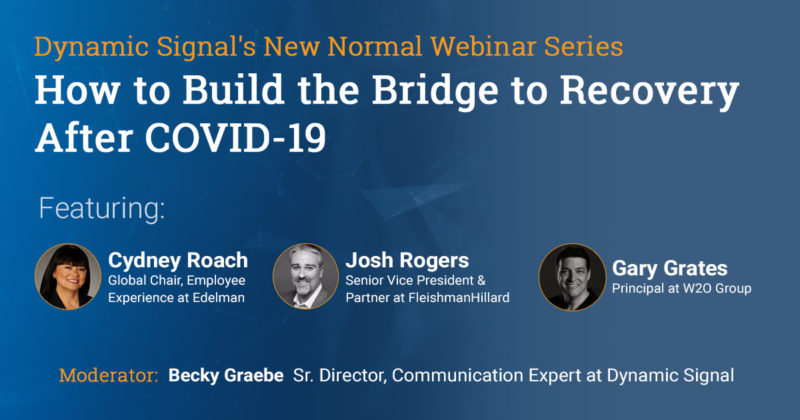
Join Becky Graebe, a communication expert from Dynamic Signal, as she sits down with leaders from some of the world’s top PR agencies for a conversation around how companies are preparing for the rebound of their businesses in the second half of 2020. The group will discuss stories from companies that are successfully preparing for their post-COVID-19 comeback, insights into deciding recovery priorities and strategies, and best practices for how to prepare your workforce for the transition back to “normal.”
FleishmanHillard’s Josh Rogers will participate in the webinar along with Cydney Roach of Edelman and Gary Grates of W2O.
Marjorie Benzkofer, chief strategy officer and global managing director of FleishmanHillard’s Reputation Management practice, will be discussing ‘return to work’ in this Coffee & Connect Session. The discussion will include what organizations should be thinking and communicating about as they embark on the path of recovery and resurgence. Emphasis will be on how to ensure the health and safety of an organization’s workforce, while at the same time strengthening the culture and employee engagement.
See what else is happening
You might also like
Expertise
The New Culture Gap Report: How Brands Stay Relevant for 100 Years
March 24, 2026
News
FleishmanHillard Named Among PRovoke Media’s Best Public Relations Agencies in the World
March 10, 2026
News
FleishmanHillard Integrates Porter Novelli to Form a Stronger, More Specialized Global Communications Consultancy
February 9, 2026
News
From Ragan: Elizabeth Cook on Rethinking Preparedness in Crisis Response
January 21, 2026
Global Executive Advisory
Insights From Davos: Building Credibility Through Storytelling
January 20, 2026
News
FleishmanHillard Unveils ‘License to Lead’ Research, Revealing a Growing Confidence Gap Between Executives and Stakeholders
January 13, 2026
News
FleishmanHillard Wins 2026 Innovation Awards for Data-Driven Strategy
January 12, 2026
Expertise
When the World Gets Noisy, Great Storytelling Breaks Through
December 3, 2025
News
Ellie Tuck Appointed Chief Creative Officer of the Americas
Difficult Realities Related to Antibody Testing as a Tool in COVID-19 Recovery
May 6, 2020
By Mark Senak
Share
In the 1980s as the AIDS epidemic took root in America, there was no test for Human Immunodeficiency Virus (HIV), the cause of Acquired Immune Deficiency Syndrome (AIDS). Rather, once developed, the HIV-antibody test was used as a surrogate marker to identify the infected. Particularly before there was a treatment, an antibody test became a marker for discrimination, resulting in lawsuits. As a disability, it became illegal to discriminate against a person with AIDS and an HIV-antibody test under most circumstances could not be compelled.
In the COVID-19 America of 2020, an antibody test – this time to assess exposure to Sars-COV-2 – is being contemplated as a tool in the toolbox of those planning return to work scenarios and the notion of “immunity passports” has been reported by the media to be under consideration by some policymakers in Europe and by some employers in the U.S. The notion raises legal, communications and public health implications that loom large.
What is the practical value of the test? One of the foremost considerations in using an antibody test is a practical one. What does a positive test result tell us? Whether or not the development of an antibody confers immunity on the part of the person tested is not clear. If there is immunity as a result, it does not tell us how long that immunity may last or whether all people who develop an antibody have an equal amount of protection or whether it depends on the level of the individual’s exposure.
What are the legal implications? Can an employer compel an employee to take a test as a pre-condition to coming to work? And is there a health privacy consideration, either at a federal or state level, at stake in freely identifying – or compelling those who test positive – to publicly identify their antibody status. Can an employee demand antibody tests of co-workers? Can access to a doctor’s office or daycare center be premised on antibody status? Can a person’s livelihood or access to services or other venues be put on the line based on an antibody test?
Is there a public health concern? Use of an antibody test as a “passport” to employment, to access to services, or to attend a theatre or sports event puts a premium on being antibody positive (the exact opposite of the HIV/AIDS days). Does this possibly mean that there will be people who purposely expose themselves to the virus in order to get their passport? It may sound farfetched. It isn’t.
Finally, there is the communications lift that is associated with explaining all the nuance associated with this. Use of the antibody test as a tool at first glance sounds easy and neat. It is hard and it is messy.
At this stage of the COVID-19 pandemic, there are two tectonic plates pushing up against one another. One represents the enormous pressure to return to some state of economic normalcy with the freer flow of commerce and return to work and school. The other is the innate desire for safety — for a minimization of risk not only to one’s own person, but as a society in containing and diminishing infection and mortality. The pressure on each plate is tremendous with much at stake. These plates are in sharp relief when it comes to envisioning a return to the workplace. In a rush to get back to some state of normalcy the issues raised by antibody testing as a means for allowing freer and safer movement cannot be ignored. It should not be rushed into without a thorough consideration to the outstanding questions and potential ramifications.
See what else is happening
You might also like
Expertise
Why Trust is the Real Competitive Advantage in Ag Tech
April 2, 2026
Expertise
Notes From the Road: RSA Conference 2026 Edition
April 1, 2026
Expertise
Why Your AI Rollout Is Stalling (And What Actually Moves the Needle)
March 25, 2026
Expertise
Get the Report: Inside China’s 2026 Two Sessions
March 24, 2026
Expertise
The New Culture Gap Report: How Brands Stay Relevant for 100 Years
March 24, 2026
Expertise
The Tech Industry’s License to Lead Problem: How Tech Companies Made Themselves Vulnerable to the AI and SaaS Apocalypse Doubt
March 4, 2026
Expertise
The Five Principles of Decision-Ready Intelligence: A Framework for Making Hard Calls in an AI-driven Environment
March 3, 2026
Expertise
The Patient Engagement Gap Your Competitors Are Closing
February 26, 2026
Expertise
AI is Reshaping Communications: Inside FleishmanHillard’s Enterprise-Wide Approach
Last year, small businesses employed nearly half of the United States’ workforce, driving job creation and economic growth. Under normal circumstances, we would celebrate the accomplishments of the small business community this National Small Business Week.
The coronavirus pandemic has upended those plans, with the Small Business Administration indefinitely postponing the annual commemoration. Meanwhile, small business owners are grappling with the increasing financial and emotional toll of the global health crisis, making now a critical time for companies with a small business customer audience to support them.
FleishmanHillard’s COVID-19 study found that 88% of respondents said that local businesses play a role in responding to the crisis. Larger brands that cater to entrepreneurs are in a unique position to help small businesses do just this.
Over the years, our work with clients with a small business focus has taught us the value of communicating with these special customers. Here’s what we’ve learned:
Be empathetic. Creating and maintaining a small business was always hard work, but today’s pressures are causing new challenges and struggles. Express empathy in your communications, acknowledging the situation while reaffirming your commitment to support them.
Give advice. Small businesses are looking to various sources to figure out how to stay afloat. Use your branded or owned content to give guidance and help build your own reputation among the small business community.
Celebrate entrepreneurship. Find unique ways to recognize entrepreneurs for their ingenuity and hard work. From a campaign encouraging individuals to patronize local shops to a nationwide contest investing in start-ups, brands have put the spotlight on small businesses with success in the past. It’s always inspiring to see the enduring spirit of entrepreneurship.
These tips go beyond the current situation. During the recovery and resurgence phase, small businesses will be key to bringing the economy to life once again. Establishing yourself as a thought leader and supporter of small businesses now builds trust in the future. Create goodwill now; be rewarded later.
See what else is happening
You might also like
Expertise
Why Trust is the Real Competitive Advantage in Ag Tech
April 2, 2026
Expertise
Notes From the Road: RSA Conference 2026 Edition
April 1, 2026
Expertise
Why Your AI Rollout Is Stalling (And What Actually Moves the Needle)
March 25, 2026
Expertise
Get the Report: Inside China’s 2026 Two Sessions
March 24, 2026
Expertise
The New Culture Gap Report: How Brands Stay Relevant for 100 Years
March 24, 2026
Expertise
The Tech Industry’s License to Lead Problem: How Tech Companies Made Themselves Vulnerable to the AI and SaaS Apocalypse Doubt
March 4, 2026
Expertise
The Five Principles of Decision-Ready Intelligence: A Framework for Making Hard Calls in an AI-driven Environment
March 3, 2026
Expertise
The Patient Engagement Gap Your Competitors Are Closing
February 26, 2026
Expertise
AI is Reshaping Communications: Inside FleishmanHillard’s Enterprise-Wide Approach
The Price of Screen Presence: Will Working from Home Impact Diversity and Inclusion in the Workplace?
By Caitlin Teahan and Andre Russell
Share
Amidst a situation like the one our world is in, it’s human nature to turn inward and focus on basic needs. But there’s a balance that must be found between “survival mode” and normalcy. Today’s businesses know this all too well. As they shift and restructure to continue serving customers and employees, they face a similar struggle in trying to determine which business components will take a back seat, and which ones will remain a focus.
For many companies, one of the components in question is diversity and inclusion (D&I). Can it continue to thrive as we modify and adapt to this new work-from-home model? Can strong ethical and diverse workforces and solutions exist in a world where we are judged by our screen presence? Or will that judgment place many at a disadvantage? What considerations should be made to ensure work is still being done to advance D&I initiatives? These questions capture real problems that have the potential to inhibit today’s corporate culture that, until now, has been the arena for propelling D&I forward. Key decision-makers, leadership teams and individuals must decide if they will implement inclusion or allow it to falter as a byproduct of being categorized as a non-essential business function.
Recognizing the Problem and Becoming the Solution
At FleishmanHillard, we are continuing to invest in D&I initiatives as we work to not just maintain but thrive in a time of uncertainty. Our industry and agency are one of the few that could transition to a virtual workplace with relative ease. However, economic circumstance and inequality have become more apparent than ever. With video conferences as the preferred — and often necessary — communication method, things like internet speed, home décor and living situation are now out in the open and exposed to teammates and clients. This approach to work has the potential to increase intimacy in a way that may not be welcome or that could affect perception of peers in the workplace. Thankfully FleishmanHillard remains committed to leveling the playing field with professionalism and discretion. By offering various work-from-home resources and flexible work hours based on personal caregiving needs, our agency continues to place D&I at the forefront and emphasize our people-first approach.
Maintaining Normalcy Through D&I
Existing opportunities to share and engage peers on topics and through cultural events have continued after our shift to a virtual world. Sitting in the New York office, I can say that many of the initiatives that were built into our work community are alive and well — things like panels to discuss key movements and moments in time (e.g., women and the workplace for Women’s History Month), collaborative playlists that celebrate genres and their origins, movie nights with poignant undertones, book clubs followed by robust discussion, at-home cooking demos laden with cultural context and more! The results of these programs have enriched employee experiences through improved morale, better insights into client work and a stronger sense of collaboration. But the benefits don’t end there — many studies have consistently shown the impact that D&I has on the workforce. Which is one more reason to make D&I a priority within our “new normal.”
Making the Commitment to D&I
In a world where people are in need of personal connections, looking to be inspired and longing to share their passions and experiences, it seems D&I is now more important than ever. The choice to foster it is yours. Will you continue to be an advocate in a time that has revealed new biases? Will you be an example of understanding and support? Will you encourage inclusion amongst your peers?
At FleishmanHillard, our answer is yes. Because D&I is woven into the fabric of who we are. And as Ephraim Cohen, general manager of FleishmanHillard in New York, expressed, “FleishmanHillard has always been a place of welcoming, understanding and acceptance. It is a part of our culture and our people live and breathe it. It is why D&I hasn’t fallen by the wayside. These are important experiences that are a part of us personally and professionally. We will not allow our stance on D&I to be diminished as we navigate this new landscape.”
We will continue to enable these discussions and serve as an example for the workplace of the future where we are all welcome and equal. Please feel free to comment, share or contact us directly on Instagram at @FHNewYork. We’d love to hear from you!
See what else is happening
You might also like
Expertise
Why Trust is the Real Competitive Advantage in Ag Tech
April 2, 2026
Expertise
Notes From the Road: RSA Conference 2026 Edition
April 1, 2026
Expertise
Why Your AI Rollout Is Stalling (And What Actually Moves the Needle)
March 25, 2026
Expertise
Get the Report: Inside China’s 2026 Two Sessions
March 24, 2026
Expertise
The New Culture Gap Report: How Brands Stay Relevant for 100 Years
March 24, 2026
Expertise
The Tech Industry’s License to Lead Problem: How Tech Companies Made Themselves Vulnerable to the AI and SaaS Apocalypse Doubt
March 4, 2026
Expertise
The Five Principles of Decision-Ready Intelligence: A Framework for Making Hard Calls in an AI-driven Environment
March 3, 2026
Expertise
The Patient Engagement Gap Your Competitors Are Closing
February 26, 2026
Expertise
AI is Reshaping Communications: Inside FleishmanHillard’s Enterprise-Wide Approach
As the impact of the COVID-19 pandemic continues to be felt around the world, many countries are beginning to focus on how to resume everyday life. FleishmanHillard’s TRUE Global Intelligence’s recent study, COVID-19 Mindset: How Pandemic Times Are Shaping Global Consumers, found that consumer behaviors will likely be forever changed due to the crisis and that attitudes toward reopening differ around the globe.
China, one of the first countries to be impacted by the virus, mandated a stay-at-home order beginning in mid-January. With that order recently lifted, we’ve started to see signs of how consumers are returning to what will be the “new normal.” I wanted to share a glimpse of what we’re seeing here in China, including the impact on the food, agriculture and beverage industry.
In-person restaurant dining is returning.
During lockdown, all restaurants in China closed dine-in options and of those that could serve take-out, many were unable to operate as they depended on workers from outside the city who weren’t allowed to travel to work. Now restaurants are experiencing a strong recovery, with workforces coming back and people being allowed to eat in. While social distancing is not enforced in China currently, wearing masks while in crowded places and public transportation is still mandatory.
Grocery store e-commerce platforms are imperative.
While panic shopping for essentials was rampant during lockdown, Chinese grocery stores have robust e-commerce platforms in place, which helped mitigate crowds. Today grocery stores are returning to normal, with shoppers wearing masks for protection. Bloomberg reported that MissFresh saw a quadrupling in online orders for groceries during the first five days of the Lunar New Year compared with the same period last year. And JD.com Inc. said its sales of fresh food increased by 215%, reaching almost 15,000 tons during the 10-day period ending February 2, compared with the same period last year. While Chinese online grocery volume has increased to RMB 300 billion, the offline retail market is still 10 times larger, so there is plenty of room to grow sustainably.
Gatherings are beginning to take place again, but people are still cautious.
Once stay-at-home orders were gradually lifted in China from province to province, we saw many people starting to gather in larger groups, especially families. Hotel bookings are picking up again, as well as larger scale events such as weddings. However, we aren’t seeing mass gatherings on the same scale as before. People are still cautious – especially around others they aren’t familiar with.
Health is a stronger consideration at purchase.
Due to the pandemic, we’ve seen more consumers in China selecting higher quality and healthier products when making purchasing decisions to prioritize their safety. Endorsed by the public health experts, high-protein food consumption has increased a lot. Home cooking has become a must, especially during the traditional Chinese Spring Festival, and whole lunar new year month, and cooking recipe videos have overwhelmed social media channels. Picnics and camping have become another trend as people take advantage of the warm weather and long weekend holiday, encouraged by their local government.
As we enter the new normal of everyday life in China (and around the world), trends we already saw shaping the food, agriculture and beverage industry will continue to be expedited, such as e-commerce.
Coupled with long-lasting financial and health concerns, in-person shopping and dining experiences will likely be forever changed. However, the resiliency of Chinese consumers can already be seen, accompanied with an urge to return to tradition, community and togetherness. Businesses across the industry will need to continue to be agile and adapt to changing consumer behavior in order to survive – and thrive.
See what else is happening
You might also like
Expertise
Why Trust is the Real Competitive Advantage in Ag Tech
April 2, 2026
Expertise
Notes From the Road: RSA Conference 2026 Edition
April 1, 2026
Expertise
Why Your AI Rollout Is Stalling (And What Actually Moves the Needle)
March 25, 2026
Expertise
Get the Report: Inside China’s 2026 Two Sessions
March 24, 2026
Expertise
The New Culture Gap Report: How Brands Stay Relevant for 100 Years
March 24, 2026
Expertise
The Tech Industry’s License to Lead Problem: How Tech Companies Made Themselves Vulnerable to the AI and SaaS Apocalypse Doubt
March 4, 2026
Expertise
The Five Principles of Decision-Ready Intelligence: A Framework for Making Hard Calls in an AI-driven Environment
March 3, 2026
Expertise
The Patient Engagement Gap Your Competitors Are Closing
February 26, 2026
Expertise
AI is Reshaping Communications: Inside FleishmanHillard’s Enterprise-Wide Approach
The Transition to Recovery and Rebuilding: Consumer Trends and Policy Implications Provide Hope for the Hospitality Industry
By Michael Moroney
Share
While the social and economic damage caused by the COVID-19 pandemic has left no business untouched, few sectors of the economy have been as visibly ravaged as the hospitality industry. Based on the nature of on-premise food and drink establishments – places to gather with friends, receive personal service and meet new people – the industry finds itself particularly hard-hit by state and local shutdown orders. The path forward will be challenging, but there are glimmers of hope as consumers begin imagining the world after stay-at-home orders are lifted.
FleishmanHillard‘s TRUE Global Intelligence practice recently released a study detailing how the pandemic is reshaping consumer perceptions, expectations and behavior. In the United States, more than 54% of consumers were willing to order food and products for delivery or pick up in order to support businesses that have had to close, rather than reduce shopping or dining, and 31% were willing to tip more than usual.
As the restaurant industry looks toward recovery, it will be important to keep in mind new consumer expectations for employee protections and how quickly laid-off staff can be rehired. Overall, 91% of consumers expect companies to take various steps to help workers stay healthy – providing personal protective equipment and hand sanitizer, breaks to wash hands and making physical changes to space and operations to allow social distancing. And 40% of consumers think it’s important that companies hire back any workers they lay off as soon as the crisis is over.
Furthermore, consumers’ expectations for the on-premise dining experience have changed. According to new data from Nielsen CGA, the top things consumers want to see in venues when they reopen include:
50%: fewer tables or patrons within venues to accommodate social distancing
49%: additional hygiene programs taking place in outlets
41%: take out/ delivery offerings still being available
Encouragingly, consumers seem eager to return to on-premise establishments. In fact, 22% plan to return as soon as venues reopen, and 28% say they will return when bars and restaurants demonstrate they can facilitate distancing. Only 23% are waiting until the number of COVID-19 cases doesn’t start to increase again. While 19% of consumers said they would only return when COVID-19 is completely gone, the vast majority are willing to return in the early stages of recovery.
However, from a business and policy perspective, there are a couple evolving proposals that should be top of mind for the hospitality industry:
Liability protections: Senate Majority Leader Mitch McConnell is pushing for business liability protections, which he sees as crucial to protect employers who reopen during the crisis. Democratic leaders have voiced concerns that such protections for businesses could lead to less safe conditions for workers.
Tax Deductibility: The administration has floated the possibility of restoring meal and entertainment cost deductibility for corporations. The industry has long enjoyed this boost, but the policy was changed with the signing of the Tax Cuts and Jobs Act of 2017.
The onset of COVID-19 changed how every business operates, overnight, and brought with it a flurry of policy changes. However, as we begin to emerge from this crisis, it’s important to think beyond the immediate recovery. It’s important to ask:
How will company policies and legislation implemented during the next five months impact your business over the next five years?
Are you actively and visibly prioritizing consumer and employee safety over profits?
Are you communicating how your business decisions are directly benefiting your employees?
Do you have a return-to-work plan, and if so, are you willing to share it publicly to reassure consumers?
If you work in a hospitality-adjacent industry, what are you doing to help restaurants and bars recover and rebuild?
The economic and policy solutions implemented during the recovery and rebuilding period will carry long-term implications that will shape the trajectory of the hospitality industry for decades to come, and how businesses treat their employees and customers during this period will have long-lasting reputational ramifications.
See what else is happening
You might also like
Expertise
Why Trust is the Real Competitive Advantage in Ag Tech
April 2, 2026
Expertise
Notes From the Road: RSA Conference 2026 Edition
April 1, 2026
Expertise
Why Your AI Rollout Is Stalling (And What Actually Moves the Needle)
March 25, 2026
Expertise
Get the Report: Inside China’s 2026 Two Sessions
March 24, 2026
Expertise
The New Culture Gap Report: How Brands Stay Relevant for 100 Years
March 24, 2026
Expertise
The Tech Industry’s License to Lead Problem: How Tech Companies Made Themselves Vulnerable to the AI and SaaS Apocalypse Doubt
March 4, 2026
Expertise
The Five Principles of Decision-Ready Intelligence: A Framework for Making Hard Calls in an AI-driven Environment
March 3, 2026
Expertise
The Patient Engagement Gap Your Competitors Are Closing
February 26, 2026
Expertise
AI is Reshaping Communications: Inside FleishmanHillard’s Enterprise-Wide Approach
COVID-19 Is a Game-Changer for the PR Industry as Rapidly Shifting Landscape Presents New Opportunities
May 4, 2020
By Padraic Convery
Share
Rumors of the death of news have been greatly exaggerated. Really? Following a week in which two of Asia’s highest-profile finance sector magazines were effectively shut down, and many other publications announced furloughs, pay cuts and layoffs?
Print newspapers and magazines have been reinventing themselves for the better part of two decades against an ever-growing onslaught of digital alternatives. That’s nothing new, as those of us who once made a living from the journalism profession are all too aware. But the shrinkage and shuttering of media outlets whose presence is primarily online marks the crossing of a Rubicon: It’s not only print media that’s feeling the squeeze, but digital media, too.
Does this mean an earned coverage boon for public relations professionals? Hardly. From where I sit in Hong Kong, it’s difficult to get an adulatory corporate interview or a client puff piece published in any media outlet whose editorial budget is at breaking point or bust altogether.
Content vs. coronavirus
But one interesting effect of the COVID-19 pandemic that shouldn’t be overlooked is the fact that even though media outlets are struggling financially – online as well as in print – consumption of media content overall is on the rise.
This shouldn’t come as much of a surprise, really: social distancing, lockdowns and the closure of entertainment venues means people are stuck at home with little but each other – and the devices through which they consume media content – for company.
The mainstream media has not disappeared – nor will it – but its ongoing and increasing displacement by media outlets that do not rely primarily on advertisers that take flight at falling circulation figures, media that in fact thrive on such terrible events as pandemics, which keep consumers glued to their mobile devices, presents PR professionals with a clear sign of where they should be focusing their attention: mobile-friendly media in general, and social media in particular.
New norms, tighter targets
These changes are likely to persist even after the current pandemic abates. And the media developments to which they have given rise should show PR firms that it is no longer sufficient to unload in the same old way on the reporters upon whom they have traditionally relied.
PR pitches will need to be more targeted, as the pool of mainstream media attention becomes harder to attract, the bar for coverage is set higher, and exclusive stories become ever-more critical as the means by which such media outlets seek to differentiate themselves from the cacophony of voices in the social media sphere.
For these pillars of the traditional media landscape, getting the right news angle into PR pitches will mean everything. And, increasingly, so too will it for the unstoppably expanding universe of social media as its users become every bit discerning as the print and mainstream media consumers upon whom the industry once relied upon to support its business model.
Reaching reporters
The tools PR practitioners use to reach journalists will also require rethinking. Traditional press releases and interviews could usefully be augmented by blogs and short briefs sent to reporters, likely more often, so the drumbeat of reportable news is ever-present.
Opportunity knocks
And PR professionals’ quest for paid, earned, shared and owned media should exclude no opportunity without a compelling reason to do so.
The transformation we are witnessing in the media environment in which we operate may appear intimidating, but it presents the PR industry with opportunities entirely of its own. Change always includes an element of fear; success entails responding to fear with faith in new ways of conquering the challenges change presents.
See what else is happening
You might also like
Expertise
Why Trust is the Real Competitive Advantage in Ag Tech
April 2, 2026
Expertise
Notes From the Road: RSA Conference 2026 Edition
April 1, 2026
Expertise
Why Your AI Rollout Is Stalling (And What Actually Moves the Needle)
March 25, 2026
Expertise
Get the Report: Inside China’s 2026 Two Sessions
March 24, 2026
Expertise
The New Culture Gap Report: How Brands Stay Relevant for 100 Years
March 24, 2026
Expertise
The Tech Industry’s License to Lead Problem: How Tech Companies Made Themselves Vulnerable to the AI and SaaS Apocalypse Doubt
March 4, 2026
Expertise
The Five Principles of Decision-Ready Intelligence: A Framework for Making Hard Calls in an AI-driven Environment
March 3, 2026
Expertise
The Patient Engagement Gap Your Competitors Are Closing
February 26, 2026
Expertise
AI is Reshaping Communications: Inside FleishmanHillard’s Enterprise-Wide Approach
Double Down on CSR: Not Despite the Pandemic, but Because of It
April 30, 2020
By Bob Axelrod
Share
Two key insights from our company’s new research report, COVID-19 Mindset, underscore a belief many of us already share: What your company does today will have an indelible impact on its reputation moving forward. In light of that, it’s amazing that consumers in all six countries feel employers play just as big of a role as governments in fighting the coronavirus. But, how do they rate companies for the job they’re doing? At rock bottom.
The pandemic that has wreaked havoc on so many people is also the most significant corporate responsibility challenge to arise in generations. It has pushed to the forefront the deep linkages between companies and their many stakeholders. A likely outcome of this is heightened scrutiny of corporations’ role in society – from the way they treat people and care for our planet to the corporate governance of their businesses. In other words, they’ll increasingly be judged by their CSR/ESG* performance.
The pandemic has also led to the worst economic downturn since the 2007-2009 recession, putting nonessential expenditures on the chopping block. But companies that recognize the value CSR/ESG creates are driving their programs and reports forward, not in spite of the pandemic but because of it. (There’s precedent for that. In the wake of the Great Recession, nonfinancial reporting grew to all-time highs.) Expectations from your most important stakeholders have never been greater and will only continue to rise. Here’s a look at three of them.
INVESTORS
ESG funds and equities fared better than standard investments in the recent coronavirus-induced stock market sell-off. That’s prompting the world’s largest investors to highlight the value of sustainable portfolios and the wisdom of switching some traditional assets to sustainable ones.
The ESG rating and ranking organizations continue to comb through reports, websites and other sources for the data that fuel their various surveys of companies’ CSR/ESG performance. If what they’re looking for isn’t publicly available, your company’s scores can suffer. What’s more, some raters recently announced they’ll be tracking corporate responses to the pandemic.
EMPLOYEES
The most pronounced findings of our COVID-19 Mindset study focus on concern for and by employees. An overwhelming majority reported that the pandemic has changed how they view essential workers and their needs. One in every four surveyed said the way companies act during the pandemic will influence their loyalty to employers and future employment decisions. When you add to that an abundance of research that shows a positive connection between CSR and employee engagement, the message is loud and clear: The need to document your commitment to workers has never been more urgent. In these times, delaying or canceling your CSR/ESG report sends the absolute wrong message to employees looking for reassurance, continuity and recognition that their work matters.
CUSTOMERS
More than 80% of companies report their commitments to responsible procurement have increased over the past three years, with the main benefit being risk mitigation. The International Organization for Standardization (ISO) further raised the bar in 2017 when it released its first standard on sustainable procurement.
COVID-19 has exposed how vulnerable global value chains can be. Weeks before the virus was declared a pandemic by the World Health Organization, three-quarters of large U.S. companies had already seen disruptions to their supply chains. Clearly, as we emerge from this crisis businesses will pay even more attention to how they source products and services. In fact, more than half of U.S. CFOs are already planning changes to make their supply chains more resilient. While much of that review and planning will focus on capacity, finances and physical location, the additional scrutiny supply chains will receive is all the more reason to make sure your company continues to have a strong CSR/ESG story to tell.
COVID-19 may not pose quite the existential threat that is climate change. But it challenges companies just as much to prove to all their stakeholders that they are moving forward in a purposeful and responsible way. Robust and timely CSR/ESG reporting is an important part of meeting that challenge.
*For purposes of this post, we are using the terms Corporate Social Responsibility (CSR) and Environmental, Social, Governance (ESG) interchangeably to encompass the broad range of considerations involved in creating value for all stakeholders.
See what else is happening
You might also like
Expertise
Why Trust is the Real Competitive Advantage in Ag Tech
April 2, 2026
Expertise
Notes From the Road: RSA Conference 2026 Edition
April 1, 2026
Expertise
Why Your AI Rollout Is Stalling (And What Actually Moves the Needle)
March 25, 2026
Expertise
Get the Report: Inside China’s 2026 Two Sessions
March 24, 2026
Expertise
The New Culture Gap Report: How Brands Stay Relevant for 100 Years
March 24, 2026
Expertise
The Tech Industry’s License to Lead Problem: How Tech Companies Made Themselves Vulnerable to the AI and SaaS Apocalypse Doubt
March 4, 2026
Expertise
The Five Principles of Decision-Ready Intelligence: A Framework for Making Hard Calls in an AI-driven Environment
March 3, 2026
Expertise
The Patient Engagement Gap Your Competitors Are Closing
February 26, 2026
Expertise
AI is Reshaping Communications: Inside FleishmanHillard’s Enterprise-Wide Approach