Employee Login

Enter your login information to access the intranet

Enter your credentials to access your email

Reset employee password

Article

Sustaining AI Adoption on Your Team: Moving from Launch to Long-Haul Momentum 
December 19, 2025
By Zack Kavanaugh

Your organization launched the tools. Ran the trainings. Clarified the policies. Maybe even branded your AI initiative to rally employees and excite stakeholders.  

Now what? 

Three Brutal Truths About AI Adoption 

  1. For many organizations, AI remains more of a talking point than a true driver of change in daily work, employee experience or customer service. 
  1. With a thoughtful, risk-aware approach, adoption may not be straightforward or fast
  1. Employees will always be at different stages – some experimenting, some integrating AI into workflows, some skeptical or uncertain, and many shifting between these states as priorities and information evolve. 

Your Role as a Leader 

That’s where leaders – C-suite members, team leads and managers alike – come in. With AI adoption – a business transformation that carries emotional baggage, operational challenges and even existential questions – leaders have a responsibility to guide their people through the hype and toward something practical that drives business value. 

What You Should Get from This Article 

This piece closes out our 2025 series on AI adoption. The first article mapped out readiness across culture, leadership, knowledge and infrastructure. The second examined why adoption stalls, unpacking hesitations at the enterprise, team and individual levels. The third highlighted risks when communication and leadership lag behind technology. 

Those pieces focused on the big picture and the organizational must-haves. This one assumes those foundations are in place. It gets more tactical – outlining what leaders can do with their teams to move from launch to long-haul momentum. 

Ultimately, sustaining adoption comes down to three things: reinforcement, relevance and reflection. 

1. Reinforcement: Make AI Part of Everyday Routines 

After rollout, leaders must embed AI into daily routines, not treat it as a one-off initiative.  

Practical ways leaders can reinforce AI: 

  • Build in five minutes during team meetings for questions, concerns and hesitations related to AI use. Consider launching a dedicated channel, email thread or chat on your company’s collaboration platform so team members can share resources and ideas in real time. Funnel what you hear to the cross-functional team responsible for driving adoption. 
  • Identify and empower an AI champion – ideally, someone curious, willing to advocate and experiment, and who is influential on the team. Position this role as a professional development opportunity.  
  • Integrate AI into performance conversations and onboarding so it’s part of every team member’s role, not an optional add-on. Encourage people to rethink their work – and how that work gets done – in ways that push your team’s objectives forward. 

If reinforcement isn’t visible in everyday conversations, adoption will stall. Leaders should pay attention to whether AI is being treated as optional – and redirect if it’s not yet treated as an expectation. 

2. Relevance: Tie AI Directly to the Work People Do 

Adoption won’t stick if AI feels abstract or disconnected. It has to feel useful in the context of actual work. 

Practical ways leaders can make AI relevant: 

  • Share your own AI examples regularly – where it saved time, where it added value and, equally importantly, where it didn’t and why. Use existing channels – chat, email, 1:1s with direct reports and team meetings – to socialize your learnings. 
  • Engage the team in solving challenges and capitalizing on opportunities together. For example, run bi-weekly brainstorming sessions where team members bring problems and explore whether AI can help address them. 
  • Recognize small wins so adoption feels attainable – and do the same with failures so the team can learn from what didn’t work. Spotlight and reward team members who solve customer challenges, improve processes or identify new use cases. 

Relevance ensures employees see AI as a tool for them – not just for the company. Leaders should surface challenges, encourage collaboration and keep examples concrete and tied to team goals. 

3. Reflection: Measure What Actually Matters 

Tracking logins shows activity – but not necessarily maturity. Leaders need to move beyond superficial usage metrics and measure whether adoption is building confidence, capability and alignment with business objectives. 

Practical ways leaders can reflect on adoption: 

  • Run short (potentially anonymous) monthly pulse surveys with two or three questions that gauge clarity of your company’s AI strategy, how it connects to employees’ work, and confidence in using the tools to solve business problems. Include at least one open-ended question for crowd-sourced ideas and opportunities. 
  • Work with your AI champion to surface issues employees may hesitate to raise directly with you. Encourage them to set weekly office hours or meet 1:1 with team members to collect insights, and report back to you. 
  • Check often whether AI efforts are aligned with team objectives. If your priority is expanding your customer base, do you have the use cases to support it – or are you drifting into experimentation that doesn’t advance your goals? Consider setting time with your AI champion each month to reflect on whether you’re driving the value you set out to. 

Reflection helps separate meaningful progress from surface activity. Pairing usage data with comprehension metrics gives leaders a sharper view of where adoption stands and where support is most needed. 

The Final Test: Is Your Team Living It? 

At the start of this series, we asked what readiness looked like at the organizational level. Now the question is more immediate: Is your team living it? 

Use this scorecard to check your progress: 
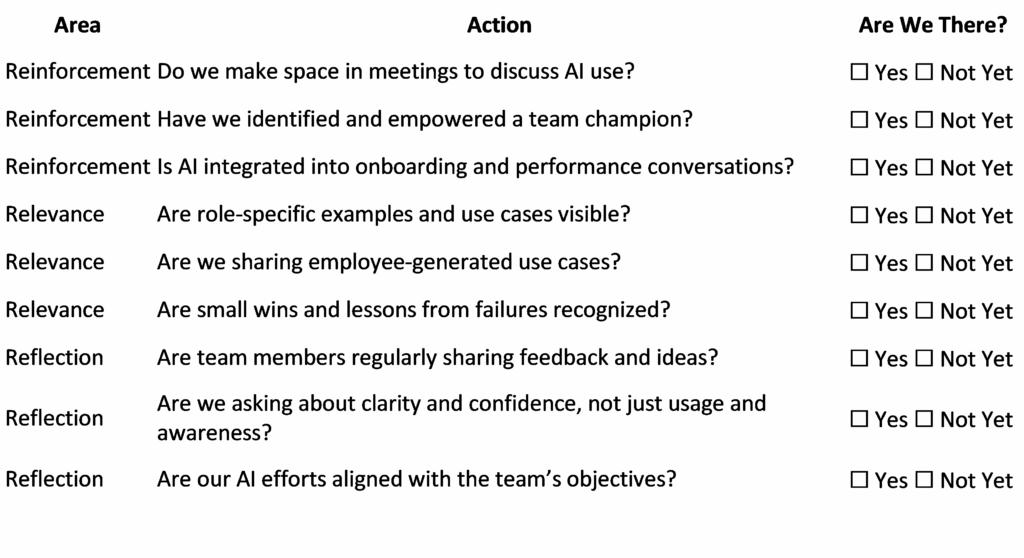
This isn’t a one-time exercise. Revisit it monthly – and at a minimum, quarterly. Consider having your AI champion fill it out too, to guard against blind spots.

The Bottom Line

The biggest challenge of AI transformation in 2026 isn’t speed – it’s staying power. The organizations and teams that succeed will be the ones that take the actions above now and treat adoption as an ongoing process, not a one-time push.


Article

Augmented Judgment, Accelerated Execution: AI’s Role in Crisis, Issues and Risk Management

October 14, 2025
By Matt Rose and Alexander Lyall

Everyone’s talking about the promise of artificial intelligence. For crisis, issues and risk managers, that promise isn’t theoretical anymore. It’s already changing the game. The speed, scale and complexity of today’s challenges demand more than human effort alone. We need tools that sharpen judgment, spot risks sooner, simulate outcomes and move faster than we ever could on our own.

At FleishmanHillard, we call this Augmented Judgment, Accelerated Execution. It’s the balance of seasoned, human counsel with the foresight, scale and speed of AI. When used well, AI doesn’t replace human judgment, it strengthens it. AI compresses timelines, expands context, flags risks earlier and gives leaders the clarity they need under pressure.

Here’s how we’re putting this advantage into practice at FleishmanHillard, using trusted frameworks and strong data governance to help clients address crises, issues and risk with confidence.

AI for Early Warning

AI is becoming an essential early warning system. It examines global news, regulatory updates, and social activity to detect emerging topics and weak signals before they escalate. By analyzing conversations across markets, languages, and, it connects jurisdictions patterns that siloed teams might miss, with speed and breadth that today’s lean human teams cannot match.

It can also track how issues are likely to evolve and flag pressure points like upcoming regulations, activist campaigns, or viral moments. In addition, it can be pointed to anticipate when separate concerns may converge, adding complexity to timing, messaging, audience response and stakeholder engagement. This kind of foresight helps leaders act early, communicate clearly and stay ahead before critical moments hit.

AI for Stakeholder Simulation

Spotting a potential issue is one thing. Understanding how different audiences might respond is the next. Employees may question values. Regulators may focus on compliance. Investors may worry about financial impact. Customers may be concerned about reliability.

AI helps make this analysis possible through FleishmanHillard’s SAGE Synthetic Audiences. These simulations, built on polling data, demographics, and behavioral insights, let teams pressure-test messaging in real time.

AI can also model how a story might spread. Coverage could draw regulatory attention, spark activism, or open the door for competitors. With this foresight, teams can weigh options early, decide how to respond, and plan outreach in the right order.

AI for Story Forecasting

Reporters rarely work in isolation. Their previous stories, tone, and interview style often foreshadow how a new piece might unfold. AI can analyze this public data to forecast likely narratives, giving teams time to scenario-plan and prepare fact-based responses.

In one recent case, the FleishmanHillard team leveraged AI to generate a full-length draft of a potential investigative article based on a reporter’s in-depth inquiry, their past work, and facts they were likely to uncover. The projection closely matched the final story, serving as a clear model for the client and FH counselors to work against and affording weeks to prepare. Together, they aligned messaging, cleared responses and rehearsed scenarios. When the article ran, the team responded with focus and confidence, avoiding both unwanted attention and business disruption.

Click Above for More From the FleishmanHillard Crisis Team

AI for Crisis Content Management

Crisis response is rarely just one statement. It quickly becomes a growing stack of analytics and materials: standby statements, employee letters, investor scripts, customer updates, government briefings, media talking points, FAQs and social posts. Managing it all can become chaotic, especially with lengthy approval chains.

AI tools like FH Crisis Navigator help bring order. Acting as a virtual program manager, it adapts approved language for different audiences with speed and consistency. Using this tool, a crisis counselor can generate drafts, maintain version control, and keep updates aligned across every document. This reduces drift, speeds up approvals, embeds expert counsel, and keeps teams focused. So, when leadership needs to respond – whether to investors, regulators, customers, or the public – everything is already in place and ready for review.

AI for Scenario-Based Training

Preparation has always been essential to crisis readiness. But traditional tabletop exercises often fall short of real-world complexity. AI-powered platforms like the FleishmanHillard Crisis Simulation Lab raise the bar. Run by experienced facilitators, these simulations evolve in real time based on participant decisions. They introduce realistic challenges like media calls, stakeholder emails and viral posts, all tailored to the organization’s sector and geography.

Simulations can launch in hours instead of weeks, making them useful for both training and real-time strategy support. Structured feedback focuses on fact management, stakeholder engagement, and adaptability – building the muscle memory teams need when reputations are on the line.

AI for Campaign Risk Screening

Crises don’t always come from the outside. Sometimes a product launch, influencer partnership, or purpose-driven campaign can spark backlash, trigger scrutiny, or misfire in a volatile moment.

FH Risk Radar helps teams assess these risks before campaigns go live. It reviews concepts against regulatory guidance, cultural signals, public sentiment, and platform-specific challenges. The system scores ideas across dimensions like reputational exposure, influencer fit, message durability, and cultural sensitivity. Instead of a simple go-or-no-go call, teams get a full risk profile and clear mitigation strategies. This shifts review from a late-stage checkpoint to a strategic advantage.

From Promise to Practice

For communicators, risk leaders, and executives, AI is no longer a future promise. It’s a working tool, a strategic coach, and a force multiplier available to improve outcomes now. It surfaces early warning signs, simulates reactions, forecasts narratives, manages complex content, powers training, and screens campaigns. It delivers sharper, faster options for decision makers when every move counts.

AI’s role in crisis and risk management will only grow more sophisticated. But the message today is simple: the technology is here and can be applied to create immediate value. The leaders who use it will be better prepared to protect reputation in high-stakes moments.

At FleishmanHillard, we’re applying these tools every day to help clients anticipate challenges, navigate uncertainty, and emerge stronger. At the heart of it is Augmented Judgment, Accelerated Execution – the combination of trusted human counsel and the structured speed of AI. Together, they help organizations make better decisions, faster.

Crisis Team width=

Matt Rose (top) – Americas Lead for Crisis, Issues & Risk Management: Matt is an SVP & Senior Partner in New York with more than 30 years’ experience in advising organizations on crisis and issues management, risk mitigation, and reputation recovery. He has guided companies through reputational crises, labor issues, regulatory challenges, ESG controversies, and high-profile litigation.
Alex Lyall – Lead, Risk Management, AI & Innovation: Alex is an SVP & Partner in New York with more than 15 years of experience in crisis communications, issues management, preparedness, and risk management, working across industries. As part of the leadership team, Alex will help define best practices, shape go-to-market strategies, and scales solutions, with a focus on AI integration and talent development.
 

FH Guidelines for AI in Crisis, Issues, and Risk Management Applications

At FleishmanHillard, we apply artificial intelligence with purpose, not hype. In crisis, issues, and risk management, that means combining human expertise and experience with proven frameworks, proprietary technology, necessary confidentiality, and responsible guardrails to help organizations respond with speed, confidence, and control.
During a crisis, there is no substitute for seasoned judgment. AI can surface information, suggest language, or model scenarios, but it cannot navigate the nuance of legal implications, stakeholder dynamics, or reputational risk in real time. That takes seasoned counselors who have sat in the room, weighed the tradeoffs, and led under pressure. When the stakes are high, experience is not just helpful, it is essential.
That is why each FleishmanHillard application of AI in the Crisis, Issues and Risk Management Practice is anchored in three principles:
  • Experienced crisis counselors remain at the center of each use case, ensuring that technology enhances but never replaces human judgment.
  • Our systems are designed in secure, quality-assured environments that safeguard client information and uphold rigorous ethical standards.
  • AI is embedded within tested frameworks and workflows, allowing teams to move faster without sacrificing accuracy, accountability, or trust.
This disciplined approach ensures AI strengthens decision-making rather than creating new risks. With FleishmanHillard, organizations embrace innovation in crisis, issues, and risk management with confidence, knowing that innovation never comes at the expense of accuracy, ethics, or trust.


Article

5 AI Risks Every Company Should Be Aware of – and What to Do about Them 

September 24, 2025
By Zack Kavanaugh

AI is accelerating, but its promise is falling behind.  

The tools are multiplying, but only 1% of organizations consider their AI efforts “mature” – and 95% of generative AI pilots are failing.  

Why? Because transformation is a people challenge, not just a tech race. 

This piece surfaces five often-overlooked risks that quietly stall progress – each one rooted not in code, but in communication. Breakdowns in clarity, coordination and leadership commitment continue to limit adoption and erode trust. 

And yet, these are exactly the areas where strategic communication plays a pivotal role – helping organizations course-correct, contain risk and unlock the value AI is meant to deliver. 

For leaders ready to close the gap, here’s where to focus next. 

1. The AI Narrative Isn’t Moving as Fast as Tech  

What’s happening: AI rollout is rolling out fast, but most employees remain unclear on what it means for their work. 

Why it matters: Multiple reports show that companies are investing in AI tools faster than they’re training teams or communicating the impact. The result? Employees feel left behind, unsure where they fit in or how to contribute. 

What to do: Communications should partner with L&D and AI enablement teams to build a clear, role-relevant narrative that connects AI to everyday work. That means going beyond the “what” and “why” to include practical, team-specific examples – and showing what good AI use actually looks like. Managers play a crucial role here and should be equipped to reinforce these messages in regular team settings. 

2. Shadow AI Is Outpacing Governance 

What’s happening: Employees are quietly using unapproved AI tools to stay productive – often because sanctioned options aren’t accessible, intuitive or well-communicated. 

Why it matters: Recent research shows that over half of employees using AI at work are doing so under the radar. Only 47% have received any training, 56% have made mistakes due to misuse and nearly half say they’ve gotten no guidance at all. That creates risk – for the business, the brand and the people trying to do the right thing without clear support. 

What to do: Communications should partner with IT, HR and Compliance to promote trusted tools, clarify what’s allowed and explain why governance matters. Use short, human-centered scenarios that help people understand tradeoffs and risks. Managers should be given clear guidance on how to check in with their teams and normalize asking, “What tools are you using and why?” 

3. People Assume AI Replaces Judgment – So They Stop Using Theirs 

What’s happening: Without the right framing and support, employees may treat AI output as the final answer – not a starting point for critical thinking, refinement or discussion. 

Why it matters: A recent MIT/Wharton study found that while AI boosts performance in creative tasks, workers reported feeling less engaged and motivated when switching back to tasks without it – suggesting that over-reliance on AI can dull ownership and reduce the sense of meaning in work. 

What to do: Communications and L&D teams should align around positioning AI as a co-pilot, not a decision-maker. Messaging should emphasize the value of human input – especially in work that shapes brand, strategy or outcomes that may pose ethical dilemmas. Training should encourage questions like: 

  • “Would I feel confident putting my name on this?” 
  • “Where does this need my voice, perspective or context?” 

By reinforcing the expectation that employees think with AI – not defer to it – organizations can strengthen decision quality, protect brand integrity and keep teams connected to the meaning in their work. 

4. The Organization Is Focused on Activity, Not Maturity 

What’s happening: Many organizations are tracking AI usage – but not its strategic impact. The focus is on activity (how often AI is used), rather than maturity (how well it’s embedded in high-value work). 

Why it matters: According to a Boston Consulting Group survey, 74% of companies struggle to achieve and scale the value of AI – with only a small fraction successfully integrating it into core, high-impact functions. Without a clearer picture of what good looks like, AI efforts risk stalling at the surface. 

What to do: Communications teams should partner with AI program leads to define and share an AI maturity journey – through narrative snapshots, team showcases or dashboard insights that reflect depth, not just breadth. Highlight moments where AI has meaningfully shifted workflows, improved decision-making, unlocked new capabilities or resulted in notable client or business wins. And celebrate progress in stages – from experimentation to strategic integration to measurable ROI – to help the organization see not just what’s happening, but how far it’s come. 

5. Leaders Aren’t Framing the Change – or Making It Visible 

What’s happening: Many leaders say they support AI – but too few are actively learning, using or communicating about it. When leaders aren’t visibly experimenting or sharing what they’re discovering, employees are left to wonder if the change is important or safe to engage with themselves. 

Why it matters: According to Axios, while a quarter of leaders say their AI rollout has been effective, only 11% of employees agree. That’s not just an implementation gap – it’s a trust gap. And the root cause isn’t technical. It’s about clarity, consistency and whether people feel the change is relevant, credible and real. 

What to do: Communications teams should make it easy for leaders to show up – not just with bold vision, but with curiosity and candor. Encourage short, human signals: what they’re trying, what surprised them, what didn’t work. Share safe-fail stories. Invite open conversations. When leaders model vulnerability and visible learning, they normalize experimentation – and create the cultural conditions that AI adoption actually needs to take root. 

Making AI Real – and Communicating What Matters Most 

These risks don’t stem from infrastructure or algorithms – they come from gaps in alignment, communication and visible leadership. And they escalate when left unspoken. 

In the first article of this AI adoption series, we made the case for a people-first approach to AI. In our second article, we unpacked the psychology of hesitation, showing how quiet friction, not overt pushback, is what most often stalls momentum. 

Our hope is that this third piece has connected the dots: Communications may not own every risk – but it’s essential to identifying, navigating and de-escalating them. 

The bottom line: Technology may spark change, but it’s clarity, trust and visible leadership that make it real. FleishmanHillard partners with organizations worldwide to align ambition and action, helping clients avoid pitfalls, contain risk and realize full value of AI. As the pace accelerates, that human advantage will be the ultimate differentiator. 

Article

What America’s AI Action Plan Means for Leaders Now

July 24, 2025
By Josh McConnell

Don’t think of this as just a policy reset. It’s a reputational crossroads. In a deregulatory moment, the real challenge isn’t compliance. It’s communication plain and simple: how to explain, defend and lead through what comes next.

The U.S. government has issued its clearest signal yet that it intends to lead the world in AI through acceleration over regulation.

America’s AI Action Plan, unveiled this month, reframes U.S. tech policy around three pillars: innovation, infrastructure, and international competitiveness. It rolls back many of the Biden-era safety and fairness frameworks, instead emphasizing open-source development, rapid deployment and private-sector partnership. For CCOs and CMOs, this isn’t just a policy update. It’s a pressure shift. With fewer federal rules in place, the burden of defining and defending responsible AI now falls squarely on companies themselves. That means your narrative, transparency and readiness matter more than ever.

How To Respond Ahead of the Spotlight

1. From frameworks to frontline comms, you can feel scrutiny shifting
With Biden-era guardrails rolled back, there’s more ambiguity and reputational risk. Review your systems, filtering practices and content neutrality positions ASAP. Comms teams need clarity and defensibility, especially where DEI, safety filters and model transparency intersect.

2. Prepare your public narrative before the news cycle tests it
Build messaging that goes beyond launches and investor decks. Emphasize ethical foresight, safety, training transparency and societal value in your comms. Assume watchdog groups, press and policymakers are already watching and look at your narrative through their eyes and position accordingly. Even consider a virtual audience simulation that will pressure test messaging for different mindsets. It’s ultimate defense as offense.

3. Make your company part of the national story
This plan isn’t just tech policy. It’s economic and diplomatic strategy. Companies that align their messaging with national priorities like innovation, infrastructure and workforce development will carry more weight with policymakers, partners and procurement leaders.

And in today’s generative search environment, those narratives aren’t just for press releases. They’re a crucial part of brand discovery. Organizations are can shape how they are surfaced, summarized and evaluated in search. If your brand isn’t telling a clear story, it’s likely that AI will try to do it for you or ignore you completely.

4. Engage now, not later
If your teams haven’t opened dialogue with NIST, OSTP or other agency stakeholders, now is the time to start. Participation in federal consultations and comment periods will shape procurement standards and signal leadership. You don’t want silence to be interpreted as an absence of a point of view.

5. Signal leadership through your talent
AI-readiness isn’t just about model performance. This is all about workforce planning. Use this moment to communicate investments in retraining, apprenticeships and education. This is reputational insulation and long-term eligibility for federal partnerships.

6. Strengthen your risk and compliance narrative
This plan includes stricter export controls, national security filters and new expectations for “secure by design” standards. Global comms must now reflect both regulatory divergence (EU, China) and internal alignment across legal, engineering and policy.

7. Know where your infra story fits
For companies in data centers, chips or energy, this is also an opportunity moment. Comms teams should coordinate early with government affairs, bid teams and legal to ensure eligibility positioning aligns with public messaging.

8. Plan for federal-state friction
As state-level bias audits, content governance and privacy laws expand, tensions with federal policy will grow. Your public narrative and internal compliance playbook must account for that dual reality.

So what comes next?

The companies that lead through this moment won’t be those that publish the longest policies. They’ll be the ones who explain their role with the most clarity, credibility and consistency both internally and externally.

The policy shift is clear: the U.S. is betting on speed, scale and innovation. But for communications leaders, the implications run deeper.

The questions coming next about explainability, bias, security and global alignment won’t be answered by engineers alone. They’ll require strong narratives, clear values and messages that hold up under scrutiny. Communications team won’t follow this story. They’ll help define it.

Josh McConnell  Josh McConnell is a VP of Technology based in New York where he helps companies navigate complex narratives at the intersection of innovation, reputation and culture. He brings over 15 years of experience across journalism and corporate comms, with leadership roles at Uber and Xero. As a journalist, he regularly interviewed tech leaders including Tim Cook, Satya Nadella and Jack Dorsey.



 
Article

Ready for What’s Next: Corporate Preparedness & Resilience in the Age of Permacrisis

May 23, 2025
By Vipan Gill

Crises are no longer episodic disruptions. Today, they form a continuous backdrop – an evolving dynamic that threatens organizational resilience and corporate reputation. Organizations that embed crisis preparedness as a core strategic capability – not simply an insurance policy – will be positioned not just to weather future challenges, but to lead through them.

That’s because risk today is faster, more complex and amplified across more dimensions than ever before. We are operating in a state of “permacrisis”. While crises are not necessarily new, it’s the speed, complexity, and amplification of risks across many different channels that have changed. Every organization faces compounding risks, whether they make headlines or not. Yet many companies remain underprepared. Insights from this month’s PRWeek Crisis Comms Conference 2025 revealed that nearly half of all companies still lack a formal crisis plan.

Readiness is Cultural, Not Just Tactical

In a world where every day feels like a crisis, many leaders mistake constant exposure for readiness. But resilience isn’t built in the moment. It’s embedded over time. Today’s risks demand deeper planning and perspective. Organizations must embed clarity of ownership, decision-making agility, and cross-functional coordination well before a disruption occurs.

At FleishmanHillard, this belief is core to how we guide clients. The conference reinforced what we see in our daily counsel; the absence of a crisis playbook isn’t the only risk. The bigger vulnerability is failing to operationalize crisis readiness as a living, evolving part of the business. In an era defined by disruption, resilience is the ultimate differentiator.

From Reactive to Resilient: Redefining Crisis Leadership

Historically, crisis management was shaped by high-profile, acute events. Today’s most damaging issues often simmer below the surface, emerging gradually, escalating quickly, and leaving little time for response.

World-class crisis outcomes now hinge on proactive, sustained investments in organizational preparedness, not just reactive action during a major event. Resilient brands do not just defend their reputation during crises; they proactively strengthen it through everyday actions.

To move from reactive to resilient, organizations need a modern readiness framework that embeds resilience into day-to-day operations. Core elements include:

  • Real-Time Risk Sensing: Implement tools to monitor traditional media, social platforms, fringe forums, and the dark web for emerging threats.
  • Reputation-First Scenario Planning: Develop scenarios that address both operational and reputational impacts, with predefined decision-making criteria.
  • Authentic Language Frameworks: Ensure communications reflect organizational values, particularly on sensitive or contentious topics to maintain credibility.
  • Strategic Spokesperson Planning: Prepare visible leaders who can act as credible, empathetic representatives under pressure.
  • Continuous Crisis Training: Treat readiness as a muscle to be exercised regularly, not a skill activated during emergencies alone.

In today’s attention economy, fringe narratives can move mainstream within hours. Resilient organizations sense what’s coming and shape the narrative before others do.

Proactive Narrative Management: Preparing for AI-driven Risk

AI is changing how reputations are shaped. Machine learning models, news algorithms, and social amplification systems serve as frontline interpreters of a brand’s behavior and its reputation. These systems don’t wait for formal updates, they ingest, index and amplify whatever narratives are most readily available.

That’s why prebunking– establishing credible narratives proactively–is essential. Organizations can no longer rely solely on reactive corrections during an active crisis. Instead, building trusted reputational foundations early on improves how audiences, and AI systems, interpret emerging narratives.

A strong crisis preparedness program ensures that communications strategies are not merely reactive after an incident, but active, strategic, and values-led well in advance.

Elevating the Role of Communications in Crisis Strategy

The role of communicators has evolved.  In a permacrisis environment, we are not just message managers, we are strategic stewards of corporate reputation—proactively guiding organizations through uncertainty, informed by data, technology, and human judgment.

While technology provides powerful tools, the true advantage lies in how organizations interpret those signals and act on them. Human insights remain essential. Context. Empathy. Judgement. These are the ingredients of trusted, decisive leadership in the moments that matter.

Our Approach  

Our global crisis and issues management team combines real-world, local market experience with global reach—guiding clients through uncertainty across time zones, sectors and cultures. We help organizations build and operationalize readiness, so that when it matters most, you’re not reacting—you’re leading.

FleishmanHillard Executive Advisory Board