Employee Login

Enter your login information to access the intranet

Enter your credentials to access your email

Reset employee password

Article

Closing the Innovation Gap With FH Fusion, Our Data and AI-Powered Solutions Suite

July 14, 2025

Our new solutions suite designed by and for communications professionals builds on Omnicom’s agentic AI platform, Omni, by integrating institutional communications knowledge with advanced audience data and technology capabilities. FH Fusion gives every FleishmanHillard counselor and team the ability to create real-time, agentic AI solutions that deliver sharper insights, more precise activations and stronger business outcomes—no engineers required.

FleishmanHillard today launched FH Fusion, a first-of-its-kind communications solution suite that puts the full range of AI models, institutional knowledge and a proprietary data toolset directly into the hands of communications professionals. Unlike tech-first applications built by developers, FH Fusion was created by—and for—counselors, enabling them to design and deploy real-time solutions backed by Omnicom’s secure, scalable intelligence layer.

Already in use by more than 1,000 FleishmanHillard strategists, FH Fusion reduces ramp-up time, accelerates delivery and improves outcomes across crisis, stakeholder messaging, media intelligence and brand strategy.

“FH Fusion closes the innovation gap—the distance between what communicators envision and what most tools actually enable,” said Ephraim Cohen, global head of data and digital. “It gives every strategist the power to turn expertise into action, combining insight, data and AI to build exactly the solution they need. We designed it so communicators can move at the speed of their ideas, with technology that’s trained to think the way they do about how people react, how issues evolve and how strategy needs to shift in real time.”


A Peek Inside: How FH Fusion Works

Today’s communicators don’t just need insights. They need infrastructure. FH Fusion leverages Omnicom’s industry-leading investments in AI and data to bring together four critical components – data, generative AI, knowledge bases and subject matter expertise in building custom agentic solutions for each client. FH Fusion combines:

  • 🔗 A full range of AI models and agentic AI technology – Omni’s AI layer enables users to create custom, multi-agent workflows from a full range of generative AI modes.
  • 📊 Industry leading data stack – The data layer of FH Fusion combines Omnicom’s collective data-driven intelligence across audience and commerce inputs from Omni and Flywheel, with corporate and consumer media, influencer, and other critical communications data from OPRG and FleishmanHillard.
  • 📚 FleishmanHillard’s institutional knowledge – FleishmanHillard’s considerable institutional knowledge and collection of proven, proprietary methodologies are being organized into a growing library of knowledge bases accessible to any agent.
  • 🧠 Subject matter experts trained in developing agentic AI solutions – Solutions are built not by engineers, but by FH counselors trained in creating AI agents, resulting in agentic solutions with communications expertise at the core.


A Smarter Model for the Future of Communications

FH Fusion is already being used by FleishmanHillard subject matter experts to build client solutions across three capability areas—each one modular, extensible and designed to integrate seamlessly with existing client workflows. The tools below are just a few of the expert-built components being combined to create end-to-end, outcome-driven solutions.

1. Predictive Audience Intelligence with Synthetic Audiences

Solutions include SAGE (Strategic Audience Generation Engine) that simulates how key stakeholder groups—from policymakers to employees—respond to messaging, content or positioning. Using AI-modeled virtual audiences built on deidentified and aggregated behavioral and attitudinal data, teams can test multiple approaches, identify what resonates and refine strategy before going live.

As AI becomes the new filter for information, SAGE helps communicators shape how messages are interpreted before they’re summarized, surfaced or amplified by algorithms. In a recent pilot, SAGE uncovered shifts around trust and transformation, informing a Fortune 100 client’s rollout across six markets.

2.  Storytelling and Strategic Alignment

Solutions include the Connectivity Diagnostic Agent that analyzes how a brand’s story aligns with shifting cultural, regulatory and reputational forces. Trained by messaging experts, it goes beyond keyword scans to reveal strategic misalignment—helping teams fine-tune positioning before small gaps become larger problems. The Communications Function Builder helps leaders optimize team structure and workflows using benchmarking and best practices—turning institutional knowledge into scalable systems.

3. Crisis Management and Corporate Communications

Solutions include Risk Radar that flags reputational, legal and operational vulnerabilities using AI trained by FleishmanHillard’s crisis experts. It filters out noise and false positives, helping teams identify and respond to meaningful risks early, serving as a calibrated early warning system built for decision-making rather than a cry-wolf dashboard.

These solutions build on FleishmanHillard’s long-standing commitment to democratizing access to data—now extended through new forms of intelligence, including curated knowledge bases (KBs), scenario-trained agents and secure, segmented workspaces that adapt to each client’s needs. FH Fusion is powered by a flexible intelligence layer that enables any employee to build multi-agent workflows tailored to real-world communications challenges, drawing from a full range of top-performing AI models. FH Fusion also taps into the depth of Omnicom’s data ecosystem, combining audience and cultural intelligence from Omni, commerce insights from Flywheel, and integrated streams of media, social, influence, and business signals—calibrated for strategic communications.

“Too many tools treat communications like an engineering problem. FH Fusion starts from a different premise: strategy is a human discipline,” said Cohen, who will host the FH Fusion Summit in September featuring live builds, cross-functional demos and client use cases. “We’ve spent years expanding data fluency across the agency—and now we’re applying that same model to AI. We’re training every FHer to be a builder, not just a user. Communications expertise alone isn’t enough anymore. What we need is that expertise plus deep data fluency—and the ability to train AI agents just like we train people. That’s the real shift with FH Fusion.”

Disclosure: This post was developed in collaboration with a custom agent trained for the communications industry—guided by FleishmanHillard counselors and built using Claude 3.5 Sonnet, one of seven major models FH Fusion can switch between on the fly. It drew from a curated knowledge base of communications research to focus on the capabilities clients care most about right now. Want to see what else it can do? Let’s talk.

How FUSION WORKS
Article

Creativity in the Age of Uncertainty

June 16, 2025
By Jim Joseph

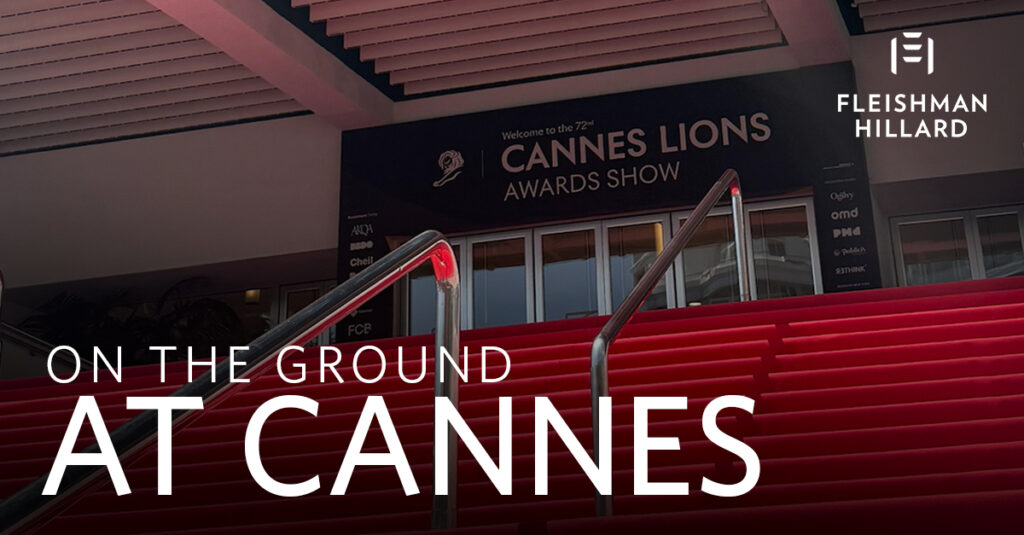
On the Ground at Cannes: There’s always a certain kind of energy on the ground at Cannes. But this year, it feels as much like a reckoning with what creativity must become as it is a celebration of a year of groundbreaking work. Yes, we’re honoring culture-shifting campaigns. But more than that, we’re witnessing a recalibration of what it means to build brands through creativity that must stay ahead of the times.

I’ll admit I arrived in Cannes feeling a bit dazed and confused by the state of the world. I wasn’t sure what I’d take away from the sea of experts and sessions ahead. But from the moment I stepped onto the Croisette and into the Palais, I felt creativity begin to work its way in—offering perspective, energy and solutions to the uncertainty surrounding us all.

Every conversation circles a similar tension: how do we lead brands through a world that’s constantly shifting—technologically, culturally and emotionally—while staying grounded in purpose and connection?

Some are waiting for change to catch up through legislation, regulation or policy. But that takes time. Creativity doesn’t sit still. It’s raring to go. It’s the lever we can pull now—every single day—to evolve brands in real-time. And what I’m hearing over and over again is this: creativity must evolve. And fast.

That’s what makes this week so powerful. For 51 weeks of the year, we’re heads down—delivering, adjusting, moving fast. But here at Cannes, we get to zoom out, reconnect with our craft and remember why we chose this industry—whether it was two years ago or twenty. We focus on the work and how to continually improve it.

And I’m picking up patterns from those doing just that. Not with theory, but with action:

💡 Bold ideas come from belief, not budget. I’ve seen this cut across industries at the start of the week: the best creative work isn’t born from excess—it’s born from conviction and a sharp understanding of audience signals. Think smart, scalable and sustainable campaigns that stay true to the brand, reward instinct and have the courage to do things differently.

💡 Creativity is being operationalized. It’s built into how decisions get made, not just how campaigns get launched. Ideas are judged by clarity, not polish. Four-slide pitch decks that cut to the a-ha. Weekly 15-minute concept reviews that favor momentum.

💡 Speed is essential. Culture moves fast—and brands that matter are keeping pace or setting a new one altogether. They’re doing it with confidence, not chaos. That’s the counter to the uncertainty we all operate in. The strongest brand teams are structured to act on signals, make real-time calls and adapt quickly.

💡 The human spark still matters. AI is everywhere—and rightfully so. But the best leaders are asking grounded questions: how does this make our message more human, more trusted, more meaningful? One tactic I’m hearing is the use dual of AI agents—one protagonist, one antagonist—to challenge assumptions and reveal underlying tension. But here’s the thing: AI is only as powerful as the brand instincts behind it. That comes from our own experience. From our earned best practices. From riding out moments like this before.

💡 Boldness is back. Brands making moves are giving themselves permission to leave the expected path and go the unexpected way. There’s a renewed focus on the 70/30 model—where 70% of energy goes to what’s proven, the tried and tested strategies, and 30% to the wild cards, the innovative and experimental approaches. If it hits, it scales. If it doesn’t, it teaches. The tried and true doesn’t work anymore—and pretending it does only adds to the uncertainty.

💡 Let your community lead. Your audience is your voice. In uncertain times, let them speak for you. They bring clarity. They bring joy. And when they do, give it back.

What’s becoming clear is this: creativity isn’t being managed. It’s being embedded—as a core function in how teams operate, how leaders lead and how decisions get made when the answer isn’t obvious. Creatives are more than makers—we are trusted counselors, translating signals into the work that keeps brands stable in the chaos. And in uncertain times, creativity becomes more than a differentiator. It becomes a stabilizer. A spark. A strategy.

If the kickoff of Cannes is any indication, the brands that thrive next won’t be the ones with the flashiest message. They’ll be the ones with the clearest voice, the fastest reflexes and the courage to build what’s next before someone else does.

Jim Joseph width= Jim Joseph is FleishmanHillard’s global head of brand impact, responsible for leading global brand business across B2B, B2C and B2G audiences, leveraging communications to enable commerce and business outcomes for the agency’s clients. He is a member of FleishmanHIllard’s Global Executive Advisory.


On the Ground at Cannes
Article

FleishmanHillard Launches Global Executive Advisory to Help Brands Navigate an Uncertain Marketplace

May 29, 2025

FleishmanHillard today announced the launch of its Global Executive Advisory, a strategic network of senior counselors designed to help C-suite leaders navigate special situations, high-impact issues and transformative change. The group is now operational and actively engaging with clients managing risk and opportunity in the face of global volatility, geopolitical uncertainty and increasing stakeholder scrutiny.

With more than 50 senior advisors across the United States, EMEA and APAC, the Global Executive Advisory pairs relevant specialists with global client leaders and sector experts to deliver precise, high-velocity counsel. The group provides integrated advisory across financial communications, crisis and issues, ESG and responsible business, talent and transformation, public affairs and brand impact. The Advisory group also taps into omniearnedID’s proprietary analytics platform — including genAI-enabled solutions that accelerate insight, risk evaluation, narrative development and decision-making.

“FleishmanHillard thrives by anticipating what our clients will need next — and by showing up with the right people to help them lead through it,” said J.J. Carter, president and chief executive officer. “The Global Executive Advisory is an extension of that legacy. It brings together first-rate advisors and modern solutions from across our network to meet the demands of this moment — leaders who understand not just communication but the weight of decision-making in a time of profound uncertainty and unpredictability. This is about accelerating impact, elevating counsel and unlocking the full value of our collective expertise.”

Rachel Catanach, head of the Global Executive Advisory, shared that while these are deeply uncertain times FleishmanHillard’s stake in the ground is clear: strategic communication is a key driver for companies wanting decision advantage despite the dilemmas they face.

“Whether it be navigating geopolitics, supply chain arbitrage, identifying new cross-industry partners, communicating new pricing or embedding AI into all operations, the winners and losers in times of uncertainty are often defined by the quality of their communication. In navigating uncertainty, the most grounded leaders focus on what aspects of their operations are immutable: the constants—people, purpose, values—that act as anchors – and then look to innovate and find a third way for those areas requiring a pivot. From an organizational perspective, that means focusing on your people and providing as much assurance as possible even if you can’t provide all the answers,” Catanach said. “That requires honesty, vulnerability and discipline. Share what decisions are being made, what’s on hold and why. Under-promise and over-deliver. That builds trust.”

Read More From Rachel: Turning Uncertainty into Opportunity

“A brand is more than a message — it’s an experience,” added Jim Joseph, global head of Brand Impact. “And in uncertain times, it’s often the brand experience that either connects people or loses them. That’s why executive counsel like this drives business results. We’re helping leaders reinforce what’s true in the world today and relevant in the moment so they can navigate complexity, lead with confidence and keep their brand experience connected to what matters most.” 

Built for flexibility and scale, the Global Executive Advisory enables FleishmanHillard to rapidly assess client needs and activate the right mix of internal and external experts. In addition to its in-house capabilities, the firm will draw on select partners across the Omnicom network including Daggerwing Group, Maslansky + Partners and public affairs firms PLUS, DDC, VOX Global and Mercury where specific expertise is required.

The cohort of advisors is equipped with proprietary tools and frameworks to solve complex challenges, and can also access resources across the full FleishmanHillard, OPRG and Omnicom network quickly. Some of these tools and frameworks include Connectivity Diagnostic, which allows clients to assess how aligned their organization is with the many outside forces that are shaping their story; Risk Radar, which is a forward-looking telemetry system that will help organizations spot reputational issues before they break; and the Two Truths framework, which is designed to help clients navigate competing belief systems to build trust in a highly polarized environment.

The Global Executive Advisory reflects FleishmanHillard’s commitment to delivering the highest level of counsel with the pace and precision today’s leaders demand. It will accelerate how the firm delivers value to clients — by putting the right talent, experience and thinking in place to guide them through their most consequential moments.

This launch also represents a broader evolution of FleishmanHillard’s Corporate Affairs model, which connects capabilities across five advisory pillars: Financial Communications; Crisis, Issues and Risk; Talent and Transformation; Responsible Business; and Public Affairs. The approach deepens the firm’s relevance to the C-suite and strengthens its positioning in special situations.

“Yes, caution is warranted. But the future won’t wait for certainty. It belongs to those who lead through the uncertainty, navigating with strategy, innovation, courage and integrity,” shared Catanach. “Let others chase the trend. We build relevance that lasts.”

FleishmanHillard Executive Advisory Board

Article

Communicating Through Dilemmas: Turning Uncertainty into Opportunity

By Rachel Catanach

I recently finished reading a book by Australian author Richard Flanagan called Question 7. The book explores his family and sense of place, set against the geopolitics of World War II. One detail that gave me pause was the title. Question 7 refers to a metaphysical puzzle posed in a short story by Russian writer Anton Chekhov:

“Wednesday, June 17, 1881, a train had to leave Station A at 3 a.m. in order to reach Station B at 11 p.m.; just as the train was about to depart, however, an order came that the train had to reach Station B by 7 p.m. Who loves longer, a man or a woman?”

Chekhov’s point is that the writer’s job is to ask the deepest questions without purporting to answer them.

Why is this relevant to communicators? Question 7 made me think about the kinds of dilemmas CEOs and C-suite leaders face every day in today’s uncertain, unpredictable environment. In a world where we have data, data everywhere, the C-suite has never faced such hard dilemmas that call on all their leadership powers and demand judgment beyond logic. They require clarity, conviction and communication.

They are operating in a world where the the new reality is … uncertainty.  They can no longer trust the models they’ve always relied on. Stakeholder views are in constant motion and increasingly polarized. Customer demands are elevated, consumer perceptions have become unpredictable and technology is driving consumption at a dizzying speed. Multiple truths are operating simultaneously, creating complexity, confusion and a need to navigate and scenario-plan in new ways at each turning point.

The escalating daily dilemmas and heightened risk will paralyze some CEOs but bring competitive opportunities for others—when tackled with decision advantage as opposed to decision regret.

That challenge is playing out at a global scale. According to the World Economic Forum’s May 2025 Chief Economists Outlook, 82% of chief economists say global uncertainty is currently “very high,” with trade, monetary and fiscal policy cited as the most volatile factors. Meanwhile, 79% expect recent U.S. policy shifts to create long-term global disruption, and nearly half of all organizations are planning to delay decisions or diversify operations in response.

For communicators, this only raises the stakes. In this kind of environment, decisiveness without alignment becomes a liability. It’s not just what leaders decide—it’s how they communicate it, who they bring with them and how ready they are to pivot when conditions shift again.

That’s why communication isn’t downstream support. In this high-risk environment, it’s often the strategic driver of success or failure. Of winning—or, at the very least, not losing. In this uncertain environment, there will be both. Yes, strategy is important.  But communication that is truly tailored to stakeholders, without compromising values, but accounting for trade-offs, is the name of the game.

Whether the challenge is market-facing or deeply internal and out of public view, communication is often the foundation of no-regret decisions that maximize opportunity as well as minimize risk.

This is where an integration of corporate affairs and brand impact matters most. At its best, communication unifies narrative, reputation and growth strategy—linking what an organization believes to how it behaves.

That’s the inflection point where communication becomes irreplaceable—not just as messaging, but as muscle. The strongest leaders today aren’t aiming for omniscience. They’re imagining new scenarios. They’re staying open to multiple truths, acting with purpose and adjusting with speed. And they’re asking their communication teams to be part of that front line, not the follow-up. 

As audiences approach brands from countless side doors—media, employee channels, investors, influencers and policy arenas—alignment can’t be an afterthought. Communication must connect narrative to value, decipher signals from the noise and turn leadership intent into audience impact. It marks a shift from defensive, reactive cycles to deliberate, plotted momentum.

Creating Anchors in an Uncertain Environment: Hear More From Rachel on the It’s No Fluke Podcast

This is how resilience is built. Not just in risk management, but in the discipline to return to your anchors—people, purpose, values—and communicate them clearly, especially when answers are incomplete. The most credible leaders today are the ones who say, “Here’s what we know. Here’s what we’re watching. Here’s how we’ll stay ready.” The credible leaders are those who understand context and how it connects to community and culture and drives decision-making.

Because let’s be honest: no one has a crystal ball big enough for this moment. But those with a process, a plan, the predictive tools and a point of view? They’re the ones leading with confidence—even in a time of shared ambiguity.

And they’re not doing it alone. They’re surrounding themselves with trusted partners who bring clarity to complexity. Who understand both the risk landscape and the human context. Who know that in a fragmented, high-pressure environment, communication isn’t just the playbook—it’s the platform.

Cody Want Rachel Catanach leads FleishmanHillard’s New York and Boston offices and the Global Executive Advisory, counseling CEOs on leadership transitions, board engagement and high-stakes issues. A global PR industry advocate, she has spoken at Davos, moderated at Cannes Lions and co-authored The Page Society’s Beyond Communication report. She was also a 2024 PRWeek Woman of Distinction.