Employee Login

Enter your login information to access the intranet

Enter your credentials to access your email

Reset employee password

Article

Get the Report: Corporate Affairs Trends for 2026

December 10, 2025

Expectations from executives and stakeholders continue to rise. Geopolitical and societal uncertainty is intensifying. The demand to show clear business impact is higher than ever. This is the constant pressure cooker corporate affairs leaders operate in. Their role is more central to enterprise value but with that comes exposure to risk, scrutiny and rapid change.

Our latest forecast surfaces the trends that matter most for senior communications professionals. Grounded in data, real-world observation and conversations with clients across sectors, it cuts through the noise to focus on what is actually shifting in the operating environment and what that means for your team, your agenda and your influence inside the business. It also looks back on 2025 predictions to draw out lessons that can guide leaders in the year ahead.

Click Below to Download the Report and dive deeper on the FleishmanHillard UK site.
 Click Below for More Reports From the UK Team:
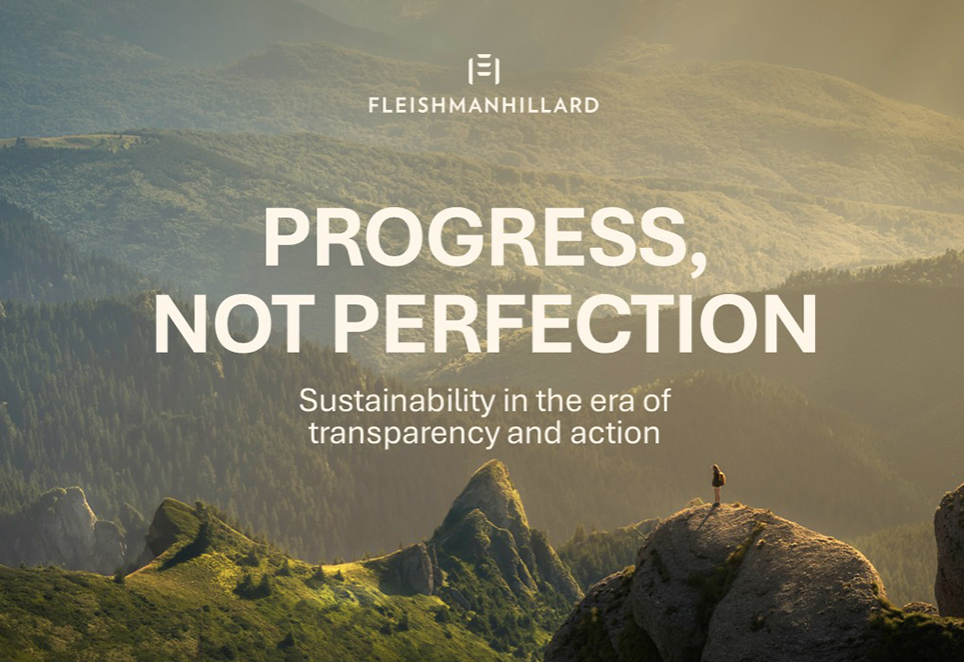
Article

Executive Impact: Turning Transitions into an Enterprise Advantage

By Elizabeth Cook, Chris Thornton and Michelle Mahony

The spotlight on executives has never been brighter. In 2025, CEO turnover is hitting record highs and CFO departures at Fortune 500 companies are up 33% year over year. CEO tenure continues to shrink —to just 6.8 years.  

Against a backdrop of AI disruption, geopolitical and supply chain pressure, employee and stakeholder challenges and investor scrutiny, leaders are expected to deliver impact fast. Nearly half of executive transitions are judged as failures or disappointments within two years. Yet despite these pressures, most organizations still treat executive transitions as a sequence of announcements and introductions — and the shallowness of this approach is more evident than ever.  

Transitions aren’t PR moments. They’re enterprise moments. The difference shows up in results. Handled well, a transition can unlock energy, clarify priorities, and accelerate operating performance. Handled poorly, it drains trust, distracts teams, and invites scrutiny. The difference in outcomes isn’t driven by the number of interviews or town halls conducted or the addition of a few more executive LinkedIn posts. It’s dependent on a complete re-think of the support that executives receive in transition and a laser focus on how leadership skills, change management principles and communications can come together to drive success.   

As we head into 2026 expecting the pressure on new leaders to only grow, the Global Executive Advisory teams for FleishmanHillard and Daggerwing Group have formalized an integrated approach to transition that moves from executive visibility to Executive Impact. Executive Impact is a new way to manage leadership transitions as critical, ongoing business processes that shape reputation and future performance. Success isn’t measured by optics but by outcomes: how quickly a leader earns trust, sets strategic direction, and delivers results.  

Because real impact depends on more than narrative, Executive Impact includes the underlying mechanics that determine performance: clarifying how the leader will shape structure, decision rights, operating rhythms, and processes so the organization can deliver measurable business results at speed. 

Our Five As for Executive Impact transition framework offers a practical path for new executives to follow from the moment they know they’ll be taking the seat—but it also can be entered at any point by an executive who begins to feel that their organization isn’t fit for the challenges ahead. We help executives create and operationalize momentum—making it easier for their team to believe, act, and deliver together: 

  • Announce with intent: Focus executive appointment communications on establishing credibility and setting expectations, align communications across audiences and regulations, and prepare leadership teams and champions to carry consistent messages. 
  • Align through understanding: Balance listening with diagnosis and the setting of leadership expectations, and operationalize early shifts in roles, rhythms, and decision forums. 
  • Activate the agenda: Articulate a visible purpose and strategy, define early choices and symbolic moves, and connect communications to execution. 
  • Accelerate the system: Equip the leadership team to deliver at pace, close gaps, manage moves decisively, and embed cadences that create urgency and ownership. 
  • Amplify what works: Codify new norms, keep stakeholders updated, reconnect to purpose, and prepare for the next inflection point. 

This system targets real business outcomes: Faster trust and alignment across executive and employee teams and boards of directors, quicker strategy adoption and execution, and reduced risk of derailment in the first 180 days. 

Our experience includes Fortune 100 leadership transition consulting and coaching; turnaround, transformation, integration and culture programs; CEO and C-suite positioning and visibility programs; employee, investor and stakeholder engagement; and counseling companies across issues, crisis, and C-suites in duress. 

Leaders don’t get a second chance to make a first impression. Every transition carries risk; the right design turns that risk into resilience. Executive Impact helps leaders set a credible course, accelerate execution, and sustain momentum beyond the early window. If you’re anticipating a change — or need to course-correct — FleishmanHillard and Daggerwing Group can partner with you to make this transition your advantage. 

Executive Impact
From Left to Right: Elizabeth Cook, Chris Thornton and Michelle Mahony

Elizabeth Cook is part of the FleishmanHillard U.S. corporate affairs leadership team and directs regional executive positioning offerings.

Chris Thornton is Senior Principal at Daggerwing Group and works with leaders to build the mindsets, skills, and confidence needed to lead transformation and embed change across complex organizations.

Michelle Mahony is the President of Daggerwing Group and works to bring together the science and art of transformation to life for clients.

Article

Sponsored Content in the AI Era

December 3, 2025
By Corina Quinn, Andrea Margolin and Amanda Hampton

The landscape may be shifting, but your brand story is still getting heard.

Sponsored content is arguably one of the most powerful tools in the PR toolbox for ensuring audiences hear a brand related story in an editorial format and context that will both resonate and drive impact. We’d be hard-pressed to think of a campaign that should not have this high-impact type of storytelling as a centerpiece.  

But how does it work in today’s AI-driven environment? 

Sponsored Content in the AI Era

This era of zero-click searches has led to lots of hand-wringing on what it means for sponsored articles and performance and whether it’s still a sound strategy for an integrated campaign.

Good news on that horizon: zero-click hasn’t marked the death to sponsored content. It remains a dynamic, stable solution to reach critical audiences with rich storytelling and trusted formats that offer unique support for a brand’s business goals.

New To SponCon?

Sponsored content is a form of paid media partnership in which brands collaborate with media publishers to co-create content that aligns with the editorial standards and audience interests of the publication, while advancing the brand’s communications objectives

Unlike traditional advertising, sponsored content is integrated within the editorial environment, delivering insights, perspectives or stories that resonate with readers and offer value beyond overt promotion. This approach leverages the credibility and reach of established media outlets, allowing brands to participate authentically in conversations that matter to their target audiences, while keeping control over message integration that you can’t guarantee with earned coverage from those same outlets.

Why Sponsored Content?

Trusted Influence at Scale
By appearing within reputable editorial environments, sponsored content benefits from the publisher’s authority and audience trust—and taps its editorial expertise in content creation. This enhances message credibility and drives deeper consideration among target audiences.

Strategic Storytelling
Sponsored content enables nuanced, narrative-driven communications that go beyond product features to communicate a range of things, from big-picture brand values, new and exciting offerings for consumers, and even thought leadership or societal impact. It supports reputation, positioning, and purpose-led initiatives as well as helps drive consumer offerings, from path to purchase and other lower-funnel tactics.

Precision Audience Engagement
Partnerships with publishers provide access to highly engaged audiences with a nuanced set of metrics you don’t get with earned media. This allows for tailored content that meets specific needs, interests, or pain points, improving relevance and engagement metrics—while driving brand business goals.

Integrated Communications Impact
As part of an integrated strategy, sponsored content amplifies earned and owned messaging, bridges gaps in the customer journey, and creates additional touchpoints that reinforce key themes across channels. It’s important to remember that sponsored content goes beyond print or digital advertorial, and includes qualitative content that also taps social media and other channels, and leverages video and audio content in addition to digital.

Measurement and Optimization
With robust analytics that can include time spent, click-through rates and more, sponsored content programs can be assessed for engagement, sentiment, and conversion—providing actionable insights to refine messaging and demonstrate business impact.

Sponsored Content in the Era of AI

There is a lot of discussion about declining site traffic due to changes in how people find information (known as zero-click search due to AI-driven features) and the truth is, there remain a lot of unanswered/developing questions about how AI summaries treat sponsored content that we will continue to track. We can also imagine a world where AI may enable more targeted distribution opportunities as media platforms respond and evolve.

Here’s what we know to be true today: Sponsored content remains effective because it is distributed and amplified through intentional, multi-channel strategies and is not just reliant on organic search or publisher homepage traffic.

There are several reasons why Sponsored Content remains effective:
Unique Traffic Drivers: In general, search and AI summaries aren’t the main traffic driver for sponsored content articles. Programs lean on newsletters, social media and paid amplification to drive qualified audiences.
Publishers Are Aware and Adapting: Many publishers moved to paywalls and subscriber-based ecosystems and have grown their cross-platform channel strategy in recent years to reduce their dependency on search, even before AI summaries emerged.
Quality Over Quantity: Our success metrics go beyond page views and impressions. We emphasize time spent, engagement and lower funnel actions such as clicks to the client’s site. Even with modest traffic results, high engagement audiences drive stronger qualitative impact.
Flexible Strategies: If we do see sponsored article performance start to be impacted, we collaborate with our media partners to evolve our strategies and content mix to make up for the loss in traffic.

Sponsored Content Goes Beyond Articles

In our current sponsored content programs, diversification is a deliberate part of our strategy to ensure we’re future-proofing programs against ecosystem shifts.
• Video, newsletter and social media integrations are important players in the content space and further distribute our reach and performance.
• Publisher-branded social handles, podcasts and more provide additional opportunities to connect with audiences even if article impressions or page views fluctuate.
• Diversifying our programs makes them less susceptible to zero-click trends because distribution is intentional and audience-driven rather than search-driven.

As the digital landscape continues to shift, we will monitor changes, adapt distribution and measurement strategies, and keep clients informed—ensuring that sponsored content continues to deliver value and impact in any environment.

From Left to Right: Corina Quinn, Andrea Margolin and Amanda Hampton

Corina Quinn is a Senior Vice President who co-leads our Media Partnerships Center of Excellence. A longtime award-winning editorial director and content strategist, she spent more than a decade in digital newsrooms at places including Conde Nast Traveler and Travel + Leisure.

Andrea Margolin is a senior communications strategist with more than 20 years of experience driving integrated storytelling, executive thought leadership and digital innovation for enterprise health brands. Based in Washington, DC, Andrea partners with global healthcare leaders to translate complex science into compelling, high-impact narratives that resonate across audiences and platforms.

Amanda Hampton is a Vice President based in Washington D.C. where she leads integrated sponsored content programs informed by audience insight and editorial excellence. She collaborates with clients and top consumer media partners to create high-impact storytelling that drives engagement and strengthens brand performance.

Article

When the World Gets Noisy, Great Storytelling Breaks Through 

By Trine Hindklev

In a world where disruption feels like the norm, clarity can feel out of reach. Our President and CEO, J.J. Carter, put it well at a recent PR Decoded discussion: “Clarity often comes from chaos for those who are bold enough to seek it.” That’s the mindset driving how we approach communications today. For us, it’s our call to action for how we think about storytelling. 

That perspective came through in our recent discussion with Chrissy Farr, editor-in-chief of Second Opinion, former tech and health reporter at CNBC and author of “The Storyteller’s Advantage: How Powerful Narratives Make Businesses Thrive.” Chrissy’s research and real-world experience show that the most effective leaders strategically use compelling narratives as a springboard to craft stories that connect, persuade and inspire.  

When storytelling is left to chance, companies lose control of the narrative. And no one wants to lose their narrative. Today, there’s a genuine need for trusted counselors to help leaders put communications at the center of their business strategy, not as a last-minute fix or a siloed function cast off to the side. 

Complexity isn’t going away. It’ll likely to get, well… more complex, but the ability to cut through it with authentic, sharp, well-crafted narratives is the key to thriving. Here’s how: 

Building resilience through narrative 

Organizations that invest in their narrative build real equity. It’s more than a safety net for tough times, Chrissy said. It’s a foundation of trust, engagement, and clarity that holds up in any environment. Leaders who go beyond facts and figures, sharing vivid, relevant and relatable stories, build solid reputations and relationships that last.  

The lesson? Invest in your narrative before you need it.  

That translates to mapping out your narrative assets, finding gaps in credibility, and creating processes for authentic engagement and rapid response. Resilience isn’t just about weathering storms; it’s about being known and trusted, no matter what comes your way. 

Moving beyond spin with courage  

Let’s be honest, being clear and human isn’t easy. It feels too risky. Too vulnerable. But the bigger risk is being boring and forgettable. People crave something real. Something bold and relatable. The risk of irrelevance is greater than the risk of saying something fresh.  

This holds true whether you’re B2B or B2C. Broad, generic messaging just gets lost. Clarity and specificity cut through. Every time. That’s why it’s so important to help leaders tap into their authentic voice, not just the safe, polished version, Chrissy shared. There’s a need to coach leaders to lean into what makes them different and set up the right guardrails to navigate complex issues with confidence. This isn’t about spin. It’s about showing up as real humans and letting that drive real connection.  

Reach without the reaching 

Metrics, dashboards and percentages dominate most conversations at the top. But honestly, who remembers a stat sheet? 

It’s stories that stick. Share the right story, and suddenly your message is making the rounds in rooms you’ve never entered, and your message travels further than any paid campaign could. That’s the kind of reach every communicator dreams of. 

But too often organizations chase impressions and views, Chrissy said. Impressions don’t impress if they don’t move people, and most don’t. The real impact of storytelling shows in influence: your message shapes industry conversations, earns trust and opens doors that numbers alone never could.  

In a nutshell, it’s time to move beyond those vanity metrics. So, look for measurement models that track the full picture, from traditional reach to narrative traction and influence mapping. Build dashboards that look at what counts, such as stakeholder sentiment, leadership invitations and the conversations you’re sparking across your sector. 

Chrissy’s advice is simple: focus on quality engagement. Nurture the audiences that matter. Invest in content people value. Rethink channel strategy, prioritizing depth over breadth and building real communities.  

Move away from chasing numbers to building lasting influence, think more modular content + smart thought leadership + executive visibility all working together as part of an integrated approach.  

Be a trusted partner  

Storytelling carries risks. But so does playing it safe. As Chrissy and J.J. put it, leaders and brands who stand out are the ones willing to show up with clarity and courage, sharing the moments that matter even when they aren’t perfect. That’s how impact grows. 

As a modern communications agency and trusted partners to many of the world’s most vibrant brands, we believe crafting a narrative isn’t just a tactic, but a strategic asset that drives measurable impact. The organizations that treat storytelling as a line item or an afterthought will get left behind. The ones who invest, with purpose, will lead. 

Do you need help being human, specific and bold? Be brave. Let’s talk.  

Trine HindklevTrine Hindklev is a senior partner and FleishmanHillard’s Global Strategic Media Relations Lead. She is part cultural anthropologist, part media strategist, part creative storyteller and all-in change-maker..
 
Article

Predictions for the Year Ahead: 3 Shifts in Internal and Change Comms in the Age of AI 

November 20, 2025
By Zack Kavanaugh

AI is reshaping how work gets done – and the field of communications is no exception. 

The fundamentals haven’t changed: people still need clarity, context and connection to make sense of change. What’s changing is how communication is created, delivered and received. 

Here are three shifts we expect to see in the year ahead – and what leaders can do now to prepare. 

Prediction 1: Content Will Keep Scaling. Attention Will Keep Shrinking. 

Stat to watch: 83% of knowledge workers say they are trapped in a communication maze of scattered emails and chats, where vital information often gets lost. 

What it means: Information overload is already a challenge, and AI-generated content is likely to add to the volume. The risk isn’t that employees won’t get enough information – it’s that they’ll disengage or find that messages actively obstruct their ability to focus on meaningful work.  

Communication teams must shift from output to impact, producing fewer, more intentional messages that protect attention and create value. 

How to prepare: Treat communication like scarce real estate. Ask: Is this message necessary? Who really needs it? Run small tests and trials, such as A/B tests, to see what captures attention, then scale your solution based on those insights. In a world of abundant content, relevance is what earns attention, provides value and builds trust. 

Prediction 2: Signals Will Get Louder. Understanding Will Stay Quiet. 

Stat to watch: 57% of employees say their company has a generative AI strategy in place, compared with 89% of executives who say it does. 

What it means: Leaders may assume their messages are landing simply because they were sent or because dashboards show clicks or activity. However, the gap between executives and employees in understanding AI strategy shows how misleading that assumption can be.  

How to prepare: Go beyond superficial metrics. Don’t just track clicks or usage. Use methods like focus groups, pulse surveys and informal conversations to assess true understanding. Ask: Do people understand the strategy? and Can they explain what it means for their role? Don’t settle for more data. Seek deeper, actionable insight that drives understanding and adoption. 

Prediction 3: Managers Will Carry More of the Message – and More of the Risk. 

Stat to watch: Only 27% of managers are engaged at work, and over half have never received formal training – including communication and people-leadership skills.  

What it means: As AI tools take on more of a team’s drafting and editing responsibilities, managers play an increasingly important role in the final stage of communication – ensuring messages are delivered in a way people understand and trust.  

Employees already look to them first for clarity, but many managers don’t feel equipped for the role. Without support, important messages risk being diluted or distorted – and organizational alignment can weaken. 

How to prepare: Support managers as the human bridge between the organization’s strategy and those who will implement it in their day-to-day responsibilities. Provide hands-on training to build confidence and give them opportunities to practice effective communications.  

In an AI-driven workplace, managers need more than digital tools. They need targeted coaching and ongoing, real-time support to communicate change. 

What AI Can’t Replace 

These shifts point to a future where AI does more of the producing, but people remain responsible for the meaning. 

More than ever, communication won’t just be about what gets said. It will be about what gets understood, internalized and acted on. And as machine-made content becomes more common, the messages employees will trust most are the ones that feel human. 

The role of the Internal Communications function is evolving – not to create more, but to help organizations make sense of more.  

Leaders who plan for this now will be better equipped to earn attention, maintain alignment and guide their people through the changes AI is accelerating. 

Article

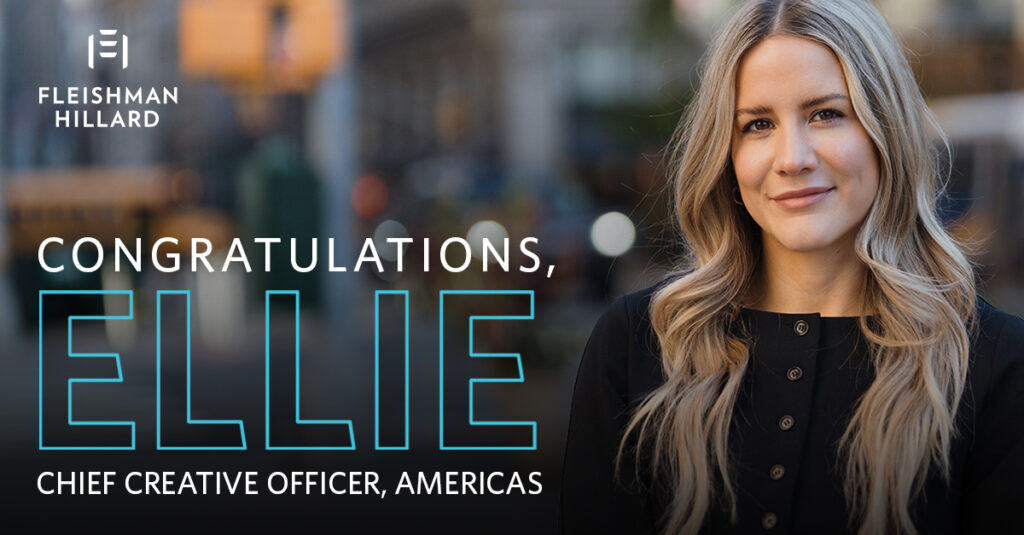
Ellie Tuck Appointed Chief Creative Officer of the Americas

November 18, 2025

The award-winning leader will unify earned creative and storytelling across the region in support of FleishmanHillard’s modern communications vision.

FleishmanHillard has appointed Ellie Tuck as chief creative officer for the Americas, aligning earned creative to the firm’s vision for modern communications: purposeful creativity that inspires action and delivers measurable impact. Tuck will lead the creative vision and output across the agency’s largest region, delivering transformative ideas for clients that live at the intersection of audience, culture and technology.

“At FleishmanHillard, we believe that bold and courageous creative powers the work and contributes meaningfully to our business, the business of our clients and the career experiences of our people,” said Della Sweetman, president, Americas, and chief strategy officer. “Ellie’s appointment will advance our creative vision. She is a unifier who very effectively brings teams together to unlock ideas and a leader who possesses strong business acumen to connect the work to impact. This is an important step forward in our reinvention and I look forward to what we will accomplish with Ellie in this role.”

“Creative today is a growth engine that drives business outcomes, not just awareness,” said Tuck. “As an industry, we’re at an inflection point, operating in a world where common ground is no longer common and where the realities our clients face are shifting fast. What excites me most is the collaboration ahead, bringing together talent and clients who challenge us to think boldly, take smart risks and build ideas that travel and prove their value in market.”

Born in the Philippines, raised in Bangladesh and British by heritage, Tuck brings a global lived experience to her creative work. She built her communications foundation at Weber Shandwick and boutique agency Eulogy before moving to Blue Rubicon’s creative consumer shop, Surname & Surname. Following Blue Rubicon’s acquisition by Teneo, she helped establish the firm’s creative practice while also mentoring emerging talent.

Tuck joined FleishmanHillard in London in 2021 to lead the firm’s UK creative team and later relocated to New York, She is a founding member of the Public Relations and Communications Association’s Creative Committee (PRCA) and was named to PRWeek’s 40 Under 40 list in 2025.

Tuck will partner with media, influence, experiential, innovation and production leads to connect data and intelligence to ideation to activation to impact. Her remit includes elevating creative standards, accelerating concept-to-market and scaling approaches that integrate story, social, creator, experiential and content.

Tuck will collaborate with market and practice leaders to codify AI-enabled tools integrated into the industry-leading tool stack and ways of working that enhance creativity, improve efficiency and effectiveness and drive creative excellence across the region.

“We’re building a creative offer for this moment,” Tuck added. “One that brings together people who understand business context and value real outcomes over vanity metrics, without losing sight of great craft.”

Tuck’s announcement follows other 2025 leadership announcements including Mei Lee in Singapore, Madhulika Ojha in India, Adrienne Connell in Canada, Marshall Manson in the United Kingdom, EJ Kim across TRUE Global Intelligence, Kristin Hollins across California, Jim Joseph as global head of Brand Impact and Mary Kosinski as global managing director of Health and Life Sciences. Together with a new global corporate affairs leadership team, these appointments reflect FleishmanHillard’s  continued investment in leaders who deliver trusted counsel and measurable impact on a global scale.

Article

Podcast: Why Communications Is the Ultimate Advantage in Sports

November 13, 2025

When the world stops to watch the Super Bowl, the Olympics or the FIFA World Cup, it’s not just athletes who take the global stage. Brands do too and the best campaigns go far beyond visibility to connect with audiences and deliver real business impact.

FleishmanHillard President and CEO J.J. Carter joined Campaign’s Play by Play to unpack how global brands can unlock the full value of sports partnerships and why 2026 will be a once-in-a-generation opportunity. Carter knows the power of these partnerships, having spent decades helping brands navigate the global sports arena on the ground at Super Bowls and nine Olympic Games.

The episode follows the announcement that FleishmanHillard will serve as the official strategic communications consultancy for the Bay Area Host Committee, supporting both Super Bowl LX and FIFA World Cup matches next year.

WATCH THE FULL CONVERSATION HERE:

Article

The Supreme Court Case That Could Redefine U.S. Trade Policy

November 12, 2025
By Geoff Mordock

In the coming weeks, the Supreme Court is expected to decide a case that could shift the balance of power between the White House and Congress – and reshape how businesses navigate global trade risk.

The case, Learning Resources, Inc. v. Trump, challenges the legality of tariffs imposed under the International Emergency Economic Powers Act (IEEPA). At its core, it asks whether the President can unilaterally impose, extend, or adjust tariffs under IEEPA after declaring a national emergency, without returning to Congress. The outcome could unlock billions in refunds for affected companies, tighten judicial review of trade actions, and force a broader reckoning with executive authority in economic policy.

The stakes are high. And the implications go far beyond trade.

What the Court Is Actually Weighing

The Trump administration used IEEPA to impose tariffs on a wide range of Chinese imports, citing national emergencies and foreign threats. But the challenge brought by Learning Resources and others focuses less on the why and more on the how.

The Court must decide:

  • Did the executive branch overstep the authority granted by Congress under IEEPA?
  • Can the President keep adjusting tariffs based on a standing national emergency declaration, without ongoing Congressional approval?
  • Are companies entitled to refunds if those tariffs are later ruled unlawful?

During oral arguments, Justices across the ideological spectrum voiced concerns about unchecked executive power. Chief Justice Roberts and Justice Barrett both questioned whether an initial finding should give the President indefinite authority. Justice Gorsuch warned of the dangers of unconstrained trade power, while Justice Sotomayor zeroed in on the lack of procedural fairness for businesses seeking relief.

That kind of bipartisan skepticism is rare. It suggests the Court may be ready to draw new boundaries.

Supreme Court Hearings

Why This Case Matters More Than It Seems

The headlines will likely focus on tariffs and China. But the deeper implications touch nearly every global business and every White House to come.

A Reset on Executive Power

If the Court limits the use of IEEPA, future administrations may be forced to return to Congress for approval of extended or revised trade actions. That would be a major shift – reintroducing legislative oversight into a domain that has become increasingly dominated by executive discretion.

A Path to Refunds

For companies, the most immediate impact may be financial. If the Court rules that these tariffs were imposed or extended unlawfully, businesses could pursue billions in refunds. That would also establish a precedent for challenging future trade actions and raise the stakes for getting them right.

Clarity, but Also Complexity

A ruling in favor of Learning Resources could bring greater predictability for importers and global supply chains. But it would also open the door to more litigation and place new burdens on companies to monitor the legality of policy changes, not just their bottom-line impact.

A Signal on Delegated Power

This case could continue a broader trend from the past several terms, where the Court has increasingly shown willingness to revisit how much power Congress delegates to the executive branch, especially in regulatory and economic matters. If the Justices continue to tighten these limits, the effects could continue to ripple into environmental law, labor regulation, and beyond.

Global Repercussions

Other governments are watching closely. If U.S. courts rein in presidential trade powers, it could change the tone of global negotiations and alter expectations in future disputes. It could also give international trading partners new leverage or new reasons to challenge U.S. moves at the World Trade Organization.

If the Trump Administration Prevails

Should the Court uphold the administration’s actions, the message will be clear. The President has broad authority to manage trade policy under IEEPA, including imposing and adjusting tariffs in response to declared national emergencies or foreign threats.

That would preserve the status quo on tariffs, but also the unpredictability that comes with it. Companies would face continued uncertainty about how and when tariffs might change, and how much say Congress or the courts might have.

For some industries, especially those protected by tariffs, this could be welcome news. For others, it could reinforce the need for strong internal planning and government affairs engagement.

What Business Leaders Should Be Doing Now

Whatever the outcome, this is a strategic inflection point. Companies need to think beyond legal exposure and assess what this case reveals about the regulatory and political environment.

Some practical questions:

  • How exposed is our business to shifts in tariff law or enforcement?
  • Could a refund, or the loss of one, impact earnings expectations?
  • Are we prepared to explain that outcome to stakeholders?
  • Do we have a plan for navigating increased scrutiny or a rush of litigation?
  • How are we preparing for the next administration’s approach to trade?

The smart move is not to wait. Whether the Court limits executive power or affirms it, the policy environment will remain fluid. The most resilient companies will have already mapped out multiple scenarios and coordinated across legal, finance, communications, and operations teams.

One Case, Many Signals

Learning Resources v. Trump is not just about one set of tariffs. It is a test of how trade power is used, how far it can go, and what legal remedies companies can expect in an era of aggressive policy moves. In other words, this is not just a case. It is a signal. And in times like these, signals are what smart leaders watch.

Geoff MordockGeoff Mordock leads Issues Management at FleishmanHillard. He is an SVP & Senior Partner based in Orange County and brings more than 25 years of experience helping organizations manage and shape corporate reputation, including navigating significant crises and issues through critical moments.


 
Article

Win What Matters

November 11, 2025

How a Purposeful Award Strategy Can Strengthen Employer Brand and Attract Top Talent

In today’s dynamic talent landscape, one principle stands out: recognition matters, but only when it’s meaningful. From “Best Places to Work” lists to industry-specific accolades, employer-of-choice awards remain a powerful tool for building credibility, boosting brand perception and attracting the right talent.

But not every award is created equal … and many come with a hefty price tag (from entry fees to the time and effort spent preparing submissions).

As the hiring market cools and qualified candidate searches intensify, now is a strategic time for organizations to double down on their employer brand. Third-party awards, in this context, retain their power as a powerful tool.

But the goal isn’t just to win. It’s to win what matters. The proper recognition, grounded in authentic storytelling and aligned to business priorities, can differentiate your organization in a crowded marketplace.

Why now?

While some companies are scaling back recruitment efforts, smart employers see this moment for what it is: a rare window to stand out and attract exceptional candidates. With fewer organizations actively vying for talent and less noise in the marketplace, even modest increases in employer visibility, such as industry mentions or niche awards, can generate an outsized impact. Recognition as an employer of choice not only draws in new talent but also boosts engagement and morale among current employees, provided it is earned and shared authentically.

That means skipping the “spray-and-pray” approach to awards submissions and instead adopt a strategic lens. Start by pondering over the following:

  • What does your organization want to be known for?
  • Which recognitions align with your values and culture?
  • How can internal communications help bring that story to life?
  • How well does your organization satisfy the award criteria or compare against potential competitors?
  • Will your chances of winning improve by implementing programmatic changes ahead of the next submission cycle and applying then instead?

When these questions are answered honestly, a more straightforward path forward emerges.

Go beyond the boilerplate

Be inspired by the fact that at the heart of every effective employer brand is strong internal communication. Award-winning cultures are built from the inside out, grounded in authentic stories that bring purpose and values to life across teams and in everyday moments. That’s why we help clients dig deep to uncover the stories that matter: how purpose is lived, how values are demonstrated at every level and how culture is defined by employees themselves.

But building a great place to work requires more than compelling narratives or polished award submissions. It takes consistent, thoughtful strategies that genuinely connect people, business goals, values, brand and reputation, resulting in an exceptional employee experience.

A smarter path to recognition

Of course, even the best narrative won’t make an impact if it’s sent to the wrong place. Award submissions can be expensive, time-consuming and competitive.

To invest time and effort wisely, an awards assessment matrix is a valuable tool organizations can use to evaluate which opportunities best align with their purpose, values and strategic priorities. Using such a resource can help your team focus on efforts that will drive real business value.

The results speak for themselves

Rest assured, a well-executed award strategy doesn’t just earn headlines. It builds trust with candidates and fosters employee pride. It instills confidence in the communications and talent attraction functions, potentially leading to additional resourcing to expand the programs responsible for the accolades won. And when an organization tells the story of its positive employee experience with intention, the benefits extend far beyond a single submission cycle. They reinforce the culture employers work hard to build—and invite others to be part of it.

We’re proud to help clients develop employer recognition strategies that do just that. From building employee engagement and alignment programs that are the foundation of a great place to work, to delivering standout storytelling, to selecting the award programs that will make the biggest impact, our team helps organizations focus their efforts where they matter most. Because when it comes to awards, the smartest strategy is simple: win what matters.

Ready to move beyond generic recognition?  FleishmanHillard’s Talent + Transformation team builds award strategies that deliver measurable talent and business outcomes.

Let’s build an awards assessment matrix to identify the right opportunities and craft a story that reflects your people, your culture and your purpose—and achieves your recruitment and retention goals.

Article

In The Age of Rage, Fairness Is the Only Way Forward

November 5, 2025
By Rachel Catanach

People are angry. We see it in the headlines, feel it in our client conversations and hear it from employees, customers, even friends. But the rage we’re living through today isn’t just a passing mood or a social media flare-up. It’s something deeper, more personal and more dangerous – for leaders, for businesses, and for the social contract that underpins both.

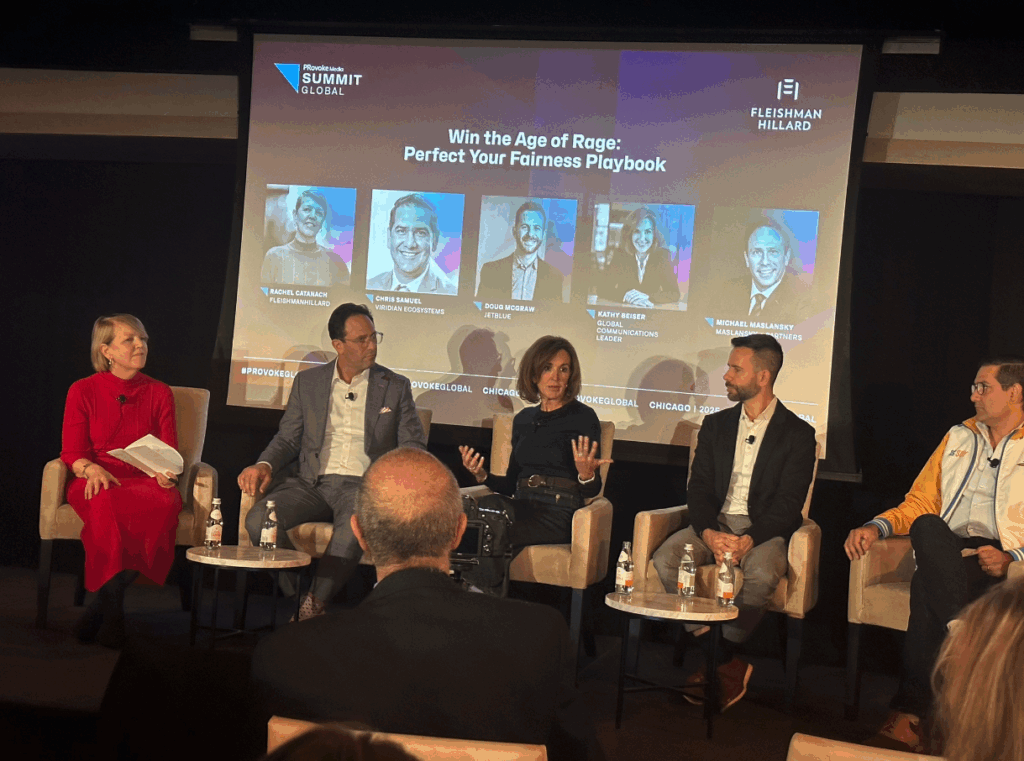
Discussing Fairness in the Age of Rage at the PRovoke Global Summit (Left to Right, Rachel Catanach, Michael Maslansky, Kathryn Beiser, Doug McGraw and Chris Samuel).

This piece draws on new research from our partners at maslansky+partners, led by Michael Maslansky (CEO) and Lee Carter (President and Partner), whose work on fairness and trust provides critical insight into today’s volatile public mood. What their data makes clear is this: the old rules no longer apply. Good intentions are no longer enough. And if you think this is just another cycle of public discontent, you’re missing the point and the opportunity.

What’s Really Fueling the Rage?

The rage we see today is not ideological. It’s not just a backlash against politics, culture wars or pandemic-era disruption. It’s personal. People don’t just distrust institutions – they believe those institutions are actively working against them. Whether it’s government, media or business, the sentiment is the same: “The system is rigged, and I’m the one paying for it.”

In the maslansky+partners’ research, more than 70% of people said they rarely or never trust companies to treat customers fairly. Over 60% believe most big companies purposely look for ways to take advantage of them. And some 80%, many of whom once said they want companies to support causes, now say what bothers them most is something more basic: hidden fees and fine print.

The message couldn’t be clearer. People aren’t asking companies to take a stand on every issue. They just want to be treated fairly.

Fairness, Not Goodness

In recent years, the corporate playbook has centered on goodness: purpose, ESG, brand values, societal impact. And those things still matter. But in the current climate, they’re not the differentiators leaders think they are.

That’s because fairness hits differently. It’s not a strategy. It’s a standard. When people feel a company is unfair – when they see surprise fees, hear about executive bonuses during layoffs or feel excluded from loyalty benefits – it doesn’t just frustrate them. It enrages them. And that rage moves quickly, particularly in a connected, post-trust world.

More than 60% of consumers say they’ve boycotted companies for putting profits ahead of people. More than 40% either agree or don’t disagree that violence might be justified in response to unethical corporate behavior. These aren’t just reputation risks. They’re survival threats.

The Real Shift: From Purpose to Permission

For years, companies have leaned on purpose to build trust and earn permission to operate. But that permission is now contingent on fairness. If your customers believe they’re getting a raw deal, no amount of purpose-driven messaging will save you. In fact, it may backfire.

This is the dark side of “doing good”: when companies promote values that feel disconnected from customers’ real lives – especially those struggling to make ends meet – those efforts aren’t seen as admirable. They’re seen as hypocritical, or worse, insulting. It’s the $2 million Super Bowl ad telling customers you care, while their internet bill just went up with no explanation.

What Leaders Should Do Now

Fairness isn’t a communications challenge. It’s a business imperative. And it requires a different kind of leadership – one rooted in empathy, consistency and operational integrity. Here’s where to start:

  • Replace goodness language with fairness language. Don’t talk about changing the world. Talk about how you’re making things better for your customers. Be specific. Be transparent. Be human.
  • Prioritize customers over causes. That doesn’t mean abandoning purpose. It means making sure it doesn’t come at the expense of the people keeping your business alive.
  • Deliver universal benefits. Avoid programs that help some while leaving others behind. Fairness means everyone gets the best price, the clearest policy, the same level of service.
  • Fix the small injustices. The fee they didn’t see coming. The policy that changed without warning. These moments define your brand more than any campaign ever will.
  • Make it personal. Every message, every policy, every change should answer one question: how does this help the individual on the other side?

A Fairness-First Future

In this age of rage, fairness isn’t just the right thing to do. It’s the only thing that works right now.

Fairness earns trust when purpose can’t. It deescalates outrage. It keeps customers loyal. And most importantly, it signals to people that they matter – not just as buyers, but as human beings. That’s a powerful message in a world where far too many feel forgotten.

For business leaders, the challenge is clear. You can keep trying to win the last war, fighting to prove your purpose, defend your values or ride out the storm. Or you can lead the solution. You can rebuild the trust that’s been broken. You can show people that fairness still exists and that your company is committed to delivering it. Because in the end, the companies that thrive won’t be the ones shouting the loudest. They’ll be the ones that show up, play fair and prove day in and day out that they’re on their customers’ side.

Cody Want Rachel Catanach is FleishmanHillard’s Global Managing Director, Corporate Affairs; General Manager, New York and Boston; and leads the Global Executive Advisory, counseling CEOs on leadership transitions, Board engagement and high-stake issues. A global PR industry advocate, she has spoken at Davos, moderated at Cannes Lions and co-authored The Page Society’s Beyond Communication report. She was also a 2024 PRWeek Woman of Distinction.