The top 3 actions companies must adopt to take authentic action on diversity, equity and inclusion
October 28, 2021
Share
Taking authentic action on DE&I There has never been a more important time for brands and businesses to take an honest look at how their actions either remove or reinforce barriers to equity, particularly standing up and championing minority voices and traditionally marginalized communities. From our Authenticity Gap research, it was clear that informed consumers […]
Lessons on Reaching and Engaging with Diverse Audiences
October 22, 2021
Share
Companies’ intentions around Diversity, Equity and Inclusion (DE&I) must go beyond statements. As change agents, communicators should push to ensure an organization’s words match their deeds.
Further, we should learn how to partner with channels that give voice to the voiceless and spark dialogue around topics that can be uncomfortable. We must reach diverse audiences exactly where they are and tell stories that reflect their lived experiences.
The following are considerations for organizations when connecting with diverse audiences across media relations, social influencer outreach and owned media channels:
How Do You Engage with Diverse Media?
Make it Relevant – Why should the audience care?: To be effective, clients must share news or story angles that best resonate with the communities they want to reach. Pitches should be hyperlocal.
Build Strong Relationships as a Trusted Source on DE&I Issues: Create meaningful relationships with owners/publishers, editors, producers and reporters so they know you are a trusted source for stories. Ensure your team also features members of the community with which you are hoping to engage.
Focus on People or Human-Interest Stories Rather than Breaking News: This requires creative storytelling to pique interest. Develop angles that incorporate the personal experiences of the executives being showcased. Include data that quantifies the related issue facing the community. Ensure spokespeople and representatives match the audience of the outlet.
Communicate with Audiences In-Language: Offer robust, in-language content to underscore the company’s commitment, build trust, strengthen reputation, expand reach and enable your brand to stand out among competitors.
Understand Cultural References and Tone of Audience: Tailor content to reach various demographics based on tone, cultural references and types of content (e.g., automotive, tech, healthcare).
How Do You Authentically Reach Diverse Audiences?
Engage Year-Long, Not Just During Heritage Months: Especially with the urgency today around racial equity, only reaching out for heritage month related stories will appear superficial and performative – because it likely is. A true commitment is an ongoing commitment.
Invest Your Paid Content Budget in Diverse Media: Content partnerships, paid/sponsored programming and other engagements around DE&I beyond earned media can further demonstrate a company’s commitment to diverse communities. Investing in the media that represents a community shows a stronger, authentic level of commitment.
Communications is a Two-Way Street – Be an Ally: Seek to understand and build relationships with communities that you aren’t a member of by becoming an ally to bring attention to the experiences of marginalized groups when their voices are not being heard. It’s an opportunity to listen more than you speak. To research and connect with members of specific communities and recognize what’s important to them.
See what else is happening
You might also like
Expertise
The AI Readiness Gap Series: How to Turn Successful AI Experiments Into Everyday Work
November 18, 2026
Expertise
Awareness of a New Day in Security
November 18, 2026
Expertise
Live From AMEC 2026: AI Is Making Communications Measurement More Important Than Ever
November 16, 2026
Expertise
Who Owns Owned? FleishmanHillard Examines PR’s Role in AI-Powered Search
November 13, 2026
Expertise
CEOs Don’t Need to Pick a Side on AI. They Need to Explain Their Choices.
November 10, 2026
Expertise
The Midterms Are Over, But the Food and Agriculture Questions Aren’t
November 5, 2026
Expertise
Changemakers Are Changing the Conversation
November 5, 2026
Expertise
The Next Washington: Planning for a New Congress and Navigating Divided Government
November 4, 2026
Expertise
Live From New York: It’s the New Front Door To Care
FleishmanHillard Launches New Race and Culture Team to Reach Diverse Audiences Where They Are
October 7, 2021
Share
Diversity, Equity and Inclusion (DE&I) isn’t just a moral imperative, it’s a business imperative. It’s been proven time and again. Knowing this, we’re excited to announce the agency’s new Race and Culture team, comprised of specialists who focus on DE&I and multicultural communications and programming for external audiences. The content integrates earned media and influencer marketing, editorial, social strategy and digital capabilities.
The team is focused on being a trusted, integral partner to organizations, helping them better engage on today’s most complex DE&I-related issues, with diverse audiences in new and meaningful ways. Race and Culture team members will advise clients on how to better engage with diverse-owned and diverse-focused media and tell more compelling stories to reach their audiences on the appropriate platforms.
As organizations rethink how to operate internally and communicate with their core audiences, they have no choice but to be in tune with, and reflective of, the world around them. They will need to be sure not only policies and procedures resonate with their employees, but also win over the hearts and minds of consumers. Today, everything – a brand’s reputation and livelihood – is at stake.
FleishmanHillard’s latest 2021 Authenticity Gap Report found that 65% of consumers expect companies to advance DE&I in the workplace, demonstrate they are culturally aware and listening to their diverse customer base, and provide a work environment that is diverse, inclusive and equal.
Today, it’s not just about what companies sell, but how the brand and its leaders engage with society.
DE&I must be at the heart of business. It must course through everything – including the communications strategy. It’s the starting position, not an add-on. Many companies require specialized guidance on how to reach diverse audiences authentically and effectively through the media and platform channels by which they consume news. That’s where the Race and Culture team comes in.
If you are interested in learning more, please contact me.
See what else is happening
You might also like
News
FleishmanHillard Named Large Consultancy of the Year at 2026 ICCO Global Awards
November 13, 2026
News
FleishmanHillard Expands Consultancy Solutions Suites With Intelligence Offering
November 2, 2026
News
FleishmanHillard London’s Amira Williams Named a 2026 Young Changemaker
October 30, 2026
News
The Chaos Advantage: The Issues Driving Award-Winning PR
October 29, 2026
News
Icelandair’s ‘The Real Unreal’ Named No. 1 Campaign in the World at Global SABRE Awards
October 27, 2026
News
New Chaos Advantage Study Shows Caution Has Become the Riskiest Strategy in Marketing
October 6, 2026
Expertise
Earning Your License to Lead: UNGA, Climate Week and Beyond
September 17, 2026
News
The Chaos Advantage: How Brands Win in a Volatile World
June 25, 2026
News
The Chaos Advantage: FleishmanHillard Research Finds Caution Has Become the Riskiest Strategy in Marketing
WEBINAR: Is meritocracy a myth? The case for socioeconomic diversity in our working lives
September 30, 2021
Share
Join us on Thursday 14th October at 1-2pm (BST) for a panel discussion on socioeconomic diversity and inclusion, hosted by Ben Levine, director & partner of FleishmanHillard TRUE Global Intelligence, in conversation with: Sarah Waddington CBE, Co-founder of Socially Mobile Saeed Atcha MBE DL, CEO of Youth Leads UK, Social Mobility Commissioner and Deputy Lieutenant […]
Diversity, equity and inclusion (DE&I) has risen to the forefront of consumers’ minds as the realities of systemic inequality remain prevalent throughout society. Consumer expectations for brands to be part of the solution and not just the conversation are high.
This year’s Authenticity Gap study, The Power of Authenticity, identifies how organizations can develop stronger relationships both internally and externally. According to the research, nearly 65% of consumers say brands must commit to advancing DE&I in the workplace to be more credible than their peers.
FleishmanHillard UK’s Christina Peach shares five tips for brands to commit to DE&I efforts and provide solutions to create ongoing, meaningful connections with their audiences.
Approximately 6,500 languages are spoken around the world and, according to The Washington Post, nearly half of the world is bilingual. Yet, those who identify as bilingual and multilingual are often greeted with more challenges in the face of communication, rather than praise.
As advocates and allies, it is important to look at how we can create inclusive measures for people who are multilingual. Through collaboration, patience and the willingness to understand, we can reimagine different languages not as a barrier, but a bridge builder.
Colleagues across our Chicago office share their personal experiences as multilingual speakers and how exposure to different languages can make us better communicators and expand our larger, global perspectives.
—
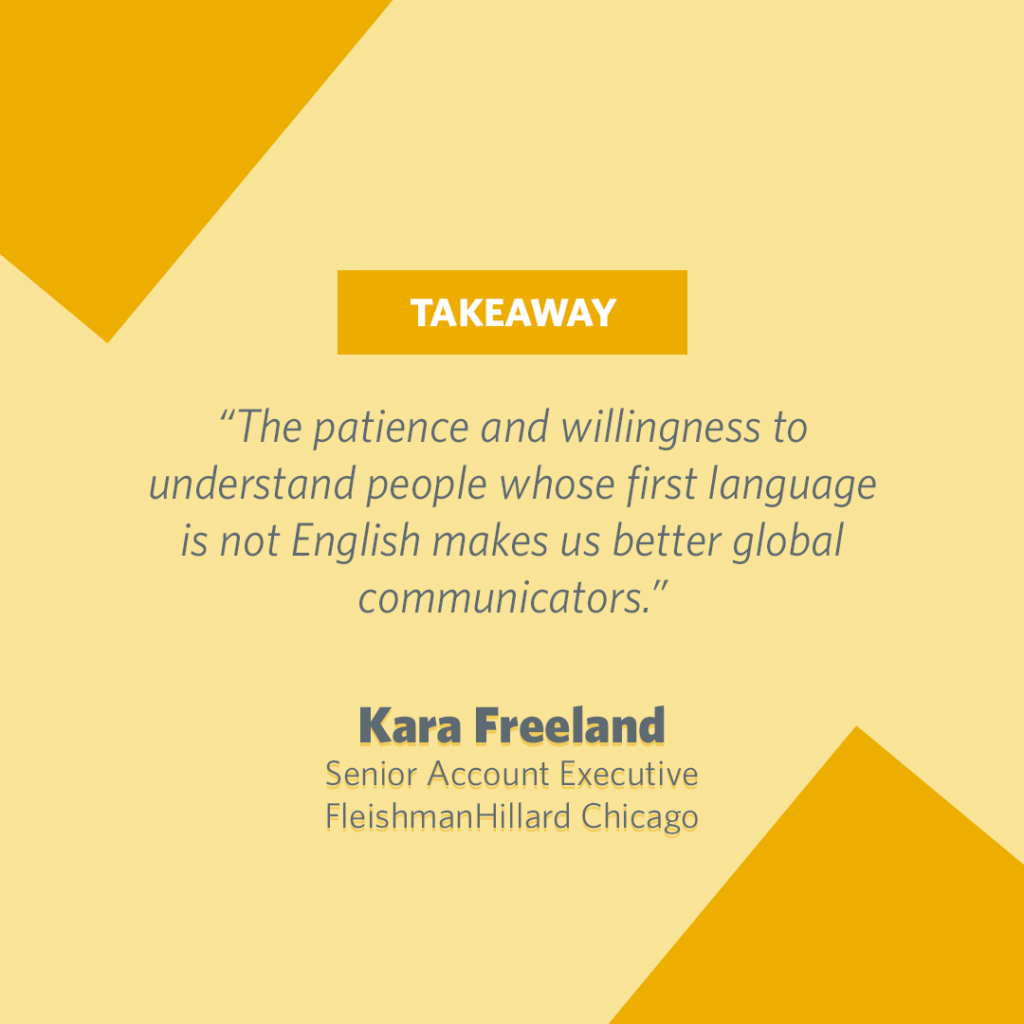
I was born and raised in Thailand speaking Thai, so English is my second language. My English lessons began when I was in pre-school. It started by learning the English alphabet and simple vocabulary.
Growing up, my dad would purchase English encyclopedias, magazines and newspapers for my brother and me to read — or more so to look at – during that time. While I was too young to understand everything then, I was excited to see books that were written in a different language. The desire and curiosity I felt for the books written in English encouraged me to keep learning. Despite my concerns on whether my accent is too strong or if I will stumble on pronunciation, I take every new word and pronunciation I learn as an accomplishment.
While it comes with a unique set of challenges, being multilingual has opened countless doors to ample opportunities to meet people from all over the world and discover my passion for a career in global communications. I would not have made it this far without support from people who are willing to understand me, even when there were words I cannot pronounce. I am grateful for these opportunities and look forward to creating similar opportunities for others.
Kara Freeland,senior account executive
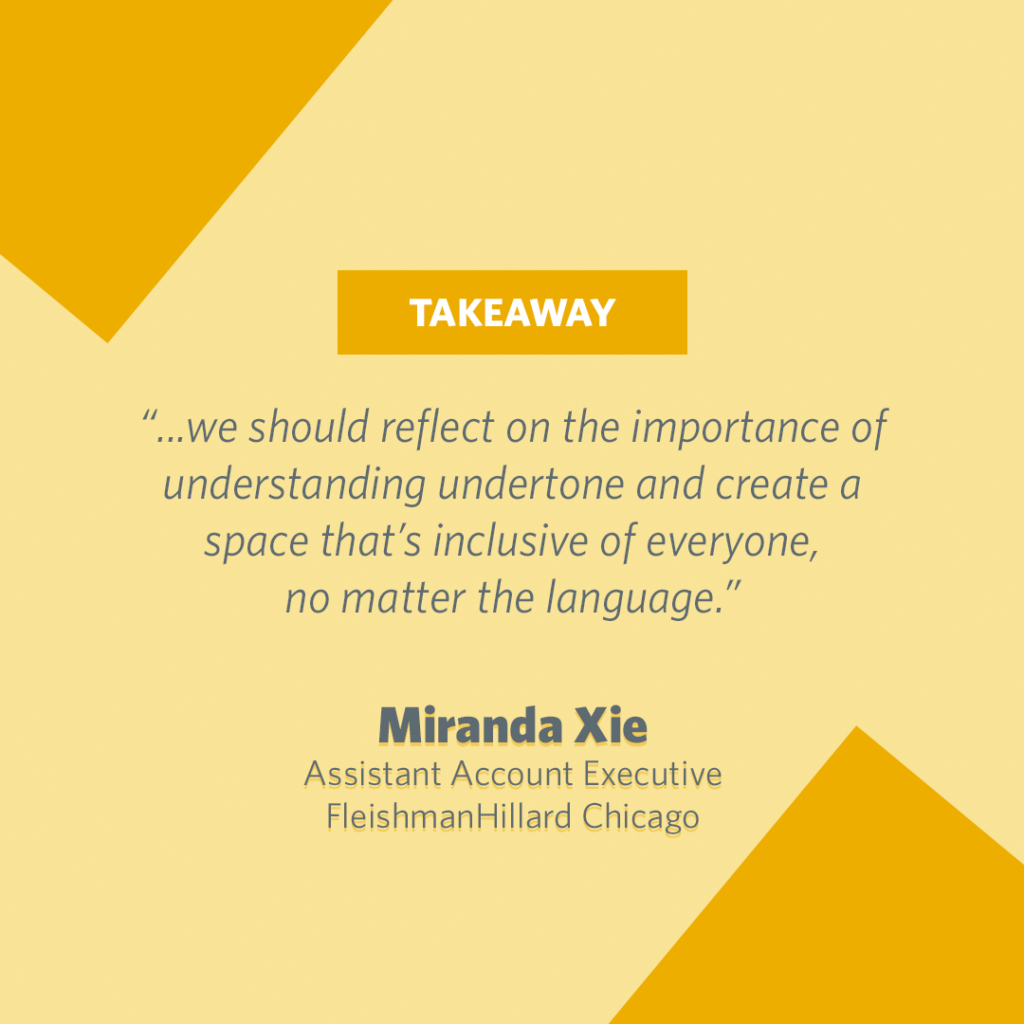
I grew up as my mother’s voice. From grocery stores, gas stations, and phone calls, I was often the one speaking on behalf of my mother. She, who I looked up to as my childhood hero, just wasn’t comfortable speaking in English. Both my parents immigrated from China to California before I was born, so I was raised speaking their familial language, while learning to speak English with my friends and classmates.
At home I speak Cantonese, a spoken language that exists in the southern regions of China. My parents also sent me to Chinese School every weekend, where I learned Mandarin, the main native language of China.
As the honorary interpreter for my parents, I realized at a young age how important connotation can be in conversation. Sometimes the direct translation of a word doesn’t epitomize the meaning, leaving little room for error and the potential to easily steer a conversation the wrong direction.
Understanding the variety of connotations also allowed me to see the differences between my parents’ perspective of the world as Chinese immigrants and my perspective, an English-speaking, first-generation American citizen. Over time, my interest in communications and public relations stemmed from my bilingual experience. It broadened my point of view and showed me the impact language has on how one speaks, listens and believes.
Miranda Xie, assistant account executive
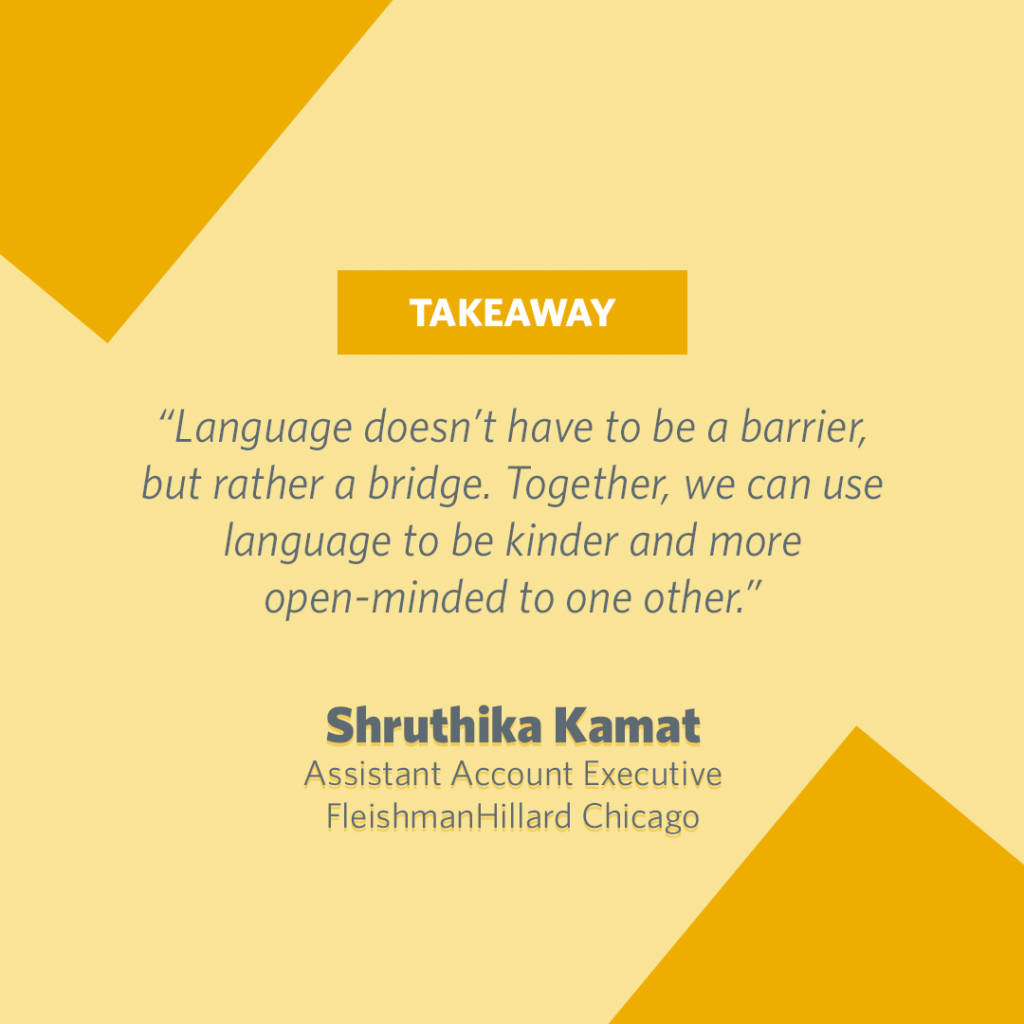
As a first-generation Indian American, I grew up speaking, learning and listening to many different Indian languages at home. While we speak Konkani, pop culture and my parents’ childhoods in Mumbai allowed us to learn Hindi as well. This multilingual foundation was set up even before I started school, with my parents switching from Konkani and Hindi to English in front of me.
As I grew up, however, I faced second-hand embarrassment of my background and, like most first-generation kids, did the most to make sure I fit in with the rest of the kids at school. This thought process bled into the way I saw my parents, as I often found myself embarrassed whenever they would mispronounce something while ordering food or shying away from their heavy accents in public. I would frequently correct them, looking down on the fact that they were unable to speak what I saw as basic English. I never stopped to think about how incredible it is that my parents, my hardworking, immigrant parents, were able to speak so many different languages, and how my closed perspective contributed to their struggle for acceptance.
Now as I reflect on my experience, growing up as a multilingual, first-generation daughter of Indian immigrants has taught me to live life with an open mind. Appreciating cultures and different languages is important today more than ever as we have become so interconnected both professionally and across our personal lives. While it may not seem like a big deal for those of us who have grown up in America, inherently balancing different cultures and knowing and understanding multiple languages is something to be proud of and should be celebrated.
When you encounter someone who didn’t grow up with English as a first language, I encourage you to take a step back and approach them with understanding, instead of jumping at the chance to correct them or target their mispronunciations with judgement. Take the time to appreciate their efforts and who they are as people.
Shruthika Kamat, assistant account executive
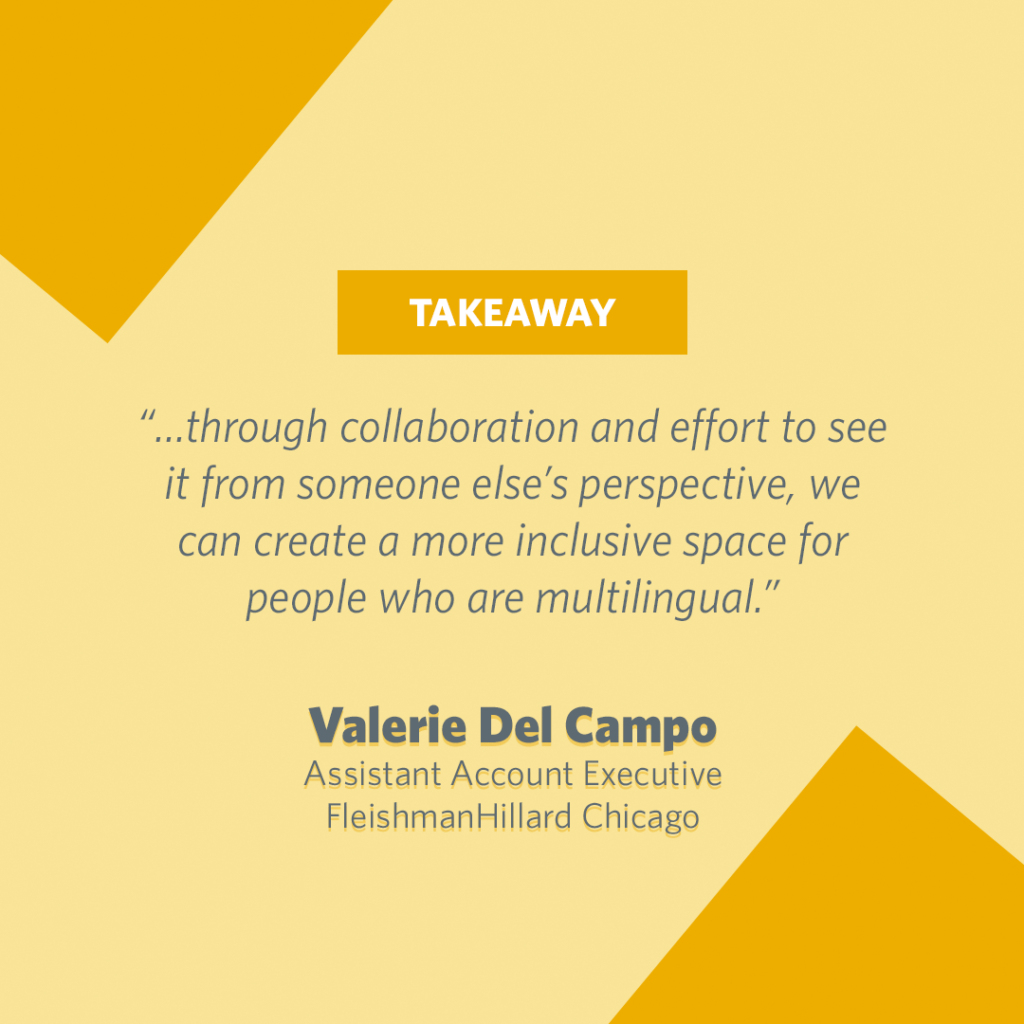
I was born in Guam and raised in America. I moved to the U.S. when I was almost six years old and consider English to be my first language. My family speaks Ilocano, a dialect of the Philippines, but the main dialect is Tagalog.
When I first moved to the U.S., I was self-conscious about the way I spoke. Sometimes an English word is not pronounced the same when you have a Filipino accent or grow up speaking a dialect of the Philippines. For example, instead of saying futon in our house, it was pronounced “puton.” I constantly compared myself to my peers because I felt like I didn’t speak or write as well as them. I would wait for someone pronounce a word first before I would say it, or dread being called on in class to read aloud because I was afraid of being laughed at.
To this day, I am still conscious about the way I pronounce things and how they appear on paper. As I grew in my career, I remember being so nervous to write my first press release, my first blog post for a company and even my first professional email. At first, it was discouraging to get edits because my insecurities of growing up mispronouncing my words or not saying the right word would come flooding back.
Although these feelings resurface occasionally, growing up with exposure to multiple languages has allowed me to connect more with my culture and with my parents. Being multilingual does not mean you are less than, it means you are a better listener, speaker and advocate.
Constructive feedback helps us grow and allows us to keep improving in our craft, though we should also be conscious of the way we deliver this feedback. First, we should take the time to learn about our peers and know that sometimes tenses or pronouns are different in another language. Also, consider asking the person what they meant or to clarify what they were trying to say instead of assuming. By doing so, we can work together on creating spaces for everyone to bring their full selves to work.
Valerie Del Campo,assistant account executive
Interested in joining our global business? We want to work with more bridge builders. View our job openings here.
See what else is happening
You might also like
ESG
Navigating Conflicting Demands to Advance Climate Action
January 20, 2025
Opinions
Supporting St. Louis Institutions Dedicated to Empowering Youth Through FH4Inclusion
January 15, 2025
Awards
FleishmanHillard Earns Perfect Score on 2025 Human Rights Campaign Foundation’s Corporate Equality Index
January 7, 2025
Opinions
Revitalizing the San Francisco Community with the Downtown Volunteer Coalition
December 23, 2024
Expertise
Responsible Business: Navigating Today’s Challenges and Opportunities
October 22, 2024
Inclusion
Recognizing the power of the LGBTQ Community in Advertising & Media with GLAAD
October 11, 2024
Opinions
FleishmanHillard and FH4Inclusion Teams Shine at the Cannes Lions International Festival of Creativity
August 28, 2024
Opinions
Bridging the Generational Divide with Generative AI
August 27, 2024
Expertise
How to ensure access and opportunity for Black and diverse students and professionals interested in working in sports
Beyond the Labels: A Deeper Understanding of Diverse Identities in the Pursuit of Genuine Brand Connections
September 14, 2021
By Isabel Abislaiman
Share
We adopt labels at an early age. It’s part of how we discover patterns, learn naming and grouping, and generally what guides our communication and understanding with everything around us, from objects and events to feelings and people.
When it comes to how we describe and define who we are – complex, multi-dimensional beings – our deep and rich personal identities can pose a challenge in terms of how we navigate a world filled with labels that don’t always fit.
We can’t live life entirely without labels – we depend on them as a source of knowledge, to inform, to categorize, to simplify and sometimes even to rationalize understanding and decisions. But it’s also true that when we use labels to describe human beings, or a group of people presumed to be the same, we can lose sight of how commonalities and differences co-exist to shape people and different points of view. That deeper understanding is an essential part of personal growth and reflection, but also of meaningful and authentic connections between people, and between companies, their employees and their customers.
When it comes to Hispanics and Latinos living in the U.S., we’re talking about a population of more than 60 million who encompass cultures and heritage from more than 20 different countries across South America, Central America, the Caribbean and other Spanish cultures. Whether we use the label Hispanic, Latino, Latina, Latine or Latinx, there’s no single world capable of precisely and completely capturing the range of identities and lived experiences within these communities.
Further confounding the categorization are the other dimensions of identity that shape who we are, from race to socioeconomics and diverse cultural influences. They impact everything from how we’re raised to the experiences we have, how we self-identify, how others see us and how we think others see us.
U.S. Hispanics and Latinos can be of any race; not all U.S. Hispanics and Latinos speak Spanish; and no, Hispanic and Latino are not actually synonymous terms. And so, we come back to that singular truth: we are not all the same. The complexity is clear but so is the path for leaning into it to foster deeper understanding and genuine relationships.
In this third installment of the True MOSAIC Racial Reckoning series, Life Beyond the Labels: The Role of Intent and Inclusion in Authentic Brand Connections, we’ve leveraged the expertise and lived experiences of our FH Hispania, TRUE Global Intelligence and True MOSAIC practices to explore what it means to be intentionally inclusive in our search for cultural relevance and meaningful connection.
Here are three reasons we felt it was important for us to bring these perspectives together and what we hope you’ll take away from reading the report and the insights that informed it:
Connections don’t happen by accident. The first step is to be intentional about investing in your desired impact or outcome. If the goal is to reach a specific audience, invest the resources needed to understand not just who they are and how they behave but why. What is it about the way they see and experience the world that shapes the decisions they make?
Centering inclusion in intelligence and information gathering brings depth and dimension. This prompts us to ask more, and different, questions – from those that aim to determine where someone is from and what language they speak to those that examine experiences and feelings.
Being intentionally inclusive fuels and inspires curiosity, critical thinking, imagination and the pursuit of deeper understanding. If we challenge ourselves to look beyond the labels, to search for inclusive answers and to believe in the power of perspectives, we are empowered – in the process – to be more inclusive and to create genuine connections.
Creating Agency Within Agencies: Women of Color & Careers with Intention
September 10, 2021
Share
When: Wednesday, September 15, 12 p.m. CT
Where: Online Event
Register for the ColorComm event presented by Omnicom Public Relations Group here.
How can communicators create personal agency within an agency?
During this ColorComm event on September 15, presented by Omnicom Public Relations Group, Della Sweetman, FleishmanHillard’s chief business development officer, will join Soon Mee Kim, chief diversity, equity and inclusion officer at Omnicom Public Relations Group; Ayanna Robinson, chief client officer at Porter Novelli; Rema Vasan, global president at Marina Maher Communications and Lindsay Wagner, senior vice president, head of DEI, North America at Ketchum to discuss how they’ve built successful careers on their own terms, how to lead and live with purpose and more.
FleishmanHillard and Omnicom Agencies Support the International Paralympic Committee Launch of #WeThe15
August 19, 2021
Share
FleishmanHillard, Porter Novelli and Portland have teamed up with the International Paralympic Committee (IPC) and adam&eveDDB to launch a global integrated campaign that sets out to become the world’s biggest human rights movement for persons with disabilities. […]
The Role of a Joint Agency-Client Charter in Mental Well Being
August 10, 2021
By Ali Gee
Share
The numbers in the PRCA’s mental wellbeing report in October 2020 made for grim reading: nine out of ten PR professionals reported struggling with their mental health. […]