Employee Login

Enter your login information to access the intranet

Enter your credentials to access your email

Reset employee password

Article

A New Approach to Modern Comms: What It Takes to Win in a World Defined by Uncertainty

August 19, 2025
By Michael Moroney, Elizabeth Cook and Michelle Mulkey

FleishmanHillard launches The Modern Comms Calibration ahead of the 2026 communications planning season

Uncertainty is no longer a passing phase. It’s the new default for business. From fragmented media and cultural volatility to shifting regulation and political polarization, change is now constant. Communicators have been on the frontlines of this evolution, and as a result, communications leaders have earned a seat at the table.

Over the last several years, the function has grown in importance, with communications teams tirelessly managing stakeholder expectations, protecting reputation, and influencing business strategy, moving far beyond writing traditional PR plans. But as we adapt to an environment of never-ending uncertainty, the bar is shifting again.

High-performing teams have built systems to manage constant crises and reclaimed time for proactive, reputation-defining strategies. They’re building messaging and thought leadership POVs that spotlight what business leaders have to offer by leveraging audience data and emerging media trends to drive focused, relevant conversations. And the teams making this pivot, from the trenches to the track, are amplifying their competitive differentiation and driving results for the business.

So how do we move more teams further, faster, toward today’s modern PR performance? The challenge is that many communications functions are consumed by the present. They’re caught up in today’s stories, issues, and shifts with too little time, space, or direction to focus on what’s next. Most teams do not lack effort. What they often lack is a shared picture of where they are going and how they will get there.

Winning starts with a function organized around today’s realities: decisive, focused, and able to navigate a complex, ever-evolving landscape. Leadership, both within communications and across the business, must set a clear direction and hold teams accountable.

To help clients assess where they stand and where to focus, we developed The Modern Comms Calibration.  It’s a fast, practical diagnostic that assesses a communications team’s maturity and provides a clear path forward. We use it to align leaders, sharpen priorities, and accelerate results.

We have worked alongside some of the world’s most ambitious companies to modernize their communications operations. Coming out of these partnerships, we’ve identified six characteristics that set high-performing teams apart:

  • Business Acumen: The most effective communications leaders are fluent in  business strategy. They use that understanding to drive messaging, shape campaigns, and ensure the function’s outputs ladder directly to growth and performance goals.
  • Relevance and Authenticity: Winning organizations are direct and clear in how they communicate. They speak in a tone that reflects their values and connect with the culture in ways that are meaningful, not performative.
  • Audience Orientation: They know who matters most, and they adapt accordingly. These teams actively engage stakeholders where they are—across new platforms,  channels, and  formats—with an understanding that traditional assumptions about audiences no longer apply.
  • Risk and Opportunity Readiness: These teams don’t just respond quickly. They prepare early. They invest in systems to monitor risk, rehearse scenarios, and are ready to act when the moment requires it. And when opportunity presents itself, they are often first to move.
  • Data Driving Decisions: High-performing teams define success in business terms, not just media metrics. They track performance and feed those insights into planning and prioritization. They understand what is working, why it’s working, and where to push further.
  • AI Adoption: They are not waiting for AI to become a mandate. They are already embedding it into workflows. From message testing and stakeholder modeling to drafting and deployment, they are using AI to drive scale and precision without sacrificing trust.

These six areas are not aspirational. They are actionable. They reflect what we have seen work in the real world. And they  guide teams toward impact, not just improvement.

Communicators are under pressure. But they are also uniquely positioned to lead. With the right structure, direction, and tools, they can be the difference between reacting and winning. We’ve seen it happen. And we’re ready to help others make it real.

Article

Leading Through Complexity: What Higher Ed Communicators Are Saying

July 25, 2025

What one word best describes your day-to-day work? 

That was the icebreaker posed by FleishmanHillard’s Sarah Francomano, who hosted and moderated a candid dinner conversation among senior higher ed communications and marketing leaders. Responses like “firefighter,” “pivot” and “controlling chaos” weren’t said for dramatic effect—they reflected the current state of the higher ed landscape. The group all concurred that leading communications in higher education today is intensely complex, often chaotic and always high stakes.

The conversation was twofold, starting with discussions around what senior leaders are currently seeing in higher education. Then, the conversation moved to what’s next and how higher-ed professionals can leverage AI and other emerging tools to support them in their roles.

The Current Reality: Complexity and Constant Pressure

Communications leaders in higher education are facing unprecedented, often competing demands—with the stakes higher than ever. A single misstep can trigger consequences ranging from trustee backlash to federal scrutiny. Plus, in an environment where issues are deeply personal and highly visible, it’s often the job of the communications team not just to respond, but to cut through the noise, determine whose voices matter most in a given moment and identify which relationships need to be prioritized in order to guide the institution through crisis or change.

Participants shared their experiences managing a high volume of inquiries on a consistent basis from students, parents, alumni, donors, faculty, media and the general public on issues pertaining to their schools. One participant described a case where their team received more than 10,000 emails in response to a global crisis. After sorting through all of the messages, they found that only a small fraction came from individuals actually affiliated with the institution. It was a telling example of how the general public’s perspective does not always reflect the opinions of key stakeholders who have an impact on a university.

Others spoke about the weight of deciding when—and whether—to issue public statements. Choosing to speak up on a cultural or political moment may be the right call in one case, but it often sets expectations for the next moment. The act of staying silent can also become a message, leaving universities at risk of receiving backlash. One communications leader noted that even a simple interaction with a reporter can draw the institution into a larger story, whether they want to be part of it or not.

Enrollment also surfaced as a key pressure point. Some schools are dealing with declining numbers and budget shortfalls; others are seeing higher-than-expected demand. Several attendees commented on the long-term risks of tuition discounting—the idea that while short-term financial aid boosts can help meet yield goals, they may also chip away at perceived brand value over time. Once an institution begins competing on price, it becomes difficult to return to a different model.

The Future: How AI is Shaping Strategic Readiness

Toward the end of dinner, the conversation shifted to some of the solutions now available to address the challenges that come with working in higher education. The group was introduced to a live AI-powered crisis simulation, led by FleishmanHillard’s Alex Lyall. The FH Crisis Simulation Lab draws from real-world crisis events and FH simulation methodologies and presents users with unfolding scenarios in the form of projected stakeholder reactions. Unlike traditional simulations, which are static, this AI-powered tool is dynamic in nature, responding to the real-time decisions of participants by evolving the crisis scenario to reflect how stakeholders might respond.

When the demo immersed participants in a campus protest scenario, the group decided to put the tool through its paces and selected the most aggressive response, forcing demonstrators to disband by a set deadline. The result generated backlash, escalation and reputational fallout in the form of emails, social media posts and media coverage, mirroring how a crisis team would experience these types of situations.

Participants were quick to note how well the tool captured the complexity and pace of an actual crisis. The AI agent mapped out the often-conflicting reactions across stakeholder groups—students, faculty, alumni, media, donors—and showed how quickly one decision can lead to a cascade of consequences. Later in the simulation, when the team chose how to correct course, the tool was prompted to generate internal and external holding statements that offered strong, usable drafts that could be easily customized to fit the voice of an institution.

Participants saw clear potential for the AI agent as both a training and planning resource—especially in conversations with boards or leadership teams. It provided a structured, precedent-informed way to explore how crisis scenarios might unfold, helping teams evaluate why one communications path might be more effective than another.

Alex shared that while this particular demo was generic, the FH Crisis Simulation Lab can be tailored to reflect each school’s culture, governance structure and audience. Even those in the room who were skeptical about AI said they could see its value in this kind of application—not to replace human instincts, but to sharpen and support them.

Going Forward: Navigating Reputational Complexities

The evening was a chance to connect with peers, swap stories and explore fresh ideas about what the future of higher ed looks like. It was an invigorating conversation that left many in the room feeling energized and inspired.

Higher ed communications may be complex, sometimes chaotic and full of tough calls—but it doesn’t have to be faced alone.

Article

The Friends You Never Knew You Needed: Why IT and Communications Must Team Up

July 24, 2025
By Scott Radcliffe

Trust is at the heart of every successful organization. In today’s digital landscape, that trust is built—and sometimes shattered—by how well you protect the data on your network. Reputation is hard-won and easily lost, making it a favorite pressure point for cybercriminals and regulators alike.

Over the past several years, threat actors have shifted tactics. Rather than relying solely on operational disruptions driven by ransomware, groups like Lapsu$ have gone as far as exposing sensitive corporate data without warning or attempted extortion, as seen in their attacks on some of the tech industry’s top companies.

At the same time, regulators and government officials are turning to more and more public responses related to cybersecurity, tightening their grip on corporate reputations through new rules and public scrutiny. With more stringent regulations and increased public reporting, organizations are being held accountable for how they manage and protect sensitive information. Meanwhile, a more cyber-savvy and skeptical public is quick to notice, and react to, any missteps.

Reputation and Technical Cyber Risk: A New Partnership

As the link between reputation and cyber risk grows stronger, IT and Communications teams can no longer afford to operate in silos. Their collaboration should go far beyond crafting post-incident press releases. Here’s how these two critical teams can—and should—work together:

  1. Translate Complexity into Clarity:
    Technical teams understand the risks. Communications teams know how to craft messages that resonate. Together, they can ensure clear, concise explanation of core policies, risks, and responses both internally and externally.
  2. Build a Culture of Security:
    It’s not just about what you say, but how you make it stick. Developing a thoughtful strategy for culture change ensures that security messages are truly internalized throughout the organization.
  3. Plan for the Unexpected:
    Effective scenario planning for data security and privacy risks requires tight coordination. Legal, technical, and Communications teams must work hand-in-hand to prepare for—and respond to—potential crises.

The Benefits of Collaboration

When IT and Communications join forces, the results are tangible:

  • Stronger organizational alignment and buy-in
  • Increased compliance with policies and regulations
  • Faster, more effective crisis response

The specifics of this collaboration will vary but the playbook begins with early alignment on goals, KPIs, desired outcomes and a plan for communicating information to the appropriate stakeholders. Starting before a crisis hits ensures everyone in the organization is working towards shared outcomes.

The threat landscape is only growing more complex and dangerous. While technical defenses are essential, they’re not enough on their own. Real security comes from building awareness, engagement and trust across every level of your organization.

If cybercriminals are evolving their tactics, organizations must evolve, too—not just in how they defend against attacks, but in how they think about and communicate cyber risk.

Scott Radcliffe width= Scott Radcliffe is FleishmanHillard’s global director of cybersecurity, leading the firm’s Cybersecurity Center of Excellence and advising clients on rising cyber risks. He recently rejoined FH from Apple, where he led cybersecurity communications and previously served as the agency’s senior global data privacy and security expert.

 
Article

AI Is a Business Imperative, But It’s a People Challenge First

June 12, 2025

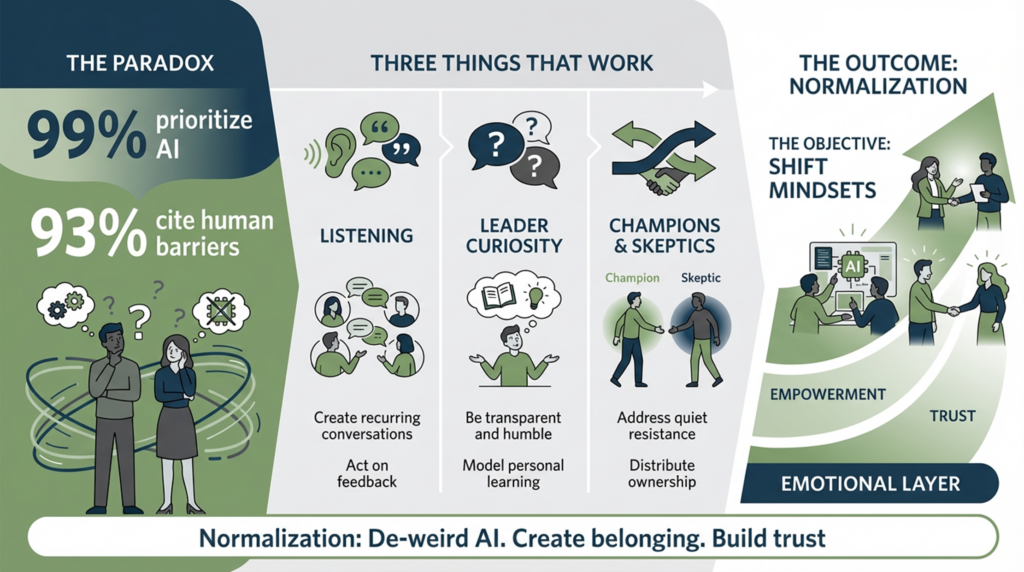
As AI continues to reshape industries, organizations must take proactive steps to engage their workforce in these emerging technologies or risk falling behind. In this series, we will share insights to help leaders ask the right questions, engage and empower their teams, and position their organizations for long-term success in an AI-driven world.

Driving a People-First Adoption Strategy

Whether you work in IT, finance, healthcare, manufacturing, retail, agriculture or any other space—you can no longer afford to view AI as a future consideration. The time to prioritize AI was yesterday. As we enter the second half of a century-defining decade, the gap between companies that empower their workforce for AI-driven change and those that resist it will only continue to widen.

Yet many face real tension—move too quickly, and risk confusion, backlash or missteps that expose the business to unnecessary risk; move too slowly and fall behind competitors or miss out on transformational opportunities. The right path isn’t at either extreme. It’s a disciplined, step-by-step journey rooted in clear communication and a people-first strategy that helps employees navigate disruption with clarity, support and agency. The more planful your organization is, the more equipped you will be to ride the tidal wave of AI innovation coming your way.

A multidimensional approach requires effective communication, cultural readiness, engaged leaders, a skilled workforce, robust infrastructure, and organization-wide AI alignment.

Embracing the Four Pillars of AI Readiness

Future-focused leaders must think critically about how their people, at every level, are thinking, feeling and acting in response to AI-driven change. True readiness goes beyond systems and strategies and is rooted in your people.

Culture

Cultural readiness is about how employees feel—whether they are curious, confident or concerned about AI’s impact on their work. Organizations should create space for conversations about the future of work, and how roles may change in the age of AI. Communication and training must address hesitations directly and intentionally to build belief, trust and understanding around AI’s potential.

Leadership

Leaders need to model behaviors that build trust, safety and resilience during AI transformation. Visible champions of change will reinforce the connection between AI initiatives and the broader business strategy, and create an environment where employees feel supported, empowered and motivated to engage with new technologies.

Knowledge

Bridging knowledge gaps calls for a focus on both skillsets and mindsets. Organizations must explain why AI matters, how it impacts roles and how employees can use it to thrive.

Infrastructure

While infrastructure decisions may reside within IT, communications play a critical role in translating what system changes mean for employees. Communicators are essential to clarify how tools and changes will support safer, better ways of working.

Building this foundation across culture, leadership, knowledge and infrastructure is essential, but understanding your organization’s starting point is just as critical. By asking the right questions, you can identify strengths to build on, vulnerabilities to address and opportunities to align your teams around a clear, honest path forward.

Assessing Your Employees’ AI Readiness

AI transformation is a cross-functional effort, requiring coordination across the executive team, operations, technology — and critically, communications. Communications teams play a pivotal role in assessing organizational readiness, shaping a corresponding narrative around AI adoption and building trust across the organization. Asking yourself these questions can help clarify where your organization stands and where to go next:

Culture

  • Are leaders and employees open to AI adoption?
  • Do employees perceive AI as a threat or an opportunity?
  • Is there a clear understanding of how AI can benefit the company?
  • Does our culture support innovation and experimentation?
  • Do employees feel safe raising concerns, questions or ideas about AI without fear of judgment?

Leadership

  • Is AI a strategic priority for company leaders?
  • Are leaders visibly modeling openness, curiosity and resilience around AI change?
  • Are leaders connecting AI initiatives to the company’s broader mission and purpose in a clear, human-centered way?
  • Are leaders actively listening to employees’ concerns and ideas about AI and incorporating that feedback into decision-making?
  • Are AI investments aligned with business strategy and long-term goals?
  • Do executives understand the risks and opportunities of AI?

Knowledge

  • Are employees clearly informed about how AI systems will impact their work?
  • Do employees have AI-related technical skills?
  • Are there AI literacy programs for nontechnical staff?
  • Is there a talent acquisition strategy for AI expertise?
  • Are employees given clear examples of how AI will make their jobs easier, more impactful or more strategic?

Infrastructure

  • Are AI policies, governance, ethics and security protocols communicated clearly to employees?
  • Are concerns about AI openly acknowledged and addressed in communications?
  • Does our organization have a dedicated function/team or clear points of contact for our AI efforts?
  • Are new AI tools introduced with practical training and ongoing support?

What’s Next?

Start with what you know. If your people seem unsure or skeptical, focus on building trust and curiosity. If your leaders lack engagement, explain why AI matters and provide a framework they can use to model the mindset you want to see. AI readiness is about steady, people-first progress — not perfection. Steps forward could look like any or all of the following:

  • Live AI demo during an upcoming meeting
  • Fireside chat with a leader exploring the why and how of your company’s AI strategy
  • AI checklist outlining ways your organization can use AI to increase efficiency and drive business outcomes

There is no one-size-fits-all path to making an organization AI-ready, but leaders who critically examine their current state and take decisive action will be better positioned to thrive. The success of any AI initiative hinges on how well people understand and adopt it. Clear communication and strategic alignment are essential, and that’s where we can assist — helping you navigate change, engage and align your workforce and ensure a smooth transition.

Elana Sindelar Elana Sindelar works in FleishmanHillard’s Talent + Transformation practice with experience in change management, employee experience and internal communications. She has supported clients through major IT transformations, corporate rebrands and M&A activity. Elana currently focuses on exploring AI’s effect on the future of work, including how the emerging technology is reshaping the employee experience.

 
Article

Stability with an Edge: A Report on China’s 2025 Economic Priorities 

March 21, 2025

China has set a 5% GDP growth target for 2025, signaling a focus on measured expansion amid evolving global and domestic conditions. Backed by a 4% deficit-to-GDP ratio, policymakers are emphasizing investment in infrastructure, innovation and industrial modernization to drive sustainable progress. 

Every China’s Two Sessions meetings highlight a roadmap for the country’s priorities, and this year underscores a shift toward long-term resilience. Sectors like AI, 6G, advanced manufacturing and clean energy are receiving increased attention as China works to strengthen its competitive edge. 

What Does This Mean for Global Businesses? 

China remains a key market for international companies, with policies aimed at boosting domestic demand and fostering high-quality growth. While opportunities in trade and investment continue to expand, evolving regulatory frameworks and market shifts may require businesses to adapt their strategies. 

Explore our latest report from our FleishmanHIllard China Public Affairs Team, Two Sessions 2025: Maintaining Stability While Achieving Progress, for insights on China’s economic outlook and what it means for global industries. 

Click the image below to learn more.

Article

Corporate Affairs Trends for 2025

December 17, 2024
By Christopher Onderstall

We’re pleased to share that our latest 2025 Corporate Affairs Trends Report is out! Using data and research, our team has forecast key trends for 2025 that corporate affairs leaders and anyone doing communications with an element of corporate, reputation, crisis or risk mitigation ought to be preparing for now.

The post Corporate Affairs Trends for 2025 appeared first on United Kingdom.

Article

Davos Digest 2023 – Issue Five

January 20, 2023
Mountain view of Switzerland

Welcome to Issue Five of FleishmanHillard’s Davos Digest 2023. 

Views from around the world 

It’s been a hectic week for our team of avid WEF watchers, exploring the hottest events, announcements and even scandals amongst the super-rich and the über-powerful at the first proper Davos since the pandemic. 

An inevitably sombre agenda this year, tackling everything from war and climate catastrophe to energy price chaos and widening inequity. There were major job cuts at tech giants, attacks on profit over people and the planet, and the conspicuous absence of top-tier heads of state. But hope was the surprise guest at Davos, as the elite crowd also expressed optimism about the recent slowdown in inflation, a bounce back from the coronavirus, and adjustment to the impact of the war in Ukraine. 

But it’s not over yet. In this issue, hear global perspectives on the Swiss summit of all summits from our experts across the FleishmanHillard network. 

Brussels, Belgium

Amelie Snijders, Senior Account Executive, FleishmanHillard Brussels 

The EU takes global stage with its new Green Industrial Plan 

On Tuesday, the President of the European Commission, Ursula von der Leyen, used WEF as her platform to introduce the “EU Green Deal Industrial Plan”. In recent weeks, the EU has been under pressure to provide a response to the U.S. Inflation Reduction Act (IRA), which many fear might damage the competitiveness of EU industry. Tuesday’s announcement illustrates Brussels’ focus on channeling investment towards sectors that are critical to the EU’s achievement of its net-zero targets.  

As part of the Plan, in classic EU fashion, it will publish a new Net-Zero Industry Act to identify the strategic clean tech sectors in Europe – such as wind, solar and hydrogen – which could benefit from both increased investment and fast-tracked permitting procedures for local production. Secondly, the EU will revamp its state aid rules, loosening the conditions under which governments can support their national industries. As a next step, it will also assess the willingness for a new EU Sovereignty Fund to scale up clean tech. Lastly, it will attempt to increase skills levels, and conclude more free trade agreements. 

This move towards a stronger industrial policy is expected to be welcomed by European industries that have been suffering from high inflation rates and the ongoing energy crisis. Nevertheless, it is likely to unleash a new wave of debate over which sectors should be considered as strategic to the green transition. In this respect, it could align with the sectors supported by the U.S. IRA to prevent the risk of EU industries relocating across the Atlantic. Despite this, the EU is adamant it is not closing the door on free trade. Instead, it is forging its own path, combining decarbonisation with a more pragmatic financing approach to maintain its place in the green industrial transition. A journey worth keeping an eye on. 

HONG KONG SAR, CHINA 

Christina Wong, Account Executive, FleishmanHillard Hong Kong 

Hong Kong: Open and back in business 

China’s recent reopening and its role as a driver of global economic growth has been a key topic, especially of late. With so many changes at home, it’s understandable that few high-profile Hong Kong attendees were at Davos this year. Nevertheless, the media watched as Hong Kong’s leaders took to panel discussions to update the world on the latest happenings in the Hong Kong market. 

Laura Cha Shih May-lung, Chairman of the Hong Kong Exchanges and Clearing Limited (HKEX), stated that China’s reopening will be the major event of the year. She outlined several expected benefits to global and domestic growth, focusing on increased consumption, tourism and pickups in the manufacturing sector. Cha reaffirmed Hong Kong’s goals to become a hub for technology, particularly biotech. Lastly, she said that emerging markets, which remained resilient during the pandemic, will also be growth drivers as investor sentiment returns. 

Paul Chan Mo-po, Hong Kong’s Financial Secretary, also spoke at Davos. Like Cha, he pointed out expected increases in tourism and consumption as well as “signs of a stabilization” in Hong Kong’s property market. Chan was optimistic about the city’s IPO market and stated that the city hopes to lure Southeast Asian and Middle Eastern companies to list in the city, saying that Hong Kong can help them diversify and manage risk. 

In another panel, Nicholas Aguzin, CEO of HKEX, pointed to the consumption and tourism sectors as the greatest beneficiaries from reopening, particularly with increased disposable income from Chinese consumers. Aguzin also expressed optimism about Hong Kong’s IPO market, saying that HK has a strong line-up this year, particularly in tech. 

Though the past few years have left Hong Kong facing an uphill battle, Asia’s World City is aware of its strengths and is doing its utmost to leverage them. Only time will tell whether Hong Kong will step back into its pre-pandemic role or write a new story for itself. 

LONDON, UK 

Michael Hartt, Senior Partner and Head of International Affairs, FleishmanHillard UK 

United Kingdom: Davos Shows the Difficulty Now, Uncertainty Ahead  

As ever, Davos prompted a debate – sometimes genuine, sometimes mocking – amongst UK media, business leaders and other stakeholders about the impact of a summit of global elites. This year brought a particular sense of the disconnect between the UK’s acute challenges and the discussions in Switzerland, even amongst those who embrace the annual meeting.  

The ‘polycrisis’ debated at Davos is having a real-world economic and social impact upon British people. The cost-of-living crisis, a winter of strikes by public sector workers, and a National Health Service seemingly on the verge of collapse both reflect and cause pain. We will hear more about extreme wealth versus extreme poverty in the months ahead. 

The broader economic picture is equally conflicted. The UK remains the only G7 country with a lower GDP than pre-pandemic and on a negative growth trajectory. While former Bank of England Governor Mark Carney praised the UK’s potential at Davos, some economists back home warned of another decade of stagnancy. Comparisons to Italy and Argentina, rather than the U.S. and Germany, popped up in several places. 

With Prime Minister Rishi Sunak skipping Davos and introducing the UK’s ‘Levelling Up’ local investment funds, Labour Party Leader Sir Keir Starmer and Shadow Chancellor Rachel Reeves seized the opportunity to strengthen the party’s relationship with global business leaders. Labour continues to hold a 15-20 point lead over the Conservatives, but reinforcing its credibility on economic issues will be vital. That includes articulating Labour’s ambition to improve post-Brexit economic and trade ties with the EU. 

UK leaders carefully avoided becoming entangled in the growing trade and investment tensions between the U.S. and EU. The country cannot jeopardise the relationship with the White House by criticising or retaliating against the Inflation Reduction Act’s green investment incentives, but must ensure it is not cast aside by businesses as the U.S. and EU turbocharge green industries.  

And this may be the UK’s takeaway from Davos. With difficulty now and uncertainty in the future, how does one of the world’s leading economies, currently sluggish and vulnerable, simply not get left behind?  

POLAND

Anna Jankowska, Associate Director, FleishmanHillard Warsaw 

Poland: Bridge to Freedom 

The main theme of the Polish House at this year’s Davos was chosen to accentuate humanitarian aid provided to refugees from Ukraine, while underlining Poland as a country connecting economies of the East and West, and a potential foreign investment destination in the era of deglobalization. 

“Never before has Davos been so close to Kiev” underlined Polish Prime Minister Mateusz Morawiecki during a press conference, clearly indicating that Ukraine remained at the center of attention and discussions led during Davos focusing on military support, as well as the future prospect of rebuilding the country from post-war damage. Major leaders discussed the prospects of NATO 2023 Vilnius Summit and the Allies’ future role in supporting Ukraine.  

During the Polish House debates, it was emphasized that recent years have shown the fragility of current supply chains, which have been disrupted or even completely broken during the pandemic and the Ukraine war. The current global situation favors a transition to the approach of international business from globalization to regionalization. This is a very important moment for Central and Eastern Europe and particularly Poland, which is a key market in the region being closer to investors, and with the potential to become a regional manufacturing and operations hub for investments from Asia or new investments. As highlighted, Poland’s strengths include consistent GDP growth and the economy’s resilience to crises, NATO membership and allied security guarantees. EU membership also gives investors in Poland access to the European single market with a favorable business environment, but also to an exceptional talent pool.  

Energy sovereignty, accelerated technology development, cybersecurity and the digital economy were other areas that stood out on the agenda. During one of the debates, Polish Deputy Prime Minister and State Assets Minister, Jacek Sasin, underlined that energy independence is a priority in the context of Europe’s future and indicated nuclear power as a way to address contemporary energy challenges. He also made a commitment to launch three new nuclear power plants in Poland in the next 10 to 12 years. 

WASHINGTON, D.C., U.S. 

Michael Schmidt, Partner and Public Affairs Lead, FleishmanHillard Washington, D.C. 

U.S. officials catch flak for Inflation Act amid debt concerns 

The U.S. highlights for this year’s Davos were global angst about the Inflation Reduction Act enacted last year, whether the U.S. would default on debt due to political dysfunction caused by divided control of Congress, and staunch support for Ukraine expressed by lawmakers from both parties.  

The gathering was snubbed by the White House and the most senior Biden administration officials. As Bloomberg wrote “there was a low-level grumble: Where are the Americans?” 

John Kerry, former senator and secretary of state who now serves as the U.S.’s climate envoy, was there, generating headlines in the U.S. for defending the UAE’s decision to make their oil minister president of the UN COP28 climate summit being held later this year. 

But U.S. media coverage gave far more attention to current members of Congress, especially Senator Joe Manchin, the moderate Democrat influential in key bills lawmakers have debated over the past few years. Politico dubbed Manchin the “newfound Davos Man” for shuttling around the forum, trying to persuade allies about the Inflation Reduction Act without success. European officials believe the new law and its $380 billion in incentives for clean and low-carbon technologies discriminate against their manufacturers. 

Senator Chris Coons, a close ally of President Biden, and other members of Congress caught flak for the law, throughout the week. As a CNBC headline blared, the “threat of a transatlantic trade war is dominating Davos.” 

Manchin and Senator Kyrsten Sinema’s high five for opposing lowering the long-standing Senate filibuster, which forces bipartisanship by requiring bills to get 60 votes to clear the chamber, received significant attention from U.S. reporters.  

The debt ceiling was also a major topic of discussion, with headlines dubbing the “U.S. debt standoff” as a “major risk ahead for markets.” Pressure on Washington to solve the issue escalated when the U.S. hit its $31.4 trillion debt limit.  

U.S. news coverage also pointed to optimism in Davos that any economic recession would be shallow, even with the risk that Washington stumbles on the debt ceiling and ongoing concerns about the war and inflation.  

Finally, media also noted the strong, bipartisan support for Ukraine, surprising given recent Republican pushback on aid packages sought by the Biden administration.  

JOHANNESBURG, SOUTH AFRICA 

Sharon Piehl, Senior Partner & General Manager, FleishmanHillard Johannesburg  

Confronting the energy crisis  

South Africa showed strong representation at WEF this year, with a 51-strong delegation in attendance – the largest from Africa. Unfortunately, President, Cyril Ramaphosa had to withdraw at the last minute due to the ongoing energy crisis.   

This crisis set the tone for key conversations from government and business leaders at Davos, focusing on the impact on the economy and ongoing foreign direct investment (FDI).  

Over and above SA’s local issues, a critical, and ongoing focus for the South African delegation was in driving the Pan-African messaging. Including how to solve the issues Africa faces as a continent, created either by global events, such as the war in Ukraine, recovery from the pandemic, as well as local issues such as ensuring FDI continues and the possible consideration of a digital currency by the South African Reserve Bank.   

From an African perspective, the Forum Friends of the Africa Continental Free Trade Area (AfCFTA) was a keen focus. This initiative is aimed at creating one African market by eliminating borders and promoting trade and production across all sectors in Africa; coupled with trying to rally support from business across the world to bolster the implementation of the initiative.  

Given SA’s influence on the continent, the impact of the ongoing energy crisis has been and will continue to negatively impact not only on the country but sub-Saharan Africa. Ramaphosa’s non-attendance to focus on a solution, the publishing of the latest report to achieve energy security, and the delegation’s various interactions with business and key leaders to provide assurance of the appetite to resolve the crisis.  

Whilst as a country we are very aware of our challenges and the hurdles we need to overcome, it is imperative to give an impetus to a clear strategy coupled with rapid, laser-focused implementation to address the energy crisis. If we don’t, we run the risk of the energy crisis worsening, further crippling the economy and losing out on FDI, which will have massive ramifications for SA and possibly further afield on the African continent. 

DUBAI, UAE 

Ronak Thakkar, Account Director, FleishmanHillard Middle East 

The Middle East Uprising 

The Middle East has been a topic of discussion over the years for various reasons, but the geopolitical crisis and climate change are the most important part of conversations every single year.  

2023 was different for the region’s position at Davos. The UAE government reiterated its commitment to unlocking opportunities for the future through its Future Possibilities Index, Saudi brought back Youth Majlis pavilion, and a few private companies addressed the concerns of today to rebuild the economies for the future. 

The Middle East’s urgency to act was yet another thing we saw roar like a lion at the forum, for the benefit of the future and on humanitarian grounds. The regional press covered the UAE’s leadership around the need to act fast and design governments that are forward-thinking as one of the best approaches. 

At the same time, the media also highlighted the voices of Iranian women heard by Davos delegates, asking for the West to step up on an international response to Tehran’s human rights abuse. 

The unstable geopolitical relations between U.S. and China and their impact on the global economy were also heavily discussed in the Middle Eastern press. The impact not only on the worldwide energy crisis but also on the global trade flow is concerning for industry leaders. “That disrupts the market in a big way … today we need to see supply chain resilience continue, we need to see the ability to supply cargo,” commented Sultan Ahmed Bin Sulayem of DP World on the global supply chain

A record number of Arab heads of state participated in various discussions at the summit. The Middle East and North Africa (MENA) region’s efforts over the years in global geopolitical events have paved the way for the stabilization of the region. Commenting on Arab presence at Davos this year, Maroun Kairouz, WEF’s head of the MENA region said, “I think, in short, it is their time to shine”. 

It is predicted that if the world enters a recession, just like in 2008, the Gulf countries are yet again expected to be at the forefront of efforts to stabilize the global markets. 

Join us soon for an in-depth summary of Davos 2023 in Issue Six of the Davos Digest.  

Article

Davos Digest 2023 – Issue Four

January 19, 2023
Mountain view of Switzerland

Welcome to Issue Four of FleishmanHillard’s Davos Digest 2023. 

Our latest must-read instalment is kicking off with a decidedly green agenda and an attack on the conference’s elite crowd.  

Greta Thunberg created more headlines on Thursday when she and fellow activists confronted the man in charge of regulating global energy at a Fridays For Future debate. Thunberg argued it’s “absurd” to be listening to the people who are the main perpetrators of the climate crisis. To be confirmed on whether she grabbed popcorn for Oliver Stone’s new movie promoting nuclear power, which played to a packed audience at Davos. 

But it’s not only the future of planet Earth that’s at stake. The European Space Agency was pushing a ‘zero debris’ policy that would mandate companies and governments to remove any space junk launched from Earth and safeguard astronauts and spacecraft. Time will tell if action is taken now or a long time ahead in a galaxy far, far away. 

In other news, there is a mountain-sized question mark over the future of Mr Davos himself, Klaus Schwab, who has run the forum for over half a century. He’s been accused by former and current WEF employees of surrounding himself with “nobodies” and being a “law unto himself.” Former UK prime minister Tony Blair is one of the leading figures being looked at as his eventual successor. Was he really at Davos to do a recce? 

Check out the latest from our avid WEF watchers in today’s Davos Digest and be sure to return here for global and on-the-ground insights coming up soon. 

CULTURE 

Davos does DE&I well 

Looking beyond the rainbow: Continuing its commitment to DE&I, WEF’s Partnership for Global LGBTQI+ Equality launched ‘Pride on the Promenade’, a rainbow light display across the Davos Promenade. Beyond the multi-coloured display of hope, recent law changes and expansion of rights across several countries were discussed at the Advancing LGBTQI+ Rights panel, and changes in the corporate world at the GLAAD panel.  

Women of WEF: Finland’s Prime Minister Sanna Marin created another viral moment this week as she deflected questions about her “role as a very young woman in this very important job.” Whilst remarkable, this pithy moment of table-turning vindication for women somewhat overshadowed actress and activist Nazanin Boniadi as she spoke out against the continued oppression of women in Iran. 

Looking ahead: Remarkable optimism persists at this week’s DE&I conversations despite political turmoil and the ongoing global backdrop of inequality. Conversations are refocusing on pragmatic next steps and diverse paths towards equitable solutions in the face of stalling efforts around equality. With some of the most productive discussions going on, it’s no wonder Politico called the Equality Lounge on the Promenade “one of the best places to be this week.”  

CORPORATE AND CONSUMER 

What have the world’s entrepreneurs been up to?  

Scaling solutions towards a sustainable future: During the Davos press conference on Trailblazing Entrepreneurs Tackling the World’s Biggest Problems, Joe Ucuzoglu, Global CEO of Deloitte, explained that if we are going to make headway, we need to tap into entrepreneurial spirit across all areas of the globe. Ucuzoglu said scaling innovative start-ups, which will accelerate progress towards our global sustainability goals, is our path to cities of the future.  

Join the ‘eco-preneur’ revolution: During a press conference, Suzanne DiBianca, Chief Impact Officer at Salesforce, echoed the Deloitte CEO’s remarks, expressing how incredible it is to see innovation developing at a global scale. The ‘eco-preneur’ revolution, as she calls it, is a big part of Salesforce’s work. Climate-minded entrepreneurs have helped the company use a carbon intelligence platform, like Moody’s credit ratings system, but for carbon projects using satellite technology. DiBianca argued we need to join the effort led by climate-minded entrepreneurs. 

Social entrepreneurs educating our youth: Okay, but let’s get specific. How are entrepreneurs really tackling the world’s biggest problems? Lindiwe Matlali, CEO of Africa Teen Geeks, explained how this social enterprise teaches children and unemployed youth how to code, exposes them to computer science and inspires a future generation of technology entrepreneurs and innovators. Research suggests there are millions of social entrepreneurs working in Africa, and social enterprises are estimated to directly create between 28 and 41 million jobs. Matlali reaffirmed that investment in young people is the long-term way to go.  

Looking ahead: What’s next for our corporates on the final day of Davos? We’re talking start-ups. geopolitical tensions, inflation and supply disruptions impacting start-ups worldwide are resulting in a lack of free-flowing capital. What’s the new formula for calculating the valuation of a start-up? We’ll soon find out. 

HEALTHCARE 

Future-proofing the health industry and care economy 

CEOs on change: Last night saw the CEOs of healthcare heavyweights Philips, Novartis and Merck gather to discuss future-proofing the health and life sciences industry. The consensus? Harnessing AI and technology, regulatory consistency and focusing on mental health are key to driving innovation and adapting to a turbulent era. 

Mind the trust gap: More than half of patients have had experiences that damaged their trust in their healthcare provider, according to a survey by Sanofi. Figures are significantly higher for minority groups and those with intersectional identities. The findings have prompted Sanofi to launch its A Million Conversations initiative. The company is pledging €50 million over the next decade to increase trust between underrepresented communities and healthcare stakeholders, conduct research and run events to promote dialogue and ultimately improve health outcomes. 

Caregivers in crisis: A shifting global demographic means ever-increasing pressure on social infrastructure. There’s a call for significant investment in elderly and child care, to the tune of trillions, in order to maintain societal health over the next few decades, according to a panel of business leaders and politicians. The issue is especially crucial for women, who often bear both the physical and mental burden of care work. 

Looking ahead: Tune in on day five for a panel on taking new approaches to medicine as life expectancies rise, as well as a discussion on the value of interdisciplinary collaboration for advancing scientific research. 

PUBLIC AFFAIRS 

UK on the global stage  

Boris at breakfast: This morning, former UK prime minister Boris Johnson spoke at the Davos breakfast briefing on Ukraine after receiving an honorary “Citizen of Kyiv” medal from Mayor Vitali Klitschko last night. He insisted Putin will not use nuclear weapons as it would create economic paralysis, comparing the Russian leader to “the fat boy in Dickens who wants to make our flesh creep.” Johnson also urged delegates they need to give “Volodymyr Zelensky the tools he needs to finish the job.” This mirrors the message Zelensky and First Lady Olena Zelenska both pushed during their respective appearances at Davos – that Ukraine urgently needs support from its global allies.   

Down the slippery slope of protectionism: Despite Rishi Sunak not being present at this year’s Davos, the UK government has been represented and on Thursday morning it was current Business Secretary Grant Shapps’ turn. Speaking on a panel, he expressed concerns about the U.S.’s Inflation Reduction Act, saying “the IRA, at the edges, is dangerous because it could lead to a slide towards protectionism.” However, Shapps later faced some debate when IEA chief Fatih Birol said at a CNBC panel that the IRA is a “very transformative move,” and hopes other countries will respond to help meet clean energy goals.   

Starmer’s Britain will be open for business: The leader of the Labour Party also spoke at Davos this afternoon during the ‘Repowering the World’ panel. He is the first Labour leader to attend the meeting since Ed Miliband and used his appearance to discuss how he would lead the UK through the current global crises. He said the country needs a strategy for renewables that would tackle high bills and create energy security. He also took the opportunity for some political point scoring, stating the “absence of the UK” has been pressed on him during his time in Davos and arguing that his presence there is a statement of the international role that Britain will play if there is a change of government.   

Looking ahead: There have been three major topics of discussion at this year’s Davos, topics that have also dominated political discussions for some time. We have seen climate change, the war in Ukraine and global economic crises top the agenda and it’s unlikely this will change much over the coming months. Davos has highlighted many reasons to be optimistic about the future, as well as areas where there needs to be a global effort for improvement.   

TECHNOLOGY 

Challenging times for tech 

Tough days ahead at Microsoft: At Davos, Satya Nadella, CEO of Microsoft, who’s jumped from panels to interviews in the Swiss Alps, announced Microsoft would cut 10,000 jobs and take a $1.2 billion charge to earnings. From another corner of the village, Uber’s CEO Dara Khosrowshahi said he was not currently planning any company-wide layoffs

Cloudy with a chance of cyber storm: In the wake of systemic geopolitical shifts in 2022, this year’s WEF dedicated a special place to cybersecurity. On day three, a panel including INTERPOL Secretary-General Jürgen Stock, and Palo Alto’s CEO Nikesh Arora predicted an expansion of the threat landscape. Davos might be missing snow this year, but the cyber storm is gathering. 

Looking ahead: Tech has had a rough start to the year, of which Davos is just an illustration. The industry is trimming down tens of thousands of employees as former cash cows, such as cloud computing, are taking a hit from a maturing market and squeezed budgets. On the other hand, tech giants are shifting towards niche growth drivers, such as AI and cybersecurity, which have been the shining stars of this year’s WEF.  

Don’t miss out on more global insights from the Swiss slopes in the next Davos Digest.  

Article

FleishmanHillard Promotes Matt Groch to Global Managing Director, TRUE Global Intelligence

January 18, 2023

ST. LOUIS – FleishmanHillard today announced the promotion of Matt Groch to global managing director of TRUE Global Intelligence (TGI), the agency’s global research and intelligence practice, after an extensive internal and external search.

“TGI has been one of our fastest growing businesses in recent years and directly fuels the growth of our client relationships,” said J.J. Carter, FleishmanHillard global chief operating officer and president, Americas. “Matt’s attention to employee development and his ability to drive intelligence deeper into our organization are the foundations of delivering great work. He also emphasizes the importance of strategic, consultative data and insights that drive clients’ business and reputation forward.”

Groch joined FleishmanHillard in March 2018 as a senior vice president and global lead of data analytics and innovation. In that role, Groch brought experience in the strategic application of research, data and technology across a variety of industries, including nine years with the research and analytics division at Edelman. Groch also served as chief technology officer for Clayco, a U.S.-based commercial construction company, and was the co-founder of a Chicago-based healthcare startup, Mondopoint. Before launching Mondopoint, Groch served as head of product innovation for Mission Metrics, the data products subsidiary of Mission Measurement responsible for the development of the Impact Genome Project™.

Groch’s work has been recognized by various academic and professional organizations. He’s been published in the Stanford Social Innovation Review and served as a keynote speaker at the Nonprofit Technology Network’s Leading Change Summit. He was recognized on the PRovoke 2022 Innovator 25 list and is a recipient of the Chookaszian Prize in Risk Management from Northwestern University. Groch earned his MBA with a concentration in analytical finance from the Kellogg School of Management at Northwestern University and holds a Bachelor of Science in computer engineering from the University of Illinois at Urbana-Champaign.

FleishmanHillard’s TRUE Global Intelligence practice reveals the truth about clients’ stakeholders, their competitive landscape and impact on desired outcomes. These insights ensure resonant connections with audiences to help clients realize goals and sustain success.

About FleishmanHillard 

FleishmanHillard specializes in public relations, reputation management, public affairs, brand marketing, digital strategy, social engagement and content strategy. FleishmanHillard was named 2021 PRovoke Global Agency of the Year, 2021 ICCO Network of the Year, 2021 Campaign Global PR Agency of the Year, 2022 PRWeek U.S. Agency of the Year and Outstanding Extra-Large Agency of the Year; 2021 PRovoke APAC Consultancy of the Year; 2021 PRWeek UK Large Consultancy of the Year; Human Rights Campaign Best Places to Work for LGBTQ Equality 2018-2021; and to Seramount’s (formerly Working Mother Media) “Top Companies for Executive Women” list 2010-2021. FleishmanHillard is part of Omnicom Public Relations Group and has nearly 80 offices in more than 30 countries, plus affiliates in 45 countries. 

About Omnicom Public Relations Group  

Omnicom Public Relations Group is a global collective of three of the top global public relations agencies worldwide and specialist agencies in areas including public affairs, language strategy, global health strategy and change management. As the largest group of communications professionals in the world, our employees provide expertise to companies, government agencies, NGOs and nonprofits across a wide range of industries. Omnicom Public Relations Group delivers for clients through a relentless focus on talent, continuous pursuit of innovation and a culture steeped in collaboration. Omnicom Public Relations Group is part of the Communications Consultancy Network, a division of Omnicom Group Inc. (NYSE: OMC).   

Article

Should businesses be preparing for Winter blackouts?

November 29, 2022

A long winter is in store for countries across Europe.  The National Grid has alerted residents that three- hour power outages could become the norm in January if the UK faces energy supply shortages. To help minimize this possibility, the National Grid has considered implementing its Demand Flexibility Service for the first time to avert blackouts. Take a look at the services our Public Affairs and Crisis teams are offering to assist clients understand the possibility of an energy crisis.

The post Should businesses be preparing for Winter blackouts? appeared first on United Kingdom.