Employee Login

Enter your login information to access the intranet

Enter your credentials to access your email

Reset employee password

Article

Achieving the Evolving Duality of Loyalty and Loyalty Programs

April 1, 2024
By Geraldine Szabo and Tricia Moore

Loyalty as a shared belief system

In the dynamic world of retail, loyalty transcends mere transactions. And so should a brand’s loyalty program. Consumers have progressed from simply accepting “buy 10, get one free” promotions to expecting a nuanced relationship between brands and consumers—a dialogue built on shared values and fueled by the infinite wisdom of AI.

It is no longer enough for generic loyalty programs to treat every customer like a clone in a factory line. Today, AI takes center stage, becoming essential to crafting personalized experiences for each customer. AI analyzes customer data not just for the sake of analysis, but to help brands craft impactful experiences that resonate with target consumers. Imagine a brand that understands you better than you understand yourself, suggesting products and services that align with your deepest beliefs, greatest needs and biggest desires.

In this paradigm, loyalty becomes a love affair between brands and consumers. Brands offer personalized offers and recommendations, while consumers feel understood, cherished and valued. It’s a harmonious union, with AI acting as the cupid, armed not with arrows, but algorithms.

Yet, brands must heed a cautionary tale: loyalty is a fickle lover. While AI can enhance experiences, authenticity remains paramount. Customers can discern sincerity from artifice, and no amount of fancy algorithms can mask insincerity. Brands must infuse charm with authenticity to seal the deal in attracting consumers to join and use their loyalty program.

… But one that needs to strike the right balance

In this delicate dance of data and desire, brands must strike a balance between personalization and privacy. Respect for boundaries and trust-building are imperative, for loyalty thrives on mutual respect, and therefore so does the success of a brand’s loyalty program. Some of the top retailers and QSR’s have seen success in offering personalized perks, making each interaction feel like a special indulgence tailored just for the customer, while not going too far as to make the personalized experience feel too nosey or invasive.

Because at the end, loyalty is rooted in belief

Genuine loyalty goes deeper than just transactions or promotions, and a loyal, repeat customer can have an impact on your business. It’s about a brand’s message resonating with what their target audience truly believes in and allowing their purchase to become a statement. If the brand doesn’t have a clear identity, and their loyalty program isn’t ultimately rooted in better serving that identity, then loyalty just becomes another sales tactic—and that’s a whole different story.

In summary, here are three key takeaways for marketers to stand up a winning loyalty program for today’s consumer:

  1. Recognize that showing customers value is as crucial as providing them value. Ensure your brand’s loyalty program isn’t just focused on offering deals and discounts to drive consumers in-store, but that it connects with their target audience on a deeper level and provides a service or incentive they need.
  2. Ensure loyalty programs are authentic to your brand. Don’t follow the heard in loyalty trends like membership fees and threshold opt ins unless it feels authentic and genuine to your brand and target audience. Loyalty programs can only help your bottom dollar if they achieve the goal of creating loyal, repeat customers.
  3. Find the balance of offering personalization while respecting privacy. Lean into creating a personalized rewards experience for members so they feel seen and valued, but avoid steering so far that consumers feel their privacy is being invaded or your loyalty program isn’t in fact proving them value.
Article

FleishmanHillard Named PRNEWS CSR Agency of the Year for Second Consecutive Year

March 28, 2024

ST. LOUIS — FleishmanHillard was recognized for the second-straight year as CSR Agency of the Year at this year’s PRNEWS Impact Communications Awards. In addition to that honor, the global public relations agency received an honorable mention in the ESG Agency of the Year category.

  • FleishmanHillard (CSR Agency of the Year)
  • FleishmanHillard (ESG Agency of the Year, honorable mention)

The PRNEWS Impact Communications Awards celebrate communicators who use their platforms to better their community and global community at large. The winners are highlighted as models of corporate social responsibility and diversity, equity and inclusion. See the full list of winners here.

Article

FleishmanHillard Nominated for Global Agency of the Year on the PRWeek Global Awards 2024 Shortlist

ST. LOUIS, MO — FleishmanHillard received two nods on the PRWeek Global Awards 2024 shortlist. The global public relations agency was nominated in the Global Agency of the Year category and also in the Employee Communications category for client work with Sandoz Group AG.

  • FleishmanHillard (Global Agency)
  • Sandoz Group AG with FleishmanHillard UK, “We Are Generation Zero” (Employee Communications)

The PRWeek Global Awards celebrate transformative work that demonstrates the highest standards across regions and territories, along with the best teams, individuals and activations in the distinct markets. Winners will be announced on May 15, 2024 at a ceremony in London.

See the full list of nominees here.

Article

Nine Principles for People Leaders to Keep in Mind Throughout a Tumultuous 2024

March 26, 2024

As a highly contentious election year, 2024 stands to be as volatile and divisive as any period in recent memory. The following principles and guidance will help ensure people leaders are equipped and ready to support and engage with their teams through the potentially rocky period ahead.

Also check out our full Guidance for People Leaders, including worksheets and a checklist, for navigating this year.

Understand the Landscape

To understand the issues creating social division and key milestones that could serve as inflection points throughout the year, people leaders should take a quick scan of the news — from a balance of sources — every morning.

Be Accessible to the Team

To determine how employees are doing, people leaders should walk the halls or host 1:1 meetings with their teams, adopt an “open door” policy, encourage people to reach out when they need to talk, and practice active listening.

Stay Neutral

To remain balanced and refrain from bringing biases into workplace conversations, people leaders should pay attention to employees’ body language, ask how people are feeling while conversations are taking place and direct discussions accordingly.

Get Familiar with Policies and Helpful Resources

To socialize helpful resources to employees, people leaders should designate time to review and share their organization’s corporate values, code of conduct and relevant policies, and use these worksheets to guide their team’s ways of working.

Consider Situations that May Arise

To prepare for potential workplace disruptions, people leaders should consider the specific political and societal issues important to employees, as well as inflection points that may result in displays of emotion in the workplace.

Maintain Control of Conversations

To navigate discussions about politics or polarizing issues in the workplace, people leaders should reinforce that employees are expected to always treat each other with respect and that the workplace is a safe space where no one should feel marginalized or harassed, among other helpful reminders.

Appropriately Address Workplace Issues

To host productive conversations about employee behavior, people leaders should consult with HR before the conversation, seek to understand each person’s perspective and respectfully remove herself/himself from any conversation in which she/he feels threatened or unsafe.

Respond When the Team Needs Support

To determine how to address something that will upset one or more employees, people leaders should consider whether it is a topic appropriate for a team-wide discussion or better suited for 1:1 check-ins and, if needed, reference relevant employee benefits and programs that may be shared in those conversations.

Seek Additional Support

To effectively manage through what’s to come in 2024, people leaders should seek the input of peers they trust or colleagues in supporting functions, such as HR, Employee Communications, Legal and Labor Relations (if applicable).

Article

Chief Diversity Officer Roundtable Featuring Fortune’s Ruth Umoh

March 19, 2024

Who: Chief Diversity Officers of Fortune 500 Companies

When: Thursday, April 25, 2024, 9-11 a.m. EDT

Where: 195 Broadway, 8th Floor, New York, NY 10007

RSVP required* by April 18, 2024. Send to [email protected].

FleishmanHillard, one of the world’s leading communications and marketing agencies, is hosting an exclusive roundtable gathering of Chief Diversity O­fficers from notable Fortune 500 companies. Featuring Fortune’s Ruth Umoh, this event will explore some of the greatest challenges in diversity, equity, and inclusion (DE&I) facing companies today as well as what lies ahead and how they can prepare.

Conducted under Chatham House Rule, this candid and open conversation will be directly targeted to an audience of C-Suite diversity leaders—those who are committed to enhancing or sustaining their current DE&I efforts and building support among key stakeholders. Please note that insights from the conversation may be used for an upcoming Fortune raceAhead newsletter without identifying sources.

Participants will also hear from DE&I leaders and expert counselors from FleishmanHillard who are working with global companies and organizations to transform DE&I into a centerpiece for reputation.

Key Speakers:

Ruth Umoh

Ruth Umoh is an Editor at Fortune, overseeing its executive leadership and management coverage. She also authors the raceAhead newsletter, an essential resource for those seeking to deepen their understanding of race-related issues and drive meaningful change in the workplace and beyond.

Adrianne C. Smith

Adrianne C. Smith is the Chief Diversity and Inclusion Officer at FleishmanHillard. She helps drive the organization’s mission to become the most inclusive agency in the world.

Join us for a roundtable with your peers and Fortune Editor Ruth Umoh. Please send a note to [email protected] to register your interest* by April 18, 2024.

*Please note, a RSVP itself does not guarantee access to the event. We encourage you to share this invite with other C-Suite diversity leaders in your network working at a top company.

Article

“ESG is in our DNA” isn’t just a cliché: How PE firms can prepare for ESG scrutiny by communicating strategically

March 14, 2024

Private equity as an asset class continues to boom, but this has brought with it added scrutiny, particularly on how firms are incorporating ESG and sustainability into their investing process. It has become a cliché to say that “ESG is in our firm’s DNA” but the PE business model lends itself particularly well to sustainable investing in a number of ways and businesses can communicate this better. In the current absence of uniform disclosure rules, firms that are transparent about their approach to ESG can stand apart in an increasingly difficult fundraising environment while setting an example in an industry that is associated with opacity.

The scene today

Assets under management in the PE industry totaled $2.7 trillion according to Preqin data in 2010 globally. Despite a marked drop in fundraising over the past two years, that figure has still mushroomed to $13.1 trillion as of June 30, 2023, with Asia accounting for nearly a third of that total. As a result, the stakeholders are proliferating, with investors such as private wealth and family offices growing, and demands for greater transparency, and even action on better distribution of profits increasing. The head of Calstrs, a major pension fund and PE Limited Partner (LP) issued a call for PE firms to “share the wealth” with the workers and communities of companies that they invest in.

Among those stakeholders, ESG is of ever-increasing importance when selecting a manager. A recent INSEAD survey showed that 90% of PE investors consider ESG as part of their investment process, with 77% citing it as a gauge for picking a manager.

Transparency is improving, but firms, particularly mid-size and smaller ones that have been hit hardest by the recent fundraising squeeze, can do much more to communicate their strategy and approach to sustainable investing.

Regulation is on its way

ESG regulation regarding disclosure is being developed in Europe and the United States in response in part to demand from investors and media. Examples include the proposed U.S. Securities and Exchange Commission Scope 3 emissions disclosure rule and the Corporate Sustainability Reporting Directive (CSRD) from the EU, which came into force in January.

The CSRD affects PE firms in Asia as several of their portfolio companies will be in the value chain of the EU companies covered in the directive. They will have to prepare detailed reports covering carbon emissions, workers’ rights and a raft of other measures. They also cover the LPs themselves. Reporting will be released in 2025, but in the meantime, firms will have to move fast to put in place the means to measure the data correctly.

The issue that firms face, and one that affects sustainable investing globally, is the lack of a uniform reporting structure. While that is being developed there are ways for firms to inform their LPs, their stakeholders and the employees of their portfolio companies how they are applying ESG to their investment process, without being mistaken for an impact fund.

ESG really is in the DNA

Private equity as a strategy has several advantages for advancing sustainability due to its ownership structure allowing greater scope for activism at a board level, its focus on sustainability and its ability to offer scale.

Even if LPs don’t own 100% of the companies they are invested in, they will almost certainly have a strong presence on the board, meaning access to information around sustainable performance, can hire or reward executives for hitting sustainable targets and can scrutinize governance closer than investors in public markets and even regulators. They also have a longer investment horizon, meaning they have the time to implement and execute new strategies and see them through to completion.

Secondly, PE as a business model is focused on maximizing efficiency and profitability, initiatives that are clearly aligned with issues like reducing energy use. To maximize efficiency and performance, PE firms also have a rigorous system of collecting KPIs, which can be used to facilitate the collection of sustainability data while aligning it with financial goals.

Finally, PE firms offer scale. Small and medium enterprises (SMEs), which make up a huge amount of the wider economy and that PE firms often invest in, may struggle with making the changes necessary to pivot to lower or zero emissions as they don’t have the technical ability, knowhow or resources to change their business model in the desired manner. Having a PE firm as an investor or owner means that SMEs can apply all the resources at their disposal and the synergies of their portfolio companies to help businesses make those changes.

How to make it count

Uniformity among reporting regimes is still to come, but firms can demonstrate their actions through increasing transparency, employing strategic messaging, recognizing their extended universe of stakeholders and engaging with them in a clear and thoughtful way. Explaining a firm’s sustainability model transparently as well as the improvements it is making from an ESG-perspective will make sure it can stand out to asset allocators, regulators and the growing universe of stakeholders which PE firms now must address.

Article

Three Best Practices for Communications Around Scope 3 Emissions

By Judith Rowland

This month, the SEC voted to approve new reporting rules that make climate disclosures legally binding. Following this long-anticipated development, sustainability communicators are rightly considering how their own strategies need to evolve. While Scope 1 and 2 emissions are the primary target of the new rules, conversations on the importance of reducing Scope 3 emissions continue to rise at a fast clip.

Scope 3 emissions refer to indirect emissions that occur both upstream and downstream of a company’s value chain. The Science Based Targets initiative (SBTi)— a global collaboration launched by CDP, the United Nations Global Compact, World Resources Institute and WWT in 2015 — considers Scope 3 emissions the “most significant and most challenging source of emissions from businesses.” According to CDP, emissions in a company’s supply chain are on average 11 times higher than direct (Scope 1) emissions and reflect more than 70% of total emissions. Sectors with large, global value chains — including the food and agriculture sector — likely experience the most pressure to decarbonize their supply chains.   

Since 2021, Google Trends reports search volume for topics related to Scope 3 emissions has increased by more than 214%, signaling heightened visibility of the importance of reducing emissions throughout the value chain. As the pressure to reduce Scope 3 emissions intensifies, there are three best practices for sustainability communications leaders to leverage.

Transparently Report Out Scope 3 Emissions

Though the new SEC reporting rules lack a mandate for reporting on Scope 3 emissions, regulations in other markets — especially Europe — go much further. Due in part to this global regulatory pressure, disclosing emissions is becoming common place for large companies. To qualify as a science-based target, companies must have a plan to “reduce Scope 1, 2 and 3 emissions to zero or a residual level.” As of this writing, 7,705 companies have started the process of setting a science-based target and 4,778 companies have had their targets approved.

For companies that haven’t taken the step of aligning with SBTi, finding ways to start tracking and reporting out on Scope 3 emissions is a best practice. Scope 3 emissions can be disclosed within sustainability reports and key reductions in emissions should be celebrated in website materials, handouts or even content for LinkedIn.

Focus Media Pitches on Achieving Rather Than Setting Goals

Over two decades ago, psychologists conducted a study designed to assess how people think about the future. Researchers asked participants to consider their activities and available spare time that day and a month from that day, and then decide on which day they’d have more time. This landmark study demonstrated humanity’s tendance toward “delay discounting” wherein we prefer to incur a large cost later, rather than a small cost now.

As 2030 inches closer, the gap between where companies are currently, and the ambition established within their net-zero targets is becoming apparent. In response to the “delay discounting” related to climate targets, many sustainability-focused reporters are giving less airtime to goals announcements and instead prioritizing coverage for companies that meet or exceed targets early. Highlighting key successes and strategies that can be leveraged by other stakeholders to reach net-zero can be a top-tier media-winning strategy.

Collaborate to Proactively Address the Barriers to Decarbonization Within the Value Chain

Disclosing and reducing Scope 3 emissions is challenging because these emissions are not produced by the company themselves. Companies must lean on suppliers and customers to report emissions and track progress. This is particularly challenging for companies like food processors that take in a wide range of inputs to create a food product, and for companies that operate across multiple markets with a patchwork of sustainability regulations. Sharing learnings throughout the value chain and collaborating to increase the accuracy of Scope 3 emissions reporting must become a standard practice. Rather than a “race” to net-zero, we must consider how we can collaborate to get there together.

Though the new norm of reporting out on Scope 3 emissions and diligently working to meet targets set well into the future may be challenging, my colleagues and I remain energized by the opportunity to define solutions for entire value chains to collaborate on decarbonization. By setting transparent goals, working to achieve them and collaborating with sector partners, we can take critical steps on the journey to net zero.

Ericka Loida contributed to this piece.

Article

FleishmanHillard Named Three-Time Finalist at 2024 Anvil Awards

March 8, 2024

ST. LOUIS, MO — FleishmanHillard earned three nominations for the 2024 PRSA Anvil Awards on behalf of client work with Krispy Kreme Doughnuts and WaterWipes. The global PR and communications agency was recognized for outstanding client work including:

  • WaterWipes with FleishmanHillard, “Hallowclean” (Silver Anvil Marketing > Consumer Products National Focus)
  • WaterWipes with FleishmanHillard, “Hallowclean” (Bronze Anvil > Paid Promotions)
  • Krispy Kreme Doughnuts with FleishmanHillard, “Krispy Kreme Doughnuts Turns Losing Lottery Tickets into Dough” (Bronze Anvil Tactical Award > Media Relations > Consumer Services)

Celebrating their 80th year, the Anvil Awards are presented by the Public Relations Society of America and celebrate the best strategic public relations campaigns each year, as well as outstanding organizational excellence.

Winners will be revealed at a ceremony at the Edison Ballroom in New York City on May 9th. Find the full list of winners here.

Article

Takeaways from Today’s SEC Vote Requiring Climate Disclosure

March 6, 2024

The U.S. Securities and Exchange Commission (SEC) voted today to adopt a long-awaited rule mandating that public companies listed in the U.S. disclose financial risks related to climate change.

The decision came two years later than expected – a period that has seen investor and corporate support for ESG grow and more recently ease amid a political backlash that labeled efforts “woke capitalism.”

The new regulation, effective on May 5, will become a requirement for publicly traded companies.

The SEC rolled back what was perceived as the most onerous part of the rule it proposed: the requirement that companies disclose Scope 3 emissions – those produced by their suppliers and customers.

The new rule requires measurement and disclosure of carbon emissions, as well as reporting about factors like extreme weather events and the clean energy transition that are increasingly impacting public companies’ bottom lines – information the SEC wants investors to have to make investment decisions.

Specifically, the final rule requires companies to disclose:

· Scope 1 and/or Scope 2 greenhouse gas emissions

· Material climate-related risks and activities to mitigate or adapt to such risks

· Information about the company’s board of directors’ oversight of climate-related risks

· Information about management’s role in managing material climate-related risks

· Information on any climate-related targets or goals that are material to the registrant’s business

· Disclosure of the financial statement effects (costs and losses) of severe weather events

Since the SEC proposed the rule in March 2022, it received more than 24,000 public comments – the most in the Commission’s 95-year history.

A lawsuit challenging the rule was filed by 10 states just hours after the vote. Industry groups have threatened to sue to stop the rule from taking effect. The rule will also face challenges from congressional Republicans; it would be unlikely to survive if former President Trump prevails in his bid to return to the White House.

FleishmanHillard’s Public Affairs and global ESG specialists are here to help clients navigate the fractured regulatory landscape and stakeholder expectations in a way that allows them to manage risk and reputation.

Article

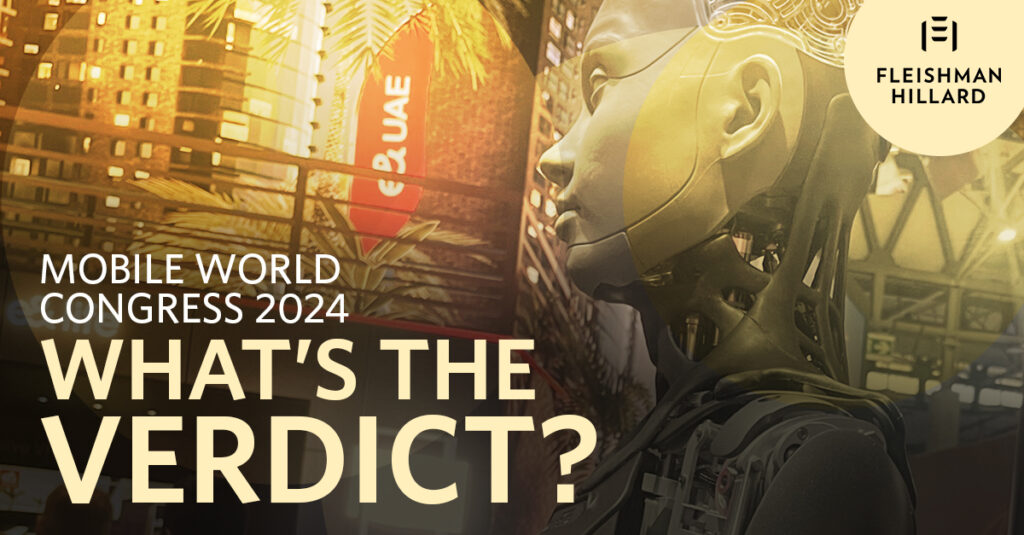
TickTockTech: Mobile World Congress 2024 — What’s the Verdict?

March 1, 2024
By Claire Jones

Last week I posted in prelude to attending one of the world’s biggest mobile conferences, Mobile World Congress 2024 (MWC24), anticipating how the event will have changed since I last attended in the noughties.

It turns out the communications landscape may have shifted significantly, but many things have reassuringly stayed the same. Ironically, the Wi-Fi is still shocking, you can’t find a charging point for love nor money, the food remains just below average, transport is chaos and your daily steps will always exceed 20,000.

But that didn’t deter attendance. The show was quite literally heaving, with nearly 100,000 attendees jostling through the halls. And although the media list still looked a little thin last week, there was a host of late additions, spanning UK national and business media.

One analyst, who has attended most years over the last two decades, reliably informed me that this year’s Congress was the best yet — back to pre-Covid popularity, with the most interesting tech she’s ever seen on display.

I can’t disagree. From flying taxis, robot dogs and cats, to 3D advertising walls, the visual display of futuristic tech was incredibly impressive. I had chills when I saw the most realistic female android conversing effortlessly with the crowds. Imagine how gutted you’d feel if that was on the stand next to yours?

What did the media think?

As a comms professional, I felt this Congress had enough meat on the bones for media to feel it was worth attending to get a pipeline of stories and inspiration for what is coming down the line. But I wanted to test my views with a selection of seasoned journalists who were on the ground, whose experiences range from the novice attendee to returners like me.

Jess Jones, TMT reporter at City A.M., a MWC24 first-timer, attended primarily to moderate a GSMA Foundry Innovation panel, but was not disappointed and felt the show more than met up to expectations. In her words:

“My first time at MWC definitely lived up to the madness I was pre-warned about. From a media perspective, it was useful to see first-hand what telcos are up to beyond the day-to-day business activities; for example, SK Telecoms’ AI aircraft simulator and Vodafone’s XR glasses. It was also a good opportunity to catch up with old and new contacts.”

Mike Moore, Deputy Editor at TechRadar Pro, was also impressed with what this year had to offer and the key themes consistent across many of the exhibiting companies. He explained:

“MWC 2024 was my first for five years, and while a lot of the big exhibitors and big themes have stayed the same, it was no surprise to see that AI dominated pretty much every conversation. It was really interesting to hear just how companies from all different sectors and all different sizes want to use AI, and how it can affect not just businesses, but consumers as well. It was also quite telling to see how many large companies were calling for greater co-operation and collaboration with their peers — hopefully this is a sign of things to come.”

Ryan Browne, Tech Correspondent at CNBC echoes Mike’s views on how AI was clearly the dominant theme of the show, explaining:

“The most attention-grabbing products from the show were, unsurprisingly, focused on the realm of AI. And you saw major smartphone makers and device manufacturers talking up the inclusion of artificial intelligence in their gadgets this year. Separately from this, there was a plethora of smaller tech companies, including Chinese smartphone maker Honor, U.S. startup Humane, and even German mobile network operator Deutsche Telekom, which showed off ways the future “phone” experience might look a lot different with the integration of AI as more of an everyday personal assistant.”

Ryan also explained the role of MWC24 in the wider ecosystem of global shows and its role in setting the scene for the key topics across the tech sector:

“This Mobile World Congress was one of the biggest and boldest shows I’ve been to in years. The show, which has the knack for focusing on some of the most critical stories and trends in the technology, media, and telecom space, had a packed event programme filled with interesting insights into the way that artificial intelligence is impacting and disrupting telecoms companies. And the opportunities that the technology can bring with networks making major investments into proprietary AI, as well as partnering with hyperscalers such as Amazon Web Services and Microsoft Azure for a helping hand with the cloud and software expertise they don’t have as much access to.”

My take: Did it live up to the hype?

In one word, yes. Absolutely. It’s clear that MWC is back with gusto, and the GSMA should be thrilled at this year’s success. From a comms perspective, visually standing out is always going to be a challenge when we have hit the Star Trek android era and Back to the Future flying taxis.

However, many of the coverage winners were companies whose CEOs and senior execs took time to meet with media and understand they need a relevant and interesting point of view. With such a strong and engaged media turnout, it’s crucial that brands start considering their comms strategy for next year sooner rather than later. And while not all exhibitors can drive footfall to their stand with robot animals, perhaps all they need is a charging booth and free water to draw the crowds!