Employee Login

Enter your login information to access the intranet

Enter your credentials to access your email

Reset employee password

Article

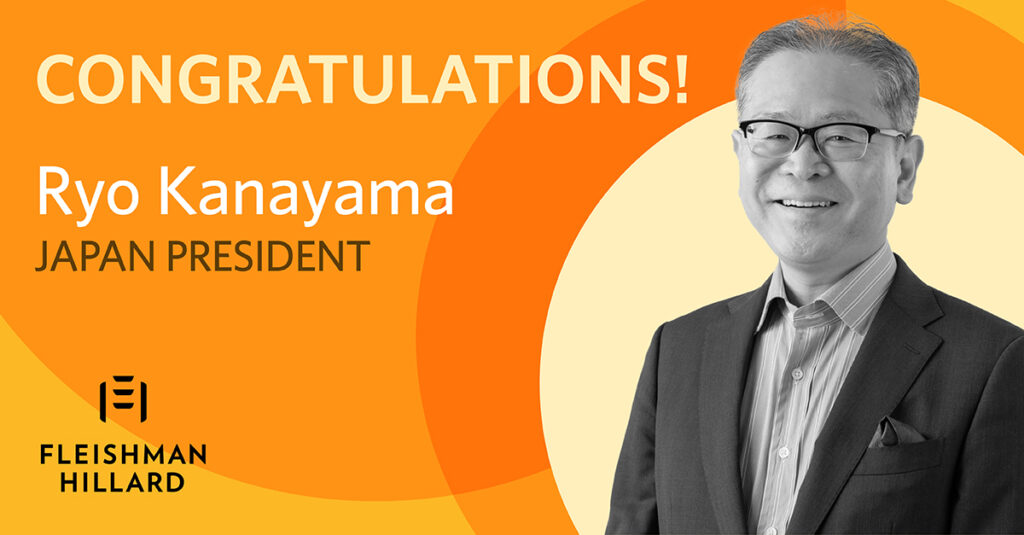
Ryo Kanayama Appointed President of FleishmanHillard’s Japan Group

January 30, 2024

ST. LOUIS, MO — FleishmanHillard today announced the appointment of Ryo Kanayama to president of FleishmanHillard’s Japan Group of companies, including FleishmanHillard Japan and VOX Global Japan.

“We’re thrilled to have Ryo return to FleishmanHillard in this role and help grow the agencies,” said Joanne Wong, FleishmanHillard APAC president. “Ryo has extensive experience driving transformation and societal change working with businesses, non-profits, governmental entities and local communities. With his experience both in-house and within consultancies, Ryo can effectively lead and coach our own team, as well as our clients, to advance the use of communications as a strategic and effective business problem-solving tool to drive desired outcomes. Ryo recognizes how such outcome-oriented, value-focused communications offerings enable us a competitive and distinct proposition to capture evolving market opportunities in Japan.” 

Kanayama returns to FleishmanHillard after serving as a partner at Deloitte Japan (also known as Deloitte Tohmatsu Group) for its Clients & Industries and Brand Marketing groups. He originally joined the agency in 1999 and was a key leader in conceptualizing and advocating for a strategic communications model in Japan. During his eight-year tenure, he also led the Corporate Reputation and Issues Management practice before moving to the corporate world to lead the Corporate Affairs function at Walmart Japan and Seiyu.

“I look forward to collaborating with our team to take the business to its next stage of growth,” said Kanayama. “Japan continues to play a critical role on the world’s stage and the evolving business and market environments require both local insights and connectivity to global offerings. FleishmanHillard and VOX Japan are well-positioned to respond to growing outbound and inbound client needs in corporate reputation, public affairs, financial communications and special situations.”

Continuing to support the agencies will be managing directors Atsuko Kamegaya and Ryoji Tanabe, who will report to Kanayama and form the operations’ core leadership team. Shin Tanaka, founding president of FleishmanHillard Japan, will act as a senior advisor to offer senior counsel and advice to clients.

The appointment takes place as FleishmanHillard Japan embarks on a new chapter of growth, helping clients navigate post-pandemic transformations. Connecting clients with FleishmanHillard’s global and regional network, the agency will deliver data-driven communications expertise to clients across borders and help them identify and effectively engage their stakeholders.

Kanayama received a Bachelor of Arts, Law, from The University of Tokyo and a Master of Business Administration degree from the University of Virginia Darden School of Business. He will begin the position on April 1, with his departure from Deloitte at the end of March.
Article

What we learned from our panel discussion on sustainability regulation and communications in 2024

By Rima Sacre

It’s difficult to do justice in just one blog, to a one-hour conversation with four experts that covered the highs and lows of sustainability communications, but in the following words we certainly try!

Article

Four Key Trends Shaping Sustainable and Responsible Business in 2024

By Mandy McAnally

The world is bracing for a 2024 that brings the unpredictability of unprecedented global elections, disruptive AI technology and an onslaught of environmental, social and governance disclosure rules. All of this will shape how companies operate sustainably and responsibly now and in the years to come. Below are some of the top trends that communicators will need to navigate in 2024. 

Climate disclosure requirements will become a reality, and companies must be prepared. 

New disclosure rules have serious implications for corporate reputation, company culture and operations, and legal and financial matters. The throng of disclosure requirements hitting thousands of companies will significantly change the approach to communications for many of the world’s largest brands. Companies operating in California, whether headquartered there or not, will be impacted by three climate reporting bills, requiring certain organizations to back up their public sustainability claims with third-party verified data. For many companies subject to the EU’s Corporate Sustainability Reporting Directive (CSRD), FY24 starts the clock ticking as the basis for comprehensive disclosures that go well beyond climate and will need to be included in their 2025 reporting.  

Compliance is a massive undertaking and will demand new models of internal communications, culture change and collaboration just to navigate the process, along with skilled communication professionals who must plan now for the impending era of unparalleled transparency. Learn more in FleishmanHillard’s brief on EU and U.S. Sustainability Disclosure Requirements. 

Climate action commitments and challenges loom large as countries look to COP29. 

COP28 marked progress in addressing the climate crisis, including creation of a loss and damage fund and first-ever reference to transitioning away from fossil fuel, but reinforced the formidable challenges to reaching a lower and then zero-carbon future. We also saw an elevated focus on biodiversity and health equity as climate change increasingly impacts public health. The implications of COP28 will be significant for companies addressing disparate legal and regulatory frameworks, managing political expectations and communicating with stakeholders and the public about climate action.  

Expectations for COP29 in Azerbaijan will be equally high, and eyes will be on the need to increase public and private sector financial commitments. Companies should prepare to communicate tangible and forward-looking climate action and manage questions or challenges related to the direction and pace of change.  

2024 elections will profoundly influence future action on sustainability and social responsibility. 

Elections are scheduled in 70 countries in 2024, which means voters will make their voice heard on major issues like climate, human rights, societal inclusion and more. Companies operating in the U.S. will need to navigate the politicization of ESG, as a term and construct, even as other countries push ahead, and public interest remains strong. National climate agendas and efforts to advance diversity, equity and inclusion have already undergone significant changes in the past year, but the elections could profoundly influence future action on these issues. Communications teams need to work cross-functionally to provide expert counsel to companies navigating political headwinds, decide when and how to engage with the media and stakeholders, and to maintain a clear and authentic message as the landscape shifts. 

Companies will increasingly leverage AI as a core solution to advance their ESG objectives. Regulators will try to keep up. 

More companies will make AI a core solution to accelerate and track their progress toward their decarbonization objectives. Bringing the worlds of technology and climate change together is not a new phenomenon. Yet the speed at which AI is catalyzing technological innovation and driving change is focusing minds on how to effectively leverage AI in an accountable and transparent way. While some of the largest cloud providers claim carbon-neutral operations, there are scores of data centers and providers that can’t. Looking ahead, we’re sure to see more headlines decrying the environmental impacts of resource-intensive AI. FleishmanHillard’s global advisory approach can help companies navigate emerging policy discussions and different stakeholder expectations as the business, regulatory and international environments explore and implement AI solutions. 

This year, businesses, governments and consumers are entering uncharted territory. What companies need now, more than ever, is a business strategy that unifies all corporate functions globally to not only successfully adhere to new ESG regulations but also communicate authentically and transparently. An approach that is siloed at the country, function and even agency level must evolve to a connected outlook. FleishmanHillard’s unique global advisory approach helps companies anticipate the shifting sands in a coherent and connected way across policy, legal, brand, communications and reputation. Connect with us at [email protected] to learn more. 

Bob Axelrod, Michael Hartt and Jane Gimber contributed to this article. 

Article

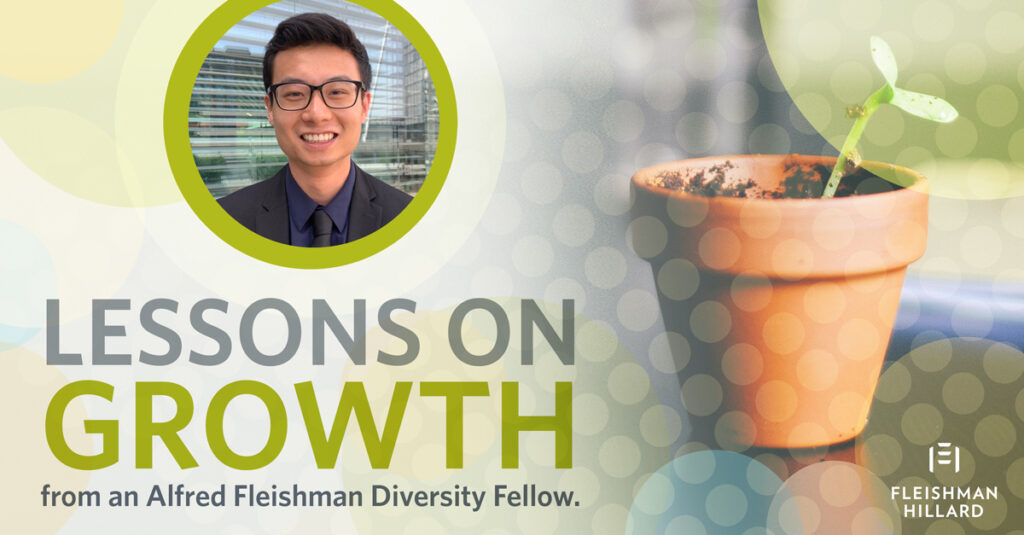
All the things I’ve learned to see: Lessons on growth from an Alfred Fleishman Diversity Fellow

January 25, 2024
By Jessica Millett

Welcome to the Fellowship Focus, a new quarterly feature about the Alfred Fleishman Diversity Fellowship program. Here, you’ll get a glimpse into the lives and perspectives of our talented Fellows as they begin their careers and leave their marks on our industry and the world around them.

If you ask Zhiyao (Allen) Yang which first name he uses, he will say “both.” Born in the Guangxi Province of China and raised in Los Angeles, Zhiyao (Allen) learned that it’s best to embrace who you are, where you come from, and the unexpected lessons you learn along the way. We talked to him about his passion for PR, his path to the Fellowship program and what he looks forward to as he begins his career.

Lesson One: See the possibilities

After completing an internship in Austria, Zhiyao (Allen) pursued a master’s degree at the famed Graduate Institute of Geneva. It was while researching the relationship between the European Union and China during this internship that the idea of studying in Switzerland first presented itself. “I always knew I wanted to pursue international relations, but I didn’t care where I went. I applied to The Institute because of the program’s focus on global governance, and I wanted to learn more about how the world works.” It was an unexpected path, but he soon found that his intuition was correct — Switzerland was precisely where he needed to be. “Going to school in Geneva was not my initial plan,” Zhiyao (Allen) said, “but I’ve learned to go with the flow. You can focus on your goal, but your journey there should be flexible.”

Lesson Two: See different points of view

The Graduate Institute housed a diverse class, as students from six continents worked and lived together, many preparing for a future with the United Nations. The work was challenging and rewarding, giving him a glimpse of what it is like to work with international organizations. While studying, he started an internship where his tasks included event planning and social media management. Here, he zeroed in on a new goal— global communications.  “I realized that what I was really doing was helping clients foster their communication skills.” When asked to summarize his time at the Institute, Zhiyao (Allen) said, “The program showed me that there are many perspectives and taught me how different cultures view the world. My classes helped me look at situations, even global conflicts, holistically.” He added, “There is a Chinese saying that when translated states, 5+5 is 10, but 4+6 is also 10. Just because you are right doesn’t mean the other side is wrong.” Wise words, indeed.

Lesson Three: See the opportunities

When asked if he had any advice for college students, Zhiyao (Allen) replied, “Never say no to new opportunities, even if they seem boring.” It’s a perspective he honed during one of his internships. “It was a state agency in California. I wanted to do international work, so it wasn’t something I saw myself doing long term.” Still, it taught him several valuable skills and gave him the experience of working with new people. “In hindsight, I can see how it helped me and why it was a good foundation.” He added, “I learned to look beyond my silos and comfort zones and to be open to trying new things.”

One of the things that Zhiyao is open to is the potential for AI (artificial intelligence). ”AI is here to stay. Our role as people is to learn how to live with it and use it responsibly. However, I think the government should help regulate it because we can’t rely on tech companies to regulate it themselves.” He continued, “When the ATM came out, people wondered if that would take teller’s jobs, but they made teller’s jobs easier. In 5-10 years, I can see myself using AI as the baseline for my work and then editing it to sound like me. I see it as an opportunity that will free me up to do more complicated critical thinking.”

Lesson Four: See your potential

Starting a new career can be scary, but when left unchecked, fear can hold you back. Zhiyao (Allen) shared, “When I first started at FleishmanHillard, I overthought. I was scared to ask questions. I was afraid to ask for help. I soon learned that it was up to me to believe in myself and to communicate my needs. When I did, I saw that everyone here was so nice and that people were more than willing to help. If I had to do it again, I would say to myself, ‘Just ask, don’t think about it.’” It is a lesson he aims to take with him throughout his career. “When I am in a more senior role, I hope I remember not to overthink things and to ‘just do it.’”

Though it can sometimes be easier said than done, we hope he continues to take his advice because he is right – the team at FleishmanHillard wants him to succeed. We look forward to everything that Zhiyao (Allen) will accomplish, and we’re grateful that he saw an opportunity to grow with us.

The Alfred Fleishman Diversity Fellowship Program is a North America-based internship where diverse talent can combine their PR, communications and media talents with their passion for diversity and inclusion. Our teams across the U.S. and Canada hire, mentor and prepare Fellows for entry-level roles at FleishmanHillard. If you want to start your career with us, you can learn more about openings by visiting our Join Us page.  

Article

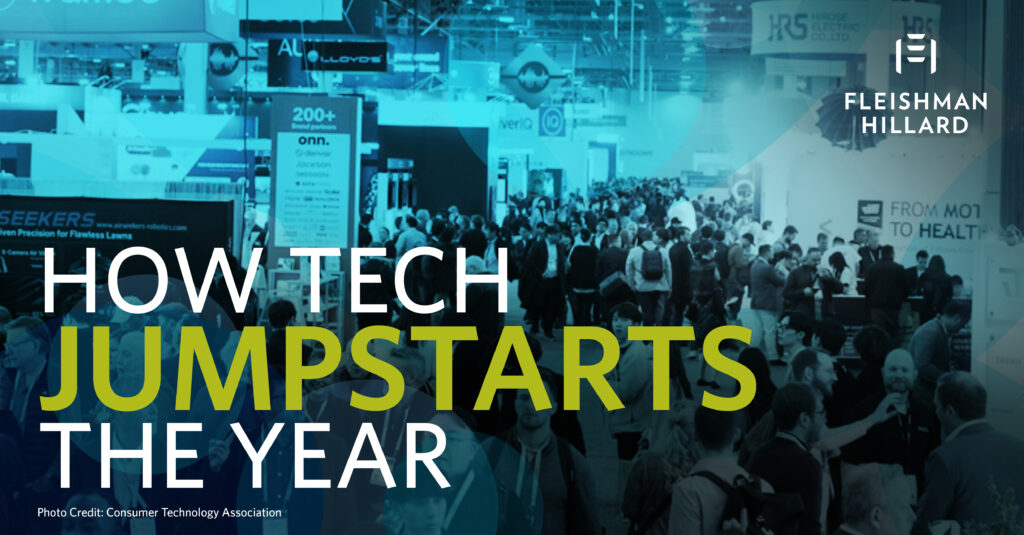
TickTockTech: CES 2024 – How Tech Jumpstarts the Year

January 22, 2024
By Alison McNally

For more than 50 years, tech enthusiasts, gadget lovers, influencers and deal makers have descended on Las Vegas to see the latest and greatest in innovation at the Consumer Electronics Show (CES). Sure, brands have used it historically as the place to launch everything from TVs to smart phones and driverless cars, but it was the celebrity stunts (and mishaps), epic late-night parties and awe-inspiring booths that have allowed media, analysts, executives, opinion leaders and consumers to mix and mingle – coalescing around the next great technology developments.

Covid-era mandates, global polycrisis and general fatigue (even predating the pandemic) had many wondering whether CES truly had the staying power other industry trade shows and events seem to have lost. This was especially true considering 2023 was a tough year for the technology industry at large, with sweeping layoffs, budget cuts, regulatory pressure and supply chain issues dominating the headlines.

Perhaps unsurprisingly, Melissa Harrison, vp of marketing and communications at the Consumer Technology Association (CTA) was optimistic, stating that “you’re going to see the greatest minds, the most powerful brands and most impactful technology.” A few days after the closing of the show I must agree — CES 2024 was something to see. Trolling social posts of colleagues and friends onsite, reading news coverage and gossiping about what we were seeing with my teams on the ground had me genuinely excited. I was even a little jealous not to be on the ground amongst the “3,500+ exhibitors, 1,000+ startups and 130,000+ industry professionals,” that CTA said attended.

Why? Because CES 2024 had something we hadn’t seen in a while: a little magic. The show felt fresh, futuristic and energized, with more vision and prototypes than established products. What had started to become an auto and health focused show emerged, in many ways, as an AI show. But it was also a human show, digging into how AI and tech more broadly could improve our lives and collective experience — touching auto, healthcare and, yes, even nail salons.

Throughout the show, robots, futuristic vehicles, transparent TVS and AI-powered consumer gadgets were everywhere. There was a smart pillow, robot shoes and a baby cry translator, all of which featured prominently on product roundup lists. Consumer gadgets such as cocktail-making robots, remote control pet doors and facial recognition smart home locks drove coverage in top tier business and tech media. Samsung, one of our sector clients, showed off even cooler foldable phones, a robot ball and AI-enabled vacuums and refrigerators.

But the real star of the show may have been the show itself. Fast Company’s Harry McCraken wrote a piece on the staying power of CES. Anecdotal feedback from friends and colleagues hammered this point home. This was a truly energizing start to 2024…but what does it mean for the rest of the year?

Wars continue to wage, supply chains are crippled, a U.S. presidential election is looming. Despite this, what CES reminded me is that technology innovation is truly about giving us hope — and maybe a little magic. Hope for a better future where AI and robotics enhance the human experience. Where sustainability and taking care of ourselves and our planet remain a priority.

So as communications professionals, I’d like to take a cue from this year’s CES as we approach our year.

Takeaways from CES 2024

  • Be Bold: Like the startups and dreamers demoing concepts on the show floor. Take a few risks and don’t be afraid of mistakes. The best innovation comes from iteration, and you can’t always get it right the first time. A stake in the ground starts a conversation and gets people excited.
  • Have an eye on tomorrow: The concept of today is tomorrow’s reality. It’s fulfilling to see the future imagined by science fiction writers 80 years ago become reality. This is true across industries and markets — and will continue to be. Focus your energy on developing and communicate the vision that takes you into tomorrow.
  • Focus on the Good: Sustainability, equity and well-being were all topics touched on at CES by many different brands. During Covid, a support system grew for our fellow humans — and these topics were top of mind. As we’ve all returned to office and “normal,” let’s not lose that focus on doing good for each other, the environment and humanity overall. 

I cannot even begin to predict what this year will bring but I know one thing…you’ll see me at CES 2025!

Article

Views of the WEF from Around Our Global Network  

January 18, 2024

This year’s World Economic Forum in Davos centered on a theme close to every communicator’s heart: “Rebuilding Trust.” A theme that is particularly poignant after a year that saw the promise and perils of Artificial intelligence arise in the public’s consciousness. The start of the new year is underscored by continued geopolitical conflicts and the anticipation of 3 billion people globally preparing to vote for new leaders in 2024, including in the EU, U.S., UK, Bangladesh, India, Indonesia, Mexico and Pakistan. By next year’s WEF, we can anticipate significant transformations in the geopolitical, business and political landscapes. 

With over 1,600 global leaders attending this year’s conference, including 800 CEOs and 60 heads of state, WEF continues to solidify its role as a key pacesetter for the global news agenda. As the 2024 WEF concludes today, our global communications experts, representing diverse geographies and industries, share their insights from the event and some lessons corporate communicators can take away for the year ahead. 

Geopolitical Concerns Dampen Economic Optimism at Davos

Michael Hartt, senior partner, head of International Affairs in London 

Given the focus on “economic” in its name, the World Economic Forum’s annual meeting should have been a moment of quiet confidence for business leaders. Growth metrics are moving in the right direction in many leading economies. There is tangible progress in the fight against high inflation. We are seeing resilience and recovery. But that optimism is colliding with anxiety and uncertainty on geopolitics for many multinational companies.   

2024 will see eight of the 10 most populous countries going to the polls, with a year of contentious debates, polarised views and pressure on business to take a stance on difficult issues. At Davos, business leaders have recognised how the political landscape will pull them in conflicting directions simultaneously.   

Simultaneously, they must navigate immediate geopolitical conflicts and tensions on multiple fronts. The continued strain from the Russia-Ukraine war, growing impact of the Israel-Hamas war, latent U.S.-China tensions and emerging conflict between international allies and Houthi rebels are affecting strategic business decisions about growth and investment and day-to-day management of supply chains and trade routes.   

These pressures go beyond just adding complexity and confusion. As the atmosphere in Davos showed, they have the potential to disrupt economic progress achieved over the past year.  

Trump’s Possible Return to White House a Hot Topic

Michael Schmidt, partner, Public Affairs lead in Washington, D.C.

As leaders gathered in Davos this week, there was extensive chatter about someone who was not there and holds very different views than most of the leading voices at the World Economic Forum: former U.S. President Donald Trump. The gathering kicked off just as Trump won the first presidential primary. He is expected to have a relatively easy time winning the Republican nomination, which would set up a rematch of the 2020 race against President Joe Biden.    

The outcome of the November election holds enormous consequences for the U.S. and the global economy, American democracy, relations between world powers, taxes and regulation, progress on critical issues such as climate change and much more.    

U.S. executives in Davos are telling reporters they are not concerned about Trump returning to the White House. European policymakers do not share the same view given disagreements with Trump during his presidency.  

Whether or not Trump wins the election in November, business leaders would do well to consider that we are likely to see a period of heightened uncertainty in the U.S. that has already begun and will continue for the foreseeable future. The deepening political divide illustrated by the January 6 attack on the U.S. Capitol has not ebbed and the presidential race is likely to rekindle the tensions seen domestically after the 2020 election.   

GCC’s Golden Age of Influence and Economic Growth

Ronak Thakkar, associate director, Middle East, UAE

Amidst the global discourse of Davos, the Middle East takes center stage, once again. Navigating a storm of challenges from a geopolitical point of view — war in Gaza, Red Sea tensions and GCC’s immense potential for progress dominated the newsrooms.  

Attendees from the UAE, KSA and Iraq had a strong showing at Davos this year. But one country getting much of the mileage from the region was the UAE, continuing to portray its strong foothold in influencing the conversations and even setting itself as the perfect example of growth. Thanks to its strong leadership, policies, approach to globalization and its efforts to be a hub for business, a hub for entrepreneurs, and new economies in the future.  

As the world’s first AI Minister, H.E. Omar Al Olama spearheaded UAE’s global tech collaboration efforts, highlighting investments in emerging sectors and new tools like generative AI for a future-proof economy. Across continents, a vision sparked. At Davos, Satya Nadella lauded the UAE’s pioneering AI tutor plan, while tech experts in Dubai at Intersec 2024 (running in parallel with WEF) dissected its potential for wider human impact.  

Davos Highlights Global Risks to Corporate Communications 

Jane Gimber, director, Brussels  

As companies come together at Davos to discuss the multiple inflection points facing businesses, a key question being asked is how companies can communicate meaningfully on purpose and values amidst ongoing risks to global stability and political fragmentation.  

The threats associated with AI (see latest IMF report here), economic uncertainty, political instability caused by the numerous elections in 2024 and finally the green transformation to net zero emissions, all cause great societal uncertainty.  

In a world of confrontation and fragmentation, navigating these risks through authentic communication has never been more important to gain trust. This is especially relevant in this time where we see an increasing polarization of values, and accountability is high on the agenda in the EU, for example through stricter obligations for companies to report on their progress on sustainability standards.  

Davos provided an important platform to discuss these global risks in 2024 (see full risk assessment by the WEF here) but it also demonstrated the increased geopolitical tensions. For companies, it is therefore more important than ever to align their public affairs and corporate communications strategies and to communicate meaningfully on purpose and values, in order to navigate the new realities.  

Stephan Ester, associate director, Frankfurt  

The motto of this year’s WEF is “Rebuilding Trust”, and hardly anything could describe the current mood more aptly, as the ongoing erosion of trust in traditional institutions, whether public or private, is one of the greatest challenges to our society. When it comes to the reasons for this crisis of trust, a lack of or inadequate communication on the part of those in charge is often cited as a significant cause. If trust is to be regained, it can only happen through transparent and trustworthy communication. This task is made even more complex by the rapid spread of AI — another dominant theme at WEF this year. While AI certainly opens up a wide range of new possibilities, it also threatens to undermine trust as it has become more difficult than ever to verify the authenticity of news and messages.  

My top takeaway from Davos is therefore twofold: As communicators, we must enable our clients to engage in a trusting dialog with their stakeholders — to this end, we must keep our ears very close to discussions such as those held in Davos, where the central issues of our time are debated. At the same time, our task will increasingly be to show them ways in which they can (re)establish trust in a world in which it is more and more difficult to distinguish the authentic from the ‘fake news’.  

Healthcare was the Red Thread Through the Biggest Topics at Davos 

Christine Lydon, director, Healthcare, London  

Climate change, conflict in the Middle East and beyond, the global economy and the opportunities  (and risks) posed by AI have all taken centre stage at this year’s World Economic Forum. Healthcare hasn’t been forgotten though. Indeed, it’s arguably a red thread throughout most of the discussions. Case in point: Bill Gates’ observation that improving access to health care in developing countries will play a vital role in tackling climate change. There’s also been much talk about leveraging the potential of AI to revolutionise healthcare, particularly through multi-sectoral partnerships. 

Women’s health stood as a hot topic. In fact, one of the most notable reports launched at the meeting focused exclusively on the transformative impact of closing the women’s health gap. And with good reason: despite living longer, women spend 25% more of their lives in poor health than men. Eliminating the gap could cut this by almost two-thirds, while adding $1 trillion to the annual global economy by 2040, along with a 1.5% increase in per capita GDP. In response to the findings, the World Economic Forum has launched the Global Alliance for Women’s Health, an initiative that’s already been embraced by a host of key players from across the healthcare and pharmaceutical landscape, pledging $55 million so far. With the payoff from meaningful change so high, this is one to watch closely. 

Shifting Political Landscape Demands Proactive Measures from Business Leaders 

Yvonne Park, senior partner, APAC Public Affairs lead, and president, FleishmanHillard in Korea 

While the main agenda of this year’s Davos Forum focused on AI’s impact on the global economy and regulatory discussions, attention quickly shifted to the November U.S. presidential election and the unfolding power dynamics between the United States and China. This shift in emphasis can be attributed to the fact that this year coincided with global elections and anticipated geopolitical conflicts, as well as other non-economic factors poised to exert substantial influence on the world economy.  

It becomes imperative for global business leaders to adopt proactive measures to mitigate the risks posed by non-economic factors during these uncertain times.  

UK Political Parties Jockey for Position at the Start of an Election Year 

Liam McCloy, head of Public Affairs in London

In the UK, Conservative Chancellor, Jeremy Hunt, and his opposite number, Labour’s Rachel Reeves, have both spent this week in Davos busy vying for the support of high-profile science, health and tech companies and investors with those sectors serving as a litmus test for the competitiveness of a country’s economy in a global marketplace. There are different pressures at play however. The Conservatives are currently in charge and need to maintain investor confidence during the tail end of a political cycle but with opinion polls showing a consistent Labour lead, the alpine interest in Reeves and her party Leader, Keir Starmer, has been palpable. In turn, investors are seeking clarity on what a Labour Government might mean for their interests and ensuring that there are no surprises should they secure victory in the UK general election. While those in Davos might not be directly responsible for determining the election outcome, standing tall on the world stage still matters to many people at home — something not lost on our politicians keen to secure a foothold on those slippy slopes in Switzerland this week. 

A Difficult but Essential Challenge Lies Ahead in Rebuilding Trust for Future Generations and their Prospects

Elliot Rylance, account director, Youth & Culture, London 

This year’s Davos theme, “Rebuilding Trust”, couldn’t be more relevant to the youth audiences of today. From “rage bait” content to AI filters and deepfakes, youth audiences are almost desensitised to consuming media that is created to provoke emotional responses and spread misinformation.  

 It’s not just trust in media that must be rebuilt for younger generations, it is also their trust in the political powers and governing bodies that have created an uncertain economic present and future for them. As UN Secretary-General António Guterres stated, “political instability is adding to economic insecurity,” and today we are seeing young people experience high levels of financial anxiety and low levels of job security.  

Another significant factor is the increasingly influential impact of AI. We have long spoken about youth audiences, particularly Gen Z, as digital natives who are comfortable navigating new, online landscapes to find or create opportunities for themselves. However, for all its exciting potential to unlock opportunities, there are big questions that remain unanswered about how AI will be regulated for future generations. While the EU made a positive step through the AI Act late last year, Emmanuel Macron urged the need for global regulation to ensure growth and, just as importantly, safety — echoed by speakers such as Microsoft President, Brad Smith and Spanish Prime Minister, Pedro Sánchez, who both called for enhanced efforts around AI governance.  

On-the-Ground Recap

Sheila Rose, partner, global Corporate Media Practice co-lead

Hello from Day 4 at Davos where it has warmed up steadily. As I walk along the Promenade, people do not even have hats and gloves on, which is a big change from when I arrived!   It’s been an optimistic Davos and I have heard a couple of CEOs make that same comment.  More optimistic than 12 months ago. There is a feeling that there has been positive momentum over the past year despite the geopolitical unrest.  

It’s been an overwhelmingly AI focused Davos. One speaker aptly said that last year, there were two storefronts with AI on the door along the Promenade. This year, it’s hard to find a company or organization that doesn’t have it in their signage or tagline. 

I’ve heard a lot of positive messaging around how AI is not scary (although it does have that reputation) and you don’t have to be a technologist to use it. Non-tech experts in far-flung places can learn the skills of the future and not be left behind. The sessions have been peppered with interesting AI use cases, ranging from AI in healthcare where people with health conditions can take care of themselves from their device, to young family members who have peace of mind with elderly loved ones in faraway places using a voice-enabled virtual caregiver.   There was a big focus in sessions regarding bias built into data.  Companies need to do a better job of investing in data sets that are testing for ethnicity and gender, and taking into account a much broader global scope of people. And of course, the importance of doing AI responsibly and using a trusted partner to help you implement it. 


Article

World Economic Forum 2024

January 15, 2024
By Sheila Rose

FleishmanHillard Davos Digest

Greetings and welcome to the kickoff of the FleishmanHillard Davos Digest and the World Economic Forum 2024! Today was a day of getting adjusted — to the altitude (drinking lots of water), snowy streets (tricky with ice underneath) and the food (raclette and fondue). It was also a day for exploring the Promenade (Davos’ main drag) to see which corporations, media houses and governments have set up shop this year. And of course, attending the first day of thought-provoking panels and sessions at hotels, media houses and even outdoors at the top of a snowy mountain. The most pervasive thread running through most all of today was AI. Whether it was discussions of AI impacting the workforce, AI and trust (or lack thereof) or the democratization of AI — it was on everyone’s mind.

WEF’s theme this year — Rebuilding Trust — is a relevant one, particularly with threats to trust in areas such as misinformation and disinformation. In fact, AI-derived misinformation and disinformation ranked ahead of climate change, war and economic weakness in the “Global Risk Report 2024” just released by WEF. And with the elections around the corner (not just in the U.S., but about half of the world’s adult population will be casting their vote this year, according to a recent CNBC article), concern about the role of AI in disrupting election outcomes tops the WEF risk report.

Big names in U.S. government in attendance include Secretary of State Antony Blinken, National Security Adviser Jake Sullivan and Special Presidential Envoy for Climate John Kerry (the latter has some intrigue given the news of his leaving his post in the Biden administration to join the President’s re-election campaign). Internationally, Ukranian President Volodymyr Zelenskyy will give a speech and likely meet with Secretary Blinken. And from other countries, Emmanuel Macron is the only G7 leader to be on the ground this year, and China’s second in command Li Qiang will be speaking. Argentina President Javier Milei will likely garner a lot of interest given he is newly inaugurated and has announced some shocking economic policies such as a sharp currency devaluation.

On the business leader front, there is a lot of buzz about Sam Altman, CEO of ChatGPT maker OpenAI, making the trip. In addition, Microsoft’s Satya Nadella, Pfizer’s Albert Bourla and a whole slew of bank CEOs including Bank of America’s Brian Moynihan, Blackstone’s Stephen Schwarzman, Citi’s Jane Fraser, Goldman Sach’s David Solomon, JPMorgan Chase’s Jamie Dimon and Morgan Stanley’s Ted Pick will be on site. Certain there will be some interesting themes and headlines coming out of this group — stay tuned!

Watch for FleishmanHillard’s top takeaways from the World Economic Forum coming later this week.

Article

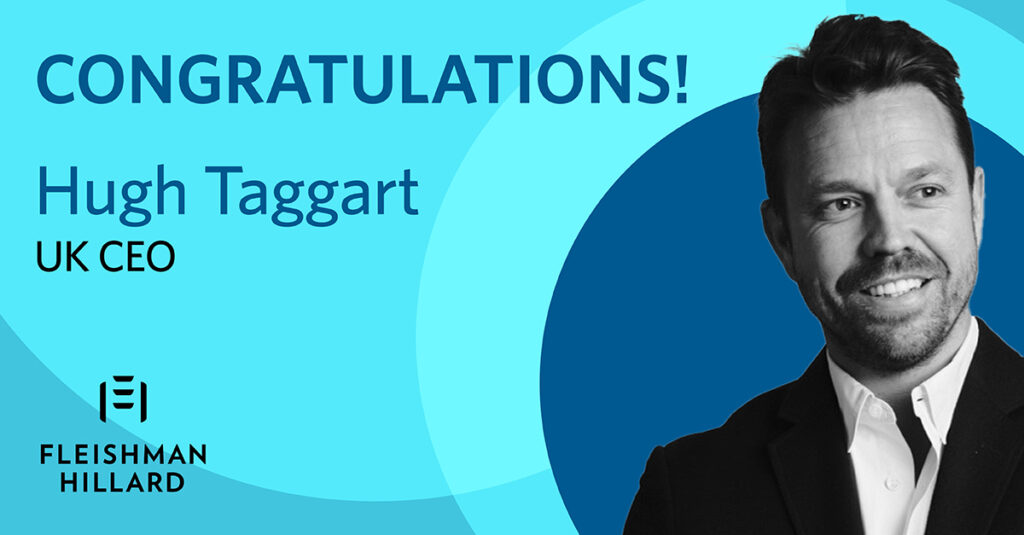
FleishmanHillard Hires Hugh Taggart as CEO of FleishmanHillard in the UK

January 10, 2024

ST. LOUIS, MO — FleishmanHillard today announced the appointment of Hugh Taggart to CEO of the agency’s UK operations starting February 21.

“We have an incredible business in the UK, with real breadth and substance, and a truly exceptional culture,” said John Saunders, FleishmanHillard president and CEO. “London will always be a critical market for FleishmanHillard and we believe Hugh is the ideal leader to follow the terrific growth achieved under Jim Donaldson and help deliver on our future plans.

“We’re delighted to get someone of Hugh’s calibre to the firm. In Hugh we have gained a dynamic leader with a hugely impressive track record of improving teams, developing talent and growing businesses. He will bring gravitas, energy and sharpness to our UK team and will add real depth to our global leadership.

“In addition to his business acumen, Hugh brings a wealth of experience leading integrated teams and advising CEOs and other leaders on a range of business-critical matters. This will be invaluable to our major clients at a time when brands are faced with an increasingly complex set of issues to navigate. We’re excited to welcome Hugh to FleishmanHillard and look forward to him starting soon.”

Taggart joins FleishmanHillard after more than five years in leadership positions with Edelman, most recently as the UK’s co-CEO where he led some 650 people and oversaw a period of rapid growth in the UK. He also served as Edelman’s global chair of Issues & Crisis and previously led Edelman’s EMEA Corporate Affairs practice. During this period, Taggart also sat on the PRCA’s board of directors.

Of his appointment, Taggart said: “It’s a real thrill to be joining such an iconic agency and professionally run organisation. I’ve always admired FleishmanHillard from afar and held them in high regard when coming up against them. However, what is most exciting is joining an agency with such ambitious plans. The UK is a particularly competitive market, but FleishmanHillard has a great platform from which it can grow and I’m looking forward to helping the agency unlock all of its potential.”

Article

Climate Commitments, Action and Challenges to Come: FleishmanHillard Takeaways from COP28

December 20, 2023
By Michael Hartt, Maximo Miccinilli and Wang Yang

The 28th Conference of the Parties (COP28), hosted in Dubai from November 30 to December 13, 2023, marked a pivotal gathering of government leaders, multilateral organizations, scientific experts and corporate stakeholders, all driven by the urgency to address climate mitigation and adaptation. After two weeks of intense negotiations characterized at times by debate and division, nearly 200 Parties reached a new climate deal at COP28. The implications of this Global Stocktake – the midway point from the 2015 Paris Agreement to its 2030 targets – will be significant for companies addressing disparate legal and regulatory frameworks, managing political expectations, and communicating with stakeholders and the public about climate action.

Key takeaways from COP28 include:

1. Major Agreements and Commitments

  • Agreeing the UAE Consensus: COP28 participants unanimously adopted the UAE Consensus, the new climate framework that outlines targets and actions to limit global temperature rise to 1.5°C and accelerate emissions reductions.
  • Transitioning Away from Fossil Fuels: A highly debated issue revolved around the inclusion of a fossil fuel phase-out in the agreement. Ultimately, the decision was made to endorse a commitment to “transition away” from fossil fuels. While this marks the first use of the term “fossil fuel” in a COP agreement and is seen as a historic achievement in recognizing the role of fossil fuels in driving climate change, some scientists, climate advocates and government leaders deemed it unacceptable for not going all the way to a complete “phase out” of fossil fuels.

2. Energy Transition Pathways

  • Renewable Energy Transition: COP28 witnessed several countries pledging to transition to renewable energy sources and phase out coal, complete with specific timelines and goals that mean tripling renewable deployment by 2030 under the Global Pledge on Renewables and Energy Efficiency. However, the final agreement recognized the role of “transitional fuels,” typically meaning gas, which burns cleaner than oil or coal. This was a significant win for the gas industry and prompted questions about the speed and scale of a transition away from natural gas and LNG.
  • Tripling Nuclear Energy Capacity: One of the key developments at COP28 was the agreement by 22 countries, including the United States, France, Japan, South Korea, Sweden and the United Kingdom, to triple their nuclear energy capacity from 417 gigawatts in 2022 to over 900 gigawatts by 2050. This move recognizes the role of nuclear energy in achieving the 1.5C target for some countries, though nuclear continues to face resistance in countries like Germany. Under the pledge, countries will adopt several measures, including extending the life of existing nuclear reactors and build both new large-scale reactors and advanced small modular reactors (SMR).

3. Climate Finance Commitments

  • Breakthrough on Loss and Damage Funding: After strong efforts by lower- and middle-income countries and vulnerable countries to build on promises at previous COPs, COP28 saw the major breakthrough: Large donations by the UAE, United States, United Kingdom, Germany and others to a loss and damage fund. This fund will provide support for unavoidable climate impacts, such as extreme weather events and rising seas – though skeptics assert it provides a small fraction of the amounts required to address needs.

4. Food Systems and Food Security Declaration

  • Declaration on Food Systems: For the first time, COP attendees examined the connection between food systems and climate, from the relationship between current food demand and carbon emissions to the ways to improve food security amidst climate-driven extreme weather incidents and long-term weather changes. The Declaration on Sustainable Agriculture, Resilient Food Systems and Climate Action emphasizes resilience, food security and resource efficiency, with a special focus on water.

5. Policy and Regulatory Updates

  • Carbon Pricing Initiatives: Several nations discussed plans to implement carbon pricing mechanisms and carbon trading systems, but debates around the creation of a supervisory body was not resolved and the permanence of carbon reductions and removals were not resolved. This leaves implementation of the Paris Agreement’s carbon trading provisions in an uncertain position at the halfway point to 2030.
  • Stringent Emissions Reduction Targets: COP28 introduced new, more stringent emissions reduction targets for various sectors, signifying a need for potential adjustments in companies’ sustainability strategies. The Global Methane Pledge (GMP) is one of the most important examples by aiming to cut anthropogenic methane emissions by at least 30% by 2030 from 2020 levels. Another example is the global commitment, endorsed by the World Cement Association, to set intermediate targets to support a sustainable cement and concrete industry, encouraging technical development and innovation by its members to help achieve full decarbonization by 2050.

The wide range of topics addressed at COP28 will create expectations – and in some cases mandates – for businesses from a range of sectors to take greater and faster action. While media coverage focused on heavy emitting industries like energy, the impact of the renewable transition will be felt across supply chains. Businesses will need to review their targets and plans, particularly with countries required to submit updated climate plans in 2025 and the continued pressure for improvement by 2030.

The final COP28 agreement represents an unprecedented global consensus to transition away from fossil fuels, which have long been the primary driver of the climate crisis. This historic agreement, reached after 28 years of international climate negotiations, undoubtedly marks a significant step forward. However, it also prompted a sense of bittersweet victory, with some arguing that it falls short of the more decisive phase out of fossil fuels that many had hoped for.

With elections scheduled in over 70 countries in 2024, the political landscape remains dynamic and the fate of climate policies remains uncertain. Green initiatives have faced criticism over their cost and burden upon the public, with risk of being rolled back in several major economies. Simultaneously, the EU will push forward with its aggressive plans for carbon reduction – meaning companies will need to manage diverse political interests simultaneously.

COP28 serves as both a cause for celebration and a call to action. It highlights the progress made in recognizing the urgency of the climate crisis, but also the formidable challenges that persist in transitioning to a sustainable future. As organizations move forward, it is imperative that they remain committed to pushing for more ambitious climate goals and holding leaders accountable for their promises. The road ahead is long and challenging, but the stakes have never been higher, and the need for decisive action has never been more apparent.

Article

FleishmanHillard Makes 2024 PRWeek US Awards Shortlist in Multiple Categories Including Outstanding Extra-Large Agency and Agency Dynasty of the Last 25 Years

December 14, 2023

After taking home the award the past two years, FleishmanHillard was named as a finalist in the Outstanding Extra-Large Agency category of the 2024 PRWeek US Awards. The global agency was also nominated in the new Agency Dynasty of the Last 25 Years category, as well as a nod for Best in Healthcare for client work with Johnson & Johnson.

  • FleishmanHillard (Outstanding Extra-Large Agency)
  • FleishmanHillard (Agency Dynasty of the Last 25 Years)
  • Johnson & Johnson Innovative Medicine and FleishmanHillard, “Save Legs. Change Lives. Spot Peripheral Artery Disease Now” (Best in Healthcare)

The PRWeek US Awards spotlight excellence and leadership in the communications industry. The program celebrates the best corporate, agency, non-profit and education teams and the work they produce.

Winners will be announced at a ceremony on March 14th in New York City. Get the full list of winners here.