Employee Login

Enter your login information to access the intranet

Enter your credentials to access your email

Reset employee password

Article

Get the Report: Corporate Affairs Trends for 2026

December 10, 2025

Expectations from executives and stakeholders continue to rise. Geopolitical and societal uncertainty is intensifying. The demand to show clear business impact is higher than ever. This is the constant pressure cooker corporate affairs leaders operate in. Their role is more central to enterprise value but with that comes exposure to risk, scrutiny and rapid change.

Our latest forecast surfaces the trends that matter most for senior communications professionals. Grounded in data, real-world observation and conversations with clients across sectors, it cuts through the noise to focus on what is actually shifting in the operating environment and what that means for your team, your agenda and your influence inside the business. It also looks back on 2025 predictions to draw out lessons that can guide leaders in the year ahead.

Click Below to Download the Report and dive deeper on the FleishmanHillard UK site.
 Click Below for More Reports From the UK Team:
Article

Executive Impact: Turning Transitions into an Enterprise Advantage

By Elizabeth Cook, Chris Thornton and Michelle Mahony

The spotlight on executives has never been brighter. In 2025, CEO turnover is hitting record highs and CFO departures at Fortune 500 companies are up 33% year over year. CEO tenure continues to shrink —to just 6.8 years.  

Against a backdrop of AI disruption, geopolitical and supply chain pressure, employee and stakeholder challenges and investor scrutiny, leaders are expected to deliver impact fast. Nearly half of executive transitions are judged as failures or disappointments within two years. Yet despite these pressures, most organizations still treat executive transitions as a sequence of announcements and introductions — and the shallowness of this approach is more evident than ever.  

Transitions aren’t PR moments. They’re enterprise moments. The difference shows up in results. Handled well, a transition can unlock energy, clarify priorities, and accelerate operating performance. Handled poorly, it drains trust, distracts teams, and invites scrutiny. The difference in outcomes isn’t driven by the number of interviews or town halls conducted or the addition of a few more executive LinkedIn posts. It’s dependent on a complete re-think of the support that executives receive in transition and a laser focus on how leadership skills, change management principles and communications can come together to drive success.   

As we head into 2026 expecting the pressure on new leaders to only grow, the Global Executive Advisory teams for FleishmanHillard and Daggerwing Group have formalized an integrated approach to transition that moves from executive visibility to Executive Impact. Executive Impact is a new way to manage leadership transitions as critical, ongoing business processes that shape reputation and future performance. Success isn’t measured by optics but by outcomes: how quickly a leader earns trust, sets strategic direction, and delivers results.  

Because real impact depends on more than narrative, Executive Impact includes the underlying mechanics that determine performance: clarifying how the leader will shape structure, decision rights, operating rhythms, and processes so the organization can deliver measurable business results at speed. 

Our Five As for Executive Impact transition framework offers a practical path for new executives to follow from the moment they know they’ll be taking the seat—but it also can be entered at any point by an executive who begins to feel that their organization isn’t fit for the challenges ahead. We help executives create and operationalize momentum—making it easier for their team to believe, act, and deliver together: 

  • Announce with intent: Focus executive appointment communications on establishing credibility and setting expectations, align communications across audiences and regulations, and prepare leadership teams and champions to carry consistent messages. 
  • Align through understanding: Balance listening with diagnosis and the setting of leadership expectations, and operationalize early shifts in roles, rhythms, and decision forums. 
  • Activate the agenda: Articulate a visible purpose and strategy, define early choices and symbolic moves, and connect communications to execution. 
  • Accelerate the system: Equip the leadership team to deliver at pace, close gaps, manage moves decisively, and embed cadences that create urgency and ownership. 
  • Amplify what works: Codify new norms, keep stakeholders updated, reconnect to purpose, and prepare for the next inflection point. 

This system targets real business outcomes: Faster trust and alignment across executive and employee teams and boards of directors, quicker strategy adoption and execution, and reduced risk of derailment in the first 180 days. 

Our experience includes Fortune 100 leadership transition consulting and coaching; turnaround, transformation, integration and culture programs; CEO and C-suite positioning and visibility programs; employee, investor and stakeholder engagement; and counseling companies across issues, crisis, and C-suites in duress. 

Leaders don’t get a second chance to make a first impression. Every transition carries risk; the right design turns that risk into resilience. Executive Impact helps leaders set a credible course, accelerate execution, and sustain momentum beyond the early window. If you’re anticipating a change — or need to course-correct — FleishmanHillard and Daggerwing Group can partner with you to make this transition your advantage. 

Executive Impact
From Left to Right: Elizabeth Cook, Chris Thornton and Michelle Mahony

Elizabeth Cook is part of the FleishmanHillard U.S. corporate affairs leadership team and directs regional executive positioning offerings.

Chris Thornton is Senior Principal at Daggerwing Group and works with leaders to build the mindsets, skills, and confidence needed to lead transformation and embed change across complex organizations.

Michelle Mahony is the President of Daggerwing Group and works to bring together the science and art of transformation to life for clients.

Article

The Supreme Court Case That Could Redefine U.S. Trade Policy

November 12, 2025
By Geoff Mordock

In the coming weeks, the Supreme Court is expected to decide a case that could shift the balance of power between the White House and Congress – and reshape how businesses navigate global trade risk.

The case, Learning Resources, Inc. v. Trump, challenges the legality of tariffs imposed under the International Emergency Economic Powers Act (IEEPA). At its core, it asks whether the President can unilaterally impose, extend, or adjust tariffs under IEEPA after declaring a national emergency, without returning to Congress. The outcome could unlock billions in refunds for affected companies, tighten judicial review of trade actions, and force a broader reckoning with executive authority in economic policy.

The stakes are high. And the implications go far beyond trade.

What the Court Is Actually Weighing

The Trump administration used IEEPA to impose tariffs on a wide range of Chinese imports, citing national emergencies and foreign threats. But the challenge brought by Learning Resources and others focuses less on the why and more on the how.

The Court must decide:

  • Did the executive branch overstep the authority granted by Congress under IEEPA?
  • Can the President keep adjusting tariffs based on a standing national emergency declaration, without ongoing Congressional approval?
  • Are companies entitled to refunds if those tariffs are later ruled unlawful?

During oral arguments, Justices across the ideological spectrum voiced concerns about unchecked executive power. Chief Justice Roberts and Justice Barrett both questioned whether an initial finding should give the President indefinite authority. Justice Gorsuch warned of the dangers of unconstrained trade power, while Justice Sotomayor zeroed in on the lack of procedural fairness for businesses seeking relief.

That kind of bipartisan skepticism is rare. It suggests the Court may be ready to draw new boundaries.

Supreme Court Hearings

Why This Case Matters More Than It Seems

The headlines will likely focus on tariffs and China. But the deeper implications touch nearly every global business and every White House to come.

A Reset on Executive Power

If the Court limits the use of IEEPA, future administrations may be forced to return to Congress for approval of extended or revised trade actions. That would be a major shift – reintroducing legislative oversight into a domain that has become increasingly dominated by executive discretion.

A Path to Refunds

For companies, the most immediate impact may be financial. If the Court rules that these tariffs were imposed or extended unlawfully, businesses could pursue billions in refunds. That would also establish a precedent for challenging future trade actions and raise the stakes for getting them right.

Clarity, but Also Complexity

A ruling in favor of Learning Resources could bring greater predictability for importers and global supply chains. But it would also open the door to more litigation and place new burdens on companies to monitor the legality of policy changes, not just their bottom-line impact.

A Signal on Delegated Power

This case could continue a broader trend from the past several terms, where the Court has increasingly shown willingness to revisit how much power Congress delegates to the executive branch, especially in regulatory and economic matters. If the Justices continue to tighten these limits, the effects could continue to ripple into environmental law, labor regulation, and beyond.

Global Repercussions

Other governments are watching closely. If U.S. courts rein in presidential trade powers, it could change the tone of global negotiations and alter expectations in future disputes. It could also give international trading partners new leverage or new reasons to challenge U.S. moves at the World Trade Organization.

If the Trump Administration Prevails

Should the Court uphold the administration’s actions, the message will be clear. The President has broad authority to manage trade policy under IEEPA, including imposing and adjusting tariffs in response to declared national emergencies or foreign threats.

That would preserve the status quo on tariffs, but also the unpredictability that comes with it. Companies would face continued uncertainty about how and when tariffs might change, and how much say Congress or the courts might have.

For some industries, especially those protected by tariffs, this could be welcome news. For others, it could reinforce the need for strong internal planning and government affairs engagement.

What Business Leaders Should Be Doing Now

Whatever the outcome, this is a strategic inflection point. Companies need to think beyond legal exposure and assess what this case reveals about the regulatory and political environment.

Some practical questions:

  • How exposed is our business to shifts in tariff law or enforcement?
  • Could a refund, or the loss of one, impact earnings expectations?
  • Are we prepared to explain that outcome to stakeholders?
  • Do we have a plan for navigating increased scrutiny or a rush of litigation?
  • How are we preparing for the next administration’s approach to trade?

The smart move is not to wait. Whether the Court limits executive power or affirms it, the policy environment will remain fluid. The most resilient companies will have already mapped out multiple scenarios and coordinated across legal, finance, communications, and operations teams.

One Case, Many Signals

Learning Resources v. Trump is not just about one set of tariffs. It is a test of how trade power is used, how far it can go, and what legal remedies companies can expect in an era of aggressive policy moves. In other words, this is not just a case. It is a signal. And in times like these, signals are what smart leaders watch.

Geoff MordockGeoff Mordock leads Issues Management at FleishmanHillard. He is an SVP & Senior Partner based in Orange County and brings more than 25 years of experience helping organizations manage and shape corporate reputation, including navigating significant crises and issues through critical moments.

 
Article

In The Age of Rage, Fairness Is the Only Way Forward

November 5, 2025
By Rachel Catanach

People are angry. We see it in the headlines, feel it in our client conversations and hear it from employees, customers, even friends. But the rage we’re living through today isn’t just a passing mood or a social media flare-up. It’s something deeper, more personal and more dangerous – for leaders, for businesses, and for the social contract that underpins both.

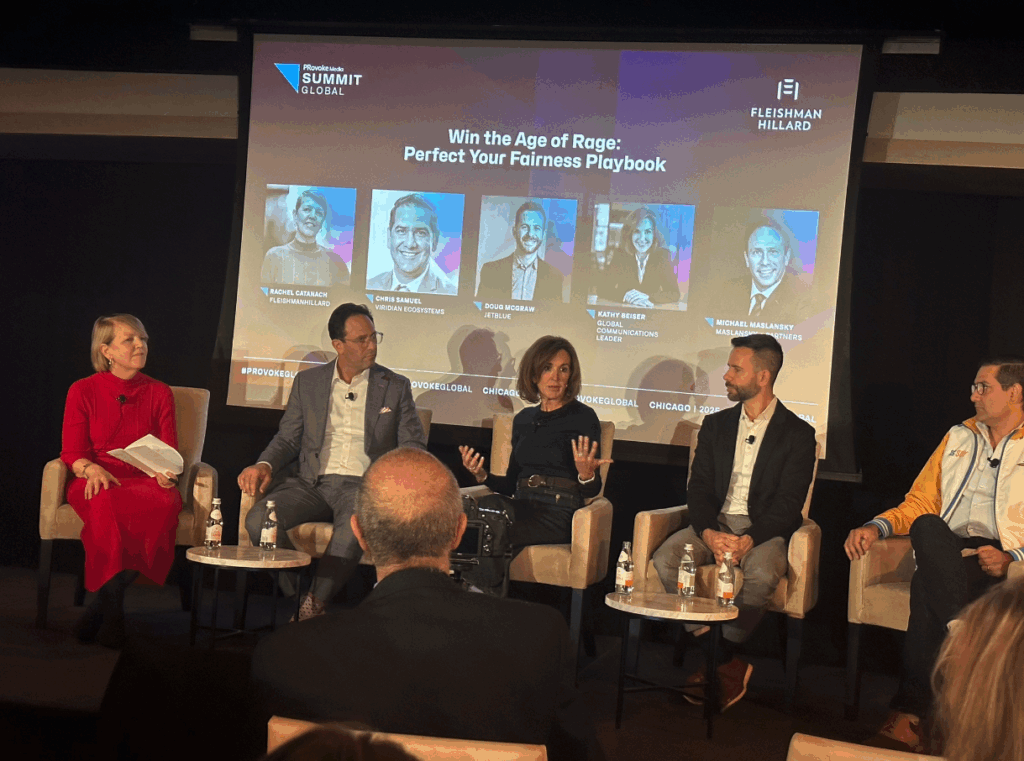
Discussing Fairness in the Age of Rage at the PRovoke Global Summit (Left to Right, Rachel Catanach, Michael Maslansky, Kathryn Beiser, Doug McGraw and Chris Samuel).

This piece draws on new research from our partners at maslansky+partners, led by Michael Maslansky (CEO) and Lee Carter (President and Partner), whose work on fairness and trust provides critical insight into today’s volatile public mood. What their data makes clear is this: the old rules no longer apply. Good intentions are no longer enough. And if you think this is just another cycle of public discontent, you’re missing the point and the opportunity.

What’s Really Fueling the Rage?

The rage we see today is not ideological. It’s not just a backlash against politics, culture wars or pandemic-era disruption. It’s personal. People don’t just distrust institutions – they believe those institutions are actively working against them. Whether it’s government, media or business, the sentiment is the same: “The system is rigged, and I’m the one paying for it.”

In the maslansky+partners’ research, more than 70% of people said they rarely or never trust companies to treat customers fairly. Over 60% believe most big companies purposely look for ways to take advantage of them. And some 80%, many of whom once said they want companies to support causes, now say what bothers them most is something more basic: hidden fees and fine print.

The message couldn’t be clearer. People aren’t asking companies to take a stand on every issue. They just want to be treated fairly.

Fairness, Not Goodness

In recent years, the corporate playbook has centered on goodness: purpose, ESG, brand values, societal impact. And those things still matter. But in the current climate, they’re not the differentiators leaders think they are.

That’s because fairness hits differently. It’s not a strategy. It’s a standard. When people feel a company is unfair – when they see surprise fees, hear about executive bonuses during layoffs or feel excluded from loyalty benefits – it doesn’t just frustrate them. It enrages them. And that rage moves quickly, particularly in a connected, post-trust world.

More than 60% of consumers say they’ve boycotted companies for putting profits ahead of people. More than 40% either agree or don’t disagree that violence might be justified in response to unethical corporate behavior. These aren’t just reputation risks. They’re survival threats.

The Real Shift: From Purpose to Permission

For years, companies have leaned on purpose to build trust and earn permission to operate. But that permission is now contingent on fairness. If your customers believe they’re getting a raw deal, no amount of purpose-driven messaging will save you. In fact, it may backfire.

This is the dark side of “doing good”: when companies promote values that feel disconnected from customers’ real lives – especially those struggling to make ends meet – those efforts aren’t seen as admirable. They’re seen as hypocritical, or worse, insulting. It’s the $2 million Super Bowl ad telling customers you care, while their internet bill just went up with no explanation.

What Leaders Should Do Now

Fairness isn’t a communications challenge. It’s a business imperative. And it requires a different kind of leadership – one rooted in empathy, consistency and operational integrity. Here’s where to start:

  • Replace goodness language with fairness language. Don’t talk about changing the world. Talk about how you’re making things better for your customers. Be specific. Be transparent. Be human.
  • Prioritize customers over causes. That doesn’t mean abandoning purpose. It means making sure it doesn’t come at the expense of the people keeping your business alive.
  • Deliver universal benefits. Avoid programs that help some while leaving others behind. Fairness means everyone gets the best price, the clearest policy, the same level of service.
  • Fix the small injustices. The fee they didn’t see coming. The policy that changed without warning. These moments define your brand more than any campaign ever will.
  • Make it personal. Every message, every policy, every change should answer one question: how does this help the individual on the other side?

A Fairness-First Future

In this age of rage, fairness isn’t just the right thing to do. It’s the only thing that works right now.

Fairness earns trust when purpose can’t. It deescalates outrage. It keeps customers loyal. And most importantly, it signals to people that they matter – not just as buyers, but as human beings. That’s a powerful message in a world where far too many feel forgotten.

For business leaders, the challenge is clear. You can keep trying to win the last war, fighting to prove your purpose, defend your values or ride out the storm. Or you can lead the solution. You can rebuild the trust that’s been broken. You can show people that fairness still exists and that your company is committed to delivering it. Because in the end, the companies that thrive won’t be the ones shouting the loudest. They’ll be the ones that show up, play fair and prove day in and day out that they’re on their customers’ side.

Cody Want Rachel Catanach is FleishmanHillard’s Global Managing Director, Corporate Affairs; General Manager, New York and Boston; and leads the Global Executive Advisory, counseling CEOs on leadership transitions, Board engagement and high-stake issues. A global PR industry advocate, she has spoken at Davos, moderated at Cannes Lions and co-authored The Page Society’s Beyond Communication report. She was also a 2024 PRWeek Woman of Distinction.

 
Article

Augmented Judgment, Accelerated Execution: AI’s Role in Crisis, Issues and Risk Management

October 14, 2025
By Matt Rose and Alexander Lyall

Everyone’s talking about the promise of artificial intelligence. For crisis, issues and risk managers, that promise isn’t theoretical anymore. It’s already changing the game. The speed, scale and complexity of today’s challenges demand more than human effort alone. We need tools that sharpen judgment, spot risks sooner, simulate outcomes and move faster than we ever could on our own.

At FleishmanHillard, we call this Augmented Judgment, Accelerated Execution. It’s the balance of seasoned, human counsel with the foresight, scale and speed of AI. When used well, AI doesn’t replace human judgment, it strengthens it. AI compresses timelines, expands context, flags risks earlier and gives leaders the clarity they need under pressure.

Here’s how we’re putting this advantage into practice at FleishmanHillard, using trusted frameworks and strong data governance to help clients address crises, issues and risk with confidence.

AI for Early Warning

AI is becoming an essential early warning system. It examines global news, regulatory updates, and social activity to detect emerging topics and weak signals before they escalate. By analyzing conversations across markets, languages, and, it connects jurisdictions patterns that siloed teams might miss, with speed and breadth that today’s lean human teams cannot match.

It can also track how issues are likely to evolve and flag pressure points like upcoming regulations, activist campaigns, or viral moments. In addition, it can be pointed to anticipate when separate concerns may converge, adding complexity to timing, messaging, audience response and stakeholder engagement. This kind of foresight helps leaders act early, communicate clearly and stay ahead before critical moments hit.

AI for Stakeholder Simulation

Spotting a potential issue is one thing. Understanding how different audiences might respond is the next. Employees may question values. Regulators may focus on compliance. Investors may worry about financial impact. Customers may be concerned about reliability.

AI helps make this analysis possible through FleishmanHillard’s SAGE Synthetic Audiences. These simulations, built on polling data, demographics, and behavioral insights, let teams pressure-test messaging in real time.

AI can also model how a story might spread. Coverage could draw regulatory attention, spark activism, or open the door for competitors. With this foresight, teams can weigh options early, decide how to respond, and plan outreach in the right order.

AI for Story Forecasting

Reporters rarely work in isolation. Their previous stories, tone, and interview style often foreshadow how a new piece might unfold. AI can analyze this public data to forecast likely narratives, giving teams time to scenario-plan and prepare fact-based responses.

In one recent case, the FleishmanHillard team leveraged AI to generate a full-length draft of a potential investigative article based on a reporter’s in-depth inquiry, their past work, and facts they were likely to uncover. The projection closely matched the final story, serving as a clear model for the client and FH counselors to work against and affording weeks to prepare. Together, they aligned messaging, cleared responses and rehearsed scenarios. When the article ran, the team responded with focus and confidence, avoiding both unwanted attention and business disruption.

Click Above for More From the FleishmanHillard Crisis Team

AI for Crisis Content Management

Crisis response is rarely just one statement. It quickly becomes a growing stack of analytics and materials: standby statements, employee letters, investor scripts, customer updates, government briefings, media talking points, FAQs and social posts. Managing it all can become chaotic, especially with lengthy approval chains.

AI tools like FH Crisis Navigator help bring order. Acting as a virtual program manager, it adapts approved language for different audiences with speed and consistency. Using this tool, a crisis counselor can generate drafts, maintain version control, and keep updates aligned across every document. This reduces drift, speeds up approvals, embeds expert counsel, and keeps teams focused. So, when leadership needs to respond – whether to investors, regulators, customers, or the public – everything is already in place and ready for review.

AI for Scenario-Based Training

Preparation has always been essential to crisis readiness. But traditional tabletop exercises often fall short of real-world complexity. AI-powered platforms like the FleishmanHillard Crisis Simulation Lab raise the bar. Run by experienced facilitators, these simulations evolve in real time based on participant decisions. They introduce realistic challenges like media calls, stakeholder emails and viral posts, all tailored to the organization’s sector and geography.

Simulations can launch in hours instead of weeks, making them useful for both training and real-time strategy support. Structured feedback focuses on fact management, stakeholder engagement, and adaptability – building the muscle memory teams need when reputations are on the line.

AI for Campaign Risk Screening

Crises don’t always come from the outside. Sometimes a product launch, influencer partnership, or purpose-driven campaign can spark backlash, trigger scrutiny, or misfire in a volatile moment.

FH Risk Radar helps teams assess these risks before campaigns go live. It reviews concepts against regulatory guidance, cultural signals, public sentiment, and platform-specific challenges. The system scores ideas across dimensions like reputational exposure, influencer fit, message durability, and cultural sensitivity. Instead of a simple go-or-no-go call, teams get a full risk profile and clear mitigation strategies. This shifts review from a late-stage checkpoint to a strategic advantage.

From Promise to Practice

For communicators, risk leaders, and executives, AI is no longer a future promise. It’s a working tool, a strategic coach, and a force multiplier available to improve outcomes now. It surfaces early warning signs, simulates reactions, forecasts narratives, manages complex content, powers training, and screens campaigns. It delivers sharper, faster options for decision makers when every move counts.

AI’s role in crisis and risk management will only grow more sophisticated. But the message today is simple: the technology is here and can be applied to create immediate value. The leaders who use it will be better prepared to protect reputation in high-stakes moments.

At FleishmanHillard, we’re applying these tools every day to help clients anticipate challenges, navigate uncertainty, and emerge stronger. At the heart of it is Augmented Judgment, Accelerated Execution – the combination of trusted human counsel and the structured speed of AI. Together, they help organizations make better decisions, faster.

Crisis Team width=

Matt Rose (top) – Americas Lead for Crisis, Issues & Risk Management: Matt is an SVP & Senior Partner in New York with more than 30 years’ experience in advising organizations on crisis and issues management, risk mitigation, and reputation recovery. He has guided companies through reputational crises, labor issues, regulatory challenges, ESG controversies, and high-profile litigation.
Alex Lyall – Lead, Risk Management, AI & Innovation: Alex is an SVP & Partner in New York with more than 15 years of experience in crisis communications, issues management, preparedness, and risk management, working across industries. As part of the leadership team, Alex will help define best practices, shape go-to-market strategies, and scales solutions, with a focus on AI integration and talent development.
 

FH Guidelines for AI in Crisis, Issues, and Risk Management Applications

At FleishmanHillard, we apply artificial intelligence with purpose, not hype. In crisis, issues, and risk management, that means combining human expertise and experience with proven frameworks, proprietary technology, necessary confidentiality, and responsible guardrails to help organizations respond with speed, confidence, and control.
During a crisis, there is no substitute for seasoned judgment. AI can surface information, suggest language, or model scenarios, but it cannot navigate the nuance of legal implications, stakeholder dynamics, or reputational risk in real time. That takes seasoned counselors who have sat in the room, weighed the tradeoffs, and led under pressure. When the stakes are high, experience is not just helpful, it is essential.
That is why each FleishmanHillard application of AI in the Crisis, Issues and Risk Management Practice is anchored in three principles:
  • Experienced crisis counselors remain at the center of each use case, ensuring that technology enhances but never replaces human judgment.
  • Our systems are designed in secure, quality-assured environments that safeguard client information and uphold rigorous ethical standards.
  • AI is embedded within tested frameworks and workflows, allowing teams to move faster without sacrificing accuracy, accountability, or trust.
This disciplined approach ensures AI strengthens decision-making rather than creating new risks. With FleishmanHillard, organizations embrace innovation in crisis, issues, and risk management with confidence, knowing that innovation never comes at the expense of accuracy, ethics, or trust.


Article

Full Speed Ahead: An Executive’s Guide to Change Management for Regulated Reporting 

October 7, 2025
By Bob Axelrod

As the deadline for complying with the EU Corporate Sustainability Reporting Directive (CSRD) approaches, company leaders will soon need to evolve their reporting process. The CSRD and its underlying disclosure standards, the European Sustainability Reporting Standards (ESRS), usher in a new era of reporting, requiring companies operating in the EU to provide detailed, standardized responsible business and sustainability disclosures that are audit-grade.  

The temptation to pause and await further clarifications — such as outcomes from the “Omnibus Simplification Package” — may seem prudent, but that’s a risky calculation. The direction of travel is clear, and operational readiness is a multiyear endeavor that cannot wait. 

Change Management: The Deciding Factor 

CSRD compliance is far more than a reporting exercise. It requires a transformation in how your company operates, collaborates and delivers information — with audit-ready precision and cross-functional accountability.  

If your company has experience with voluntary responsible business reporting, you’re somewhat ahead of the curve. But regulated, externally assured reporting is a different game altogether, comparable to the shifts required when financial reporting became regulated. The scale of change necessitates active executive sponsorship, clear ownership and a culture that embraces transparency and due diligence. 

Acting Now Is Essential 

Waiting for absolute certainty from regulatory bodies creates a dangerous illusion. The core requirements of the CSRD are already defined.  

Delaying action can leave your organization scrambling to catch up, leading to higher implementation costs, operational disruptions and potentially subpar reporting that may expose your organization to fines and reputational risks. Early movers can pilot new processes, identify data gaps and course-correct before mandatory disclosures are enforced, therefore gaining an advantage in data quality, audit readiness and stakeholder credibility. 

Key Steps for Success 

1. Expand Cross-Functional Collaboration: Sustainability, finance, legal, risk, HR, IT, audit, procurement and other key functions must all be fluent in responsible business principles and actively engaged in reporting processes. 

2. Upskill and Train: Teams require targeted training in data governance, due diligence and audit-level documentation — going beyond simple awareness. 

3. Resource for Rigor: Subject matter experts need greater support, including additional staff, time and specialized expertise. Empowering them is critical for accurate, timely and complete disclosures. 

4. Embed Accountability: Define clear roles, set ownership and align performance incentives. Make CSRD compliance a shared objective, visibly sponsored by both the C-suite and the board of directors. 

5. Invest in Technology: Manual data collection is no longer viable. Integrated systems for data management and workflow are non-negotiable to meet the demands of CSRD. 

Executive Leadership: Setting the Pace 

Leaders must model the mindset shift that CSRD requires. Treat compliance as a transformation, not a checkbox exercise. Champion resource allocation and insist on regular progress updates.  

Building a Resilient, Future-Ready Organization 

CSRD compliance is ultimately a change management effort — one that will be won or lost at the executive level. By setting new expectations, providing the necessary resources and embedding accountability, you can transform compliance from a regulatory burden into a strategic advantage.  

The upcoming Omnibus Simplification Package may clarify technical nuances, but the urgency to act is now. Operational readiness takes time, and the cost of playing catch-up is high. Is your organization equipped to meet not just the letter of mandatory reporting, but to thrive in this new era of transparency and due diligence? 

FleishmanHillard is here to help your organization navigate this evolving landscape. Connect with us today to propel you forward, no matter where you are on the winding road to CSRD readiness.  

Bob Axelrod width= Bob Axelrod is a member of FleishmanHillard’s global Responsible Business and Impact leadership team. He has 30+ years’ experience advising corporations on Responsible Business strategy and reporting and is spearheading a multi-agency effort to help clients effectively comply with mandatory reporting requirements, including the EU’s Corporate Sustainability Reporting Directive

 
Article

Tariffs, Trust and Transparency: How to Communicate Price Increases Without Losing Stakeholder Confidence

August 13, 2025
By Donna Fontana, Matt Rose and Kristie Sigler

As of August 2025, expanded US tariffs are reshaping pricing across industries, from seafood and electronics to Swiss watches and appliances. While many companies have avoided public discussion of tariff-driven price increases, this “run silent” strategy may be unsustainable as cumulative price pressures intensify and customer sensitivity peaks.

For business leaders and their communications teams, the question is no longer whether to communicate price increases but how to do so without damaging trust, inviting backlash or creating political risk.

Why Silence May Not Be Sustainable

Most organizations still approach price communication as if customers, whether in B2B or consumer markets, evaluate each increase in isolation. The reality is shifting. With tariffs now affecting multiple categories at once, customers will face higher costs from many directions simultaneously. Even modest, justified increases risk being seen as price gouging when viewed through the lens of cumulative burden.

For consumer brands, the risks are visible and often viral. For B2B companies, the stakes are just as high. Cost pressures are identical but brand recognition is often weaker and communication channels fewer.

There is also a political dimension. In sensitive categories, tariff-related price communications must consider alignment, or perceived misalignment, with the Administration’s economic narrative. Messaging that appears to contradict official positions on trade, inflation or consumer costs can draw not just customer pushback but also political scrutiny.

The Emotional Reality

Price increases may be driven by economics, but they are received emotionally. Customers, whether households or procurement teams, feel the squeeze of multiple increases across different products and services. That can produce frustration far out of proportion to any one company’s actions.

This is where communication becomes as much about empathy as explanation. Overcommunication carries its own risks but failing to address perceptions leaves a vacuum that competitors, critics or policymakers may fill. Monitoring sentiment, anticipating questions and responding in plain language should be treated as operational priorities.

Strategic Principles for Tariff-Era Price Communication

Not every company will face the same pricing challenges but many will need to refresh their approach. The following principles offer a framework for explaining price increases in a way that preserves relationships and reduces reputational risk.

1. Lead with Transparency, Not Excuses
Replace generic “rising costs” statements with specific context:

“Recent changes in trade policy have significantly increased our sourcing costs. Rather than compromise quality, we have made a modest price adjustment while continuing to invest in the partnerships and processes that protect the quality customers expect.”

2. Make It Personal, Not Political
Customers want empathy, not a policy seminar:

“We know prices are rising everywhere, and we are not immune. We are committed to fairness, transparency, and quality – even as global input costs change.”

3. Show Your Mitigation Efforts
Make it clear that you have considered the interests of all stakeholders, including policymakers, and that raising prices was the last resort:

“We have streamlined logistics and reduced packaging waste to shield customers from rising costs. We are also absorbing a portion of the increase ourselves to minimize the impact. But with input costs climbing sharply, a modest adjustment has become unavoidable.”

4. Ensure Cross-Channel Consistency
Your investor communications will be seen by customers and customer communications will be seen by policymakers. Develop unified messaging for all stakeholder groups, equip teams with consistent language and monitor every touchpoint.

5. Reinforce Brand Values
Tie the increase to commitments to quality, sustainability or integrity. A beauty brand citing tariffs also emphasized its continued investment in cruelty-free, high-quality products. The subtext: we are not cutting corners.

6. Prepare for Emotional Responses Across Markets
Monitor sentiment in real time, assess perception gaps between audiences and benchmark against peers. Be mindful of global market reactions and ensure you have the channels in place for agile, coordinated communication across regions. Respond quickly with empathy, clarity and cultural awareness when resistance rises in any market.

7. Consider Industry Coordination
Trade associations can sometimes lower political and consumer risk by explaining category-wide economics, though each brand must still deliver its own aligned message.

The Bottom Line: From Pass-Through to Reputational Risk

Pass-through pricing has evolved from a supply chain term to a source of reputational risk. While there is no universal blueprint, companies that plan now will have more control over the narrative later.

Tariffs may be beyond corporate control. But the story you tell about your pricing decisions, and the value your products deliver, is entirely yours to shape. Trust is not lost in a single price increase; it is lost when companies fail to explain why. In an environment where nearly everything costs more, transparent reasoning may be the most valuable thing you share for free.

Our Executive Advisory. Your C-level advantage.

Article

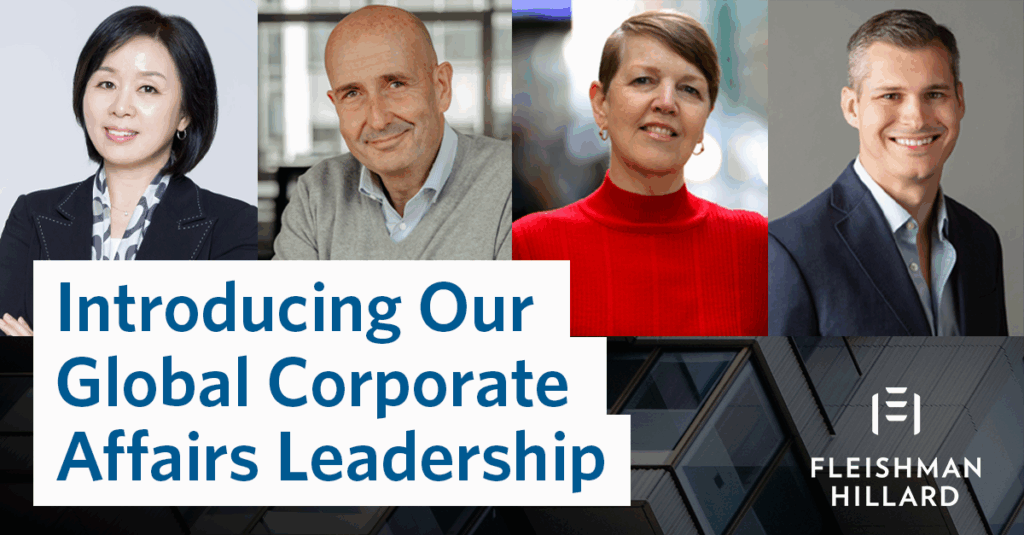
Announcing Our Global Corporate Affairs Leadership Team

August 7, 2025

New leadership strengthens integration across regions and capabilities, helping clients navigate uncertainty, reputation, risk and transformation at speed.

As companies face rising volatility, stakeholder scrutiny and operational complexity, the role of corporate affairs has become an increasingly critical issue for the C-suite. To meet this moment, FleishmanHillard today announced a new Corporate Affairs Practice leadership structure to deliver more connected, insight-driven counsel and stay ahead of the demands of today’s global business environment.

Rachel Catanach has been appointed global managing director, corporate affairs, unifying the firm’s advisory offerings across seven core pillars: corporate reputation; financial and M&A; crisis and issues; executive positioning; public affairs and geopolitical strategy; talent and transformation; and responsible business. Catanach will also ensure FleishmanHillard’s Global Executive Advisory network provides strategic guidance to senior leaders navigating high-stakes issues and transformative change. She continues to lead the agency’s New York and Boston offices.

“Rachel is a visionary leader who understands how to drive business results through modern, reputation-centered communications,” said J.J. Carter, FleishmanHillard president and CEO. “Her leadership of corporate affairs will elevate the impact FH delivers to global clients navigating extraordinary uncertainty and strategic challenges.”

To support this global capability, the agency has also named three regional leaders:

  • Michael Moroney, managing director, corporate affairs, Americas – A trusted counselor on regulatory complexity and executive visibility, Moroney will guide strategy across the Americas while continuing to shape the Executive Advisory portfolio and lead key client relationships.
  • Yvonne Park, managing director, corporate affairs, APAC – Based in Seoul, Park brings two decades of experience in litigation communications, stakeholder engagement and CEO succession planning. She will drive consistency and innovation across Asia, aligning with global capability and sector leads.
  • Hanning Kempe, managing director, corporate affairs, EMEA – With a track record advising multinationals and government stakeholders across Europe, Kempe will leverage his expertise in change management, corporate strategy and crisis to lead the region’s growth and service excellence.

(From left to right: Yvonne Park, Hanning Kempe, Rachel Catanach, Michael Moroney)

FleishmanHillard’s global corporate affairs practice leverages a powerful combination of counselor-driven solutions and advanced intelligence infrastructure that enables teams to respond to client challenges with greater speed, precision and business impact. Counselors across the network are empowered to design and deploy real-time solutions that integrate proprietary tools, institutional knowledge and advanced audience insights, no engineering background required.

  • Risk Radar: An AI-powered early warning system that flags reputational, legal and operational vulnerabilities, helping clients identify and respond to meaningful risks before they escalate.
  • SAGE (Strategic Audience Generation Engine): A predictive audience intelligence tool that simulates stakeholder reactions to messaging and positioning, enabling teams to test and refine strategies for maximum impact.
  • Connectivity Diagnostic Agent: A solution that analyzes how a brand’s story aligns with shifting cultural, regulatory and reputational forces, revealing areas of strategic misalignment and opportunity.

These capabilities, combined with FleishmanHillard’s Global Executive Advisory network of more than 50 senior counselors, enhance the firm’s ability to deliver high-impact counsel at the intersection of risk, reputation and growth. Corporate affairs teams routinely collaborate across brand work and all FleishmanHillard centers of excellence, ensuring clients lead with confidence in their most consequential moments.

These appointments follow several recent FleishmanHillard market leadership announcements, including Mei Lee in Singapore, Madhulika Ojha in India, Adrienne Connell in Canada, Kristin Hollins across California and Marshall Manson in the United Kingdom — as FleishmanHillard continues to invest in regional leaders who deliver trusted counsel and measurable impact on a global scale.

With this next chapter, FleishmanHillard’s corporate affairs leadership is uniquely positioned to help leaders anticipate risk, accelerate transformation and build enduring reputation in a world defined by complexity and change.

Article

Closing the Innovation Gap With FH Fusion, Our Data and AI-Powered Solutions Suite

July 14, 2025

Our new solutions suite designed by and for communications professionals builds on Omnicom’s agentic AI platform, Omni, by integrating institutional communications knowledge with advanced audience data and technology capabilities. FH Fusion gives every FleishmanHillard counselor and team the ability to create real-time, agentic AI solutions that deliver sharper insights, more precise activations and stronger business outcomes—no engineers required.

FleishmanHillard today launched FH Fusion, a first-of-its-kind communications solution suite that puts the full range of AI models, institutional knowledge and a proprietary data toolset directly into the hands of communications professionals. Unlike tech-first applications built by developers, FH Fusion was created by—and for—counselors, enabling them to design and deploy real-time solutions backed by Omnicom’s secure, scalable intelligence layer.

Already in use by more than 1,000 FleishmanHillard strategists, FH Fusion reduces ramp-up time, accelerates delivery and improves outcomes across crisis, stakeholder messaging, media intelligence and brand strategy.

“FH Fusion closes the innovation gap—the distance between what communicators envision and what most tools actually enable,” said Ephraim Cohen, global head of data and digital. “It gives every strategist the power to turn expertise into action, combining insight, data and AI to build exactly the solution they need. We designed it so communicators can move at the speed of their ideas, with technology that’s trained to think the way they do about how people react, how issues evolve and how strategy needs to shift in real time.”


A Peek Inside: How FH Fusion Works

Today’s communicators don’t just need insights. They need infrastructure. FH Fusion leverages Omnicom’s industry-leading investments in AI and data to bring together four critical components – data, generative AI, knowledge bases and subject matter expertise in building custom agentic solutions for each client. FH Fusion combines:

  • 🔗 A full range of AI models and agentic AI technology – Omni’s AI layer enables users to create custom, multi-agent workflows from a full range of generative AI modes.
  • 📊 Industry leading data stack – The data layer of FH Fusion combines Omnicom’s collective data-driven intelligence across audience and commerce inputs from Omni and Flywheel, with corporate and consumer media, influencer, and other critical communications data from OPRG and FleishmanHillard.
  • 📚 FleishmanHillard’s institutional knowledge – FleishmanHillard’s considerable institutional knowledge and collection of proven, proprietary methodologies are being organized into a growing library of knowledge bases accessible to any agent.
  • 🧠 Subject matter experts trained in developing agentic AI solutions – Solutions are built not by engineers, but by FH counselors trained in creating AI agents, resulting in agentic solutions with communications expertise at the core.


A Smarter Model for the Future of Communications

FH Fusion is already being used by FleishmanHillard subject matter experts to build client solutions across three capability areas—each one modular, extensible and designed to integrate seamlessly with existing client workflows. The tools below are just a few of the expert-built components being combined to create end-to-end, outcome-driven solutions.

1. Predictive Audience Intelligence with Synthetic Audiences

Solutions include SAGE (Strategic Audience Generation Engine) that simulates how key stakeholder groups—from policymakers to employees—respond to messaging, content or positioning. Using AI-modeled virtual audiences built on deidentified and aggregated behavioral and attitudinal data, teams can test multiple approaches, identify what resonates and refine strategy before going live.

As AI becomes the new filter for information, SAGE helps communicators shape how messages are interpreted before they’re summarized, surfaced or amplified by algorithms. In a recent pilot, SAGE uncovered shifts around trust and transformation, informing a Fortune 100 client’s rollout across six markets.

2.  Storytelling and Strategic Alignment

Solutions include the Connectivity Diagnostic Agent that analyzes how a brand’s story aligns with shifting cultural, regulatory and reputational forces. Trained by messaging experts, it goes beyond keyword scans to reveal strategic misalignment—helping teams fine-tune positioning before small gaps become larger problems. The Communications Function Builder helps leaders optimize team structure and workflows using benchmarking and best practices—turning institutional knowledge into scalable systems.

3. Crisis Management and Corporate Communications

Solutions include Risk Radar that flags reputational, legal and operational vulnerabilities using AI trained by FleishmanHillard’s crisis experts. It filters out noise and false positives, helping teams identify and respond to meaningful risks early, serving as a calibrated early warning system built for decision-making rather than a cry-wolf dashboard.

These solutions build on FleishmanHillard’s long-standing commitment to democratizing access to data—now extended through new forms of intelligence, including curated knowledge bases (KBs), scenario-trained agents and secure, segmented workspaces that adapt to each client’s needs. FH Fusion is powered by a flexible intelligence layer that enables any employee to build multi-agent workflows tailored to real-world communications challenges, drawing from a full range of top-performing AI models. FH Fusion also taps into the depth of Omnicom’s data ecosystem, combining audience and cultural intelligence from Omni, commerce insights from Flywheel, and integrated streams of media, social, influence, and business signals—calibrated for strategic communications.

“Too many tools treat communications like an engineering problem. FH Fusion starts from a different premise: strategy is a human discipline,” said Cohen, who will host the FH Fusion Summit in September featuring live builds, cross-functional demos and client use cases. “We’ve spent years expanding data fluency across the agency—and now we’re applying that same model to AI. We’re training every FHer to be a builder, not just a user. Communications expertise alone isn’t enough anymore. What we need is that expertise plus deep data fluency—and the ability to train AI agents just like we train people. That’s the real shift with FH Fusion.”

Disclosure: This post was developed in collaboration with a custom agent trained for the communications industry—guided by FleishmanHillard counselors and built using Claude 3.5 Sonnet, one of seven major models FH Fusion can switch between on the fly. It drew from a curated knowledge base of communications research to focus on the capabilities clients care most about right now. Want to see what else it can do? Let’s talk.

How FUSION WORKS
Article

Creativity in the Age of Uncertainty

June 16, 2025
By Jim Joseph

On the Ground at Cannes: There’s always a certain kind of energy on the ground at Cannes. But this year, it feels as much like a reckoning with what creativity must become as it is a celebration of a year of groundbreaking work. Yes, we’re honoring culture-shifting campaigns. But more than that, we’re witnessing a recalibration of what it means to build brands through creativity that must stay ahead of the times.

I’ll admit I arrived in Cannes feeling a bit dazed and confused by the state of the world. I wasn’t sure what I’d take away from the sea of experts and sessions ahead. But from the moment I stepped onto the Croisette and into the Palais, I felt creativity begin to work its way in—offering perspective, energy and solutions to the uncertainty surrounding us all.

Every conversation circles a similar tension: how do we lead brands through a world that’s constantly shifting—technologically, culturally and emotionally—while staying grounded in purpose and connection?

Some are waiting for change to catch up through legislation, regulation or policy. But that takes time. Creativity doesn’t sit still. It’s raring to go. It’s the lever we can pull now—every single day—to evolve brands in real-time. And what I’m hearing over and over again is this: creativity must evolve. And fast.

That’s what makes this week so powerful. For 51 weeks of the year, we’re heads down—delivering, adjusting, moving fast. But here at Cannes, we get to zoom out, reconnect with our craft and remember why we chose this industry—whether it was two years ago or twenty. We focus on the work and how to continually improve it.

And I’m picking up patterns from those doing just that. Not with theory, but with action:

💡 Bold ideas come from belief, not budget. I’ve seen this cut across industries at the start of the week: the best creative work isn’t born from excess—it’s born from conviction and a sharp understanding of audience signals. Think smart, scalable and sustainable campaigns that stay true to the brand, reward instinct and have the courage to do things differently.

💡 Creativity is being operationalized. It’s built into how decisions get made, not just how campaigns get launched. Ideas are judged by clarity, not polish. Four-slide pitch decks that cut to the a-ha. Weekly 15-minute concept reviews that favor momentum.

💡 Speed is essential. Culture moves fast—and brands that matter are keeping pace or setting a new one altogether. They’re doing it with confidence, not chaos. That’s the counter to the uncertainty we all operate in. The strongest brand teams are structured to act on signals, make real-time calls and adapt quickly.

💡 The human spark still matters. AI is everywhere—and rightfully so. But the best leaders are asking grounded questions: how does this make our message more human, more trusted, more meaningful? One tactic I’m hearing is the use dual of AI agents—one protagonist, one antagonist—to challenge assumptions and reveal underlying tension. But here’s the thing: AI is only as powerful as the brand instincts behind it. That comes from our own experience. From our earned best practices. From riding out moments like this before.

💡 Boldness is back. Brands making moves are giving themselves permission to leave the expected path and go the unexpected way. There’s a renewed focus on the 70/30 model—where 70% of energy goes to what’s proven, the tried and tested strategies, and 30% to the wild cards, the innovative and experimental approaches. If it hits, it scales. If it doesn’t, it teaches. The tried and true doesn’t work anymore—and pretending it does only adds to the uncertainty.

💡 Let your community lead. Your audience is your voice. In uncertain times, let them speak for you. They bring clarity. They bring joy. And when they do, give it back.

What’s becoming clear is this: creativity isn’t being managed. It’s being embedded—as a core function in how teams operate, how leaders lead and how decisions get made when the answer isn’t obvious. Creatives are more than makers—we are trusted counselors, translating signals into the work that keeps brands stable in the chaos. And in uncertain times, creativity becomes more than a differentiator. It becomes a stabilizer. A spark. A strategy.

If the kickoff of Cannes is any indication, the brands that thrive next won’t be the ones with the flashiest message. They’ll be the ones with the clearest voice, the fastest reflexes and the courage to build what’s next before someone else does.

Jim Joseph width= Jim Joseph is FleishmanHillard’s global head of brand impact, responsible for leading global brand business across B2B, B2C and B2G audiences, leveraging communications to enable commerce and business outcomes for the agency’s clients. He is a member of FleishmanHIllard’s Global Executive Advisory.



On the Ground at Cannes