How Can the European Union Better Support Consumer Choice and Promote More Sustainable Products?
June 17, 2020
Share
The new Circular Economy Action Plan launched under the European Green Deal aims to transform production and consumption. This means changing the way consumer products for the EU market are made and offering consumers more sustainable choices. […]
John Saunders, FleishmanHillard president and CEO, shared the note below with global employees.
“I could share a list of every micro-aggression, every slur shouted from a passing car, every time I felt harassed, exoticized, tokenised, too dark, every time I had security guards follow me around a shop, every time I was randomly selected by police on the street to show my ID and asked if I had drugs on me.” – the words of Sean Gallen a young Black Irish designer and writer now based in Berlin writing in the “Irish Times” this week about his experience growing up in Ireland.
As I reflect on the tragedies of the past weeks, I am both furious and saddened by the shocking levels of racism that remain so rampant in 2020. Issues relating to race are a particular sickness in American society but also across the globe. Just think, Ahmaud Arbery, Breonna Taylor and George Floyd who were mercilessly killed at the hands of law enforcement. Anyone who knows me well knows that I have had a lifelong love affair with America, but America is off the charts in terms of its levels of brutality and the number of those killed each year by police. All that said, the global Black Lives Matter protests that have taken place across the world this past month have highlighted that racism is by no means confined to America.
When it comes to this truly disturbing issue, words can be cheap, but what we say and what we do really matters right now. At FleishmanHillard, we have had a deep commitment to diversity. In some parts, we have carried out our mission. In too many other ways, our commitment got stuck in good intentions and we have not made the kind of progress to which we have previously committed ourselves. We allowed ourselves to become side-tracked by the daily grind of the business. Instead, our commitment and ambition to become the most inclusive agency in the world should have been at the epicentre of every business decision. In truth, it wasn’t and this makes me very uncomfortable – as it ought to.
A series of candid, intimate discussions with colleagues during the past week have left me deeply unsettled. The reflection in the mirror is clear – we must change. We must get better and we need to do it now. I want FleishmanHillard’s people to be proud. I want Black and Brown team members, and all our colleagues of diverse backgrounds, to be uplifted and to feel they are valued and truly at home here.
As a leader it starts with me. After a groundswell of brave and passionate grassroots efforts across our firm, lengthy discussion and careful reflection, I would like to share our initial commitments which are part of a larger, long-term and deliberate plan we are holding ourselves accountable to:
Beginning Immediately
Recognizing Friday, June 19, “Juneteenth,” as a companywide day off along with all Omnicom agencies. Colleagues around the world will show solidarity and reflect and engage on this day in 1865 that marked the end of slavery in the United States.
Chief Diversity Officer. While diversity is a priority for us ALL, we will for the first time in our 74-year history, make this a dedicated leadership role reporting to me and our COO, and working with leadership across our global network, including our Chief Talent Officer.
Active listening through regular firmwide #LosetheWhisper programs. We will listen more, so we can learn.
Challenging our clients, with dedicated counsel, to show up differently. We will be vocal on asking them to embrace an inclusive and progressive stance on issues happening in our world – not just in America and their role in solving them.
Continue our practice of analysing compensation for all diverse employees to ensure market competitive salaries are reflected in our 2020 cycle.
Senior Leadership will be held accountable for engaging in change as soon as they can, each time they can.
Our most recent Cabinet meeting was devoted in large measure to the subject of diversity. Our next one will have a single agenda item – Diversity.
Immediately, we will reignite our Alfred Fleishman Diversity Fellowship – strengthening our talent pipeline with exceptional junior level professionals.
And Moving Ahead
By July 15, creating a benchmark for our DE&I progress and consistent measurement against it.
Changing our agency’s face. We will require diverse talent on our largest client teams and diverse talent as client leaders.
Relentless focus on retaining and growing our existing talent by ensuring opportunities for advancement and promotion.
Dedicated funding and investments to fuel Diversity, Equity & Inclusion (DE&I) hiring, retention, training and development.
We will move DE&I to the centre of our business – touching all areas from our Client Experience to our Business Development and beyond – treating it as critical and essential to our viability and license to operate.
We need critical mass. This requires strength in numbers and vested leadership cross-agency to drive DE&I forward – we will not have FleishmanHillard’s Black and Brown employees shoulder this load on their own.
More to Come
I do not have all the answers, but I know action is critical. And we have already started. We are also putting far more rigor to plans that already exist. We will measure, evaluate and have honest feedback cycles on what is working and what must be done better. This is not about platitudes, this is about our vow to be the change we want to see in the world – one step and one day at a time. Unlike in the recent past, there can be no pause button applied this time whenever we are caught up in the fog of daily business.
We will do all we can to rid America of its original sin — racism. But the rest of us have a lot to answer for too. That’s the Uncomfortable Truth.
See what else is happening
You might also like
Expertise
Earning Your License to Lead: UNGA, Climate Week and Beyond
September 17, 2026
News
The Chaos Advantage: How Brands Win in a Volatile World
June 25, 2026
News
The Chaos Advantage: FleishmanHillard Research Finds Caution Has Become the Riskiest Strategy in Marketing
June 22, 2026
News
FleishmanHillard Releases U.S. ‘License to Lead’ Report, Revealing Sharp Confidence Gap Between Executives and Stakeholders
June 2, 2026
News
FleishmanHillard Launches the “America 250” Unit to Help Organizations Navigate a Historic Milestone
May 12, 2026
News
PRovoke Media Names FleishmanHillard a Top Agency in the UK and Europe
April 30, 2026
Expertise
Live from the PRWeek Sports Conference: A Team-First Approach to Communications
April 28, 2026
News
Rebecca Weinstein and Jonathan Arias Win the 2026 U.S. Young Lions Digital Competition
April 23, 2026
Expertise
The New Culture Gap Report: How Brands Stay Relevant for 100 Years
According to McKinsey we face a structural break where patterns of behavior have changed overnight and will not return to the status quo. It’s the end of an era and it remains to be seen which companies will be leading industries where the underlying structure has changed dramatically; writing the rules for the new […]
How Can the EU Promote Reuse in the Circular Economy?
June 11, 2020
Share
The most efficient way to limit the impact of waste on the environment, is to prevent it. After prevention, the second best option, saving energy and resources is the reuse of products. […]
Post-COVID-19 Reboot Offers Ideal Chance to Reimagine Inclusion
May 20, 2020
Share
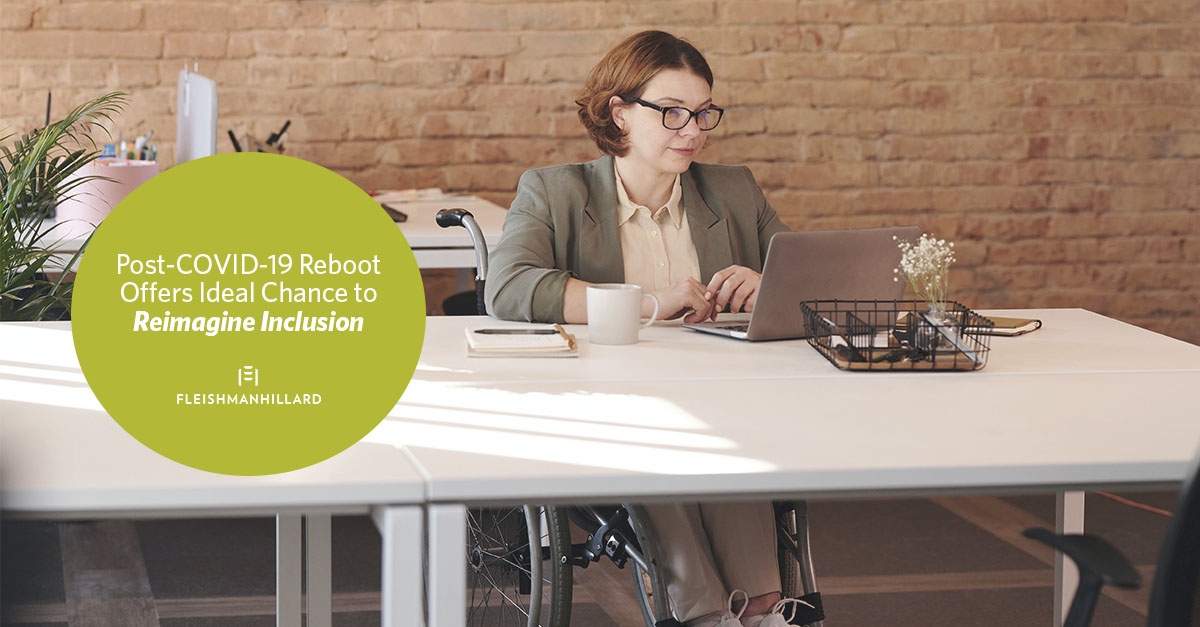
Isolated. Excluded. Inconvenienced. You probably have experienced one or more of these emotions due to COVID-19 and the rigid restrictions it has forced into our lives.
In recent weeks, nearly everyone has battled the ongoing challenges these conditions pose. But for one part of the population, it’s nothing new. That adds needed emphasis to today, Global Accessibility and Awareness Day. The day is dedicated to talking, thinking and learning about digital access and inclusion for people with different disabilities.
Many persons with disabilities (PWDs) – including 61 million in the United States and more than 1.3 billion worldwide – have battled against isolation, exclusion and inconvenience for a lifetime.
The onset of this virus only further complicated things:
Consider a deaf person who may rely on lip-reading to follow a conversation and facial expression to determine tone, two social cues lost to face masks.
Think about a person with mobility issues, particularly those with limited hand coordination. Just getting supplies can be a challenge. How then will they effectively disinfect themselves AND their supplies?
Thankfully, for the mask example, a solution is available: add a transparent strip around the mouth of the mask. It’s an innovation born of necessity. And a proof point that overcoming inclusion challenges can be done.
It also may be a silver lining to COVID-19. We’ve each caught a tiny glimpse into the isolation and inconvenience that so many in the disabled community live with every day. While certainly not apples-to-apples, this experience surely opened our eyes – and hopefully our minds – motivating us to move inclusion forward.
More than meets the eye
While I don’t think of myself as such, I fit the definition of a PWD due to a partial hearing loss and rheumatoid arthritis. Both are rarely obvious. Even so, I may need a little help on occasion from things like a wireless mouse or an external mic to limit my typing.
But whether our conditions are obvious or not, many PWDs struggle to find a comfortable place within society. PWDs are resourceful and resilient; we have to be because so many times we are left to provide our own solutions to issues with everything from housing to transportation to employment. And as society works to survive a pandemic, real assistance with those efforts may draw less attention. Consider the prevailing attitude as protests pop up all over the country: We need to focus on reopening economies and restoring jobs. True enough. But in tackling these priorities, it’s likely that everything else fades into the background.
That’s why inclusion warrants our attention more than ever.
Rewriting the requirements
Almost every challenge presents an opportunity, including COVID-19. There may be no greater opportunity than in the workplace.
One thing the global pandemic quickly proved is that millions of people can work remotely. And if they can, why can’t more PWDs? (Workplace accommodations are often cited by employers as a leading reason they don’t hire more PWDs.) According to the U.S. Bureau of Labor Statistics, in 2019, 19.3% of PWDs were employed, while for persons without a disability, that number was 66.3%.
Thousands of companies are already rethinking how – and even IF – they will bring their employees back to the workplace. Every one of these plans is going to require a multitude of changes, special processes and things that will require some level of difficulty to achieve.
And yet, to keep everyone safe, it must be done. How then can we make sure that everyone is actually a part of those plans? It can’t be enough to put so much effort into reshaping society collectively and workplaces specifically while leaving this vital part of our population behind.
Let’s turn the frustration of having been cooped up at home for months into energy that transforms our world into one that everyone can be part of. Let’s not allow the need for social distancing to make us emotionally distant where inclusivity is concerned.
As our nation slowly returns to the workplace or chooses other work arrangements, if you’re a decision-maker, inject inclusion into those plans. Talk to your employees with disabilities or even partner with the disabled community in the planning process.
If the decisions aren’t yours, make your voice heard. Hold tight to what you experienced during the spring of our discontent. Ask how your company is including those for whom the battle against exclusion continues.
See what else is happening
You might also like
ESG
Navigating Conflicting Demands to Advance Climate Action
January 20, 2025
Opinions
Supporting St. Louis Institutions Dedicated to Empowering Youth Through FH4Inclusion
January 15, 2025
Awards
FleishmanHillard Earns Perfect Score on 2025 Human Rights Campaign Foundation’s Corporate Equality Index
January 7, 2025
Opinions
Revitalizing the San Francisco Community with the Downtown Volunteer Coalition
December 23, 2024
Expertise
Responsible Business: Navigating Today’s Challenges and Opportunities
October 22, 2024
Inclusion
Recognizing the power of the LGBTQ Community in Advertising & Media with GLAAD
October 11, 2024
Opinions
FleishmanHillard and FH4Inclusion Teams Shine at the Cannes Lions International Festival of Creativity
August 28, 2024
Opinions
Bridging the Generational Divide with Generative AI
August 27, 2024
Expertise
How to ensure access and opportunity for Black and diverse students and professionals interested in working in sports
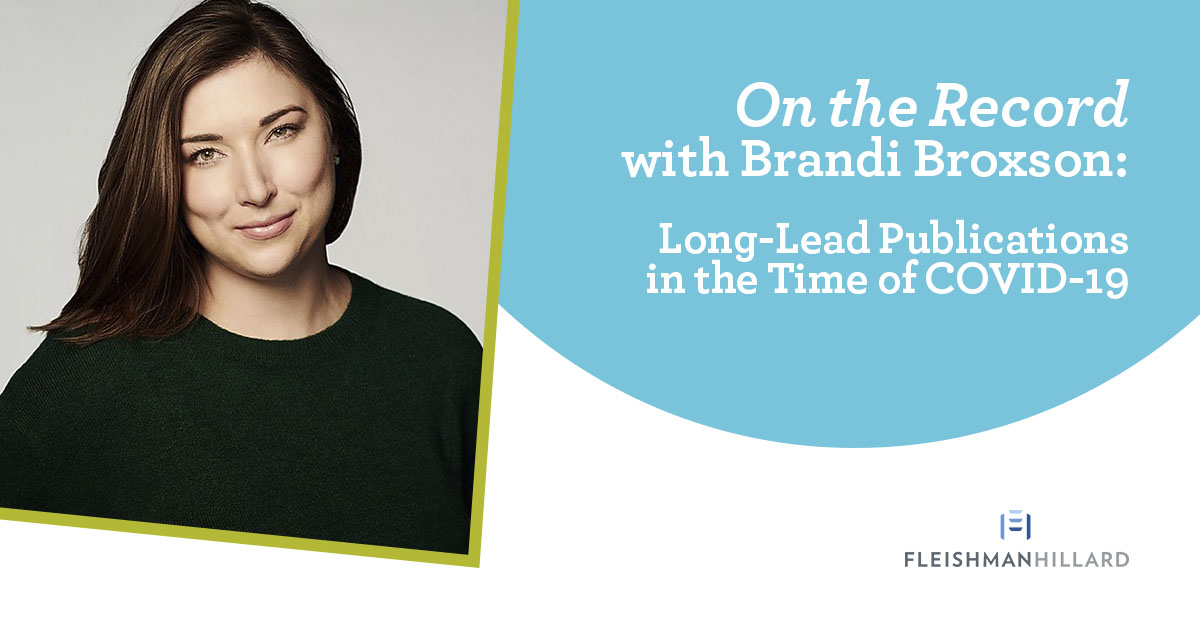
On The Record with Brandi Broxson: Long-Lead Publications in the Time of COVID-19
May 19, 2020
Share
‘On the Record’ is a new series where we sit down with our colleagues and friends who are often at the receiving end of our pitch emails – journalists. We will be tackling hot topics, learning and growing from their perspective and thoughtful advice.
For the second ‘On The Record’ post, Katrina Stern explores how long-lead publications are being impacted by COVID-19. Specifically, how are the digital and print departments collaborating on content, and what are the biggest concerns and standouts from media mailers to video briefings. Their candid Q&A session took place at a safe distance (video chat), as at the time it was conducted, New York City was still on a shelter-in-place order.
KS: First off, how are you doing?
BB: It is just a crazy time. I was reading something today saying that we are “in a permanent state of today.” Couldn’t be more the truth right now.
KS: Agree! Tell me more about the current climate of long-lead publications right now.
BB: So we have been working from home now for the last few months and as you can imagine, producing a magazine is so collaborative. Since we’re working from all over the country right now, it has definitely been a challenge. But it’s really cool to see how our team has come together and, in some ways, we have been able to streamline our day-to-day work flow which has been awesome.
Our April issue was the first one that came out since social distancing, and it was kind of wild because the issue was all about cleaning. It’s a topic that’s really true to the Real Simple brand but was even more of a win, given the current scenario we are in. We saw a real boost in our newsstands sales because people were out shopping and wanted something comforting to read.
And then our May issue which most recently came out was themed around the idea of “getting it done” issue. It was all about little projects you might have put off that you can finally check off your list. That, also, felt in-line with the times and what people are thinking about.
At a long-lead publication like Real Simple, our goal is to provide valuable service to our readers, whether it’s relaxation, inspiration to get something done around the house or cleaning – we want to be solution-oriented.
On our team it has been great to see that sense of unity.
KS: Thinking about something you have shared with me before, are you still having those online and print meetings virtually? And how is that going? Are people on the print side doing more online right now?
BB: Yeah, for sure. We get this great newsletter from our executive editor on the digital side and it’s a breakdown of what everyone is working on. Also, it shares what is going on in the news so we stay “up with the times.”
But something I have seen that is neat is how we’ve come together to produce more video. At the beginning print and digital editors were sent these video kits that had a tripod and ring light. So actually, I am using one of those ring lights right now, so already going to good use. We got these kits so that we have the ability to do videos from home and we are doing them based on our beat. I’ve done a couple videos with it, so far, that you may have seen. One of my franchises is New Uses for Old Things and with how popular toilet paper and paper towels have become during all of this, I came up with ways you could repurpose them into stamps or even a bird feeder.
I think it has been very comforting for readers and viewers at home to get a look at our life and what we are doing, while still giving them something entertaining to read/watch.
The continued collaboration between print and digital has been inspiring to see.
KS: What are the biggest concerns you are facing and how are you handling it?
BB: So I think the questions we are asking ourselves as editors are probably the same questions a lot of people in the world are asking themselves right now. How will things change over the next few months?
We are starting to look at content for our fall and holiday issues. What will Thanksgiving look like this year? Usually there is a mad dash around the holidays with travel – how will that be different?
Editors at long-lead publications are used to looking into their crystal ball and trying to anticipate what readers might need three or four months in advance. And I think that is even true right now because there are so many unknowns. Thinking about: how will the virus change things? How will people be thinking about money and their career?
So that is our biggest concern: how will we anticipate the needs of our readers in a time of uncertainty?
KS: Has anything changed in how you have developed content?
BB: We are really lucky at Meredith, we get these reader surveys that help us to understand the reader and how they go through the magazine, and what stands out to them. What we have heard from our readers is that they come to our magazine to relax and recharge, often reading the magazine if they have an hour at the end of the day to get their mind at ease.
What we’ll continue to do is make sure there aren’t a lot of pain points in the book that might stress readers out during an already worrisome time.
In our June issue we have a big feature on chicken recipes that take you around the world, which I think is so smart since we are all looking to escape our day-to-day at home – traveling through food is interesting. We, also, have a career story coming up and how to make a career pivot – which a lot of people are thinking about. But it is focused on how to do this without going back to school since loans are such a burden.
We’re taking the current climate and inputting it into our content.
KS: This all applies. You kind of touched on this, but what topics are you honing in on more right now?
BB: We’re definitely thinking about personal finance and how we can empower readers. We have some very helpful stories coming up in the next few months. For instance, one is how emotions affect your purchasing habits and money rules you can break right now. Really empowering.
As you know, our September issue is money-themed and there has never been a better time for it to come out to help our readers in this difficult time. Readers are rethinking their finances and ways to save.
KS: Now moving away from content, and talking about the once again popular – media mailers. How are you receiving media mailers?
BB: It is so interesting, my office address has always been in my signature and your home address is something that is a little more personal. It is not something I am putting in my signature for everyone to use.
At the beginning of all this, I was getting a lot of requests for someone to send me wine like every day! And I’m thinking, “you know exactly what I am going through right now, you know what I need.” In the beginning and ever since my inbox has felt like a community. A place for virtual hugs where people are checking in on each other which was nice.
But now I need to be a bit more mindful of what I accept since I don’t have a product closet, like I do at my office. I live in a very tiny apartment with my fiancé, who is often the one bringing the boxes up from the lobby, wondering “what is this?”
But media mailers are super important for my column. I try to make sure they know “don’t send me surprise stuff” – I am not sure I will be able to store it.
KS: So you are saying, no beta fish? Got it! Any media mailers that stick out?
BB: There is this crafting brand and the idea behind their business is that there is an expert video and they craft along with you. They sent me a punch needle kit, similar to embroidery, and it is so genius since I needed something like that to fill my time. And I have the time to do it! Very smart of them.
I received a fun mailer from a food brand. It was a whole Cinco de Mayo kit for a dinner. We cooked along with the food founder. It started with a cocktail, loosening everyone up to get to know people on the briefing. Then we made these chicken tacos, super easy. That one stands out since it was helping me with something I would have to do anyways. A brand saying you can “cook along with us” and here are all the materials. When I got done, I can enjoy the dinner with my fiancé – so nice.
KS: It definitely is interesting to hear. That makes me also think of video briefings, what are your preferences?
BB: Recently I’ve attended a lot of financial video conferences open to the public on investing and budgeting. I thought it was great to see what the public was thinking about the topics, as well as how those in the space are discussing it. I, also, appreciated the briefing since there were multiple ways to submit a question. You could’ve sent in questions beforehand, through the chat, and vocally. Since finance is really personal and private to people, I respected that flexibility.
As for launches, any kind that is engaging in some way where I am not just sitting and watching a presentation – always is a plus. But also, like a number of editors, keeping in mind that we have even more limited time than before is important. Sometimes we are unable to attend and need to default to a product sheet.
KS: This was great, thank you for taking the time to chat!
BB: You know I love to share the knowledge. Chat soon!
Brandi Broxson is senior editor at Real Simple Magazine where she oversees the brand’s service, products, career, and money content. Connect with her here.
See what else is happening
You might also like
ESG
Navigating Conflicting Demands to Advance Climate Action
January 20, 2025
Opinions
Supporting St. Louis Institutions Dedicated to Empowering Youth Through FH4Inclusion
January 15, 2025
Opinions
Revitalizing the San Francisco Community with the Downtown Volunteer Coalition
December 23, 2024
Opinions
FleishmanHillard and FH4Inclusion Teams Shine at the Cannes Lions International Festival of Creativity
August 28, 2024
Opinions
Bridging the Generational Divide with Generative AI
August 27, 2024
Inclusion
Success on Repeat: Alumni of the Alfred Fleishman Diversity Fellowship Discuss Promotions and How to Get Them
May 29, 2024
News
EU climate policy: The new borderlines?
May 27, 2024
News
Achieving the Evolving Duality of Loyalty and Loyalty Programs
April 1, 2024
Expertise
TickTockTech: Mobile World Congress 2024 — What’s the Verdict?
On the Record with Elizabeth Yuko, PhD: The Press Industry in the Time of COVID-19
May 13, 2020
By Caitlin Teahan
Share
‘On the Record’ is a new series where we sit down with our colleagues and friends who are often at the receiving end of our pitch emails – journalists. We will be tackling hot topics, learning and growing from their perspective and thoughtful advice.
For the first ‘On the Record’ post, Caitlin Teahan explores the impact COVID-19 is having on freelance journalism with seasoned freelancer and notable bioethicist, Elizabeth Yuko, PhD. Their candid Q&A session took place at a safe distance (video chat), at the time it was conducted, New York City was still on a strict quarantine lockdown.
CT: How do you think COVID-19 has impacted freelance journalists for better and for worse?
EY: First, for worse. I have lost my main sources of income – specifically my three main clients. For two of them, I still contribute but it is no longer a daily guaranteed income. That has completely changed everything because now, everything I am doing is based on pitches, and it has never been harder to have a pitch accepted or even acknowledged by editors. I have editors say they think a pitch is great and will assign it and then hear nothing for two months. Even a rejection at this point is nice!
CT: That rejection comment speaks to me as a PR person!
EY: Exactly! Also, so many people have lost their staff jobs and now have become freelancers. So now, am I not only competing with the pool of normal full-time freelancers, there is an extra group of people with whom I compete. Almost all publications have slashed their freelance budgets and are saying they only assign stories to staff writers … but are laying them off. I am at a loss as to where things are coming from. In terms of coverage itself it is weird, because some publications only want COVID content, other places say they want other topics but when you pitch anything else, their feedback is that the content isn’t relevant right now, which is obvious, because it isn’t related to COVID. Basically, it is a no-win situation. But it isn’t just about having less work to do. Publications I have written for, for a while now, have cut their rates. So even if you do get a yes, some are only able to offer half the usual rate – which at any other time, is a no. But right now, it may be the only thing I am doing this week so, OK. I am concerned about that because it sets a dangerous precedent moving forward and I am worried we are never going to make it back to pre-COVID rates. No one is in a position now to take major salary cuts.
Now, good things. For me personally, and very specifically me, it has been a good time to be a bioethicist. I have had a PhD since 2012 and there have been a lot of advancements in science and medicine, but nothing on a global scale that affects everyone, like this, so there hasn’t been that much interest in my work until now. All of sudden, everything we do is raising these moral questions, and everyone says, “Great! Let’s ask her!” My recent work with one particular outlet is something I am most proud of because it has been very ethics focused which is so bizarre to me (as it is not on brand for the outlet). They are on an ethics kick at the moment and it is based on what people are clicking on. That is what they want to read right now. If you had told me three months ago, I would be writing one ethics article after another for them, I would have told you that you are incorrect. In that way it has been good. On the other hand, again very specific to me, there are other publications where I normally would have been asked to write the article but am now being interviewed (as the expert). Which is fine – it is my same thoughts as if I were writing and my time – but I am not getting paid for it.
CT: That seems like a doubled-edged sword?
EY: Yes! Everything I am doing is in the hopes of getting more work in the future. Right now, live speaking isn’t a thing and paid lecturing during COVID is limited. It is something I do during ‘normal times’ so there is always the idea that this could lead to a lecture that could help pay my rent. Everything is weird right now.
CT:Besides layoffs, how do you think COVID-19 has impacted staff journalists for better and for worse?
EY: I think they have to write a lot more of their own content because their budgets have been cut. It is stretching them even thinner than they were previously. They have their normal responsibilities including the same amount of content to produce but with significantly less money to do it. I also think because everyone is working remotely, it is not like your boss is seeing you work from 6 a.m. to 11 p.m. every day. They may assume, but it is different when they see it, you are all in the office starving and it is nine o’clock. Stuff like that. So, I know they are stretched and so much of it comes down to advertisers who are pulling advertising money. It is all connected. The editors are now under pressure to produce ‘the clickiest’ stories possible, which is always the case, but right now with everything, it is more the case. Every section has been pivoting to COVID, so there is that. As someone who has worked as a health journalist for years, it is interesting that everyone else is thrown into that mix in certain capacities. In some ways it’s good and in some ways it is not great. You have had a lot of reporting for example, on new research that has an extremely small sample size or things that are preliminary findings that lack tests. Things have been disseminated that people are taking now as absolute truths, but the testing could be wrong.
CT:That can be a very dangerous game – misinformation. This could impact the quality of reporting, right? People who aren’t health journalists for example, don’t necessarily know they should look for strict methodology requirements, etc. because they have to overcompensate and keep pumping out content.
EY: Yes, it is! But it isn’t their fault either. They are under pressure, strict time constraints.
CT:This could be the tenth article today they have written, right?
EY: Totally. I absolutely don’t blame them. When I was a health editor in a previous on-staff role, I had no staff writers. I wrote the content and anything I didn’t write I assigned to freelancers – with a very small budget – and the freelancers I worked with received an extensive document from me that was essentially a training. It would share things like: if you see a study make sure it has these three things or if it involves a doctor, make sure it is this type of doctor versus this type. Not everyone has that type of background or training, which can perpetuate things. But alternatively, this gives other journalists work debunking the bad reporting! So, it is a weird, weird cycle.
Personally, I have been getting nonstop phone calls from family and friends about who to believe, trust. Because everything now is so weird and unbelievable, even far-fetched things seem remotely plausible. I don’t blame them for wanting to cling to something, but staying on top of that sort of thing is a lot of work.
CT: With so many press no longer on staff at publications, do you feel there will be an influx of freelancers? Will that impact your business?
EY: 100%. Even without layoffs, the budget cuts alone (to freelance budgets) have made everything more competitive.
CT: So really, it’s multiplied by two. You have experienced freelance budget cuts and there are more people in the freelance pool. It is a true scarcity.
EY: Yes! Yes.
CT:How has the pandemic changed what you write? Are you considering beats that you hadn’t beforehand?
EY: Usually when you pitch you have to sell yourself and your idea: why now, why I am the person to write and why people care about this. You still have to do all of that, but you also have to account for how COVID fits into this. Even if the story has nothing to do with the pandemic, you have to justify the idea and someone spending money on it by saying how it fits into our current situation. Travel is the most obvious example of that. I was finally getting more travel-related work and that all just … you know. But now general publications that have travel sections have pivoted. A notable news outlet was very public about switching their travel section to a home section. I submitted travel articles to a national consumer magazine long before the pandemic and now they are just not running them. I have several travel articles in limbo that were commission and submitted before the pandemic that just never ran. You don’t get paid until it runs! So, it isn’t like I am just losing work now, but I am not being paid for work I did in some cases months ago. One publication did pay me for an article they decided to hold, for which I am very grateful, but that is only one out of many.
When it comes to beats, I have dabbled in writing about architecture and design but really in the historical context. I had written a few things over the past maybe four years. I think the topic is very interesting but have absolutely no training in that area. It isn’t something I do regularly but because the aspect of design that I focus on is at the intersection of health, whether it is public health and an environment or design within homes, that tiny area that I do know, is all people care about. For example, I wrote an article about how infectious diseases have shaped the modern American bathroom.
CT: THIS IS SO COOL. Please write a book!
EY: Thank you! People are really interested in learning about this. I did two NPR interviews about it, one with the Australian Broadcasting Company. For some reason it has just totally blown up! I am working on a similar story now. For me, it has been an area that was a teeny tiny part of my overall beat to a much more prominent part of it. But all of a sudden now, I am getting TONS of pitches from interior design brands. So many. But I am really only writing about historical context, so I don’t really have any use for it.
CT: You don’t want to know about the latest in rugs, is what you are saying?
EY: Yes, exactly. It is historical. I try to say it in a nice way. Yes, I am writing about bathtubs but, from a hundred years ago, so … there are some brands that are relevant then and now. One of my favorite PR people works with that brand and we talk about their history, etc. but because they happened to be an industry leader then and are still around. So for me, it is this design space. I think because I do not have any formal training on this subject the way I approach it is different. I am working on the history of the home office in America right now. There is no history on this, so I have had to take it apart piece by piece. It is definitely different.
CT: Please make this book. I will read this book.
EY: It is good! But maybe I need more background. And here is the PR perspective – I am not ‘unpitchable’ but because I am not doing anything new, it is difficult. Unless you have an architectural historian, which no one is, it is tough.
CT: As quarantine starts to lift and we begin to come together, what do you predict will change in terms of your work?
EY: I don’t think it will. Because I have been working from home or remotely for a year now or while traveling, this is how I have been used to working. In that sense, it isn’t that different. One thing that will be harder after this is over – it has been so much easier to get interviews with people because everyone is at home all of the time. A lot of people are bored. That does not hold true when I am interviewing public health experts – they are NOT bored. Other people tell me to call them any time, they can talk for hours. That is not the norm! I have been able to get stuff done faster because sources have been responding to email more than usual and are more agreeable to interviews. It is just faster. They don’t need to check with a person to check their schedule. People have been more accessible, in a good way. Also, depending on who I am interviewing, it is probably pretty beneficial to them to get exposure right now. It is another kind of win-win situation.
CT: Thank you for taking the time! Always good to chat.
EY: Thank you!
For information about Dr. Elizabeth Yuko’s bioethics work or journalism, head to elizabethyuko.com.
See what else is happening
You might also like
ESG
Navigating Conflicting Demands to Advance Climate Action
January 20, 2025
Opinions
Supporting St. Louis Institutions Dedicated to Empowering Youth Through FH4Inclusion
January 15, 2025
Opinions
Revitalizing the San Francisco Community with the Downtown Volunteer Coalition
December 23, 2024
Opinions
FleishmanHillard and FH4Inclusion Teams Shine at the Cannes Lions International Festival of Creativity
August 28, 2024
Opinions
Bridging the Generational Divide with Generative AI
August 27, 2024
Inclusion
Success on Repeat: Alumni of the Alfred Fleishman Diversity Fellowship Discuss Promotions and How to Get Them
May 29, 2024
News
EU climate policy: The new borderlines?
May 27, 2024
News
Achieving the Evolving Duality of Loyalty and Loyalty Programs
April 1, 2024
Expertise
TickTockTech: Mobile World Congress 2024 — What’s the Verdict?
“Learn the rules like a pro, so you can break them like an artist” — Creativity in a Time of Crisis
May 11, 2020
Share
“Learn the rules like a pro, so you can break them like an artist.” Many people in the marketing and communications community will have seen the supercut of brand responses to the crisis calling out how strikingly similar in approach and execution they are. […]
Work(shops) from Home: How to Make Remote Meetings and Workshops More Productive
April 29, 2020
Share
When suddenly all colleagues are working from home, the way we work together changes as weil. Collaboration and constructive exchange still work to a certain extent in well-rehearsed teams. In other constellations it becomes much more difficult. Everywhere, important workshops are currently being postponed. […]
National Volunteer Week: Growing Our FH4Inclusion Commitment
April 22, 2020
By Janel O'Brien and Alana Reinhardt
Share
In celebration of National Volunteer Week, we’re highlighting the efforts of teams across our network. More than 1,000 FleishmanHillard employees have donated their time as part of FH4Inclusion, our global pro bono initiative launched in 2016. This effort promotes inclusion in the communities where we live and work through our teams’ volunteer work with nonprofit partners.
In 2019, we exceeded our cumulative goal of the equivalent of $4 million provided in time and talent. That total represents more than 20,000 hours working with more than 100 global FH4Inclusion partners. Some of the many highlights to-date include hosting personal branding workshops for up-and-coming professionals in South Africa, providing professional development lessons to seventh-grade students from Marian Middle School in St. Louis, and raising much-needed scholarship funds for women attending the Asian University for Women in Hong Kong.
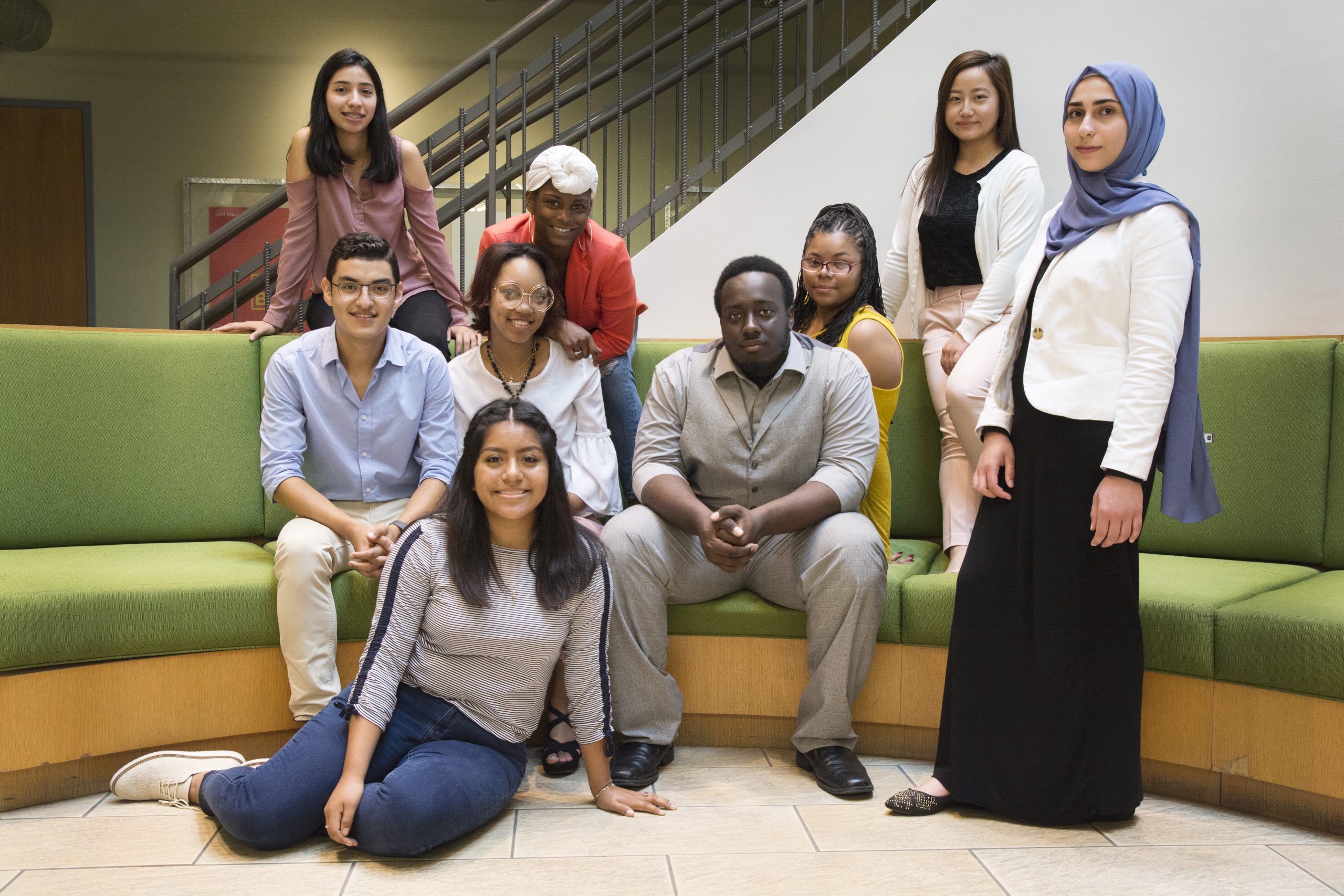
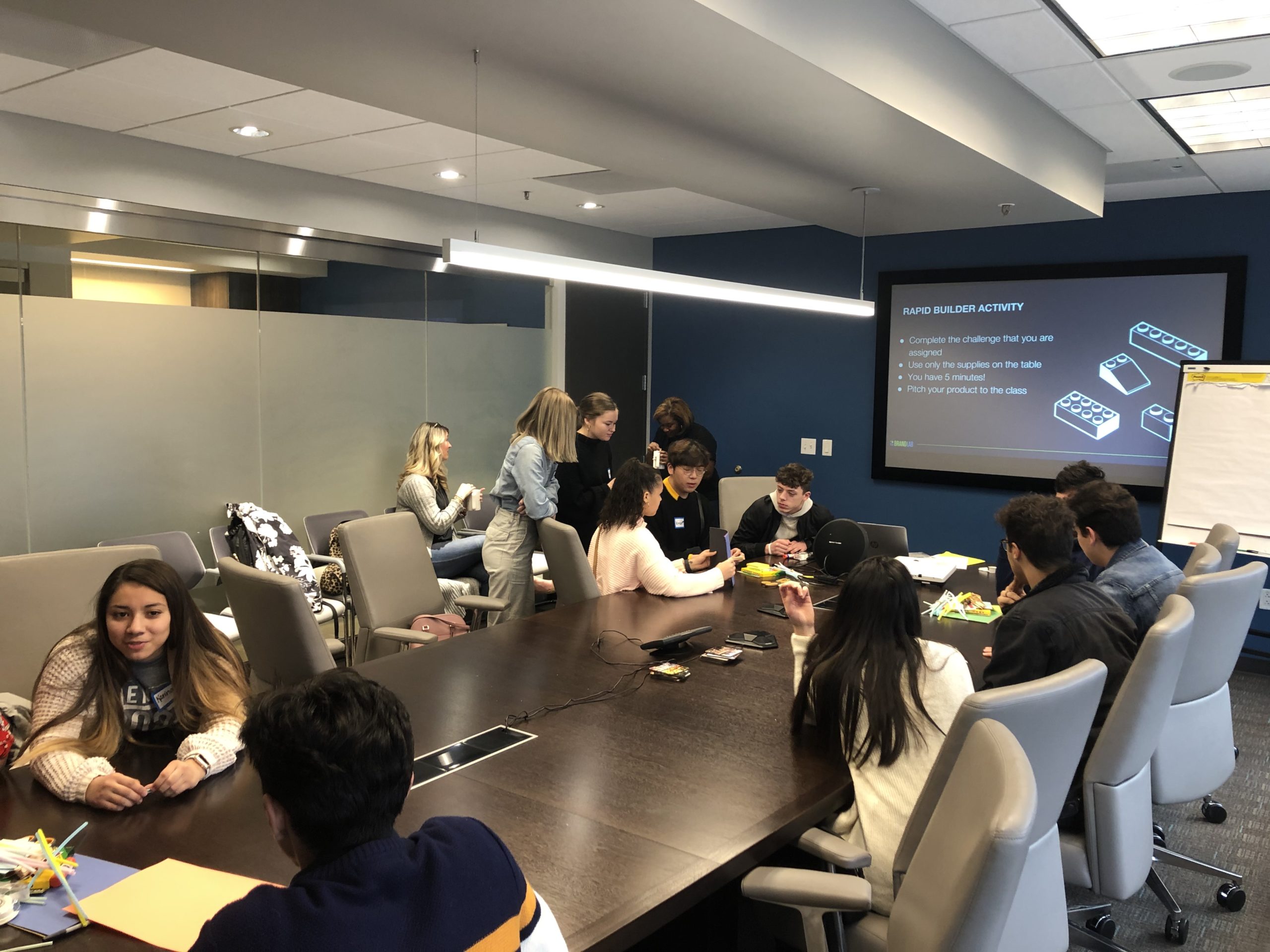
FleishmanHillard in Kansas City has partnered with The BrandLab since 2018 when Kansas City professionals came together to establish the organization in the community. FleishmanHillard’s Kansas City office was a founding partner and since then, the team has taken a hands-on-approach to grow the organization’s presence. Founded in Minneapolis in 2007 with the mission to introduce diverse high school students to creative careers, The BrandLab aims to change the face and voice of the communications and marketing industry.
The BrandLab student interns smile for a photo.
Our Kansas City team hosted junior and senior interns the past two summers, helping them understand what a communications career entails and develop professional skills. The office also hosted Spark Days, where freshman and sophomore students spend a day at our agency and are introduced to the industry. In addition, the team participates in The BrandLab’s Fearless Conversations, an annual event that brings together industry professionals for an open dialogue about race and bias.
Our Kansas City team works to challenge and educate their student partners at a Spark Day event.
This important inclusion work not only benefits the next generation of job seekers and the future of our industry, but it also pushes our teams to create an inclusive professional environment where we all can thrive.
Inspiring the Next Generation of PR Professionals in New York
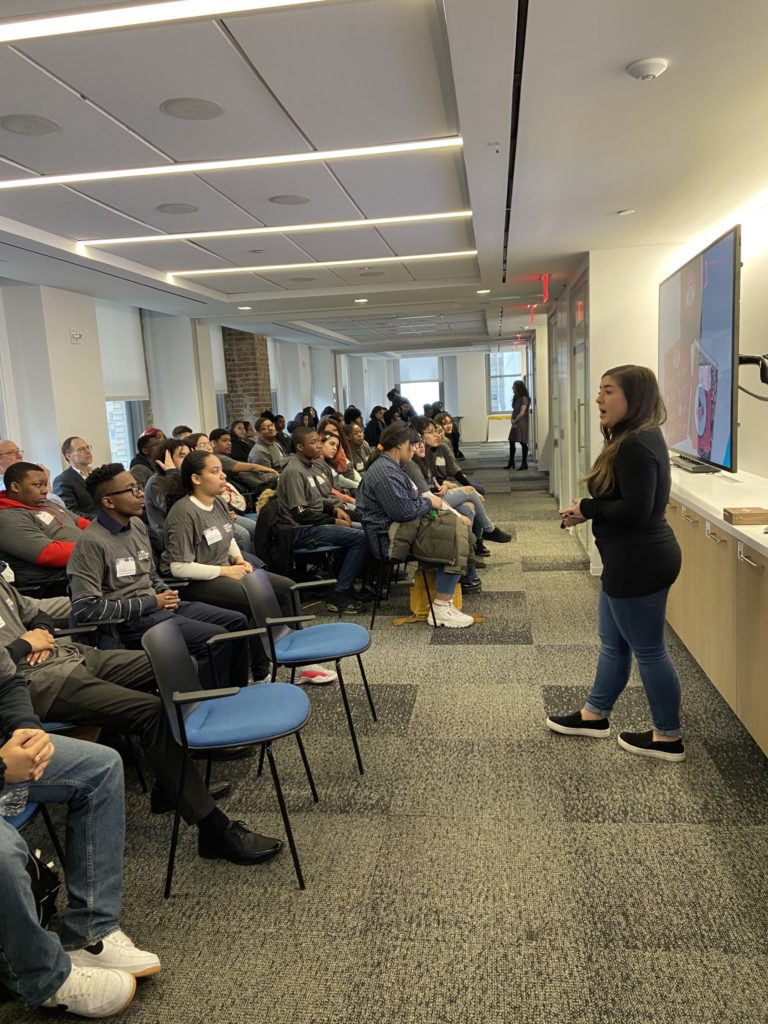
On February 11, 2020 FleishmanHillard in New York participated in the first-ever Career Discovery Week, an initiative founded by the Partnership for New York City and the New York City Department of Education.
The office hosted 75 tenth-grade students from four New York City public schools with the intention to educate the students on a variety of career opportunities in public relations and marketing.
Alex Foley, a member of our Global New Business team, discussed her role with students.
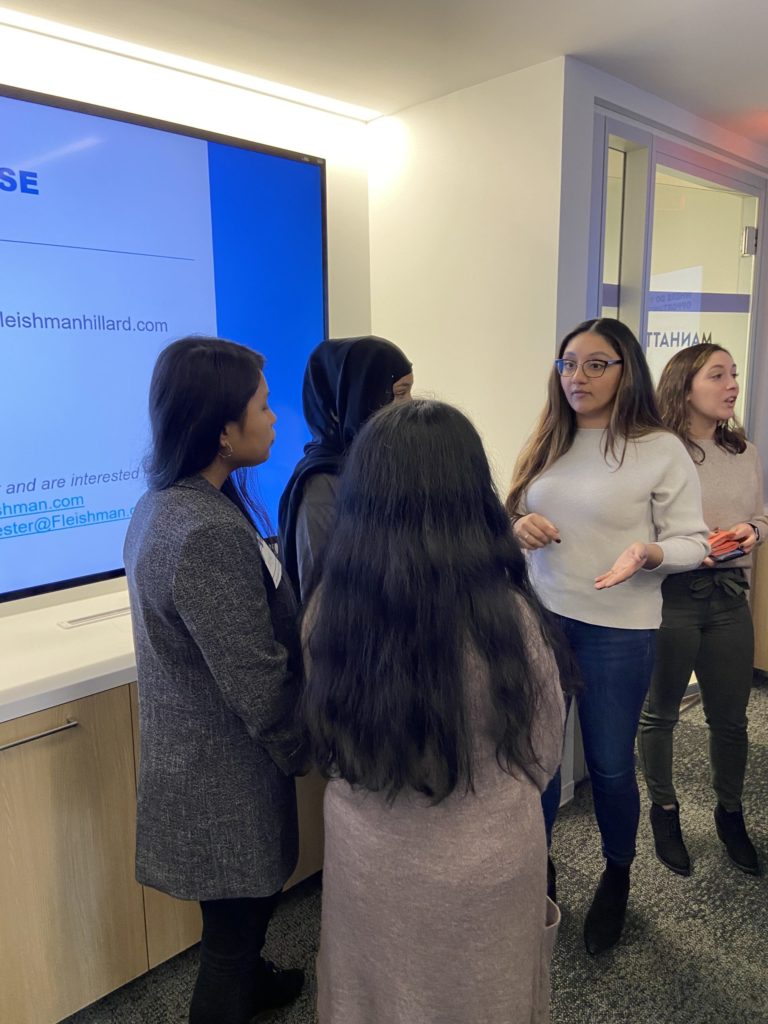
Vipan Gill, a member of the Corporate team, and Angela Anastasi of the Consumer team chat with students during the visit.
The day began with presentations by representatives from each New York team, including Technology, Social and Innovation, Corporate, Consumer, New Business Development, Media Relations and Healthcare. Each presenter shared information about their respective team and included a Q&A portion where the students asked thoughtful questions about the speakers’ roles and how their careers had progressed to where they are today.
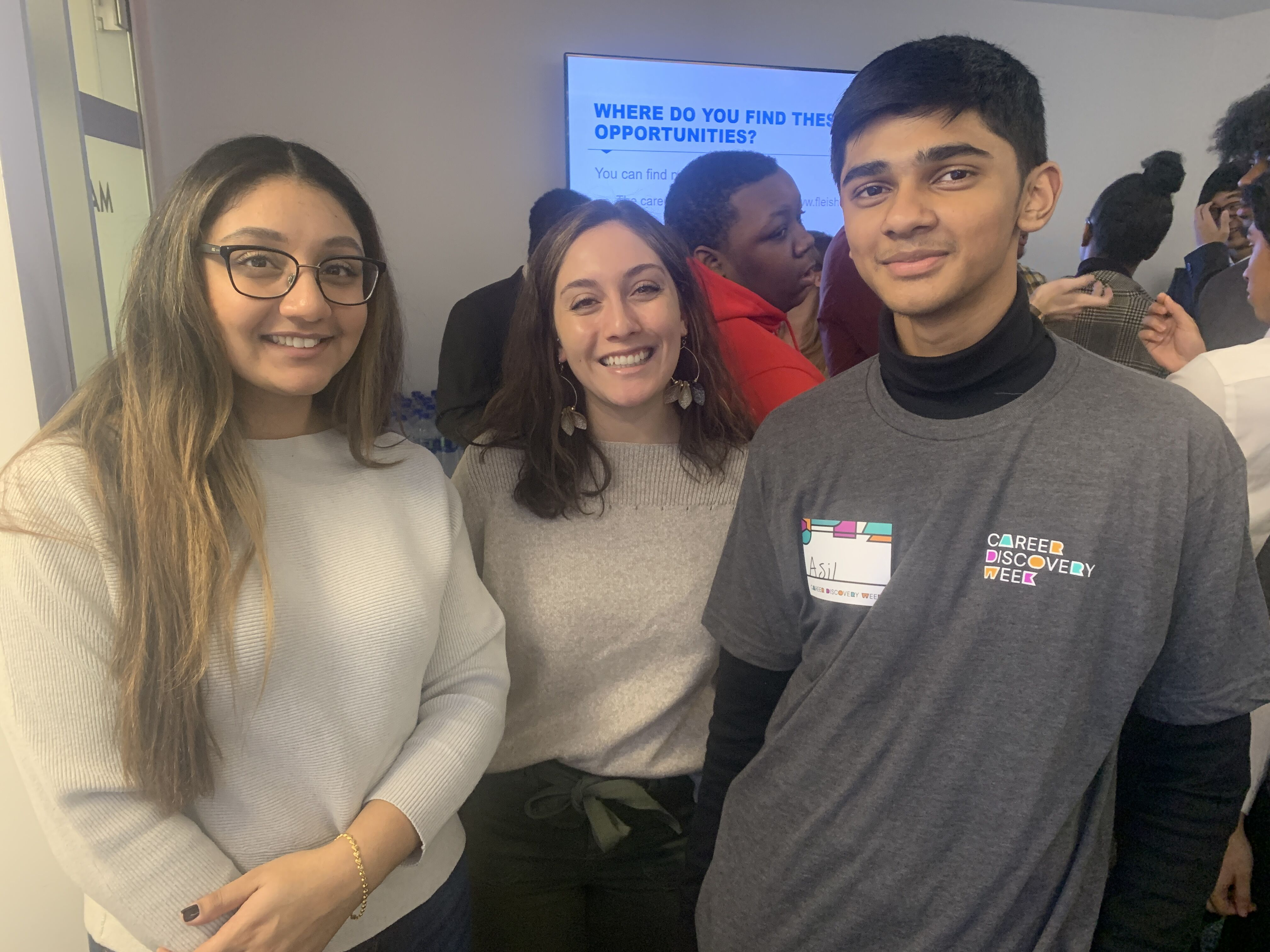
Equally important was the networking session held after the presentations. For many students, this was the first time at a networking event. They learned more about creating professional relationships through first-hand experience, which — as we all know — is a valuable skill to have on the path to your future career.
After the networking session, FleishmanHillard’s Talent Development team provided tips and information about resume and cover letter building and editing, interviewing and future internship opportunities, and graduate and fellowship programs.
Overall, Career Discovery Day was a great opportunity for students to get a look into the professional world and for FleishmanHillard employees to share their stories and showcase the work they do every day.
Our own Vipan Gill and Angela Anastasi enjoyed networking with Career Discovery Week students.
The importance of advancing inclusion and supporting nonprofit partners is greater than ever. According to Population Reference Bureau’s U.S. 2020 census study, children are at the forefront of racial and ethnic change in the United States, creating a diversity gap among generations. With upcoming generations being more diverse than ever, inclusion efforts will need to improve accordingly. FleishmanHillard will continue to partner with organizations that address growing needs and societal changes.
Janel O’Brien, a member of our Talent Development team in our New York office, and Kristen Ingram, a member of our Healthcare team in our Kansas City, and Alana Reinhardt contributed to this article.
See what else is happening
You might also like
ESG
Navigating Conflicting Demands to Advance Climate Action
January 20, 2025
Opinions
Supporting St. Louis Institutions Dedicated to Empowering Youth Through FH4Inclusion
January 15, 2025
Awards
FleishmanHillard Earns Perfect Score on 2025 Human Rights Campaign Foundation’s Corporate Equality Index
January 7, 2025
Opinions
Revitalizing the San Francisco Community with the Downtown Volunteer Coalition
December 23, 2024
Expertise
Responsible Business: Navigating Today’s Challenges and Opportunities
October 22, 2024
Inclusion
Recognizing the power of the LGBTQ Community in Advertising & Media with GLAAD
October 11, 2024
Opinions
FleishmanHillard and FH4Inclusion Teams Shine at the Cannes Lions International Festival of Creativity
August 28, 2024
Opinions
Bridging the Generational Divide with Generative AI
August 27, 2024
Expertise
How to ensure access and opportunity for Black and diverse students and professionals interested in working in sports