Employee Login

Enter your login information to access the intranet

Enter your credentials to access your email

Reset employee password

Article

The Answer Engine Era Is Here

August 20, 2025
By Ellie Tuck

We are living through another fundamental shift in how people discover brands. But we’ve seen this pattern before: the move from analog to web, from search to social. Each time, the brands that adapted early gained lasting advantages. Now we are seeing the rise of LLM-powered answer engines and the emergence of Generative Engine Optimization (GEO), a strategy that leverages AI to optimize a brand’s visibility and reputation in answer engine results.

The numbers tell the story: over half of Google results now include a generative response. AI agents and chatbots are increasingly becoming the first stop for people seeking recommendations, advice or information. If your audience is already there and you are not auditing how your brand shows up, you are missing a critical piece of the discovery puzzle.

How we are navigating the shift

While the fundamentals of trust and quality content remain, GEO redefines how they are executed. Analysing tools like ChatGPT, Gemini and Perplexity shows that these models lean heavily on what is already in the public domain, especially high-trust, earned media sources.

In response, we have had to build custom tools to get under the hood of how a brand is being interpreted. These tools allow us to see where a client is showing up, how they are being described, and how that compares to others in their space.

This new landscape also demands a new level of precision from our creative campaigns. We are asking more specific questions. Is our messaging backed by the right expert validation? Is our content tailored for the types of media AI models trust? Is our phrasing distinctive enough to be picked up by both machines and people?

This is where creativity and technical precision now overlap. Our teams are building synthetic AI audiences to test ideas earlier and using our FH Fusion platform to assemble virtual focus groups that inform smarter, faster decision-making.

A practical framework for influence

Our approach is led by audience behavior. That has always been our starting point in PR, and it is no different in the world of AI.

To influence how LLMs respond, we focus on a few key levers:

  • Earned coverage in high-trust sources
  • Structured storytelling to make key messages clear
  • Cross-channel reinforcement of the right signals
  • Consistency, because LLMs rely on pattern recognition

This work is complex, and the environment is not static. But an adaptable, audience-led strategy puts us in the best position to succeed.

What this means for our industry

The implications are broad. Business leaders need to get smart about how these models make decisions, guided by real data, not guesswork. Answer engine visibility should become a core KPI, not just for communications teams, but for growth.

But reputational risk is a major factor. We are already seeing AI tools surface outdated or outright false content about brands. Because what an LLM says feels factual to users, our role shifts from defending a single source of truth to shaping the entire ecosystem that AI learns from. This is nuanced work, but it is also where we can have the most significant impact.

No one has all the answers yet. The models are evolving, the sources they trust are shifting, and the tactics that work today may not work tomorrow. But the brands that start auditing their answer engine presence now will have a significant advantage over those who wait.

The communications industry has adapted to every major shift in how people consume information. This one is no different, except for the speed at which it is happening. The question is not whether your brand will need a GEO strategy; it is how quickly you can build one that works. We’ve adapted before, and we’ll do it again.

Ellie Tuck width= Ellie Tuck is the chief creative officer of the Americas based in New York.

 
Article

A New Approach to Modern Comms: What It Takes to Win in a World Defined by Uncertainty

August 19, 2025
By Michael Moroney, Elizabeth Cook and Michelle Mulkey

FleishmanHillard launches The Modern Comms Calibration ahead of the 2026 communications planning season

Uncertainty is no longer a passing phase. It’s the new default for business. From fragmented media and cultural volatility to shifting regulation and political polarization, change is now constant. Communicators have been on the frontlines of this evolution, and as a result, communications leaders have earned a seat at the table.

Over the last several years, the function has grown in importance, with communications teams tirelessly managing stakeholder expectations, protecting reputation, and influencing business strategy, moving far beyond writing traditional PR plans. But as we adapt to an environment of never-ending uncertainty, the bar is shifting again.

High-performing teams have built systems to manage constant crises and reclaimed time for proactive, reputation-defining strategies. They’re building messaging and thought leadership POVs that spotlight what business leaders have to offer by leveraging audience data and emerging media trends to drive focused, relevant conversations. And the teams making this pivot, from the trenches to the track, are amplifying their competitive differentiation and driving results for the business.

So how do we move more teams further, faster, toward today’s modern PR performance? The challenge is that many communications functions are consumed by the present. They’re caught up in today’s stories, issues, and shifts with too little time, space, or direction to focus on what’s next. Most teams do not lack effort. What they often lack is a shared picture of where they are going and how they will get there.

Winning starts with a function organized around today’s realities: decisive, focused, and able to navigate a complex, ever-evolving landscape. Leadership, both within communications and across the business, must set a clear direction and hold teams accountable.

To help clients assess where they stand and where to focus, we developed The Modern Comms Calibration.  It’s a fast, practical diagnostic that assesses a communications team’s maturity and provides a clear path forward. We use it to align leaders, sharpen priorities, and accelerate results.

We have worked alongside some of the world’s most ambitious companies to modernize their communications operations. Coming out of these partnerships, we’ve identified six characteristics that set high-performing teams apart:

  • Business Acumen: The most effective communications leaders are fluent in  business strategy. They use that understanding to drive messaging, shape campaigns, and ensure the function’s outputs ladder directly to growth and performance goals.
  • Relevance and Authenticity: Winning organizations are direct and clear in how they communicate. They speak in a tone that reflects their values and connect with the culture in ways that are meaningful, not performative.
  • Audience Orientation: They know who matters most, and they adapt accordingly. These teams actively engage stakeholders where they are—across new platforms,  channels, and  formats—with an understanding that traditional assumptions about audiences no longer apply.
  • Risk and Opportunity Readiness: These teams don’t just respond quickly. They prepare early. They invest in systems to monitor risk, rehearse scenarios, and are ready to act when the moment requires it. And when opportunity presents itself, they are often first to move.
  • Data Driving Decisions: High-performing teams define success in business terms, not just media metrics. They track performance and feed those insights into planning and prioritization. They understand what is working, why it’s working, and where to push further.
  • AI Adoption: They are not waiting for AI to become a mandate. They are already embedding it into workflows. From message testing and stakeholder modeling to drafting and deployment, they are using AI to drive scale and precision without sacrificing trust.

These six areas are not aspirational. They are actionable. They reflect what we have seen work in the real world. And they  guide teams toward impact, not just improvement.

Communicators are under pressure. But they are also uniquely positioned to lead. With the right structure, direction, and tools, they can be the difference between reacting and winning. We’ve seen it happen. And we’re ready to help others make it real.

Article

Tariffs, Trust and Transparency: How to Communicate Price Increases Without Losing Stakeholder Confidence

August 13, 2025
By Donna Fontana, Matt Rose and Kristie Sigler

As of August 2025, expanded US tariffs are reshaping pricing across industries, from seafood and electronics to Swiss watches and appliances. While many companies have avoided public discussion of tariff-driven price increases, this “run silent” strategy may be unsustainable as cumulative price pressures intensify and customer sensitivity peaks.

For business leaders and their communications teams, the question is no longer whether to communicate price increases but how to do so without damaging trust, inviting backlash or creating political risk.

Why Silence May Not Be Sustainable

Most organizations still approach price communication as if customers, whether in B2B or consumer markets, evaluate each increase in isolation. The reality is shifting. With tariffs now affecting multiple categories at once, customers will face higher costs from many directions simultaneously. Even modest, justified increases risk being seen as price gouging when viewed through the lens of cumulative burden.

For consumer brands, the risks are visible and often viral. For B2B companies, the stakes are just as high. Cost pressures are identical but brand recognition is often weaker and communication channels fewer.

There is also a political dimension. In sensitive categories, tariff-related price communications must consider alignment, or perceived misalignment, with the Administration’s economic narrative. Messaging that appears to contradict official positions on trade, inflation or consumer costs can draw not just customer pushback but also political scrutiny.

The Emotional Reality

Price increases may be driven by economics, but they are received emotionally. Customers, whether households or procurement teams, feel the squeeze of multiple increases across different products and services. That can produce frustration far out of proportion to any one company’s actions.

This is where communication becomes as much about empathy as explanation. Overcommunication carries its own risks but failing to address perceptions leaves a vacuum that competitors, critics or policymakers may fill. Monitoring sentiment, anticipating questions and responding in plain language should be treated as operational priorities.

Strategic Principles for Tariff-Era Price Communication

Not every company will face the same pricing challenges but many will need to refresh their approach. The following principles offer a framework for explaining price increases in a way that preserves relationships and reduces reputational risk.

1. Lead with Transparency, Not Excuses
Replace generic “rising costs” statements with specific context:

“Recent changes in trade policy have significantly increased our sourcing costs. Rather than compromise quality, we have made a modest price adjustment while continuing to invest in the partnerships and processes that protect the quality customers expect.”

2. Make It Personal, Not Political
Customers want empathy, not a policy seminar:

“We know prices are rising everywhere, and we are not immune. We are committed to fairness, transparency, and quality – even as global input costs change.”

3. Show Your Mitigation Efforts
Make it clear that you have considered the interests of all stakeholders, including policymakers, and that raising prices was the last resort:

“We have streamlined logistics and reduced packaging waste to shield customers from rising costs. We are also absorbing a portion of the increase ourselves to minimize the impact. But with input costs climbing sharply, a modest adjustment has become unavoidable.”

4. Ensure Cross-Channel Consistency
Your investor communications will be seen by customers and customer communications will be seen by policymakers. Develop unified messaging for all stakeholder groups, equip teams with consistent language and monitor every touchpoint.

5. Reinforce Brand Values
Tie the increase to commitments to quality, sustainability or integrity. A beauty brand citing tariffs also emphasized its continued investment in cruelty-free, high-quality products. The subtext: we are not cutting corners.

6. Prepare for Emotional Responses Across Markets
Monitor sentiment in real time, assess perception gaps between audiences and benchmark against peers. Be mindful of global market reactions and ensure you have the channels in place for agile, coordinated communication across regions. Respond quickly with empathy, clarity and cultural awareness when resistance rises in any market.

7. Consider Industry Coordination
Trade associations can sometimes lower political and consumer risk by explaining category-wide economics, though each brand must still deliver its own aligned message.

The Bottom Line: From Pass-Through to Reputational Risk

Pass-through pricing has evolved from a supply chain term to a source of reputational risk. While there is no universal blueprint, companies that plan now will have more control over the narrative later.

Tariffs may be beyond corporate control. But the story you tell about your pricing decisions, and the value your products deliver, is entirely yours to shape. Trust is not lost in a single price increase; it is lost when companies fail to explain why. In an environment where nearly everything costs more, transparent reasoning may be the most valuable thing you share for free.

Our Executive Advisory. Your C-level advantage.

Article

Why Primary Research is the Power Source for AI That Works 

August 11, 2025
By Marina Stein Lundahl

Generative AI isn’t a promise anymore. It’s here.  

In the momentum of this modern gold rush though, it’s easy to forget a critical truth: the power behind these tools is still human. The quality of generative AI outputs depends on the inputs we feed them, and that begins with the rigor of primary research.  

Since 2023, the use of generative AI by organizations has more than doubled, with 71% of companies leveraging it by 2025. One standout application? Synthetic audiences, a powerful new way for communicators to gain insight into their audiences’ attitudes, perceptions and behaviors. But just like it’s easy to get swept away by the wave of generative AI, it’s easy to think that synthetic audiences are rendering traditional primary research obsolete. Nothing could be further from the truth.  

Synthetic audiences can’t outrun the human source 

Primary research and AI aren’t in competition. They’re codependent. 

The best synthetic audiences are built on the back of great human data. On the other hand, primary research can be made more focused and agile when layered with synthetic audience outputs. Synthetic audiences can extend the life of primary research when we incorporate real-time news or cultural data, keeping the insights fresh and up to date. Understanding the complexities of this relationship enables researchers to maximize benefits of both methods.  

As the old saying goes garbage in, garbage out. 

That’s never been truer than it is today. 

The Human Edge: What AI Still Can’t Simulate 

AI’s emergence has elevated the importance of research design and data quality vigilance, as MRS chief Jane Frost highlights in her article covering the Global Data Quality Initiative. Now more than ever, poorly designed studies don’t just lead to flawed short-term insights; they embed those flaws into synthetic audiences that rely on these studies as crucial training datasets. When applied carelessly, this flawed insight can lead to misinformed decisions that create business or reputational risk. 

This new reality demands that we approach primary research with heightened rigor and foresight. The questions we ask, the participants we recruit and the methodologies we employ must all be optimized not just for their immediate results but for their value as training inputs for AI models that expand the radius of these data.  

The equation is simple: better human data lead to better AI models. Human insights provide texture and nuance that synthetic models currently fail to accurately simulate. 

  • Cultural Context: AI models struggle to understand deep-rooted and implicit cultural knowledge that humans navigate effortlessly through lived experiences 
  • Emotional Nuance: The richness and range of human emotional responses remains difficult to synthesize  
  • Emerging Behaviors: Primary research captures to-the-moment changes or evolutions in human behaviors before they become widespread enough to appear in secondary sources 
  • Contradictions and Complexity: Humans often hold conflicting views simultaneously; a complexity that enriches our understanding but challenges AI models 

These qualities aren’t “nice to haves.” They’re ingredients for insight that inspire action. The kind of action clients, policymakers and customers can trust.  

The ‘garbage in, garbage out’ dynamic shouldn’t be viewed as loose guidance for fine-tuning virtual audience models; there are real risks involved when primary sources are undervalued (e.g., algorithmic bias, insight homogenization and missed innovation opportunities). 

Reimagining Primary Research for the AI Age 

While critical to the relevance and credibility of AI-driven audience research, traditional primary research isn’t immune to the pressure to adapt and evolve in the age of advancing generative AI. Today’s research must be crafted with dual purposes: 

  1. Delivering precise and actionable insights 
  1. Creating high-quality, scalable inputs for AI systems and synthetic audiences 

This evolution means considering: 

  • Data Structure: How will this data need to be formatted to serve as effective model inputs? 
  • Comprehensive Capture: Are we collecting the contextual information AI needs for proper interpretation? 
  • Longitudinal Value: How will this data remain relevant as behavioral patterns evolve? 
  • Ethical Considerations: What guardrails ensure our data fuels responsible AI development? 

Final Word 

Forward-thinking organizations recognize that the competitive advantage is not in choosing between primary research and synthetic audiences, but in their purposeful integration. Investing in the quality, design and implementation of primary research is no longer optional. It’s a requirement to fuel the next generation of insights, both human and artificial.  

As we navigate this rapidly evolving landscape, we’re firmly planting the flag:  

Primary research isn’t just still relevant, it’s more important than ever and will improve synthetic audiences.  

Article

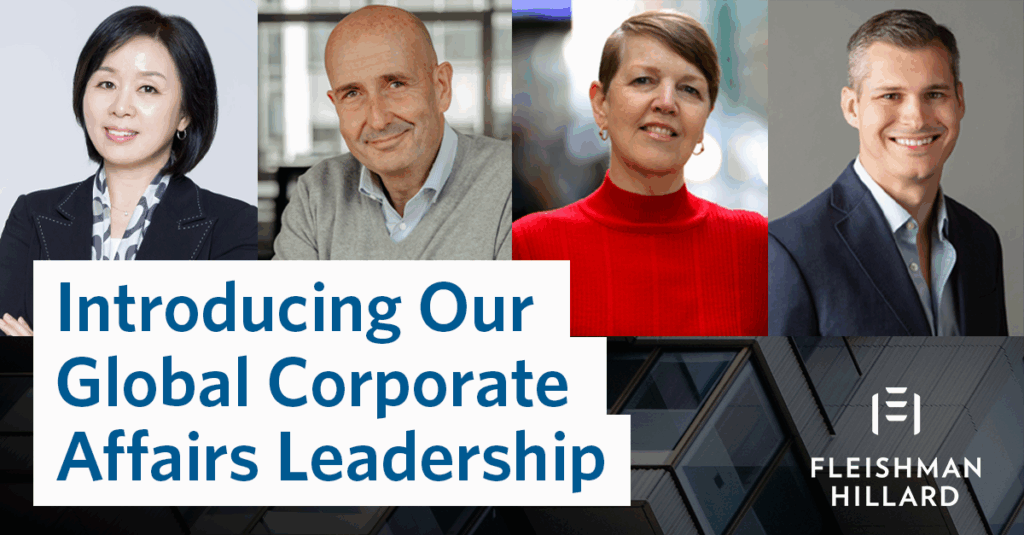
Announcing Our Global Corporate Affairs Leadership Team

August 7, 2025

New leadership strengthens integration across regions and capabilities, helping clients navigate uncertainty, reputation, risk and transformation at speed.

As companies face rising volatility, stakeholder scrutiny and operational complexity, the role of corporate affairs has become an increasingly critical issue for the C-suite. To meet this moment, FleishmanHillard today announced a new Corporate Affairs Practice leadership structure to deliver more connected, insight-driven counsel and stay ahead of the demands of today’s global business environment.

Rachel Catanach has been appointed global managing director, corporate affairs, unifying the firm’s advisory offerings across seven core pillars: corporate reputation; financial and M&A; crisis and issues; executive positioning; public affairs and geopolitical strategy; talent and transformation; and responsible business. Catanach will also ensure FleishmanHillard’s Global Executive Advisory network provides strategic guidance to senior leaders navigating high-stakes issues and transformative change. She continues to lead the agency’s New York and Boston offices.

“Rachel is a visionary leader who understands how to drive business results through modern, reputation-centered communications,” said J.J. Carter, FleishmanHillard president and CEO. “Her leadership of corporate affairs will elevate the impact FH delivers to global clients navigating extraordinary uncertainty and strategic challenges.”

To support this global capability, the agency has also named three regional leaders:

  • Michael Moroney, managing director, corporate affairs, Americas – A trusted counselor on regulatory complexity and executive visibility, Moroney will guide strategy across the Americas while continuing to shape the Executive Advisory portfolio and lead key client relationships.
  • Yvonne Park, managing director, corporate affairs, APAC – Based in Seoul, Park brings two decades of experience in litigation communications, stakeholder engagement and CEO succession planning. She will drive consistency and innovation across Asia, aligning with global capability and sector leads.
  • Hanning Kempe, managing director, corporate affairs, EMEA – With a track record advising multinationals and government stakeholders across Europe, Kempe will leverage his expertise in change management, corporate strategy and crisis to lead the region’s growth and service excellence.

(From left to right: Yvonne Park, Hanning Kempe, Rachel Catanach, Michael Moroney)

FleishmanHillard’s global corporate affairs practice leverages a powerful combination of counselor-driven solutions and advanced intelligence infrastructure that enables teams to respond to client challenges with greater speed, precision and business impact. Counselors across the network are empowered to design and deploy real-time solutions that integrate proprietary tools, institutional knowledge and advanced audience insights, no engineering background required.

  • Risk Radar: An AI-powered early warning system that flags reputational, legal and operational vulnerabilities, helping clients identify and respond to meaningful risks before they escalate.
  • SAGE (Strategic Audience Generation Engine): A predictive audience intelligence tool that simulates stakeholder reactions to messaging and positioning, enabling teams to test and refine strategies for maximum impact.
  • Connectivity Diagnostic Agent: A solution that analyzes how a brand’s story aligns with shifting cultural, regulatory and reputational forces, revealing areas of strategic misalignment and opportunity.

These capabilities, combined with FleishmanHillard’s Global Executive Advisory network of more than 50 senior counselors, enhance the firm’s ability to deliver high-impact counsel at the intersection of risk, reputation and growth. Corporate affairs teams routinely collaborate across brand work and all FleishmanHillard centers of excellence, ensuring clients lead with confidence in their most consequential moments.

These appointments follow several recent FleishmanHillard market leadership announcements, including Mei Lee in Singapore, Madhulika Ojha in India, Adrienne Connell in Canada, Kristin Hollins across California and Marshall Manson in the United Kingdom — as FleishmanHillard continues to invest in regional leaders who deliver trusted counsel and measurable impact on a global scale.

With this next chapter, FleishmanHillard’s corporate affairs leadership is uniquely positioned to help leaders anticipate risk, accelerate transformation and build enduring reputation in a world defined by complexity and change.

Article

The Real Reason Your AI Rollout is Stalling

July 30, 2025
By Zack Kavanaugh

When it comes to the success of AI rollouts and adoption, there’s a notable delta between the perspectives of a company’s leaders and its employees.

About a quarter of leaders say their AI rollout has been effective. Only 11% of employees agree.

That’s not just a signal that implementation is lagging – it’s a signal that alignment is lacking. And that gap likely isn’t due to tech – at least not tech alone. More likely, it’s about trust, clarity, consistency, relevance … even identity.

You can launch the right tool with a solid rollout plan behind it. But if employees don’t understand why it matters – or where they fit in – behavior change stalls before it has the chance to take root.

Why Behavior Change Stalls: The Distance Between Intention and Action

Behavior change doesn’t just happen because a tool is available – it has to be intentionally built into the experience. Early. Clearly. With a level of resourcing and support commensurate with what the company has invested in the platform itself.

That means embedding behavior-shaping touchpoints from day one – not waiting for adoption to happen organically. What does this look like in action? Continuous feedback loops to surface and address employee hesitations, leaders modeling new behaviors in visible ways, regular moments of reflection woven into team rhythms, and dedicated roles focused on coaching and practical support – among other things.

People pull back when things feel vague. When the shift doesn’t connect to what they care about, or how they see their role. Even the best tools get overlooked if the environment around them doesn’t support the change they’re meant to create.

Where Behavior Change Breaks Down: The Subtle Signs of Resistance

But where exactly does the friction show up?

Resistance doesn’t always show up as vocal opposition – more often, it shows up in silence. A tool gets rolled out, but questions go unasked. Team conversations sidestep it. Some employees disengage or quietly revert to old habits like manually analyzing large swaths of data or generating meeting summaries and first drafts from scratch.

This refusal isn’t manifested as loud rebellion. It’s slow fade. And in AI transformation, that quiet drift is one of the biggest threats to sustained impact.

Left unchecked, that disengagement can erode tool ROI – dragging down productivity, creating adoption gaps across teams and limiting the career growth of those who hesitate, especially in roles where fluency with AI is quickly becoming table stakes. In short, when employees don’t buy in, the business can’t move forward at the pace it needs to.

The good news? These signals are visible – if you know where to look. Spotting and addressing them early can protect your investment, align your people and accelerate progress where it matters most.

The Three Layers of Hesitation: Enterprise, Team and Individual

For companies struggling to drive AI adoption, this is the moment to step back and start asking simple questions like the ones here.

While the tools will get better and the use cases will expand, none of that guarantees impactful adoption.

Right now, most organizations don’t need a newer generation of the technology. They need better feedback loops. More storytelling and open conversation. A stronger bridge between AI strategy and lived experience.

And more honest signals from leaders – that this isn’t just about the next tool, it’s about how the work is changing, why that matters and how the organization is committed to making space for people to come along with it.

The Final Takeaway: Change Sticks When Conditions Are Right

Adoption doesn’t accelerate just because the tools get better. And AI doesn’t scale well in confusion. These things happen only when the environment is ready – when culture, clarity and context catch up to the ambition.

That’s when change starts to feel real. And when people decide it’s worth leaning in.

Article

Leading Through Complexity: What Higher Ed Communicators Are Saying

July 25, 2025

What one word best describes your day-to-day work? 

That was the icebreaker posed by FleishmanHillard’s Sarah Francomano, who hosted and moderated a candid dinner conversation among senior higher ed communications and marketing leaders. Responses like “firefighter,” “pivot” and “controlling chaos” weren’t said for dramatic effect—they reflected the current state of the higher ed landscape. The group all concurred that leading communications in higher education today is intensely complex, often chaotic and always high stakes.

The conversation was twofold, starting with discussions around what senior leaders are currently seeing in higher education. Then, the conversation moved to what’s next and how higher-ed professionals can leverage AI and other emerging tools to support them in their roles.

The Current Reality: Complexity and Constant Pressure

Communications leaders in higher education are facing unprecedented, often competing demands—with the stakes higher than ever. A single misstep can trigger consequences ranging from trustee backlash to federal scrutiny. Plus, in an environment where issues are deeply personal and highly visible, it’s often the job of the communications team not just to respond, but to cut through the noise, determine whose voices matter most in a given moment and identify which relationships need to be prioritized in order to guide the institution through crisis or change.

Participants shared their experiences managing a high volume of inquiries on a consistent basis from students, parents, alumni, donors, faculty, media and the general public on issues pertaining to their schools. One participant described a case where their team received more than 10,000 emails in response to a global crisis. After sorting through all of the messages, they found that only a small fraction came from individuals actually affiliated with the institution. It was a telling example of how the general public’s perspective does not always reflect the opinions of key stakeholders who have an impact on a university.

Others spoke about the weight of deciding when—and whether—to issue public statements. Choosing to speak up on a cultural or political moment may be the right call in one case, but it often sets expectations for the next moment. The act of staying silent can also become a message, leaving universities at risk of receiving backlash. One communications leader noted that even a simple interaction with a reporter can draw the institution into a larger story, whether they want to be part of it or not.

Enrollment also surfaced as a key pressure point. Some schools are dealing with declining numbers and budget shortfalls; others are seeing higher-than-expected demand. Several attendees commented on the long-term risks of tuition discounting—the idea that while short-term financial aid boosts can help meet yield goals, they may also chip away at perceived brand value over time. Once an institution begins competing on price, it becomes difficult to return to a different model.

The Future: How AI is Shaping Strategic Readiness

Toward the end of dinner, the conversation shifted to some of the solutions now available to address the challenges that come with working in higher education. The group was introduced to a live AI-powered crisis simulation, led by FleishmanHillard’s Alex Lyall. The FH Crisis Simulation Lab draws from real-world crisis events and FH simulation methodologies and presents users with unfolding scenarios in the form of projected stakeholder reactions. Unlike traditional simulations, which are static, this AI-powered tool is dynamic in nature, responding to the real-time decisions of participants by evolving the crisis scenario to reflect how stakeholders might respond.

When the demo immersed participants in a campus protest scenario, the group decided to put the tool through its paces and selected the most aggressive response, forcing demonstrators to disband by a set deadline. The result generated backlash, escalation and reputational fallout in the form of emails, social media posts and media coverage, mirroring how a crisis team would experience these types of situations.

Participants were quick to note how well the tool captured the complexity and pace of an actual crisis. The AI agent mapped out the often-conflicting reactions across stakeholder groups—students, faculty, alumni, media, donors—and showed how quickly one decision can lead to a cascade of consequences. Later in the simulation, when the team chose how to correct course, the tool was prompted to generate internal and external holding statements that offered strong, usable drafts that could be easily customized to fit the voice of an institution.

Participants saw clear potential for the AI agent as both a training and planning resource—especially in conversations with boards or leadership teams. It provided a structured, precedent-informed way to explore how crisis scenarios might unfold, helping teams evaluate why one communications path might be more effective than another.

Alex shared that while this particular demo was generic, the FH Crisis Simulation Lab can be tailored to reflect each school’s culture, governance structure and audience. Even those in the room who were skeptical about AI said they could see its value in this kind of application—not to replace human instincts, but to sharpen and support them.

Going Forward: Navigating Reputational Complexities

The evening was a chance to connect with peers, swap stories and explore fresh ideas about what the future of higher ed looks like. It was an invigorating conversation that left many in the room feeling energized and inspired.

Higher ed communications may be complex, sometimes chaotic and full of tough calls—but it doesn’t have to be faced alone.

Article

What America’s AI Action Plan Means for Leaders Now

July 24, 2025
By Josh McConnell

Don’t think of this as just a policy reset. It’s a reputational crossroads. In a deregulatory moment, the real challenge isn’t compliance. It’s communication plain and simple: how to explain, defend and lead through what comes next.

The U.S. government has issued its clearest signal yet that it intends to lead the world in AI through acceleration over regulation.

America’s AI Action Plan, unveiled this month, reframes U.S. tech policy around three pillars: innovation, infrastructure, and international competitiveness. It rolls back many of the Biden-era safety and fairness frameworks, instead emphasizing open-source development, rapid deployment and private-sector partnership. For CCOs and CMOs, this isn’t just a policy update. It’s a pressure shift. With fewer federal rules in place, the burden of defining and defending responsible AI now falls squarely on companies themselves. That means your narrative, transparency and readiness matter more than ever.

How To Respond Ahead of the Spotlight

1. From frameworks to frontline comms, you can feel scrutiny shifting
With Biden-era guardrails rolled back, there’s more ambiguity and reputational risk. Review your systems, filtering practices and content neutrality positions ASAP. Comms teams need clarity and defensibility, especially where DEI, safety filters and model transparency intersect.

2. Prepare your public narrative before the news cycle tests it
Build messaging that goes beyond launches and investor decks. Emphasize ethical foresight, safety, training transparency and societal value in your comms. Assume watchdog groups, press and policymakers are already watching and look at your narrative through their eyes and position accordingly. Even consider a virtual audience simulation that will pressure test messaging for different mindsets. It’s ultimate defense as offense.

3. Make your company part of the national story
This plan isn’t just tech policy. It’s economic and diplomatic strategy. Companies that align their messaging with national priorities like innovation, infrastructure and workforce development will carry more weight with policymakers, partners and procurement leaders.

And in today’s generative search environment, those narratives aren’t just for press releases. They’re a crucial part of brand discovery. Organizations are can shape how they are surfaced, summarized and evaluated in search. If your brand isn’t telling a clear story, it’s likely that AI will try to do it for you or ignore you completely.

4. Engage now, not later
If your teams haven’t opened dialogue with NIST, OSTP or other agency stakeholders, now is the time to start. Participation in federal consultations and comment periods will shape procurement standards and signal leadership. You don’t want silence to be interpreted as an absence of a point of view.

5. Signal leadership through your talent
AI-readiness isn’t just about model performance. This is all about workforce planning. Use this moment to communicate investments in retraining, apprenticeships and education. This is reputational insulation and long-term eligibility for federal partnerships.

6. Strengthen your risk and compliance narrative
This plan includes stricter export controls, national security filters and new expectations for “secure by design” standards. Global comms must now reflect both regulatory divergence (EU, China) and internal alignment across legal, engineering and policy.

7. Know where your infra story fits
For companies in data centers, chips or energy, this is also an opportunity moment. Comms teams should coordinate early with government affairs, bid teams and legal to ensure eligibility positioning aligns with public messaging.

8. Plan for federal-state friction
As state-level bias audits, content governance and privacy laws expand, tensions with federal policy will grow. Your public narrative and internal compliance playbook must account for that dual reality.

So what comes next?

The companies that lead through this moment won’t be those that publish the longest policies. They’ll be the ones who explain their role with the most clarity, credibility and consistency both internally and externally.

The policy shift is clear: the U.S. is betting on speed, scale and innovation. But for communications leaders, the implications run deeper.

The questions coming next about explainability, bias, security and global alignment won’t be answered by engineers alone. They’ll require strong narratives, clear values and messages that hold up under scrutiny. Communications team won’t follow this story. They’ll help define it.

Josh McConnell  Josh McConnell is a VP of Technology based in New York where he helps companies navigate complex narratives at the intersection of innovation, reputation and culture. He brings over 15 years of experience across journalism and corporate comms, with leadership roles at Uber and Xero. As a journalist, he regularly interviewed tech leaders including Tim Cook, Satya Nadella and Jack Dorsey.

 
Article

The Friends You Never Knew You Needed: Why IT and Communications Must Team Up

By Scott Radcliffe

Trust is at the heart of every successful organization. In today’s digital landscape, that trust is built—and sometimes shattered—by how well you protect the data on your network. Reputation is hard-won and easily lost, making it a favorite pressure point for cybercriminals and regulators alike.

Over the past several years, threat actors have shifted tactics. Rather than relying solely on operational disruptions driven by ransomware, groups like Lapsu$ have gone as far as exposing sensitive corporate data without warning or attempted extortion, as seen in their attacks on some of the tech industry’s top companies.

At the same time, regulators and government officials are turning to more and more public responses related to cybersecurity, tightening their grip on corporate reputations through new rules and public scrutiny. With more stringent regulations and increased public reporting, organizations are being held accountable for how they manage and protect sensitive information. Meanwhile, a more cyber-savvy and skeptical public is quick to notice, and react to, any missteps.

Reputation and Technical Cyber Risk: A New Partnership

As the link between reputation and cyber risk grows stronger, IT and Communications teams can no longer afford to operate in silos. Their collaboration should go far beyond crafting post-incident press releases. Here’s how these two critical teams can—and should—work together:

  1. Translate Complexity into Clarity:
    Technical teams understand the risks. Communications teams know how to craft messages that resonate. Together, they can ensure clear, concise explanation of core policies, risks, and responses both internally and externally.
  2. Build a Culture of Security:
    It’s not just about what you say, but how you make it stick. Developing a thoughtful strategy for culture change ensures that security messages are truly internalized throughout the organization.
  3. Plan for the Unexpected:
    Effective scenario planning for data security and privacy risks requires tight coordination. Legal, technical, and Communications teams must work hand-in-hand to prepare for—and respond to—potential crises.

The Benefits of Collaboration

When IT and Communications join forces, the results are tangible:

  • Stronger organizational alignment and buy-in
  • Increased compliance with policies and regulations
  • Faster, more effective crisis response

The specifics of this collaboration will vary but the playbook begins with early alignment on goals, KPIs, desired outcomes and a plan for communicating information to the appropriate stakeholders. Starting before a crisis hits ensures everyone in the organization is working towards shared outcomes.

The threat landscape is only growing more complex and dangerous. While technical defenses are essential, they’re not enough on their own. Real security comes from building awareness, engagement and trust across every level of your organization.

If cybercriminals are evolving their tactics, organizations must evolve, too—not just in how they defend against attacks, but in how they think about and communicate cyber risk.

Scott Radcliffe width= Scott Radcliffe is FleishmanHillard’s global director of cybersecurity, leading the firm’s Cybersecurity Center of Excellence and advising clients on rising cyber risks. He recently rejoined FH from Apple, where he led cybersecurity communications and previously served as the agency’s senior global data privacy and security expert.

 
Article

Closing the Innovation Gap With FH Fusion, Our Data and AI-Powered Solutions Suite

July 14, 2025

Our new solutions suite designed by and for communications professionals builds on Omnicom’s agentic AI platform, Omni, by integrating institutional communications knowledge with advanced audience data and technology capabilities. FH Fusion gives every FleishmanHillard counselor and team the ability to create real-time, agentic AI solutions that deliver sharper insights, more precise activations and stronger business outcomes—no engineers required.

FleishmanHillard today launched FH Fusion, a first-of-its-kind communications solution suite that puts the full range of AI models, institutional knowledge and a proprietary data toolset directly into the hands of communications professionals. Unlike tech-first applications built by developers, FH Fusion was created by—and for—counselors, enabling them to design and deploy real-time solutions backed by Omnicom’s secure, scalable intelligence layer.

Already in use by more than 1,000 FleishmanHillard strategists, FH Fusion reduces ramp-up time, accelerates delivery and improves outcomes across crisis, stakeholder messaging, media intelligence and brand strategy.

“FH Fusion closes the innovation gap—the distance between what communicators envision and what most tools actually enable,” said Ephraim Cohen, global head of data and digital. “It gives every strategist the power to turn expertise into action, combining insight, data and AI to build exactly the solution they need. We designed it so communicators can move at the speed of their ideas, with technology that’s trained to think the way they do about how people react, how issues evolve and how strategy needs to shift in real time.”


A Peek Inside: How FH Fusion Works

Today’s communicators don’t just need insights. They need infrastructure. FH Fusion leverages Omnicom’s industry-leading investments in AI and data to bring together four critical components – data, generative AI, knowledge bases and subject matter expertise in building custom agentic solutions for each client. FH Fusion combines:

  • 🔗 A full range of AI models and agentic AI technology – Omni’s AI layer enables users to create custom, multi-agent workflows from a full range of generative AI modes.
  • 📊 Industry leading data stack – The data layer of FH Fusion combines Omnicom’s collective data-driven intelligence across audience and commerce inputs from Omni and Flywheel, with corporate and consumer media, influencer, and other critical communications data from OPRG and FleishmanHillard.
  • 📚 FleishmanHillard’s institutional knowledge – FleishmanHillard’s considerable institutional knowledge and collection of proven, proprietary methodologies are being organized into a growing library of knowledge bases accessible to any agent.
  • 🧠 Subject matter experts trained in developing agentic AI solutions – Solutions are built not by engineers, but by FH counselors trained in creating AI agents, resulting in agentic solutions with communications expertise at the core.


A Smarter Model for the Future of Communications

FH Fusion is already being used by FleishmanHillard subject matter experts to build client solutions across three capability areas—each one modular, extensible and designed to integrate seamlessly with existing client workflows. The tools below are just a few of the expert-built components being combined to create end-to-end, outcome-driven solutions.

1. Predictive Audience Intelligence with Synthetic Audiences

Solutions include SAGE (Strategic Audience Generation Engine) that simulates how key stakeholder groups—from policymakers to employees—respond to messaging, content or positioning. Using AI-modeled virtual audiences built on deidentified and aggregated behavioral and attitudinal data, teams can test multiple approaches, identify what resonates and refine strategy before going live.

As AI becomes the new filter for information, SAGE helps communicators shape how messages are interpreted before they’re summarized, surfaced or amplified by algorithms. In a recent pilot, SAGE uncovered shifts around trust and transformation, informing a Fortune 100 client’s rollout across six markets.

2.  Storytelling and Strategic Alignment

Solutions include the Connectivity Diagnostic Agent that analyzes how a brand’s story aligns with shifting cultural, regulatory and reputational forces. Trained by messaging experts, it goes beyond keyword scans to reveal strategic misalignment—helping teams fine-tune positioning before small gaps become larger problems. The Communications Function Builder helps leaders optimize team structure and workflows using benchmarking and best practices—turning institutional knowledge into scalable systems.

3. Crisis Management and Corporate Communications

Solutions include Risk Radar that flags reputational, legal and operational vulnerabilities using AI trained by FleishmanHillard’s crisis experts. It filters out noise and false positives, helping teams identify and respond to meaningful risks early, serving as a calibrated early warning system built for decision-making rather than a cry-wolf dashboard.

These solutions build on FleishmanHillard’s long-standing commitment to democratizing access to data—now extended through new forms of intelligence, including curated knowledge bases (KBs), scenario-trained agents and secure, segmented workspaces that adapt to each client’s needs. FH Fusion is powered by a flexible intelligence layer that enables any employee to build multi-agent workflows tailored to real-world communications challenges, drawing from a full range of top-performing AI models. FH Fusion also taps into the depth of Omnicom’s data ecosystem, combining audience and cultural intelligence from Omni, commerce insights from Flywheel, and integrated streams of media, social, influence, and business signals—calibrated for strategic communications.

“Too many tools treat communications like an engineering problem. FH Fusion starts from a different premise: strategy is a human discipline,” said Cohen, who will host the FH Fusion Summit in September featuring live builds, cross-functional demos and client use cases. “We’ve spent years expanding data fluency across the agency—and now we’re applying that same model to AI. We’re training every FHer to be a builder, not just a user. Communications expertise alone isn’t enough anymore. What we need is that expertise plus deep data fluency—and the ability to train AI agents just like we train people. That’s the real shift with FH Fusion.”

Disclosure: This post was developed in collaboration with a custom agent trained for the communications industry—guided by FleishmanHillard counselors and built using Claude 3.5 Sonnet, one of seven major models FH Fusion can switch between on the fly. It drew from a curated knowledge base of communications research to focus on the capabilities clients care most about right now. Want to see what else it can do? Let’s talk.

How FUSION WORKS