Employee Login

Enter your login information to access the intranet

Enter your credentials to access your email

Reset employee password

Article

CES 2026 Shows Why Discipline Is Becoming a Competitive Advantage in Tech 

January 16, 2026
By Josh McConnell

This year felt less like a science fair and more like a shipping roadmap, revealing an industry increasingly focused on discipline, practicality, and trust. 

CES has long been a Rorschach test for the technology industry. In some years, it’s a stage for ambitious moonshots and far-off visions of the future. In others, it’s a noisy inventory of incremental upgrades. This year felt like something else entirely. 

Despite once again being held in Las Vegas, CES 2026 reflected an industry recalibrating. One that’s less interested in spectacle for spectacle’s sake and more focused on what’s viable, valuable, and ready to meet people where they are right now. 

Across the show floor, the strongest signals weren’t about what might exist someday, but what companies are confident enough to ship soon, support responsibly, and stand behind long term. 

Here are the themes that stood out most after walking the show floor. 

1. CES felt unusually short-term, and that’s not a bad thing. 

For years, CES has been a playground for moonshots and “maybe someday” concepts. This year felt different. A lot of what was on the floor looked like things you’ll actually be able to buy in the next 6–18 months. Lawn mowers, monitors, keyboards, smart lighting, pool cleaners, wearables, bird feeders, speakers — they’re all practical items solving real problems. It felt less risky and more grounded. Companies seemed focused on shipping rather than speculating. 

2. AI is now the default setting, even when it doesn’t belong. 

AI was everywhere. Sometimes meaningfully, sometimes gratuitous. In health and med tech, it often made sense, with AI used to support decision-making, reduce friction, or help people navigate complexity. Elsewhere, it felt like AI had replaced Bluetooth or Wi-Fi as the checkbox feature that needs to be in everything. One company’s booth tagline was simply, “AI in everything we build.” 

But some products and services were simply built on top of LLMs the companies don’t actually own or control, like ChatGPT or Claude. When your entire business depends on access to someone else’s foundation model, it’s hard to see a long-term future. There were also moments — music creation tools especially — where AI crossed into creative territory, raising questions about authorship, art, and intrusion rather than augmentation. 

3. Health, med tech, and life sciences felt like the right focus for this moment. 

Given where AI and hardware actually are today, health tech just made sense at CES this year. Wearables, exoskeletons, mental health tools, or brain interfaces were all practical applications addressing real needs on the show floor. It felt less speculative and more responsible. 

Pet tech followed a similar logic. Products like smart bird feeders and AI-powered cameras were emotionally resonant, clearly useful, and easier to justify than some broader “smart everything” narratives. 

4. Chinese manufacturing is astonishing but software is the bottleneck. 

The speed and quality coming out of Chinese manufacturers were impossible to ignore. Beautifully designed and well-built hardware could be seen everywhere, with many often based on ideas conceived just 6–12 months ago. That level of speed and execution is incredibly difficult to replicate in North America right now. 

But the gap showed up quickly in software. Robots that looked like they belonged in a Boston Dynamics demo would freeze, fall over, or fail basic tasks. The hardware is ready but the software often isn’t there yet, and that’s becoming the new race for many of these companies. The result is a growing gap between what hardware can promise and what software can reliably deliver. 

5. Purpose-built tech quietly won the show. 

Amid all the noise, the products people kept talking about after they got home were the ones that did one thing well. Devices with a clear reason to exist. Phones with keyboards designed for communication. Digital clocks designed to be clocks with an artistic flair. Dartboards designed to help you play better.  LEGO’s smart bricks. TVs and monitors with focused new capabilities. Smart lights that don’t try to be platforms.  

There was a noticeable skepticism toward bloated, do-everything tech and genuine enthusiasm for tools that respected attention and intent. That signal showed up again and again, including in mainstream CES coverage. 

Final Thoughts

At CES this year, restraint wasn’t a limitation. It was the differentiator. 

CES 2026 suggested a tech industry in the middle of a quiet self-correction. Less chasing hype and over-promising. More focus on usefulness, credibility, and follow-through in the near term. 

What stood out wasn’t who had the boldest vision of the future, but who showed discipline in how technology showed up in people’s lives. The products that resonated most didn’t try to do everything. They did one thing clearly, reliably, and with an obvious reason to exist. 

For brands, that’s the signal worth paying attention to. Audiences are no longer impressed by intelligence for intelligence’s sake. They’re looking for clarity, accountability, and proof that technology is being applied with purpose. 

Josh McConnell  Josh McConnell is a VP of Technology based in New York where he helps companies navigate complex narratives at the intersection of innovation, reputation and culture. He brings over 15 years of experience across journalism and corporate comms, with leadership roles at Uber and Xero. As a journalist, he regularly interviewed tech leaders including Tim Cook, Satya Nadella and Jack Dorsey.
 
Article

FleishmanHillard Unveils ‘License to Lead’ Research, Revealing a Growing Confidence Gap Between Executives and Stakeholders 

January 13, 2026

New global survey finds stakeholder confidence and leadership credibility increasingly shape how much latitude companies have to drive strategy. 

WASHINGTON, D.C. — January 13, 2026 — As geopolitical volatility, technological disruption, and social scrutiny reshape the business landscape, new global research from FleishmanHillard finds that the central leadership challenge is no longer simply setting strategy. It is maintaining the confidence and permission needed to execute when strategies must evolve. 

“Uncertainty is no longer episodic. It is the operating environment,” said Rachel Catanach, Senior Partner and Global Managing Director, Corporate Affairs, at FleishmanHillard. “What this research shows is that stakeholders understand why companies need to adapt. But they are also raising the bar on how leaders communicate, align, and explain those decisions.” 

The research, titled ‘License to Lead,’ is based on a global survey of 5,550 respondents, including 1,550 business and political leaders and 4,000 engaged consumers, executed by FleishmanHillard’s TRUE Global Intelligence. The findings reveal a growing gap between how leaders assess their own performance and how stakeholders experience corporate leadership during periods of change.  

“Trust is dead. When change is constant, stakeholder support is built through how leaders explain decisions, align internally, and show accountability in real time,” said Michael Moroney, Senior Partner and Managing Director, Corporate Affairs, The Americas.

Key findings include: 

  • Unpredictability is now the norm, and adaptability is viewed as a defining leadership skill. Eighty-four percent of engaged consumers and 82 percent of policymakers agree that the business environment is more unpredictable and disruptive than it was three years ago. More than half of engaged consumers (51 percent) say the ability to adapt quickly will matter most for business leaders’ success over the next decade. 
  • Stakeholders accept strategic change, but expectations of leadership behavior have risen. Compared to a few years ago, about half of engaged consumers report higher expectations for companies to act with customers in mind (52 percent), do the right thing (50 percent), and balance the needs of multiple stakeholders (47 percent). More than 90 percent say confidence in leadership depends on clear strategy communication, consistent messaging, transparency around difficult decisions, genuine engagement, and accountability.
  • Executives and stakeholders view corporate readiness very differently. Nearly half of business and policy leaders express high optimism in large companies’ ability to address major challenges. By contrast, only 20 percent of engaged consumers are very optimistic about companies’ ability to do so. Fewer than one in five believe corporate leaders will act in society’s best interests or are well prepared for future disruption.
  • Erosion of confidence has direct commercial consequences.  Almost all engaged consumers (98 percent) say they are paying close attention to whether companies follow through on commitments. When confidence is lost, 58 percent report stopping or significantly reducing spending, 50 percent switch to a competitor, and 40 percent privately advise others against the company. 
  • Integrity and accountability now outweigh competence alone. When asked what gives a company the “right to lead” during periods of change, engaged consumers rank demonstrated ethical behavior (24 percent) and clear, consistent communication (21 percent) highest. While executives believe leaders frequently display integrity and accountability, engaged consumers rate performance roughly half as high, revealing a meaningful perception gap. 

A New Executive Playbook 

The findings point to a leadership model that is both urgently needed and largely within organizations’ control. Companies that retain the confidence to move through uncertainty simplify their strategic narrative, enforce leadership alignment, communicate consistently, explain the rationale behind difficult decisions, and engage stakeholders without relying on broad or aspirational shortcuts. 

“When these conditions are met, reputation becomes an enabling force rather than a constraint,” said Catanach. “Stakeholders are more willing to grant leaders the latitude to adapt, absorb uncertainty, and continue moving forward even when outcomes are not fully known.” 

The research also underscores the evolving role of corporate affairs as an integrated leadership infrastructure. High-performing organizations rely on corporate affairs to translate complexity into clarity, anticipate friction, and understand where stakeholders will grant flexibility and where limits remain. 

As disruption becomes an enduring condition rather than a temporary shock, the study concludes that leadership success will depend less on minimizing change and more on sustaining legitimacy while managing it. 

About the Research 
The ‘License to Lead‘ study was conducted by FleishmanHillard’s Global Executive Advisory and True Global Intelligence teams. The global survey includes 5,550 respondents across multiple markets, comparing the perspectives of 1,550 business and political leaders and 4,000 engaged consumers.

    Get the Full Report

    Article

    From Survival Mode to License to Lead: A Corporate Affairs Playbook for an Uncertain Era

    License To Lead Report

    New calendar years often come with a fresh perspective and a commitment to a fresh start. And though there’s been no shortage of reflection on the current era of unprecedented and pervasive uncertainty, many organizations are still struggling to shift from reactivity to recapturing strategic agency and advantage.  

    The compounded experience of widespread corporate shifts on social and political stances, sustainability and product development and the pervasive fear of what AI might mean for work, security and safety have played into a new paradigm of what it takes to build confidence in a company’s leadership. 

    It’s past time that every executive leadership team and corporate affairs organization develop a durable playbook for success under these conditions. Our experience counseling C-Suites and communications teams from across global industries and markets have shown us that the central challenge facing organizations is often not determining the right strategy. It is securing the permission to execute when bold or evolving strategies test the limits of stakeholder confidence. That’s what we call having License to Lead.   

    Organizations and executives with a License to Lead do not avoid volatility or always manage to walk a straight line from strategy to execution. Instead, they move and adapt with less friction. Why? They start from a position of strength and confidence with their stakeholders. They can pivot earlier and with less reputation clean up, enabling them to recover faster and sustain legitimacy. All while their competitors stall under resistance and skepticism.  

    A new survey from our Global Executive Advisory and True Global Intelligence identifies what it takes to earn the License to Lead and where executive teams are falling short. The comprehensive global study includes and compares the opinions of 1,550 business and political leaders and 4,000 engaged consumers—a new, modern definition that identifies proactive individuals who have recently taken multiple tangible actions tied to a company’s values and reputation. Together, the findings paint a clear picture of shifting corporate expectations and reputation. Jump Straight To The Full Report

    1. Data from engaged consumers and policymakers show they aren’t blind to the challenging dynamics that business leaders face, leading to a new belief that a top leadership skill is the ability to adapt quickly to change. 

    • 84% of engaged consumers and 82% of policy stakeholders agree the current business environment is more unpredictable and disruptive than it was three years ago. 
    • 51% of engaged consumers believe the ability to adapt quickly to change will matter most for business leaders to succeed over the next decade.   

    2. While engaged consumers understand changing circumstances must be met with strategic shifts, there are clear expectations of what must be true to have permission to pivot without losing stakeholders along the way.

    Compared to a few years ago, around half of engaged consumers report higher expectations of companies to:

    • Act with their customers in mind (52%)
    • Do the right thing (50%)
    • Act with a balanced stakeholder approach (47%)

    Over 90% of engaged consumers report the following actions are key to building confidence in a company’s leadership:

    • Communicating their strategy and direction in clear, straightforward terms (93%)
    • Ensuring a consistent message about the company’s goals (93%)
    • Being transparent about the reasons behind difficult decisions (93%)
    • Genuinely engaging with and listening to their stakeholders (94%)

    The top three factors to building long-term loyalty include:

    • Product the company offers (42%)
    • Company’s mission and purpose (38%)
    • How the company treats employees and stakeholders (38%)  

    The benefits of meeting these expectations are striking: 92% say a company with a strong, positive reputation has more permission to undertake a major business transformation and 85% of engaged consumers being likely to give a company they respect the benefit of the doubt if there is a crisis or mistake. 

    3. However, there’s a major gap between how leaders think they’re doing, and how stakeholders grade them – and that gap reveals a major erosion of confidence in business.    

    • Business and policy stakeholders express great confidence in large companies despite today’s volatility. 49% of executives and 44% of policy stakeholders are very optimistic in corporate leaders’ ability to address challenges; 51% and 41% respectively have a lot of confidence that business leaders will act in the best interest of society, and 44% and 36% believe large companies are very prepared to lead effectively during future disruption.   
    • However, engaged consumers don’t score business nearly as high. Just 20% of global engaged consumers are very optimistic about large companies’ ability to address major challenges. Only 19% have a lot of confidence that corporate leaders will act in the best interests of society, and only 15% believe companies are very prepared to navigate uncertainty and disruption.    

    4. The consequences of failing to bring stakeholders along as a company drives the strategy forward go well beyond an abstract benchmark on reputation. 

    • Corporate credibility has become highly fragile: 98% of engaged consumers say they are paying attention to corporate follow-through, and nearly half (48%) say that inconsistent or conflicting messages from company leadership greatly decrease their confidence.   
    • That loss of confidence comes with a loss of spending. In the past 12 months, engaged consumers reported that after a company’s actions caused them to lose confidence they stopped buying or significantly reduced spending (58%), switched to a competitor’s products or services (50%), or privately advised friends or family against the company (40%).  

    5. Engaged consumers are over grand purpose and vision statements. Today’s priorities are about rebuilding the table stakes of corporate behavior, communication and stakeholder respect – and to earn License to Lead, executives must take a hard look at whether they’re measuring up.  

    • When asked what gives a company the “right to lead” during periods of change, engaged consumers ranked demonstrated ethical behavior (24%) and clear and consistent communication (21%) the highest. When it comes to confidence-building behaviors from leaders, an overwhelming 76% of global engaged consumers say displaying integrity is very important and 74% say the same of accountability. These values rank higher than even raw competence (66%). 
    • A major perception gap must be addressed by business leaders about the success of their current efforts. While executives say they often see business leaders displaying integrity and honesty (44%) and accountability (40%), engaged consumers rank their performance much lower at 23% and 22%, respectively.   

    A New Executive Playbook to Create the License to Lead 

    What emerges from the data validates that a new playbook for leadership is both urgently needed and also completely within a company’s control – built through a consultative partnership between the C-Suite and corporate communications, corporate affairs, public affairs and other critical functions. In other words, while so much of the world feels out of a company’s control, successfully winning and retaining license to lead isn’t. 

    Becoming a high performing, aligned organization that can move quickly to fast-track opportunities and adapt without the drag of residual “reputation pollution” isn’t accidental. It is the result of cultivated conditions.  

    • Simplification as an Antidote to Complexity: High-performing leaders focus relentlessly on answering three fundamental questions: Where are we going? Why now? What principles guide us? If your stakeholders can’t repeat the direction back to you, you haven’t simplified enough. 
    • Ruthless Leadership Alignment: Misalignment erodes permission faster than bad news. In organizations with a License to Lead, alignment is a discipline, not a communications exercise. Visible alignment signals strategic confidence and pivots feel coordinated rather than chaotic. 
    • Campaign the Strategy: Too many companies assume everyone is following the breadcrumbs. Recently, one of our clients had an analyst who attended the company’s Investor Day where the strategy was launched act surprised when he heard about it again six months later. The strategy for the future should anchor every communication to drive to a consistent audience takeaway.  
    • Owning the “Why”: Our data proves that stakeholders are savvy to the big picture – and they don’t want to feel gaslit by leaders about decision reasons or implications. Radical honesty about rationale and tradeoffs behind strategic shifts protects credibility and keeps leaders in control of the narrative. 
    • Stakeholder Relevance Without Shortcuts: Permission is earned through engagement, not declaration. Broad, aspirational purpose statements are insufficient during real change. Stakeholders grant permission when can see their concerns reflected in how decisions were made and how the human impacts are handled.  

    When these conditions are met, reputation becomes an enabling force. Stakeholders grant leaders the permission to change course, absorb uncertainty, and continue moving forward even when the path is not yet fully visible. That permission is what allows ambition and adaption without breaking execution. 

    Corporate Affairs as Leadership’s Operating System 

    Meeting these conditions cannot be improvised. It requires a system. To build License to Lead, corporate affairs must operate as an integrated leadership infrastructure—one that continuously converts complexity into clarity and builds reputational capital through stakeholder buy-in to sustain legitimacy as leaders make decision that move the strategy forward.  

    This shift is subtle but profound. Leaders increasingly rely on corporate affairs to answer fundamental questions: 

    • What do stakeholders have confidence in us to do?  
    • What do they need to understand to stick with us through change?  
    • Where will friction emerge and how can we smooth it? 
    • How much latitude do we have to move—and where are the limits? 

    High-performing corporate affairs functions integrate three capabilities—Insight, Influence, and Adaptability—not as separate activities, but as a continuous operating loop. We look forward to expanding on those throughout 2026.  

    The Leadership Test Ahead 

    What’s clear from the data and trends is that in 2026, disruption is expected. It will no longer be an excuse for inertia, poor performance and self-inflicted stalls. In fact, adapting fast enough to succeed despite chaotic conditions is the new benchmark for leadership. Taken together, these implications redefine what it means to lead through uncertainty to get to the competitive advantage. Leadership is no longer about minimizing change. It is about managing it without losing legitimacy. 

    Strategy will evolve. Assumptions will break. External realities will continue to intrude. The leaders who succeed will be those who recognize that permission is as critical as direction—and who build the reputational and organizational capacity to sustain it over time. 

    That is the essence of a License to Lead. 

      Get the Full Report

      Article

      FleishmanHillard Wins 2026 Innovation Awards for Data-Driven Strategy

      January 12, 2026

      FleishmanHillard has won two North America 2026 SABRE Awards: Data-Driven Agency of the Year for “Democratizing Data” and Data Professional of the Year for Ines Schumacher and SAGE Synthetic Audiences.

      SAGE Synthetic Audiences, built on Omnicom’s industry-leading data stack and FleishmanHillard’s audience profiling expertise, was officially introduced last spring.

      The wins underscore FleishmanHillard’s operational mindset of embedding intelligence and analytics at the center of communications strategy.

      The recognition follows last fall’s news of 13 AMEC Measurement and Evaluation Awards including seven Gold, four Silver and two Bronze across FleishmanHillard TRUE Global Intelligence, Methods+Mastery and Omnicom Public Relations. Those accolades included Innovation Award for New Measurement Methodologies, Best Use of New Technology in Communications Measurement and Best Use of Measurement for a Single Event or Campaign.

      The wins reflect what FleishmanHillard describes as an “integrated intelligence model,” where rigorous analysis and critical thinking are baked into strategy development and execution from the start rather than applying data after the fact. The news follows the rollout of the agency’s counselor-led AI solutions suite FH Fusion last summer.

      The SABRE recognition validates the investments made in building proprietary methodologies, scaling analytics capabilities across regions and training advisors agency-wide to lead with insight.

      Article

      License To Lead: A Corporate Leadership Global Study

      January 7, 2026

      In an era of unprecedented disruption, executives face a paradox: while they understand the strategic direction their organizations need to pursue, they often lack the stakeholder capital required to execute bold change. This is the central insight of a new global study on corporate leadership, and it helps explain why so many well-conceived strategies stall before gaining traction.

      The research identifies what top-performing companies are doing differently. They possess what we call a License to Lead, the stakeholder confidence that allows them to innovate and adapt without losing legitimacy or reputation.

      Disruption is no longer an excuse for poor performance. It is simply the operating environment. The organizations that will thrive are those that treat corporate affairs not as a discrete function, but as an integrated leadership operating system—one that continuously converts complexity into clarity and builds the reputational capital needed to sustain confidence through inevitable change.

      FleishmanHillard has developed a comprehensive playbook based on these global responses to help leaders navigate this new reality. Organizations looking to close the gap between narrative and operations can access the full License to Lead report below:

      Click above to download ‘License To Lead’
      Article

      Sustaining AI Adoption on Your Team: Moving from Launch to Long-Haul Momentum 

      December 19, 2025
      By Zack Kavanaugh

      Your organization launched the tools. Ran the trainings. Clarified the policies. Maybe even branded your AI initiative to rally employees and excite stakeholders.  

      Now what? 

      Three Brutal Truths About AI Adoption 

      1. For many organizations, AI remains more of a talking point than a true driver of change in daily work, employee experience or customer service. 
      1. With a thoughtful, risk-aware approach, adoption may not be straightforward or fast. 
      1. Employees will always be at different stages – some experimenting, some integrating AI into workflows, some skeptical or uncertain, and many shifting between these states as priorities and information evolve. 

      Your Role as a Leader 

      That’s where leaders – C-suite members, team leads and managers alike – come in. With AI adoption – a business transformation that carries emotional baggage, operational challenges and even existential questions – leaders have a responsibility to guide their people through the hype and toward something practical that drives business value. 

      What You Should Get from This Article 

      This piece closes out our 2025 series on AI adoption. The first article mapped out readiness across culture, leadership, knowledge and infrastructure. The second examined why adoption stalls, unpacking hesitations at the enterprise, team and individual levels. The third highlighted risks when communication and leadership lag behind technology. 

      Those pieces focused on the big picture and the organizational must-haves. This one assumes those foundations are in place. It gets more tactical – outlining what leaders can do with their teams to move from launch to long-haul momentum. 

      Ultimately, sustaining adoption comes down to three things: reinforcement, relevance and reflection. 

      1. Reinforcement: Make AI Part of Everyday Routines 

      After rollout, leaders must embed AI into daily routines, not treat it as a one-off initiative.  

      Practical ways leaders can reinforce AI: 

      • Build in five minutes during team meetings for questions, concerns and hesitations related to AI use. Consider launching a dedicated channel, email thread or chat on your company’s collaboration platform so team members can share resources and ideas in real time. Funnel what you hear to the cross-functional team responsible for driving adoption. 
      • Identify and empower an AI champion – ideally, someone curious, willing to advocate and experiment, and who is influential on the team. Position this role as a professional development opportunity.  
      • Integrate AI into performance conversations and onboarding so it’s part of every team member’s role, not an optional add-on. Encourage people to rethink their work – and how that work gets done – in ways that push your team’s objectives forward. 

      If reinforcement isn’t visible in everyday conversations, adoption will stall. Leaders should pay attention to whether AI is being treated as optional – and redirect if it’s not yet treated as an expectation. 

      2. Relevance: Tie AI Directly to the Work People Do 

      Adoption won’t stick if AI feels abstract or disconnected. It has to feel useful in the context of actual work. 

      Practical ways leaders can make AI relevant: 

      • Share your own AI examples regularly – where it saved time, where it added value and, equally importantly, where it didn’t and why. Use existing channels – chat, email, 1:1s with direct reports and team meetings – to socialize your learnings. 
      • Engage the team in solving challenges and capitalizing on opportunities together. For example, run bi-weekly brainstorming sessions where team members bring problems and explore whether AI can help address them. 
      • Recognize small wins so adoption feels attainable – and do the same with failures so the team can learn from what didn’t work. Spotlight and reward team members who solve customer challenges, improve processes or identify new use cases. 

      Relevance ensures employees see AI as a tool for them – not just for the company. Leaders should surface challenges, encourage collaboration and keep examples concrete and tied to team goals. 

      3. Reflection: Measure What Actually Matters 

      Tracking logins shows activity – but not necessarily maturity. Leaders need to move beyond superficial usage metrics and measure whether adoption is building confidence, capability and alignment with business objectives. 

      Practical ways leaders can reflect on adoption: 

      • Run short (potentially anonymous) monthly pulse surveys with two or three questions that gauge clarity of your company’s AI strategy, how it connects to employees’ work, and confidence in using the tools to solve business problems. Include at least one open-ended question for crowd-sourced ideas and opportunities. 
      • Work with your AI champion to surface issues employees may hesitate to raise directly with you. Encourage them to set weekly office hours or meet 1:1 with team members to collect insights, and report back to you. 
      • Check often whether AI efforts are aligned with team objectives. If your priority is expanding your customer base, do you have the use cases to support it – or are you drifting into experimentation that doesn’t advance your goals? Consider setting time with your AI champion each month to reflect on whether you’re driving the value you set out to. 

      Reflection helps separate meaningful progress from surface activity. Pairing usage data with comprehension metrics gives leaders a sharper view of where adoption stands and where support is most needed. 

      The Final Test: Is Your Team Living It? 

      At the start of this series, we asked what readiness looked like at the organizational level. Now the question is more immediate: Is your team living it? 

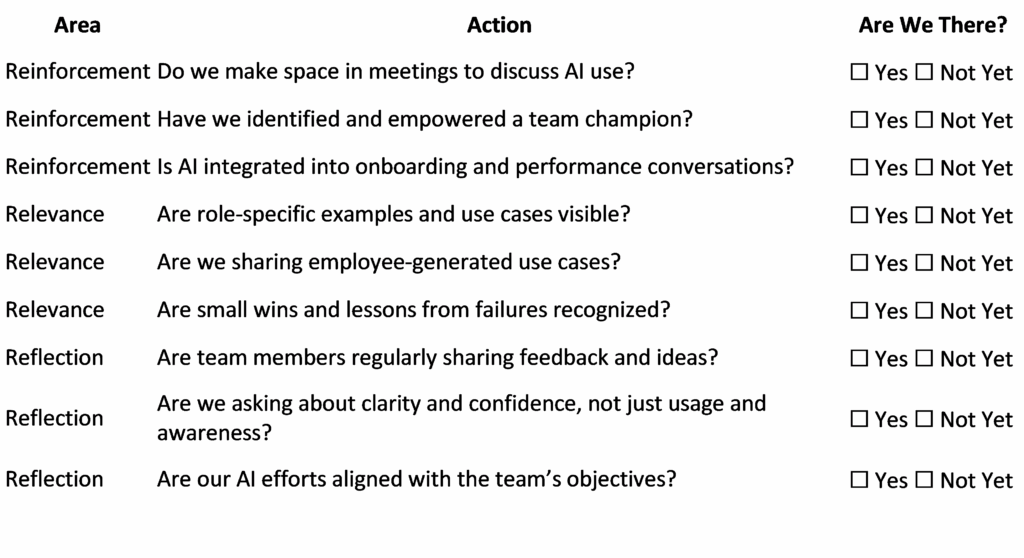
      Use this scorecard to check your progress: 

      This isn’t a one-time exercise. Revisit it monthly – and at a minimum, quarterly. Consider having your AI champion fill it out too, to guard against blind spots.

      The Bottom Line

      The biggest challenge of AI transformation in 2026 isn’t speed – it’s staying power. The organizations and teams that succeed will be the ones that take the actions above now and treat adoption as an ongoing process, not a one-time push.

      Article

      Accelerating Action: Why Canada’s Agriculture Industry is Done with “Someday”

      December 17, 2025
      By Brooklyn Lutz and Amanda Patterson

      Last week in Calgary, the Canadian agriculture industry held their annual gathering, Grow Canada 2025, and the energy was unmistakably different. This wasn’t a room rehashing familiar challenges; it was growers, agtech innovators, equipment manufacturers, policy makers, and industry leaders ready to move from aspiration to action.

      The two-day event featured keynotes on navigating AI, sessions on trade policy and tariff strategy, and panels on innovation and resilience. A standout moment came from Dr. Jody Carrington’s closing keynote on “Building Resilience in the Age of Burnout,” underscoring why acknowledging stress and uncertainty isn’t weakness; it’s the reset button the industry needs.

      One clear message emerged: agriculture is tired of being a supporting actor in Canada’s economic story.

      Key Takeaways

      Action Over Aspiration. The industry is done with reports and “let’s explore this further” conversations. Combined, Canadian agriculture and agrifood generate more GDP than automotive and steel, yet those sectors dominate policy conversations because they’re unapologetic about their value. Agriculture has earned the same confidence and must act on it.

      Trade Diversification is Urgent. The U.S.-Mexico-Canada trade agreement faces mandatory review by July, with potential changes sooner. Tariffs and price pressures will persist. The geopolitical landscape demands strategic market expansion beyond traditional trading relationships. This isn’t a temporary crisis; it’s the new operating environment.

      Data Wins. The current Canadian government responds to one thing: solid stats backed by rigorous analysis. When agriculture speaks with one unified voice, armed with compelling data on economic contribution and job creation, doors open. Numbers move the needle; frustration doesn’t.

      Connection Over Screens. AI dominated conference discussions for good reason. But here’s what stood out: in an increasingly digital world, human connection is the most powerful competitive advantage. Relationships move Canadian agriculture; tech supports it. Brands and teams that marry AI innovation with intentional relationship-building will lead.

      Innovation Needs to Fail Better, Faster. The stigma around failed experiments is choking innovation. The industry must normalize discussing what didn’t work and why, so learnings accelerate the next iteration. When teams feel safe to experiment without fear, breakthrough innovations emerge faster.

      What This Means for Brands

      These themes signal a market inflection point. Companies should adjust advocacy strategies to align with data and policy priorities. Generic messaging won’t cut it. Specific, quantifiable value propositions tied to trade, investment, or resilience will.

      As AI reshapes the industry, lean into authentic connection. Prioritize demos over dashboards, peer validation over features lists, and human touchpoints over automated workflows. Build a culture of experimentation internally and externally. Companies that normalize failure and celebrate learning will attract top talent, accelerate innovation, and build equity with partners.

      Finally, partner with advisors who understand this complex landscape. The intersection of policy, trade, innovation, and unified messaging requires strategic positioning, earned storytelling, and policy engagement that moves the needle and supports the regulatory environment this sector needs.

      The Bottom Line?

      Grow Canada reinforced that the window for coordinated, confident advocacy is open and the stakes are high. The Canadian agriculture industry is loud, ready, and waiting for partners brave enough to match that energy. The question isn’t whether to step up; it’s how quickly.

      “JudithBrooklyn Lutz is a Saskatchewan-born farm girl with deep agriculture roots. Brooklyn grew up on the seat of a tractor. A truly integrated practitioner, she uses her diverse background in brand marketing, corporate communications and client relations to become a trusted partner and advisor her clients can rely upon.
      Amanda Patterson leads the planning practice in Canada. With over two decades of strategic brand experience and a passion for agriculture, she works with clients to develop innovative approaches to their business challenges, specializing in bridging strategy, audience insights and culture from commodity organizations to global business leaders.

       
      Article

      Get the Report: Corporate Affairs Trends for 2026

      December 10, 2025

      Expectations from executives and stakeholders continue to rise. Geopolitical and societal uncertainty is intensifying. The demand to show clear business impact is higher than ever. This is the constant pressure cooker corporate affairs leaders operate in. Their role is more central to enterprise value but with that comes exposure to risk, scrutiny and rapid change.

      Our latest forecast surfaces the trends that matter most for senior communications professionals. Grounded in data, real-world observation and conversations with clients across sectors, it cuts through the noise to focus on what is actually shifting in the operating environment and what that means for your team, your agenda and your influence inside the business. It also looks back on 2025 predictions to draw out lessons that can guide leaders in the year ahead.

      Click Below to Download the Report and dive deeper on the FleishmanHillard UK site.

      The License To Lead Study: A New Corporate Playbook for 2026

       Click Below for More Reports From the UK Team:

      Article

      Executive Impact: Turning Transitions into an Enterprise Advantage

      By Elizabeth Cook, Chris Thornton and Michelle Mahony

      The spotlight on executives has never been brighter. In 2025, CEO turnover is hitting record highs and CFO departures at Fortune 500 companies are up 33% year over year. CEO tenure continues to shrink —to just 6.8 years.  

      Against a backdrop of AI disruption, geopolitical and supply chain pressure, employee and stakeholder challenges and investor scrutiny, leaders are expected to deliver impact fast. Nearly half of executive transitions are judged as failures or disappointments within two years. Yet despite these pressures, most organizations still treat executive transitions as a sequence of announcements and introductions — and the shallowness of this approach is more evident than ever.  

      Transitions aren’t PR moments. They’re enterprise moments. The difference shows up in results. Handled well, a transition can unlock energy, clarify priorities, and accelerate operating performance. Handled poorly, it drains trust, distracts teams, and invites scrutiny. The difference in outcomes isn’t driven by the number of interviews or town halls conducted or the addition of a few more executive LinkedIn posts. It’s dependent on a complete re-think of the support that executives receive in transition and a laser focus on how leadership skills, change management principles and communications can come together to drive success.   

      As we head into 2026 expecting the pressure on new leaders to only grow, the Global Executive Advisory teams for FleishmanHillard and Daggerwing Group have formalized an integrated approach to transition that moves from executive visibility to Executive Impact. Executive Impact is a new way to manage leadership transitions as critical, ongoing business processes that shape reputation and future performance. Success isn’t measured by optics but by outcomes: how quickly a leader earns trust, sets strategic direction, and delivers results.  

      Because real impact depends on more than narrative, Executive Impact includes the underlying mechanics that determine performance: clarifying how the leader will shape structure, decision rights, operating rhythms, and processes so the organization can deliver measurable business results at speed. 

      Our Five As for Executive Impact transition framework offers a practical path for new executives to follow from the moment they know they’ll be taking the seat—but it also can be entered at any point by an executive who begins to feel that their organization isn’t fit for the challenges ahead. We help executives create and operationalize momentum—making it easier for their team to believe, act, and deliver together: 

      • Announce with intent: Focus executive appointment communications on establishing credibility and setting expectations, align communications across audiences and regulations, and prepare leadership teams and champions to carry consistent messages. 
      • Align through understanding: Balance listening with diagnosis and the setting of leadership expectations, and operationalize early shifts in roles, rhythms, and decision forums. 
      • Activate the agenda: Articulate a visible purpose and strategy, define early choices and symbolic moves, and connect communications to execution. 
      • Accelerate the system: Equip the leadership team to deliver at pace, close gaps, manage moves decisively, and embed cadences that create urgency and ownership. 
      • Amplify what works: Codify new norms, keep stakeholders updated, reconnect to purpose, and prepare for the next inflection point. 

      This system targets real business outcomes: Faster trust and alignment across executive and employee teams and boards of directors, quicker strategy adoption and execution, and reduced risk of derailment in the first 180 days. 

      Our experience includes Fortune 100 leadership transition consulting and coaching; turnaround, transformation, integration and culture programs; CEO and C-suite positioning and visibility programs; employee, investor and stakeholder engagement; and counseling companies across issues, crisis, and C-suites in duress. 

      Leaders don’t get a second chance to make a first impression. Every transition carries risk; the right design turns that risk into resilience. Executive Impact helps leaders set a credible course, accelerate execution, and sustain momentum beyond the early window. If you’re anticipating a change — or need to course-correct — FleishmanHillard and Daggerwing Group can partner with you to make this transition your advantage. 

      Executive Impact
      From Left to Right: Elizabeth Cook, Chris Thornton and Michelle Mahony

      Elizabeth Cook is part of the FleishmanHillard U.S. corporate affairs leadership team and directs regional executive positioning offerings.

      Chris Thornton is Senior Principal at Daggerwing Group and works with leaders to build the mindsets, skills, and confidence needed to lead transformation and embed change across complex organizations.

      Michelle Mahony is the President of Daggerwing Group and works to bring together the science and art of transformation to life for clients.

      Article

      Sponsored Content in the AI Era

      December 3, 2025
      By Corina Quinn, Andrea Margolin and Amanda Hampton

      The landscape may be shifting, but your brand story is still getting heard.

      Sponsored content is arguably one of the most powerful tools in the PR toolbox for ensuring audiences hear a brand related story in an editorial format and context that will both resonate and drive impact. We’d be hard-pressed to think of a campaign that should not have this high-impact type of storytelling as a centerpiece.  

      But how does it work in today’s AI-driven environment? 

      Sponsored Content in the AI Era

      This era of zero-click searches has led to lots of hand-wringing on what it means for sponsored articles and performance and whether it’s still a sound strategy for an integrated campaign.

      Good news on that horizon: zero-click hasn’t marked the death to sponsored content. It remains a dynamic, stable solution to reach critical audiences with rich storytelling and trusted formats that offer unique support for a brand’s business goals.

      New To SponCon?

      Sponsored content is a form of paid media partnership in which brands collaborate with media publishers to co-create content that aligns with the editorial standards and audience interests of the publication, while advancing the brand’s communications objectives

      Unlike traditional advertising, sponsored content is integrated within the editorial environment, delivering insights, perspectives or stories that resonate with readers and offer value beyond overt promotion. This approach leverages the credibility and reach of established media outlets, allowing brands to participate authentically in conversations that matter to their target audiences, while keeping control over message integration that you can’t guarantee with earned coverage from those same outlets.

      Why Sponsored Content?

      Trusted Influence at Scale
      By appearing within reputable editorial environments, sponsored content benefits from the publisher’s authority and audience trust—and taps its editorial expertise in content creation. This enhances message credibility and drives deeper consideration among target audiences.

      Strategic Storytelling
      Sponsored content enables nuanced, narrative-driven communications that go beyond product features to communicate a range of things, from big-picture brand values, new and exciting offerings for consumers, and even thought leadership or societal impact. It supports reputation, positioning, and purpose-led initiatives as well as helps drive consumer offerings, from path to purchase and other lower-funnel tactics.

      Precision Audience Engagement
      Partnerships with publishers provide access to highly engaged audiences with a nuanced set of metrics you don’t get with earned media. This allows for tailored content that meets specific needs, interests, or pain points, improving relevance and engagement metrics—while driving brand business goals.

      Integrated Communications Impact
      As part of an integrated strategy, sponsored content amplifies earned and owned messaging, bridges gaps in the customer journey, and creates additional touchpoints that reinforce key themes across channels. It’s important to remember that sponsored content goes beyond print or digital advertorial, and includes qualitative content that also taps social media and other channels, and leverages video and audio content in addition to digital.

      Measurement and Optimization
      With robust analytics that can include time spent, click-through rates and more, sponsored content programs can be assessed for engagement, sentiment, and conversion—providing actionable insights to refine messaging and demonstrate business impact.

      Sponsored Content in the Era of AI

      There is a lot of discussion about declining site traffic due to changes in how people find information (known as zero-click search due to AI-driven features) and the truth is, there remain a lot of unanswered/developing questions about how AI summaries treat sponsored content that we will continue to track. We can also imagine a world where AI may enable more targeted distribution opportunities as media platforms respond and evolve.

      Here’s what we know to be true today: Sponsored content remains effective because it is distributed and amplified through intentional, multi-channel strategies and is not just reliant on organic search or publisher homepage traffic.

      There are several reasons why Sponsored Content remains effective:
      • Unique Traffic Drivers: In general, search and AI summaries aren’t the main traffic driver for sponsored content articles. Programs lean on newsletters, social media and paid amplification to drive qualified audiences.
      • Publishers Are Aware and Adapting: Many publishers moved to paywalls and subscriber-based ecosystems and have grown their cross-platform channel strategy in recent years to reduce their dependency on search, even before AI summaries emerged.
      • Quality Over Quantity: Our success metrics go beyond page views and impressions. We emphasize time spent, engagement and lower funnel actions such as clicks to the client’s site. Even with modest traffic results, high engagement audiences drive stronger qualitative impact.
      • Flexible Strategies: If we do see sponsored article performance start to be impacted, we collaborate with our media partners to evolve our strategies and content mix to make up for the loss in traffic.

      Sponsored Content Goes Beyond Articles

      In our current sponsored content programs, diversification is a deliberate part of our strategy to ensure we’re future-proofing programs against ecosystem shifts.
      • Video, newsletter and social media integrations are important players in the content space and further distribute our reach and performance.
      • Publisher-branded social handles, podcasts and more provide additional opportunities to connect with audiences even if article impressions or page views fluctuate.
      • Diversifying our programs makes them less susceptible to zero-click trends because distribution is intentional and audience-driven rather than search-driven.

      As the digital landscape continues to shift, we will monitor changes, adapt distribution and measurement strategies, and keep clients informed—ensuring that sponsored content continues to deliver value and impact in any environment.

      From Left to Right: Corina Quinn, Andrea Margolin and Amanda Hampton

      Corina Quinn is a Senior Vice President who co-leads our Media Partnerships Center of Excellence. A longtime award-winning editorial director and content strategist, she spent more than a decade in digital newsrooms at places including Conde Nast Traveler and Travel + Leisure.

      Andrea Margolin is a senior communications strategist with more than 20 years of experience driving integrated storytelling, executive thought leadership and digital innovation for enterprise health brands. Based in Washington, DC, Andrea partners with global healthcare leaders to translate complex science into compelling, high-impact narratives that resonate across audiences and platforms.

      Amanda Hampton is a Vice President based in Washington D.C. where she leads integrated sponsored content programs informed by audience insight and editorial excellence. She collaborates with clients and top consumer media partners to create high-impact storytelling that drives engagement and strengthens brand performance.